
Are auction fees taxed when you buy a car at auction?
Auction fees are taxed when your state taxes the full “sales price,” which often includes buyer’s premium, admin or doc fees, and other mandatory charges. If a fee is a true separate service charge, it may be excluded. Miss that line-item split and you can overpay or underpay sales tax, then get a corrected invoice or audit bill. This guide explains which auction invoice charges usually change the tax base and how to read the bill line by line.
How Invoice Structure and State Rules Drive Tax Liability
Why state rules and invoice setup matter
Tax follows the taxable base your state defines, not the label on the fee alone. Two invoices with the same winning bid can produce different tax because one auction bundles charges into the sale price while another lists separate service fees, title work, transport, or storage. The invoice structure matters as much as the auction terms.
Read the terms and conditions before bidding. A line that looks like “fee” may still be part of the taxable selling price under state law. Auction houses can also add local sales tax, county surtax, or both, depending on where the sale is sourced and how the vehicle is titled.
📊 HiBid shows some featured auctions ending with 2,873 lots. Source: Live and Online Auctions on HiBid.com.
What appears on a car auction invoice
A car auction invoice usually breaks the deal into a winning bid, buyer’s premium, add-on charges, a tax line, and an out-the-door total. The key question is whether each line is part of the taxable base or merely a pass-through charge. Those are not the same thing.
Winning bid and buyer’s premium
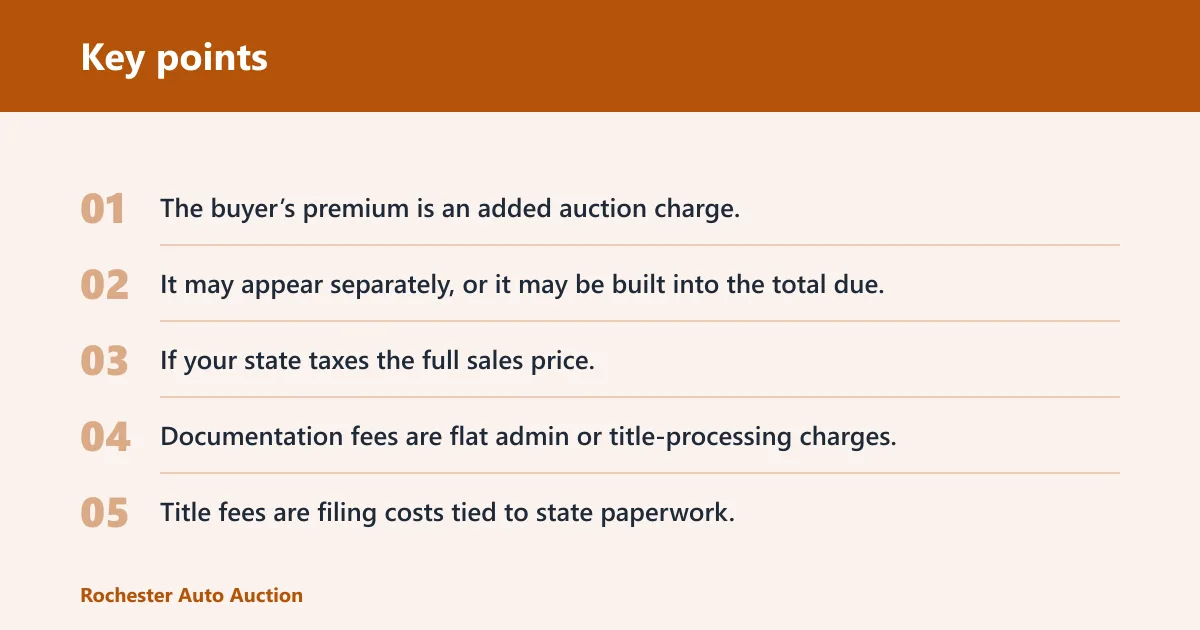
The winning bid is the hammer price. The buyer’s premium is an added auction charge, often a percentage of the bid or a fixed amount. It may appear separately, or it may be built into the total due. If your state taxes the full sales price, the premium can be taxable as part of the purchase price.
Documentation, title, transport, and storage lines
Documentation fees are flat admin or title-processing charges. Title fees are filing costs tied to state paperwork. Transport charges cover delivery, and storage charges cover time the vehicle stayed on site. These lines often receive different tax treatment, so a line-by-line invoice review matters more than the fee name.
Where the tax line and out-the-door total fit
The tax line should show what the auction calculated based on the taxable items on the invoice. The out-the-door total should add the winning bid, taxable fees, non-taxable fees, title work, transport, storage, and any required state charges. If the invoice only shows one lump sum, ask for the itemization before you pay.
Which auction charges are usually taxed, and which are not?

Most auction charges fall into three buckets: usually taxable, often non-taxable, or state-dependent. The correct bucket depends on whether the fee is part of the sale price, a separate service, or a government filing charge. Vehicle type also matters. Retail units, salvage vehicles, and dealer-only inventory do not always follow the same tax treatment.
Buyer’s premium
A buyer’s premium is often taxable when state law treats it as part of the purchase price. That is more likely when the premium is mandatory and tied directly to the sale. It matters whether the auction shows it as a separate line or bundles it into the bid total.
Documentation fee
Documentation and admin fees are state-dependent. In some states, they are taxable because they are part of the transaction. In others, they are treated as a separate service fee or a capped administrative charge. If the fee is bundled with title work or processing, the taxable base can change again.
Title fee
Title fees are often non-taxable because they are a government filing cost, not a sale charge. That said, the auction may still collect the money and remit it for you. If the invoice labels part of the charge as title service, part as processing, and part as state filing, ask which portion is taxable.
Transport and storage fees
Transport is often treated differently from sales tax because it may be a separate delivery service. Storage can also be excluded in some states if it is a true post-sale service or a late pickup charge. But if transport is mandatory and bundled into the vehicle sale, tax may apply. Storage due to delayed payment or pickup can be taxed in some jurisdictions.
Suppose a buyer wins a compact sedan for around $8,000 and the invoice adds a buyer’s premium, a doc fee, a title fee, and transport charges. If the state taxes the full sales price, the premium may join the tax base; the title fee may not; transport may or may not, depending on local rules and invoice wording.
How state tax rules change the answer

State tax rules control what counts as the taxable base. Some states tax the vehicle price plus mandatory charges. Others tax only the vehicle. Local surtaxes can also apply, so the total rate may be state sales tax plus county or city add-ons. The invoice should show the tax line, the rate used, and the taxable subtotal.
Taxable base definitions
A taxable base is the amount the state says sales tax applies to. That base may include the hammer price, buyer’s premium, doc fee, and certain mandatory processing charges. It may exclude title filing fees, separately stated transport, or other true service charges. Buyers should ask how the auction defined the taxable subtotal before paying.
Local surtaxes and state add-ons
Local surtaxes can change the final bill even when the base amount stays the same. A state rate plus county surtax can be assessed on the same taxable subtotal. That means two bidders at different pickup locations may see different tax lines even on the same vehicle type.
Resale certificates and dealer exemptions
Dealer buyers may use resale certificates or exemption paperwork to avoid tax on qualifying inventory purchases. That does not mean the transaction is tax-free forever, it means tax is deferred until the vehicle is sold retail, if applicable. Missing paperwork can turn a nontaxable dealer purchase into a taxable one.
Do dealers pay tax differently than retail buyers?
Yes. Dealers often qualify for resale treatment or a dealer exemption when the vehicle is bought for inventory and the paperwork is correct. Retail buyers usually do not have that option. Salvage units and mixed-use purchases can add another layer, because the auction may tax the transaction differently depending on whether the vehicle is sold for rebuild, parts, or road use.
Dealer-only units and resale paperwork
Dealer-only lanes often require a sales tax exemption or resale certificate before release. If the paperwork is accepted, the tax line may disappear or apply only to taxable service charges. The exact result depends on state rules and the auction’s internal compliance policy.
Retail purchases, salvage units, and mixed-use cases
Retail buyers usually pay tax unless a local exemption applies. Salvage vehicles can be taxed on the purchase price, the fees, both, or a reduced base, depending on the state and whether the vehicle is being rebuilt. Mixed-use cases are the hardest because the buyer’s intent, title class, and invoice structure all matter.
A common first-timer mistake is assuming a salvage title automatically means no tax. That is not safe. The tax question is still about the taxable base and the state’s rule for that sale channel.
Does it change if the auction is live, online, or salvage?
Yes, because the fee stack and invoice flow can change by channel. Live auctions, online auctions, and salvage auctions often use different buyer’s premiums, admin charges, late-payment rules, and pickup terms. The tax result still depends on state law, but the invoice layout can move a fee into or out of the taxable base.
Live and online auctions
Live sales can have bidder registration, gate, or release fees. Online sales may add platform charges, payment processing charges, or transport-only billing. HiBid has a dedicated Cars & Vehicles category, and HiBid groups vehicle sales among many other auction categories. HiBid also shows some featured auctions ending with 2,873 lots, another featured auction with 2,457 lots, and some auctions labeled as ending tomorrow. AuctionZip offers both online and in-person bidding and has an Automobile Auction category, with 250 miles and 500 miles as search radius options.
Salvage auctions
Salvage auctions can have different title handling, storage terms, and release deadlines. Those details matter because storage may become taxable or non-taxable based on whether it is a post-sale service, a penalty, or part of the selling process. If the vehicle is sold for parts or rebuild, ask how the state treats the tax base before bidding.
Which parts of an auction invoice are taxable and which are not?
There is no universal answer, because tax follows the taxable base your state defines and the way the invoice is written. Still, most buyers can sort charges by asking whether each line is part of the vehicle’s selling price, a mandatory fee, or a separate service. That single split often decides the tax result.
Line-item tax decision table for common auction charges
| Charge | Likely tax treatment | Why it often falls there | Exact question to ask the auction house |
|---|---|---|---|
| Buyer’s premium | Usually taxable | Often treated as part of the purchase price when mandatory and tied to the winning bid | “Is the buyer’s premium included in the taxable sales price or taxed separately?” |
| Documentation fee | State-dependent | May be a taxable admin charge, a capped fee, or a bundled processing cost | “Is the doc or admin fee part of the taxable base in this state?” |
| Title fee | Often non-taxable | Usually a government filing cost rather than a sale charge | “Is the title fee a pass-through filing cost or a taxable processing charge?” |
| Transport fee | State-dependent | May be separate delivery service or bundled with the sale | “Is transport excluded from sales tax when billed on a separate line?” |
| Storage fee | State-dependent | Can be a post-sale service, a late pickup charge, or part of the transaction | “Does storage count as taxable consideration or a separate service charge?” |
How do I calculate the final out-the-door cost at auction?
Start with the winning bid, add the buyer’s premium and any mandatory fees, then add sales tax only on the items the state treats as taxable. After that, include title, transport, storage, and transfer costs that are not part of the tax base. The final total should match the invoice’s out-the-door amount.
Build the total from bid, fees, tax, and transfer costs
- Write down the hammer price or winning bid.
- Add the buyer’s premium.
- Add doc, title, transport, storage, and any release or gate charges.
- Identify which of those charges are taxable under the auction’s state rules.
- Apply the combined state and local tax rate to the taxable subtotal only.
- Add non-taxable charges and any DMV or transfer costs.
- Confirm the invoice total before sending payment.
When to confirm the final number with the auction house
Confirm before bidding if the listing is unclear, if you are buying as a dealer, if the vehicle is salvage, or if transport will be arranged by the auction. A dealer resale certificate, a different pickup state, or a title issue can change the tax line after the bid is placed.
What should I ask the auction house before bidding?
Ask for the taxable subtotal, the tax rate, and a full fee breakdown before you bid. You are not just asking what fees exist; you are asking which line items are taxed, which are pass-through charges, and which can change if the vehicle type, buyer type, or pickup location changes.
Pre-bid checklist
- Which line items are included in the taxable base?
- Is the buyer’s premium taxed in this state?
- Are doc and admin fees taxed, capped, or excluded?
- Is the title fee a pass-through filing cost?
- Are transport and storage taxed if billed separately?
- Do dealer resale certificates or exemption forms apply?
- Does salvage status change the tax base or fee stack?
- Will the invoice show the taxable subtotal, tax line, and out-the-door total?
- Can the auction house or DMV confirm the local rule before payment?
Frequently asked questions
Do you pay sales tax on the buyer’s premium?
Often, yes, if the state treats the buyer’s premium as part of the purchase price. That is most likely when the premium is mandatory and tied to the winning bid. The invoice should show whether the premium was included in the taxable subtotal or charged outside it.
Are documentation and admin fees taxable at car auctions?
Sometimes. Documentation and admin fees can be taxable, non-taxable, or limited by state rules. The deciding factor is whether the fee is a taxable transaction charge or a separate processing service. Ask the auction house to identify the exact line item and the state rule used.
Is tax charged on transport, title, or storage fees too?
Sometimes, but not always. Title fees are often non-taxable filing costs, while transport and storage may be taxed if they are bundled with the sale or treated as part of the consideration. If those charges appear as separate lines, ask whether each one is inside the taxable base.
Can auction tax rules vary by state?
Yes, and that is the main reason no single fee answer works for every buyer. States define taxable base differently, and local surtaxes may apply on top of the state rate. The auction invoice should show what was taxed, but the DMV or auction house can confirm local treatment.