Sell Car at Auction vs Trade-In: Which Is Better?
Selling at auction can bring more than a trade-in when your car draws strong wholesale demand and you can handle fees, timing, and uncertainty. Trade-in usually wins on speed and simplicity. Pick the wrong path, and low offers, auction costs, or delays can cut the result. This guide compares net proceeds, speed, and risk so you can match the right option to your car and timeline.
Verdict: sell at auction or trade in?
The better choice depends on net payout, speed, and certainty. Auction can beat a trade-in on gross sale price, but seller commission, listing or entry fees, transport or storage, and title or payoff delays can shrink the final check. Trade-in usually wins if you want less friction, faster closing, and a possible tax benefit on the next purchase.
| Decision factor | Sell car at auction | trade-in | Winner |
|---|---|---|---|
| Cash before taxes and purchase tie-in | Hammer price minus seller commission, entry fee, transport or storage, and any reconditioning or arbitration deductions | Dealer appraisal value, usually tied to the vehicle you buy next | Sell car at auction |
| Net result when you buy another vehicle | No tax credit effect from the sale itself | May reduce sales tax on the replacement car where your state allows a trade-in credit | trade-in |
| Time to cash | Run-day timing, settlement windows, and pickup or release can stretch the process (auction settlement windows vary by house; major operators publish next-business-day or multi-day remittance schedules) | Same-day appraisal and immediate rollover into the next purchase are common | trade-in |
| Risk of a lower final number | Condition disputes, title issues, price volatility, and deductions can cut payout | Less exposed to post-sale deductions, though appraisal still reflects condition | trade-in |
| Best fit by vehicle type | Popular makes and models, older units with wholesale demand, or niche inventory | Late-model, clean-title vehicles that a dealer can retail or certify easily | Tie |
Net proceeds: what actually lands in your pocket?
Net proceeds matter more than the headline number. At auction, the formula is gross price minus seller fees, transport or storage, and payoff. For a trade-in, use trade-in offer plus any state sales-tax savings, then subtract payoff. The best option is the one with the higher net after all deductions, not the one with the bigger sticker value.
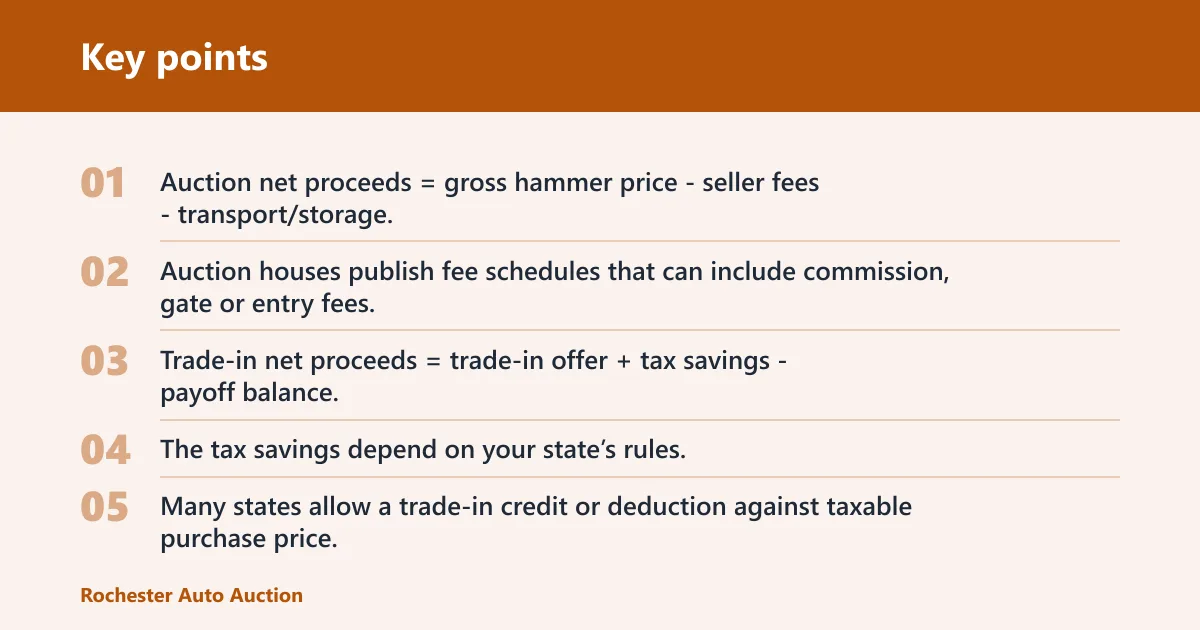
Auction net proceeds formula
Auction net proceeds = gross hammer price – seller fees – transport/storage – payoff balance. Auction houses publish fee schedules that can include commission, gate or entry fees, and other administrative charges; major auction documentation also warns that storage, arbitration, and transport can reduce final remittance (see Manheim seller fees, ADESA seller fee schedules, and Copart/IAA seller terms).
Trade-in net proceeds formula
Trade-in net proceeds = trade-in offer + tax savings – payoff balance. The tax savings depend on your state’s rules. Many states allow a trade-in credit or deduction against taxable purchase price, but the treatment varies by DMV or revenue department; for example, California, Texas, Florida, and New York all publish state-specific rules on how trade-ins affect sales tax or registration tax.
Worked example: auction path
Say your sedan brings a $9,500 hammer price at auction, but the seller commission is $600, the entry fee is $125, transport is $175, and a post-sale deduction of $200 applies. The auction net is $8,400 before any loan payoff. If the payoff is $6,900, the cash remaining after payoff is $1,500.
Worked example: trade-in path
Suppose a dealer offers $8,800 for the same sedan, and your state allows a 6% trade-in tax credit on a $24,000 replacement car. The tax savings would be $528. If the payoff is $6,900, the trade-in net is $2,428 before dealer doc fees or financing changes. That is why tax treatment can flip the result.
Speed and timing: which path gets you done faster?
Trade-in is usually faster because appraisal, paperwork, payoff coordination, and replacement purchase can all happen in one visit. Auction often takes longer because the car must be listed, queued for a run day, settled, and released after title review. If your deadline is tight, timing often outweighs a small price advantage.
Trade-in is usually same-day or next-day
A dealer can appraise the car while you shop the next vehicle, then apply the value to the deal. The handoff is often immediate once payoff and title details are confirmed. That speed is a major advantage if you need transportation continuity or want to avoid arranging separate pickup and transport.
Auction timing and settlement windows can stretch the process
Auction timing depends on the next run day, how quickly the title clears, and when the settlement window closes. Major auction operators commonly state that seller remittance is issued after the vehicle is sold and paperwork is processed, which can take several business days depending on the sale channel and title status.
Pick the path that fits your deadline
If you need to replace the car immediately, trade-in is usually the cleaner path. If you can wait for listing, sale, title review, and payout, auction can still be worthwhile. The real question is whether a higher potential sale price is worth the extra days or weeks of uncertainty.
Fees: where auction costs can erode the sale price
Auction proceeds start with the hammer price, then move through a stack of deductions before any seller payout is issued. Commission, entry fees, transport, storage, and post-sale adjustments can all reduce the final check. Major auction and dealer wholesale documents typically publish fee schedules up front, and those details matter as much as the bid itself.
Common auction fee categories
Most auction sellers should expect some combination of commission, entry or listing fee, gate fee, transport cost, and possible storage charges if pickup is delayed. Some operators also reserve the right to assess condition-related deductions after arbitration or reconditioning. The exact schedule varies by auction house, which is why the seller fee sheet is part of the comparison.
How dealer trade-in costs compare
Trade-in usually does not show a separate seller commission, but the dealer still accounts for reconditioning, retail risk, and margin inside the appraisal. That means fees are less visible, not nonexistent. A lower offer may already include the dealer’s internal cost to prepare the car for resale.
Example fee schedule assumptions should be checked
In the worksheet below, the auction cost assumptions are illustrative only, not universal. Real auction schedules can be higher or lower depending on vehicle type, sale lane, marketplace, and title status. Always check the current seller fee schedule from the auction operator before you compare offers.
Condition: which cars perform better on each path?
Condition affects both offers, but auction is usually less forgiving. Dealers can absorb cosmetic wear or minor repairs because they can recondition the car in-house or route it through wholesale channels. Auction buyers often price in more risk, especially if the car has warning lights, visible damage, or a questionable service history.
Strong auction candidates
Popular makes and models, late-model units with clean titles, and cars that are easy to inspect tend to do better at auction. Wholesale demand matters. A vehicle that is easy to resell quickly is more likely to attract competitive bidding and a healthier hammer price.
Strong trade-in candidates
Trade-in can be better for cars with ordinary wear, higher mileage, or modest cosmetic issues because the dealer can spread the cost across the next transaction. If the vehicle is otherwise straightforward to title and finance, the appraised value may be good enough once tax savings are included.
Example of condition impact
Suppose a crossover has 142,000 miles, a dented rear bumper, and a clean title. A dealer may make a modest but fast trade-in offer because it can price the repairs into the next sale. At auction, the same car can still attract wholesale interest, but the final payout may narrow once fees and condition adjustments are included.
Paperwork and title: what do you need to close the deal?
Clean title, lien release, and odometer disclosure are the basics for either path, but auction is usually stricter about missing documents. Title requirements vary by state, and some DMVs require a completed title assignment, odometer statement, and lien release before ownership can transfer. If the paperwork is messy, trade-in is often easier to close.
Title status can decide the path
A clean title moves faster. If the vehicle was financed, the lender’s lien release has to be completed before the title can transfer in many states, and some DMVs will not process a sale until the lien is satisfied and documented. That is why title status is not a formality; it can affect settlement timing and the final bid.
Odometer disclosure and ownership records matter
Most sellers need an accurate odometer disclosure on qualifying vehicles, plus proof of ownership and any state-required assignment sections. Auction houses and dealers both use these records to verify the sale. If the paperwork is incomplete, the sale may be delayed, re-run, or discounted until the file is clean.
Example of a title delay
If the title is still held by the lender, the auction may have to wait for the payoff to clear and the release to be delivered before remittance is final. That can reduce the practical advantage of a higher hammer price. Trade-in can sometimes smooth this step because the dealer handles payoff coordination directly.
Financed cars: how payoff handling changes the math
If you still owe money, the payoff process becomes part of the comparison. Positive equity means the sale price exceeds the loan balance, while negative equity means the car is worth less than the payoff. The difference matters because the seller cannot keep sale proceeds until the lender is paid and the title is cleared.
Positive equity is simpler
When the sale proceeds exceed the loan balance, the remaining amount can be paid to you or applied to the next purchase. That is straightforward on both paths, but trade-in often feels easier because the dealer coordinates the lender payoff and title work as part of the transaction.
Negative equity can favor trade-in
If the payoff is higher than the vehicle’s value, the gap has to be covered. Trade-in can sometimes roll that amount into the new deal, though that raises the next loan balance. Auction can still work, but you may need to bring cash to close the payoff shortfall before the title can be released.
Payoff handling example
Imagine a car worth $11,500 at auction with a $13,000 payoff. After fees, the sale does not eliminate the loan balance by itself, so the owner still owes the difference. A trade-in offer of $12,200 with $732 of tax savings still leaves a gap, but the dealer may handle the payoff more cleanly in the same transaction.
Hidden costs: the expenses people forget to include
Hidden costs often decide the winner. Transport, storage, arbitration, reconditioning deductions, and time lost waiting for release can all reduce the auction net. On the trade-in side, the main hidden cost is that the dealer’s offer may already reflect reconditioning and retail risk, so the “convenience premium” is baked in.
Auction-side hidden costs
Transport to the auction, storage after sale, paperwork corrections, and arbitration claims can all reduce the net. Some auction houses also charge for missed pickup windows or delayed title delivery. These charges are not always obvious in the listing, which is why the seller fee schedule and remittance rules should be checked in advance.
Trade-in-side hidden costs
Trade-in usually has fewer separate line items, but the dealer may build a discount into the appraisal to cover cosmetic work, retail risk, and expected time to resell. That is not a surprise fee so much as a lower starting value. The upside is predictability; the downside is that some value is left on the table for convenience.
Scenario matrix: compare both paths with the same formula
This matrix uses common scenarios so you can compare both paths on the same terms. Use the formulas above: auction net = gross price – seller fees – transport/storage – payoff, and trade-in net = trade-in offer + tax savings – payoff. The better choice is the one with the stronger net result after deductions, not the higher sticker number.
| Scenario | Sell car at auction: gross value | Sell car at auction: fees and costs | Sell car at auction: payoff balance | Sell car at auction: est. time to cash | trade-in: dealer appraisal | trade-in: tax credit effect | trade-in: payoff balance | trade-in: est. time to cash | Better path |
|---|---|---|---|---|---|---|---|---|---|
| Clean late-model car | $22,000 | $1,050 | $14,000 | 3-7 days | $21,200 | $1,272 | $14,000 | Same day | trade-in |
| High-mileage car | $8,700 | $950 | $0 | 3-10 days | $7,900 | $474 | $0 | Same day | Sell car at auction |
| Older car | $5,400 | $775 | $0 | 4-10 days | $4,800 | $288 | $0 | Same day | Sell car at auction |
| Car with negative equity | $11,500 | $1,100 | $13,000 | 4-10 days | $12,200 | $732 | $13,000 | Same day | trade-in |
| Car with mechanical issues | $6,200 | $1,300 | $0 | 5-12 days | $5,900 | $354 | $0 | Same day | trade-in |
| Car needing fast sale | $10,800 | $1,000 | $2,500 | 4-12 days | $10,300 | $618 | $2,500 | Same day | trade-in |
How to use the scenario matrix
- Write down the likely auction hammer price and the dealer appraisal for the same vehicle.
- Add seller commission, listing or entry fee, and any transport or storage cost to the auction side.
- Subtract the payoff balance from both paths if the vehicle is financed.
- Estimate the tax credit effect only if you are buying another vehicle and your state allows a trade-in credit.
- Choose the path with the better net result and the timeline that fits your deadline.
FAQ: common trade-in and auction questions
Is it better to sell my car at auction or trade it in?
It depends on your goal. Auction can return more on a strong vehicle in a hot wholesale segment, but trade-in usually wins on speed, paperwork, and certainty. If you want the better net result, compare fees, payoff, and any tax credit effect before choosing.
Do you get more money selling at auction than trading in?
Sometimes, yes, but only if the hammer price stays high after fees and deductions. A trade-in can still win after the dealer appraisal is paired with tax savings on the next purchase. The right comparison is net proceeds, not the headline number.
How much does an auction fee reduce my payout?
It can be a small fixed charge or a larger total made up of commission, listing or entry fee, and deductions for transport, storage, or arbitration. Even a few hundred dollars can matter on a lower-value car. Ask for the fee schedule before you commit.
How long does it take to sell a car at auction compared with a trade-in?
A trade-in can often be completed the same day as the purchase of the next vehicle. Auction often takes longer because of listing, run-day timing, title review, payment clearing, and pickup or release. If time matters most, trade-in is usually faster.
What paperwork do I need to sell a car at auction?
You usually need the title, odometer disclosure, and any lien release if the car was financed. A bill of sale may also be required, and the auction will want clean ownership documents before release. Missing paperwork can delay settlement or lower the bid.
Can I sell a financed car at auction instead of trading it in?
Yes, if the lender payoff process can be completed and the auction accepts the title status. Positive equity may leave you with cash after the loan is paid. Negative equity is harder, because the payoff gap still has to be covered before the title clears.