Reserve Price vs Market Value: How to Compare Them
Set reserve at or below your expected net proceeds from market value after auction fees, reconditioning, and transport. If your reserve sits above likely buyer demand, the car may not sell. Poor reserve math can turn a fair bid into a no-sale and add carrying costs. This guide shows how to compare reserve price and market value with a simple net-proceeds formula.
| Decision factor | Reserve price | Market value | Winner |
|---|---|---|---|
| Purpose | Seller’s confidential minimum accepted before the auction | Open-market estimate of what the car should fetch in normal selling conditions | Tie |
| Use in auction planning | Sets the lowest acceptable outcome and the sale threshold | Helps calibrate the reserve, but does not account for fees or urgency by itself | Reserve price |
| Visibility to buyers | Strictly confidential between vendor and auctioneer | Often informed by public listings, trade data, and retail comparisons | Reserve price |
| Fit for seller action | Directly actionable once set with the auction house | Useful as a benchmark, but too broad to use alone as a sale floor | Reserve price |
| Risk of being too optimistic | Low if tied to net proceeds and walk-away figure | Higher if it reflects retail optimism, rare-spec hope, or seasonal strength | Reserve price |
What is reserve price, and how is it different from market value?
Reserve price is the seller’s confidential minimum accepted before the auction begins. Market value is the current open-market estimate of what the car may sell for, useful for setting the floor, but not the same thing as the final hammer price.
Reserve price is a private sale threshold
A reserve agreement happens between the seller and auction house before the catalogue goes live, and the reserve remains strictly confidential between vendor and auctioneer. That privacy protects the seller from underselling and helps preserve bidding momentum because a leaked reserve can reduce bidding competition.
Market value is a benchmark, not a contract
Market value gives you a reference point, but it does not account for every auction cost. A car can sit above market value in a retail advert, below it in a trade context, and somewhere else again at auction depending on condition, mileage, trim, and buyer demand.
Hammer price is the binding number on the day
The hammer price is the final bid when the car is sold at auction. It may be above reserve, below retail expectations, or below market value if bidding stays cautious and the seller has set a realistic floor.
Why reserve price is usually kept confidential
Reserve price is kept confidential because it protects the seller’s floor while keeping bidders active. The auctioneer handles the reserve agreement, acts as the seller’s agent, and can sign the memorandum of sale on the seller’s behalf when the sale is agreed.
Confidentiality supports bidding momentum
The guide price is the public marketing figure shown to buyers, and it acts as an invitation to buyers. The reserve, by contrast, stays private so bidders do not anchor on the seller’s minimum and stop early.
It also protects the seller’s downside
Reserve price is the seller’s safety net. It prevents a car from selling below the agreed threshold, which matters most when the seller needs a minimum net return after fees, transport, and any likely reconditioning work.
How should you compare reserve price with market value?

Compare reserve price with market value by converting the market estimate into net proceeds, not by copying the headline figure. Start with a realistic market value range, subtract likely auction fees, transport, and any needed reconditioning, then apply an urgency discount to estimate a walk-away figure.
Start with the right value band
Use the most relevant benchmark for the car’s condition and channel. For a vehicle heading to auction, wholesale trade value and likely auction value matter more than retail value, because retail assumes time, presentation, and a consumer margin that auction buyers may not pay.
Subtract the real selling costs
A reserve based only on market value ignores the money that leaves the seller’s pocket before the car is sold. Fees, collection or transport, and condition-related work all reduce the amount the seller actually keeps.
Add a time factor
The urgency discount reflects carrying cost and the value of speed. If the car is costing money to store or is likely to lose buyer interest while waiting, the reserve should move closer to the seller’s walk-away figure rather than the top of the market range.
Should my reserve price be below market value?
Often, yes. A reserve below market value can widen bidder interest, create more active bidding, and improve the chance of a clean sale. A reserve near market value can work when the car is in strong condition, demand is steady, and the seller can wait.
When a lower reserve helps
A lower reserve can pull more bidders into the lot because the threshold looks reachable. That matters for cars where buyer confidence depends on visible value, such as mainstream trims with normal mileage and tidy presentation.
When a near-market reserve makes sense
If the car has strong condition, low mileage, desirable trim, and clear service history, the reserve can sit closer to market value. In that case, the car already gives bidders a straightforward case, so the seller does not need to discount heavily to create interest.
When an over-ambitious reserve hurts
An inflated reserve can freeze the room. Buyers may assume the seller is not serious, the lot may fail to sell, and the car can carry forward with more time, more storage cost, and a weaker next result.
How do guide prices and reserves differ?
Guide price is the public marketing figure meant to attract bids. Reserve price is the private contractual floor agreed with the auctioneer, and the two can point in different directions when the seller wants a low public entry point but a safe minimum outcome.
Guide price is public, reserve is private
The guide price appears in the catalogue and online listings, so buyers can see it before the auction. The reserve stays between the vendor and auctioneer, which helps avoid anchoring buyers to the minimum acceptable figure.
They are used for different jobs
The guide price is there to spark interest. The reserve is there to protect value. A car can be advertised with a guide that encourages bidding while still carrying a reserve high enough to keep the seller from underselling.
Decision table: turning market value into an auction-ready reserve
This table turns a market value estimate into a practical reserve range by subtracting costs and urgency. The exact numbers will vary by venue and car, but the method stays the same: start with market value, remove costs, then test the result against your walk-away figure.
| Example | Estimated market value | Auction fees | Transport | Reconditioning risk | Urgency discount | Suggested reserve range |
|---|---|---|---|---|---|---|
| Strong-condition car | £10,000 | £300 | £120 | £180 | £200 | £9,100 to £9,300 |
| Average-condition car | £6,500 | £275 | £120 | £350 | £250 | £5,300 to £5,500 |
| Weak-condition or high-risk car | £4,000 | £250 | £150 | £600 | £300 | £2,700 to £3,000 |
Strong-condition car example
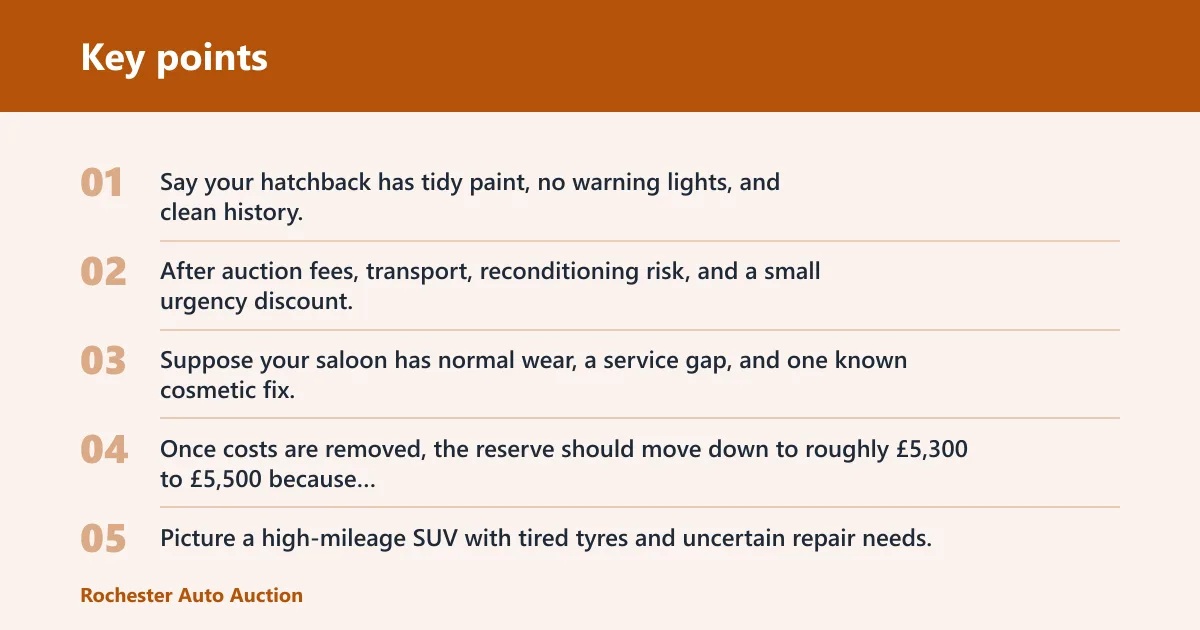
Say your hatchback has tidy paint, no warning lights, and clean history, so the market value sits at £10,000. After auction fees, transport, reconditioning risk, and a small urgency discount, a reserve around £9,100 to £9,300 protects your net return without making the lot feel out of reach.
Average-condition car example
Suppose your saloon has normal wear, a service gap, and one known cosmetic fix, so the market value is £6,500. Once costs are removed, the reserve should move down to roughly £5,300 to £5,500 because the auction buyer will price in the same work and the same risk.
Weak-condition or high-risk car example
Picture a high-mileage SUV with tired tyres and uncertain repair needs. A £4,000 market estimate can shrink quickly once fees, transport, and repair risk are counted, which is why a reserve in the £2,700 to £3,000 band may be more realistic than chasing a headline figure.
What happens if the reserve is not met?
If bidding does not reach the reserve, the lot is usually withdrawn or not sold. That does not always end the process, because post-auction negotiation may still lead to a sale if a buyer remains interested and the seller is willing to move on price.
Withdrawn lot versus unsold result
In practice, a failed reserve means the car is still in play only if the seller chooses to keep talking. Most property auctions operate on an unconditional basis, but car auctions can still use a follow-up path where the hammer does not end the discussion.
Post-auction negotiation can still work
Post-auction negotiation matters most when one bidder has already shown real interest. If the reserve was set too high, the seller may still secure a sale by trimming expectations after the ring, especially when the car is slow to move or the market has softened.
When to adjust and relist
If the same car misses reserve more than once, the number is likely too aggressive. Recheck the market value, trim any retail optimism, and reset the reserve using a firmer net-proceeds figure before relisting.
How do I compare reserve price with market value?
Use market value as the starting estimate, then convert it into a reserve by deducting fees, transport, likely reconditioning, and a time penalty. The reserve should match your walk-away figure, not the highest figure you can defend in conversation.
- Pick the most relevant market value for the car’s condition and channel.
- Subtract auction fees and any collection or delivery cost.
- Estimate the most likely reconditioning spend, not the best-case spend.
- Apply an urgency discount if you want the car sold quickly.
- Check whether the result meets your walk-away figure.
- Set the reserve at or below that figure, then keep the public guide low enough to encourage bids.
Should I use market value or retail value when setting reserve?
Use market value, rather than retail value, when setting the reserve. Retail value includes the seller’s margin, presentation, and time on forecourt, while auction reserve should reflect what a buyer will pay after factoring in repair risk, margin, and resale effort.
Wholesale, retail, and auction values are not the same
Wholesale trade value is the closest anchor for a reserve in many cases. Retail value is useful only as a ceiling for expectation, because auction buyers still need room to recondition the car and make a margin.
How do I protect value without killing buyer interest?
Protect value by setting a reserve that guards your walk-away figure while leaving enough headroom for bidding to start. A reserve that is too high blocks momentum, while a reserve that is too low can expose you to underselling if demand is weak on the day.
Use the guide price to invite bids
The guide price should invite interest without advertising desperation. Keep it aligned with likely demand, then rely on the confidential reserve to protect the minimum you can accept.
Watch for inflated values
Rare-spec optimism and seasonal demand can push market estimates above what the auction room will pay. A common first-timer mistake is treating a strong advert price as proof that the same figure will hold under bidding pressure.
Adjust for car-specific risk
Mileage, condition, trim, colour, and reconditioning costs matter more in car auctions than in many other sale channels. A high-mileage car, a weak-condition car, or a stock item with uncertain prep costs needs a lower reserve than a clean, sought-after example of the same model.
Should my reserve price be below market value?
Yes, when the goal is to create competition and close the sale quickly. Reserve should sit below market value whenever the seller wants more bidders in the room, but it should stay above the seller’s true walk-away figure so the car is not given away.
What happens if my reserve is too high?
If your reserve is too high, the car may fail to sell, carry forward, or force a weak post-auction negotiation. High reserves can also shrink bidder interest before the auction starts, because buyers sense the lot is unlikely to clear.
Can a car sell below market value at auction?
Yes. A car can sell below market value at auction when the seller prioritises speed, the lot has condition issues, or demand is thin. That is why reserve should be tied to net proceeds and urgency, not to the headline market figure alone.
What if my car doesn’t reach reserve at auction?
If the car does not reach reserve, it may be withdrawn or remain unsold, depending on the house process and seller instructions. The practical next step is to review whether market value was too optimistic, whether the guide price was too high, or whether the reserve needs a reset.
Can I negotiate after reserve isn’t met?
Yes. Post-auction negotiation can still secure a sale if a bidder is close to the reserve and still engaged. This is often the best recovery path when the room showed interest, but the seller’s minimum sat just beyond the strongest bid.
How far below market value should a reserve be?
There is no fixed gap, but the reserve should be low enough to allow real bidding and high enough to protect your walk-away figure. In practice, the gap is driven by fees, transport, reconditioning risk, and how quickly you need the car gone.
Verdict: Reserve price or market value?
Choose Reserve price if you need the seller’s confidential minimum accepted before the auction, such as setting the lowest acceptable outcome and sale threshold for a car headed to auction with fees, transport, and reconditioning already counted.
Choose market value if you need an open-market estimate to benchmark the car, such as using public listings, trade data, and retail comparisons to help calibrate a reserve for a strong-condition, low-mileage car before auction.
Frequently asked questions
What happens if my reserve is too high?
A high reserve can prevent a sale, reduce bidder interest, and leave the car unsold after the auction. If that happens, the seller may need to lower the reserve, accept post-auction negotiation, or relist the vehicle with a more realistic number.
Can a car sell below market value at auction?
Yes. That happens when condition concerns, mileage, or weak demand reduce bidder confidence, or when the seller wants a faster exit. Market value is a guide, not a promise, so reserve should be built from expected net proceeds instead of the headline estimate.
Should I use market value or retail value when setting reserve?
Use market value, not retail value. Retail pricing assumes presentation, margin, and time on forecourt, while reserve should reflect the likely auction result after costs. For a seller, the useful number is what remains after the sale, not the sticker price a consumer might see.