What Are ACV Auctions Buy Fees and Who Pays Them?
ACV Auctions buy fees are buyer-paid charges added to the hammer price. Optional services like transport or premium condition tools are paid only if you select them, and taxes or title costs still depend on the state and deal. Missing those charges can turn a winning bid into weak gross or a loss. This guide breaks down which ACV costs the buyer pays, which are optional, and how to calculate true out-the-door acquisition cost before you bid.
Fee threshold crossings and dealer costs
ACV uses a buyer-focused fee schedule, and ACV says that schedule is price-tiered rather than flat. That means the fee attached to your winning bid can change with purchase price, so check the current schedule before you place a bid.
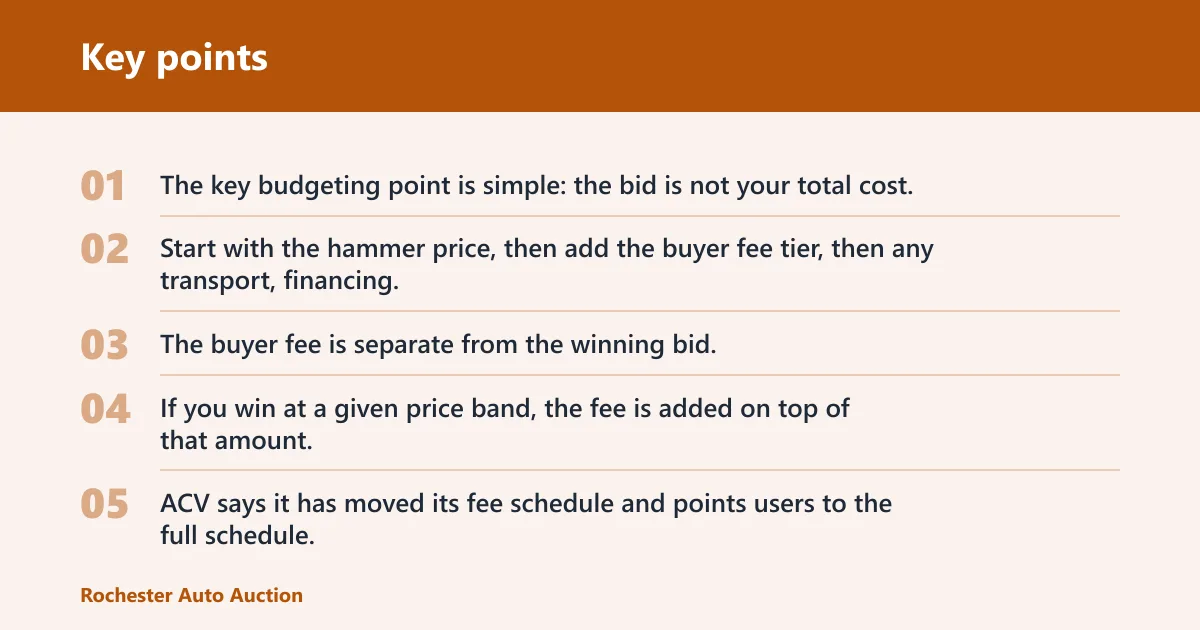
The key budgeting point is simple: the bid is not your total cost. Start with the hammer price, then add the buyer fee tier, then any transport, financing, and reconditioning costs you decide to carry.
Buyer fee versus winning bid
The buyer fee is separate from the winning bid. If you win at a given price band, the fee is added on top of that amount, which is why the same car can carry different total costs depending on where the bid lands.
Where the current fee schedule applies
ACV says it has moved its fee schedule and points users to the full schedule. That matters because a schedule like this is not universal across every vehicle and does not stay fixed forever. For a dealer, the current schedule is the only safe basis for pre-bid math.
Why price bands matter
Price bands can change your gross fast. Suppose one vehicle clears just below a fee threshold and another clears just above it. The higher-priced car can carry a higher buyer fee even when the condition difference is small, so the net cost gap may be wider than the bids suggest.
Who pays ACV buyer fees?
The buyer pays ACV buyer fees by default, along with the purchase price. The seller is not the usual payer of buyer fees. If a contract changes that allocation, the contract controls, but that is an exception rather than the normal rule.
Buyer-paid line items
For a typical ACV purchase, the buyer budgets for the hammer price, the buyer fee tied to the schedule, and any optional services selected at checkout. That is the core acquisition stack before you add reconditioning, title work, or state-specific charges.
What the seller may pay instead
The seller may have separate seller-side costs, but those are not the same thing as buyer fees. ACV’s terms describe the platform as a service that facilitates vehicle exchange between buyers and sellers, and the two sides can have different obligations in the deal lifecycle.
When contract terms change the answer
If the sale documents assign a cost to the other side, follow the deal terms. For example, a title issue, an arbitration resolution, or a negotiated transport arrangement can shift who pays a line item. The fee schedule still governs the buyer fee unless the transaction document says otherwise.
Does ACV charge hidden fees?
ACV charges disclosed buyer fees and optional service charges, not a single universal flat fee hidden inside every purchase. The real risk is incomplete budgeting: transport, financing, title support, taxes, and recon can sit outside the buyer fee and still hit your out-the-door number.
Fee disclosure at checkout
ACV Transportation is presented as a separate service with its own pricing, and ACV Capital is a financing product rather than part of the auction fee schedule. Those items can appear alongside the purchase, but they are different line items with different purposes.
Optional services versus auction charges
Not every extra charge is an auction fee. Transport is optional, financing is optional, and reconditioning is a shop decision you make after purchase. The buyer fee is the auction charge; the rest depend on whether you select the service or incur the expense in your own workflow.
How to verify the current total
Check the live checkout total before you bid, then compare it with your own estimate. If the total includes transport or a financing charge you did not plan for, move those items out of the auction-fee bucket and put them in the correct cost line. That prevents double counting.
ACV transportation costs
ACV Transportation is optional and separate from auction buy fees. The same source describes it as a service for shipping a vehicle after purchase, with pricing shown at checkout. If you need delivery, budget for it explicitly; if you do not, do not let it distort your fee estimate.
When transport is optional
Transport only belongs in the acquisition total if you choose to use it. The same source says the service uses a nationwide network of more than 5,000 carriers, but that network does not make shipping mandatory. A local pickup can leave transport at zero.
How checkout pricing works
ACV presents transport as a separate, quoted service. That means the shipping line is not baked into the buyer fee schedule. For budgeting, treat it as a decision point: route it in if you need delivery, route it out if your team handles pickup.
What to budget before bidding
Picture a dealer buying a sedan two states away. The bid may look strong until you add shipping, then the margin shrinks. In that case, calculate the delivered cost first and bid against that number, not the hammer price alone.
How ACV Capital changes purchase budgeting
ACV Capital can change the cash you need at close, but it does not erase buyer fees or other acquisition costs. The same source says the product is designed to help dealers know costs upfront and offers transparent solutions with no hidden fees, so the finance line belongs in the budget, not in the auction fee bucket.
Floor financing and cash due at close
If you finance inventory through ACV Capital, your cash requirement at purchase can shift. The financed balance may reduce the immediate cash you wire, but the purchase still carries the bid amount, the buyer fee, and any other chosen services or downstream costs.
What financing does not replace
Financing does not replace the need to budget for the vehicle itself. It also does not remove reconditioning, taxes, title support, or transport from your plan. Treat financing as a payment method, not as a discount on the acquisition price.
Planning for interest and carry costs
If a financed unit sits on the lot for 30 days or 60 days, the carrying cost can matter as much as a small fee swing. Dealers should fold expected interest into the total acquisition cost, then compare that figure against expected front-end gross before bidding.
ACV acquisition cost worksheet
Use this worksheet to build an out-the-door estimate before you bid. The point is to separate the auction charge from the optional service lines, then assign each line item to the correct payer so you do not mix buyer fees with transport or shop costs.
| Line item | Who pays it | Estimate | Notes for budgeting |
|---|---|---|---|
| Bid amount | Buyer | $12,000 | Winning hammer price before fees |
| Buyer fee tier | Buyer | $595 | Use the current ACV schedule for the vehicle’s price band |
| Transport | Optional | $275 | Only if you select ACV Transportation or another shipper |
| Financing | Depends on contract | $84 | Use only if financed costs or interest apply at purchase |
| Reconditioning | Buyer | $900 | Shop expense after purchase; varies by unit |
| Total out-the-door cost | Buyer | $13,854 | Add every line that applies to the deal |
In this worksheet, the total is not the bid alone. It is the bid plus the fee tier, plus any transport you select, plus financing costs if they apply, plus the recon work you expect to do before retailing the unit.
How to use the worksheet
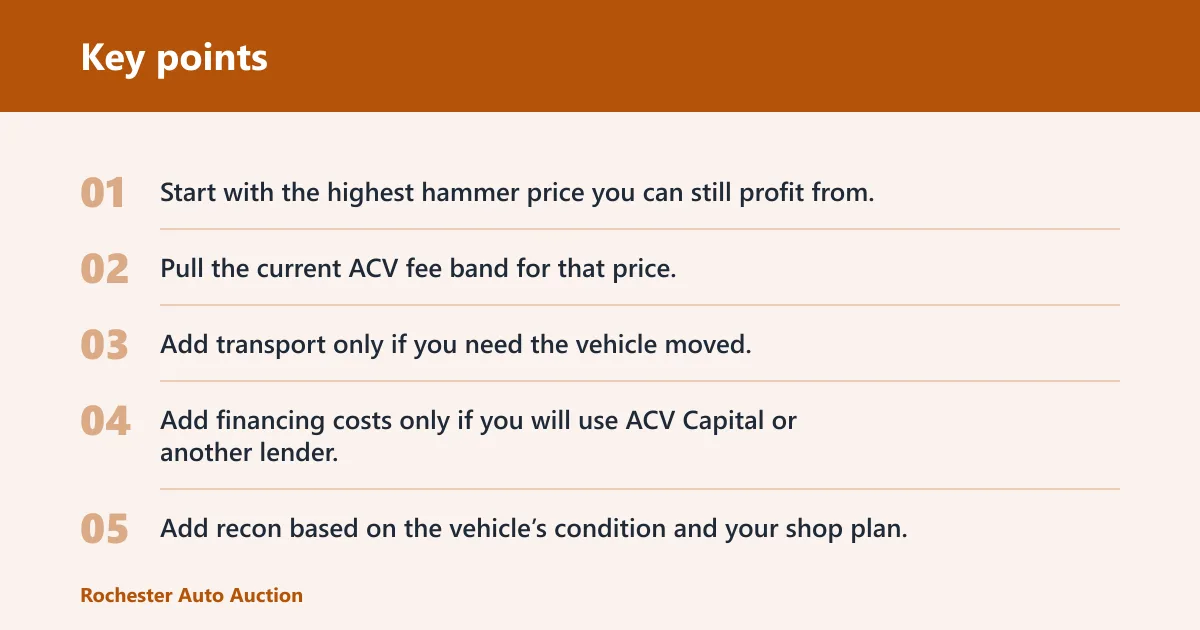
- Start with the highest hammer price you can still profit from.
- Pull the current ACV fee band for that price.
- Add transport only if you need the vehicle moved.
- Add financing costs only if you will use ACV Capital or another lender.
- Add recon based on the vehicle’s condition and your shop plan.
- Compare the total against your target gross before bidding.
How fee bands affect your bid
If the vehicle price crosses into a different fee band, recalculate before you bid again. A small bid increase can trigger a larger buyer fee, and that can erase the margin you thought you had. The dealer should compare the full net cost, not just the hammer price.
Crossing into a higher tier
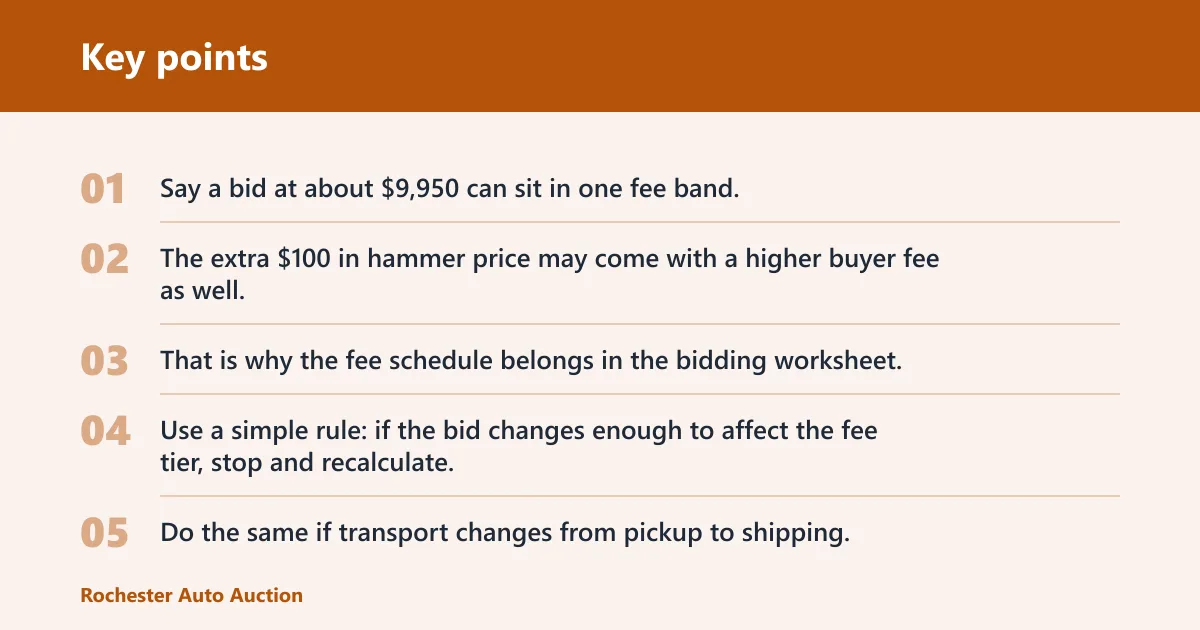
Say a bid at about $9,950 can sit in one fee band, but a bid at about $10,050 may move the vehicle into the next band. The extra $100 in hammer price may come with a higher buyer fee as well. That is why the fee schedule belongs in the bidding worksheet, not in the back office after the sale.
Rechecking net cost before you bid
Use a simple rule: if the bid changes enough to affect the fee tier, stop and recalculate. Do the same if transport changes from pickup to shipping, or if a financing decision changes the cash needed at close. The right bid is the one that still works after every line item.
Simple rule for comparing two vehicles
Compare vehicle A and vehicle B on total acquisition cost, not on hammer price alone. If one unit has a lower bid but a higher fee band, higher transport, or heavier recon, it may cost more to land than the car with the larger bid.
What ACV Auctions
ACV is a business-to-business online marketplace for buying and selling vehicles. Only legally eligible wholesale vehicle buyers or sellers can register for services, and users may need dealer documents such as a state dealer license and resale certificates. The platform is built for dealer-to-dealer transactions, not consumer retail buying.
Frequently asked questions
What are ACV Auctions buy fees?
ACV Auctions buy fees are buyer-paid charges added to the winning bid. The same source says its fee schedule is buyer-focused and price-tiered, so the charge can vary by purchase price. The safest approach is to check the current schedule before bidding and build that fee into your acquisition math.
Who pays ACV buyer fees, the buyer or seller?
The buyer pays ACV buyer fees by default. The seller may have separate seller-side costs, but those are not the usual payer of the buyer fee. If a specific contract says otherwise, follow the contract, but do not assume seller payment in a normal transaction.
How does ACV pricing work for dealers?
ACV pricing works as a buyer fee schedule layered on top of the purchase price. Dealers should treat the hammer price, buyer fee, transport, financing, and reconditioning as separate line items. That structure gives a true out-the-door number instead of a bid-only estimate.
Does ACV charge hidden fees on top of the bid?
ACV’s pricing is not best understood as hidden fees on top of the bid. The more accurate concern is that dealers may overlook disclosed line items like transport, financing, taxes, title support, or recon. Check the checkout total and separate optional services from auction charges.
Are transportation costs included in ACV buy fees?
No. ACV Transportation is described as a separate service for shipping a vehicle after purchase, and ACV presents it with separate pricing. If you need shipping, add it as its own line item. If you do not use it, it should not inflate the buy fee estimate.
Does ACV Capital change what I pay at purchase?
ACV Capital can change how much cash you need at close, but it does not replace the buyer fee or the purchase price. It is a financing tool, not a fee discount. Dealers still need to budget for acquisition cost, carry cost, and any recon tied to the unit.
How do I estimate total out-the-door cost on ACV?
Start with the bid, add the current buyer fee tier, then add transport if you will use it, financing if it applies, and reconditioning for the work you expect to perform. The result is your out-the-door acquisition cost. Compare that number to your target gross before bidding.
What happens if my fee schedule differs by vehicle price?
If the vehicle crosses into a different price band, the buyer fee can change. Recalculate the total before you bid again, because a small price increase can move the unit into a higher tier. That is the difference between a profitable bid and one that misses the margin.
What is acv auctions?
ACV Auctions is a business-to-business online vehicle marketplace for legally eligible wholesale buyers and sellers. Buyers need dealer credentials to register, and the platform facilitates the exchange rather than acting like a retail marketplace. For dealers, the important part is cost structure, not consumer-style shopping.
Who owns acv auctions
Ownership can change over time, so the most reliable answer is the company’s current corporate disclosure, filing, or official investor information. For budgeting purposes, ownership does not change the core buying math: the buyer still pays the purchase price and buyer fee, with transport and financing handled separately.