Rebuilt Title Insurance: Can You Get Full Coverage?
Yes, some insurers will write full coverage on a rebuilt title, but approval usually depends on a VIN inspection, title paperwork, repair records, and state-specific rules. Others refuse collision and comprehensive outright. If you skip the underwriting details, you can buy a policy that pays less than the car is worth. This guide explains what insurers check, what limits they impose, and when the quote is still poor value.
Can you get full coverage on a rebuilt title?
Yes, full coverage can be available on a rebuilt title, but approval is conditional and far from automatic. In practice, “full coverage” usually means collision plus comprehensive, and those physical-damage coverages may be declined, limited, or written with stricter terms than liability. Some carriers will insure the car only if the paperwork and inspection are clean.
That difference matters because liability insurance is usually the easy part. It covers damage you cause to other people and their property, while full coverage protects the insured vehicle itself. A rebuilt title can still pass underwriting, but the insurer is deciding whether the car’s repair history and value make that risk acceptable.
What full coverage usually includes
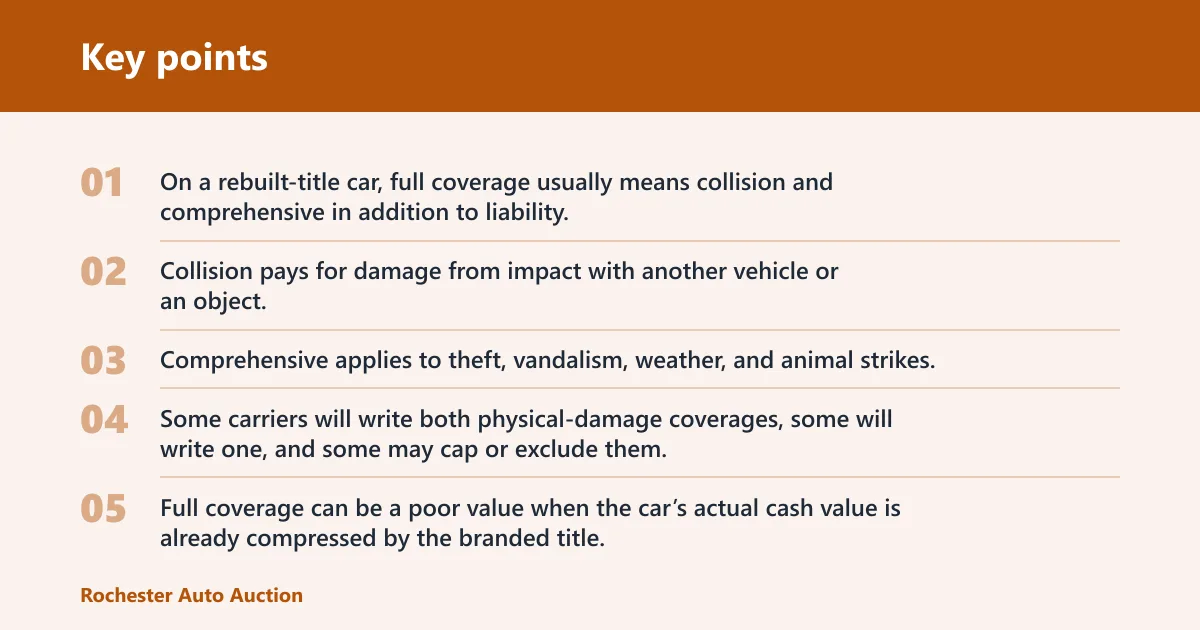
On a rebuilt-title car, full coverage usually means collision and comprehensive in addition to liability. Collision pays for damage from impact with another vehicle or an object. Comprehensive applies to theft, vandalism, weather, and animal strikes. Some carriers will write both physical-damage coverages, some will write one, and some may cap or exclude them.
Why approval is harder than liability-only coverage
Rebuilt-title vehicles can be insured, but full coverage is not guaranteed, and some carriers cover liability while declining or limiting collision and comprehensive. That is because the insurer is not only pricing driver risk. It is also judging repair quality, loss potential, and how hard the car will be to value after a claim.
When full coverage is available but still a weak buy
Full coverage can be a poor value when the car’s actual cash value is already compressed by the branded title. If the vehicle’s market value is low enough, the premium for collision and comprehensive may buy only a small payout if the car is totaled again. A policy can be available and still be a bad financial trade.
Say your rebuilt sedan is worth far less than a clean-title version of the same model. If collision coverage costs enough that several months of premiums approach the likely payout gap, the policy may not protect much beyond a lender requirement. That is a value question, not just an approval question.
Full coverage readiness checklist
| Requirement | What insurers want to see | Why it matters | What happens if it’s missing | Decision |
|---|---|---|---|---|
| Rebuilt inspection | A passed state inspection or rebuilt inspection report tied to the VIN | Shows the vehicle was repaired and cleared for road use | Coverage may be delayed, limited, or declined | Yes / No |
| Repair invoices | Itemized receipts for labor, parts, and major repairs | Helps prove the work was done and what was replaced | Underwriting may assume unknown repair quality | Yes / No |
| Before/after photos | Clear photos of damage before repair and the finished vehicle after repair | Lets the carrier compare the loss and the repair result | The insurer may not trust the restoration record | Yes / No |
| VIN/title disclosure | Exact VIN, branded-title status, and a truthful description of the title history | Prevents misrating and post-bind rescission risk | The quote can be rejected or re-rated later | Yes / No |
| Frame or unibody repairs | Shop records showing structural repairs, alignment checks, or frame documentation | Structural work changes crash risk and repair confidence | Collision may be declined or capped | Yes / No |
| Airbag and safety-system repairs | Proof that airbags, sensors, seat belts, and related modules were replaced or restored | Safety-system failures raise underwriting concerns | Coverage terms may exclude related losses or reduce confidence in approval | Yes / No |
| Lender requirements | Proof of full coverage, deductible limits, and any lienholder wording the lender requires | Most lenders want the collateral protected | Financing can stall or the policy may not satisfy the loan | Yes / No |
| Final verdict | If the file is missing airbag records, ACV is low, or the lender requires protection the carrier will not write, the policy is a weak fit | Helps separate approval from value | Liability only likely / full coverage possible / poor-value even if approved | Use this to decide |
Some carriers may require photos or documentation before binding coverage. A professional rebuilt inspection plus strong documentation may be required. In other words, the file matters almost as much as the car. A clean paper trail can move the decision from “no” to “maybe.”
-
Gather the title file. Include the rebuilt title, salvage history if available, and the VIN on every page. Underwriters use those records to match the car’s history to the policy.
-
Add repair evidence. Collect receipts, shop invoices, and parts documentation that show what was repaired. If structural or airbag work was done, keep those records separate and easy to review.
-
Prepare photo proof. Use before-and-after photos that show the same angles where possible. Clear photos help explain the damage path and the quality of the repair.
-
Ask about physical damage terms. Before binding, ask whether collision and comprehensive are available, capped, or excluded. Also ask whether the policy settles claims on ACV only, because that affects what a total loss might actually pay.
Why do insurers treat rebuilt titles differently?
Insurers often treat rebuilt titles differently because the vehicle has a branded-title history, and that history can affect repair confidence and claim value. The car was previously declared a total loss, repaired, and returned to road use. That does not make it uninsurable, but it does make the underwriting question sharper.
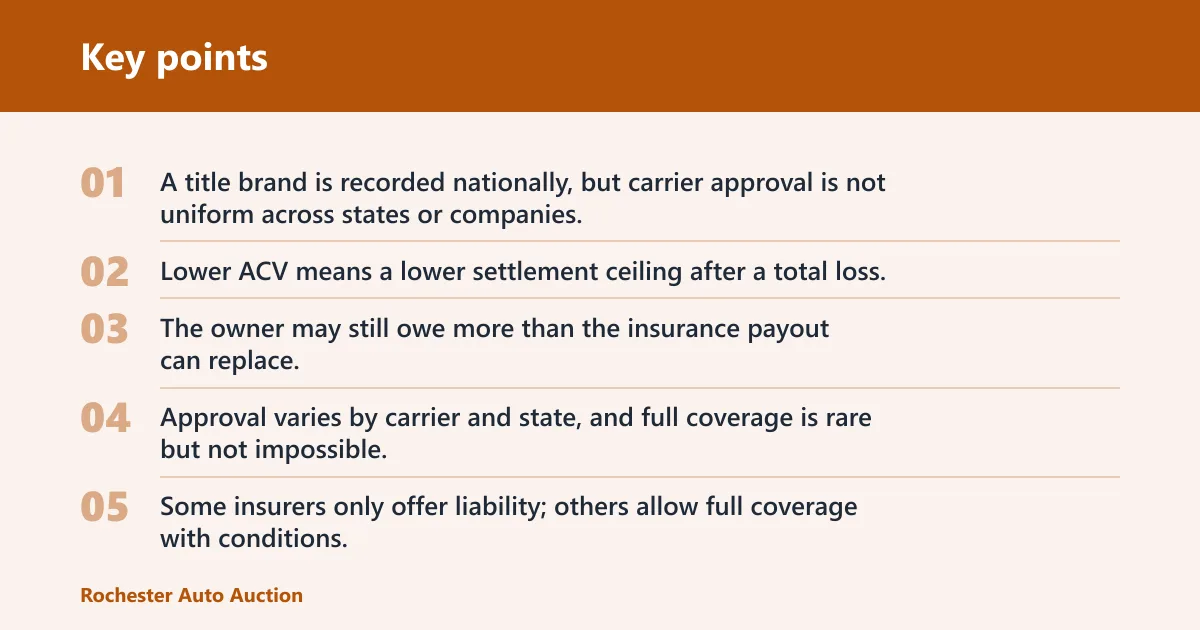
State rules also vary. A title brand is recorded nationally, but carrier approval is not uniform across states or companies. One insurer may accept a rebuilt sedan with photos and inspection records, while another may only quote liability or may refuse the car altogether.
Repair quality and hidden-damage risk
The main concern is incomplete repair. Hidden frame damage, airbag failures, wiring faults, or poor-quality parts can turn a claim into a bigger loss than expected. That is why insurers ask for shop records and photos; they want evidence that the car is structurally sound, not only cosmetically finished.
Lower actual cash value after branding
A branded title can reduce the value used for coverage and claims calculations, and rebuilt-title vehicles can be worth less than comparable clean-title cars. Lower ACV means a lower settlement ceiling after a total loss.
Suppose a clean-title version of the same model would be valued higher at claim time, but the rebuilt brand pulls the settlement down. The owner may still owe more than the insurance payout can replace. That is the risk of buying physical damage coverage on a low-ACV vehicle.
State rules and carrier differences
Approval varies by carrier and state, and full coverage is rare but not impossible. Some insurers only offer liability; others allow full coverage with conditions. Independent agents can help because they can shop multiple carriers when an online quote engine rejects the car.
What documents do insurers ask for?
Insurers usually want proof that the vehicle was repaired, inspected, and honestly described. The most common request set includes photos, repair invoices, a rebuilt inspection report, and VIN/title disclosure. If those documents are incomplete, the application can stall or the carrier may quote only liability.
The goal is to show both identity and repair quality. A carrier needs the correct VIN, the branded-title status, and evidence that the major damage was addressed. Without that package, the insurer may assume higher risk and limit the coverage it is willing to write.
Before-and-after photos and repair invoices
Photos should show the damage before repair and the finished vehicle after repair. Invoices should list the labor, parts, and major systems touched during the repair. Insurers may require photos or documentation before binding coverage, and strong documentation may be required.
Rebuilt inspection reports and shop records
A rebuilt inspection report shows the car passed the state process needed to return to road use. Shop records add detail that the inspection summary may not include, such as frame work, alignment, sensors, and replaced components. Together, those records support the repair story.
VIN and title disclosure details
Give the VIN, the rebuilt brand, and any prior salvage designation upfront. Do not wait for the carrier to discover it. A quote that is built on incomplete title information can be re-rated, narrowed, or withdrawn once the underwriter checks the file.
What coverage do you lose or keep?
You usually keep liability first, and that is the floor for many rebuilt-title policies. What you may lose is physical-damage protection, especially collision and comprehensive. Some carriers will write one and not the other, while others may restrict payout terms even when both are available.
That split matters after a second loss. Liability pays damage you cause to others. Collision and comprehensive protect your own vehicle, but on a rebuilt title those coverages may have tighter terms, higher premiums, or a settlement basis that reflects the car’s reduced ACV.
Liability versus collision
Liability coverage is often available even when the vehicle is branded. It covers injuries and property damage to others if you are at fault. Collision is different because it pays for crash damage to the insured vehicle itself, and that is where rebuilt-title underwriting often gets stricter.
Comprehensive coverage limits and exclusions
Comprehensive usually covers theft, vandalism, weather, and animal strikes. On rebuilt-title vehicles, it may be limited, excluded, or offered only with a narrow claim basis. Ask whether glass, hail, theft, and animal impact losses are included, because those are common places where terms differ.
What a claim may pay after a second loss
Even when physical damage coverage is written, the payout may still disappoint because the rebuilt title lowers the ACV used in the claim calculation. A second total loss can produce a settlement that is far below replacement cost, especially if the market already discounts the car heavily. Coverage is not the same as replacement.
Can you finance a rebuilt title car?
Yes, but financing is harder, and the insurance requirement can be the sticking point. Lenders financing a rebuilt-title vehicle often require full coverage. If the insurer will only write liability, or if collision and comprehensive are limited, the loan may not satisfy the lender.
That can block approval even when the vehicle itself is drivable and properly inspected. Lenders protect the collateral, so they want physical-damage coverage that matches their risk rules. If the policy terms do not meet those rules, the deal may stall or collapse.
Why lenders often require full coverage
Lenders usually want the vehicle protected against crash loss, theft, and other damage until the loan is paid down. That is why a rebuilt-title car can be a tough fit: the title history lowers the value, but the lender may still expect standard collateral protection. The insurance market and the loan market do not always agree.
How insurance limits affect loan approval
If the insurer caps collision, excludes comprehensive, or writes only liability, the lender may not accept the policy. Even if coverage is available, the lender can reject terms that do not protect its interest. That is where the branded title creates the biggest practical problem.
When financing may be difficult or unavailable
Financing gets harder when the car’s ACV is low, the title brand is severe, or the insurer will not write the needed physical-damage coverage. Independent agents can help with the insurance side, but they cannot force a lender to accept weak collateral terms. If the numbers do not work, cash may be the cleaner route.
Picture a rebuilt crossover that passes inspection but only gets a liability quote from the first carrier. The lender still asks for full coverage, so the buyer has to shop again before signing. That extra step is common on branded-title purchases.
Frequently asked questions
Will insurance cover a rebuilt title car for collision and comprehensive?
Sometimes. Some carriers will write collision and comprehensive, but others decline one or both, or impose stricter terms than they would for a clean-title car. Ask whether each coverage is available separately, because liability approval does not mean physical-damage approval.
Why do insurers treat rebuilt title cars differently?
Insurers focus on repair quality, hidden-damage risk, and lower claim value. A rebuilt title shows the vehicle was once a total loss, repaired, and returned to road use. That history affects both the chance of another loss and the amount the insurer may have to pay.
What documents do insurers ask for on a rebuilt title?
Common requests include before-and-after photos, repair invoices, shop records, a rebuilt inspection report, and VIN/title disclosure. Some carriers want these before binding coverage. Clear records improve the odds because they help the underwriter judge whether the repairs were complete and documented.
Is rebuilt title insurance more expensive than clean title insurance?
Not always, but the price can differ because the coverage terms differ. Some rebuilt-title quotes can come in lower than clean-title quotes, yet that does not mean every quote is lower. A policy with restrictions or lower ACV can still be a poor value.
How much is a rebuilt title car worth after a total loss claim?
Usually less than a comparable clean-title car, because the branded title lowers the value used for coverage and claims calculations. That discount can carry into ACV-based settlement math after a loss, which is why the payout may trail the replacement cost by a wide margin.