Online Auto Auctions to Avoid: Red Flags Before You Register
Use a two-step check before you register: confirm the platform’s identity, license, payment rules, and contact details, then reject any listing with missing title status, no vehicle history, or pressure to bid fast. Missing those signals can lead to fake listings, locked deposits, hidden fees, or a car you cannot title. This guide shows the platform red flags and the listing red flags to screen first.
What makes an auction site risky?
Risk comes from two places. The platform may be unlicensed, hard to contact, or vague about payment and dispute rules. The listing may hide the car’s real condition, title status, or fees. Public buyers need to screen both, because a legitimate company can still host a bad listing, and a bad operator can make every listing unsafe.
Platform risk versus listing risk
Platform risk is about whether the company can accept your money, process bids, and honor its own rules. Listing risk is about whether a specific vehicle can be bid on with enough evidence to judge value. Those are separate checks, and a clean platform does not make a weak listing acceptable.
Say a site shows a dealer badge, a toll-free number, and a branded payment page, but the listing has no VIN, no title status, and only one distant photo. That platform may be real, yet the listing still lacks the facts needed to bid safely.
Why public buyers need a stricter screen
Public buyers usually cannot rely on floor access, dealer-only inspection tools, or a long relationship with the seller. That means the burden shifts to the page itself. If the site cannot show registration rules, fees, and dispute terms in plain language, you should treat it as a higher-risk venue before you ever create an account.
How do you tell if an online auto auction is legit?
A legit auction site makes its business identity easy to verify. Look for a real company name, a physical business address, a working phone number or support channel, and clear registration rules. Check reviews and BBB ratings too. The site should also say whether it is a licensed auction company, a dealer-only platform, or a public marketplace with dealer authorization.
License, registration, and ownership signals
Check whether the site states its state licensing status or dealer authorization, and whether that claim matches the company name shown in the footer, terms, and payment pages. If ownership is hidden behind vague branding, or the legal entity changes across pages, that is a warning sign. A WHOIS lookup can also help you gauge domain age, which should match the brand’s public history.
Look for a business address that can be tied to the same company, not just a mailbox. If you cannot find a legal company name, address, phone number, and support path in a few clicks, treat that as a serious problem. A real auction site should list a phone number, email, or support form that works before registration. If you cannot reach a human without making a deposit, the platform is asking for trust before it has earned it.
Contact details, domain age, and support access
Domain age does not prove legitimacy by itself, but a newly registered domain paired with aggressive bidding pressure and no address is a poor sign. Older domains can still host bad operators, so use age as a consistency check, not a guarantee. The key question is whether the site’s identity holds together across the homepage, checkout, and terms.
Registration rules that should be clear before sign-up
Before you register, the site should explain who can bid, what documents are required, whether deposits are refundable, and when payment becomes due. If those rules are buried behind login walls or scattered across conflicting pages, the site is not giving public buyers enough information to make a safe decision.
- Confirm the legal entity. Match the company name in the terms, footer, and payment screen. If the names do not match, stop and verify the operator before entering personal or payment data.
- Check contact channels. Look for a physical address, phone number, and support email or form. Test one channel before you register; if nothing responds, assume help will be slow after you bid.
- Read access rules. Find out whether the site is dealer-only, public, or mixed access, and whether registration requires identity documents or a deposit. Clear access rules are a sign of normal operations.
- Review payment terms. Look for accepted payment methods, deadlines, refund language, and penalties for nonpayment. A platform that hides these terms is asking you to accept risk without a full cost picture.
What red flags should stop you before registering?
Stop before sign-up if the site hides its business identity, leaves contact details incomplete, or avoids clear terms on payment and disputes. Other stop signs include pressure to place a deposit before you can inspect listings, missing privacy or terms pages, and inconsistent language about who owns the auction platform.
Missing business identity or hard-to-find contact information
If you cannot find a legal company name, address, phone number, and support path in a few clicks, treat that as a serious problem. Public buyers should not have to search external databases just to learn who is taking their money. A legitimate operator makes its identity easy to verify before account creation.
No clear terms, privacy policy, or payment rules
A real site should state how it handles data, bids, payments, deposits, refunds, and disputes. If the privacy policy is absent or the terms are thin, vague, or copied across pages without matching the business name, the site may not be prepared to handle a buyer dispute. That is a stop sign before registration.
Pressure to deposit money before you can inspect listings
Some auctions require a deposit to unlock bidding, but the rules for that deposit should be plain: amount, timing, refund conditions, and what happens if you do not win. If the site pushes payment before listing access, that creates a cost without enough evidence. For first-time buyers, that is usually too much risk.
Online auto auctions risk scorecard
Use this scorecard before you register. A single red stop sign on platform trust is enough to pause, and multiple yellow checks should push you to verify more before sharing payment details. On listing checks, missing title facts or missing VIN information should stop a bid on that vehicle.
| Group | Yes/no check | Evidence to look for on the site | What a failure means | Action |
|---|---|---|---|---|
| Platform trust | License or dealer authorization is stated | State license number, dealer authorization note, or auction registration page naming the legal entity | You may be dealing with an unverified operator | Red |
| Platform trust | Business address and contact details are visible | Street address, phone number, email, and support form that match the company name | You may not be able to reach the seller after payment | Red |
| Platform trust | Company ownership and legal name are clear | Terms, footer, and payment pages all show the same legal business name | The operator may be masking who collects funds | Yellow |
| Platform trust | Registration rules are explained before sign-up | Eligibility, documents, deposit rules, and bid access are posted publicly | You may be asked to agree to hidden rules later | Red |
| Listing quality | VIN is shown and matches the vehicle page | VIN on the listing, title page, and photos if visible | You cannot verify the car’s identity | Red |
| Listing quality | Odometer reading is listed | Exact miles or kilometers, not “exempt” without explanation | You cannot judge wear or title risk | Yellow |
| Listing quality | Damage disclosure is specific | Named damage area, airbag status, run-and-drive note, and condition report | The car may have undisclosed collision or mechanical issues | Red |
| Listing quality | Multiple clear photos are available | Front, rear, interior, dash, odometer, tires, and damage-area photos | The listing may be hiding defects | Yellow |
| Cost or policy risk | Buyer fee stack is posted | Buyer premium, documentation fee, internet bidding fee, deposit, and storage or gate fee | True out-the-door cost is unknown | Yellow |
| Cost or policy risk | Payment deadline and accepted methods are clear | Hours or days to pay, card, wire, ACH, or cashier’s check rules | You may lose the car or the deposit for missing a deadline | Red |
| Cost or policy risk | Return and arbitration rules are posted | No-return clause, claim window, and misrepresentation standards | You may have no remedy after pickup | Red |
| Cost or policy risk | Pickup and storage rules are posted | Pickup deadline, yard storage fee, loading restrictions, and transport rules | Storage costs can rise fast after sale | Yellow |
What listing details should you verify before bidding?
Before you bid, verify the vehicle’s identity, condition, title status, and inspection access. A good listing page should show a VIN, an odometer reading, damage disclosure, airbag status, and a run-and-drive note. They also explain whether third-party inspection is allowed and whether the seller gives any condition guarantee.
Condition report, odometer, and VIN match
The listing should give an odometer reading and a condition report that names the damage area, airbag deployment status, and whether the vehicle starts, moves, or only runs in place. A VIN mismatch or missing VIN is a stop sign. If the VIN on the title, listing, and photos do not line up, do not bid.
Picture a sedan with 82,400 miles, a clean front photo, and a note that says “run and drive.” If the same page omits airbag status and does not show the dash or odometer, the condition report is too thin to support a bid. The gap matters more than the mileage number.
Title status, lien release, and branding terms
Title language should be plain and specific, such as clean title, salvage title, rebuilt title, flood branding, theft branding, or lien status. If the page says “title pending” without a deadline or “paperwork processing” without details, that can hide transfer problems. For a financed vehicle, a lien release should be explained before bidding.
Inspection access and third-party verification
Real auction sites usually explain whether there is a pre-bid inspection window, whether an outside inspector is allowed, and what limits apply to condition guarantees. If the site blocks inspection and also limits claims, you are left with less proof and less recourse. That combination deserves caution.
Which fees and policies create the biggest surprise costs?
The biggest surprise costs usually come from the fee stack, payment deadline, and pickup rules. A listed hammer price can rise quickly once the buyer premium, documentation fee, internet bidding fee, deposit, storage, and transport charges are added. Read the policy before you bid, not after.
Buyer premium, documentation fee, and internet bidding fee
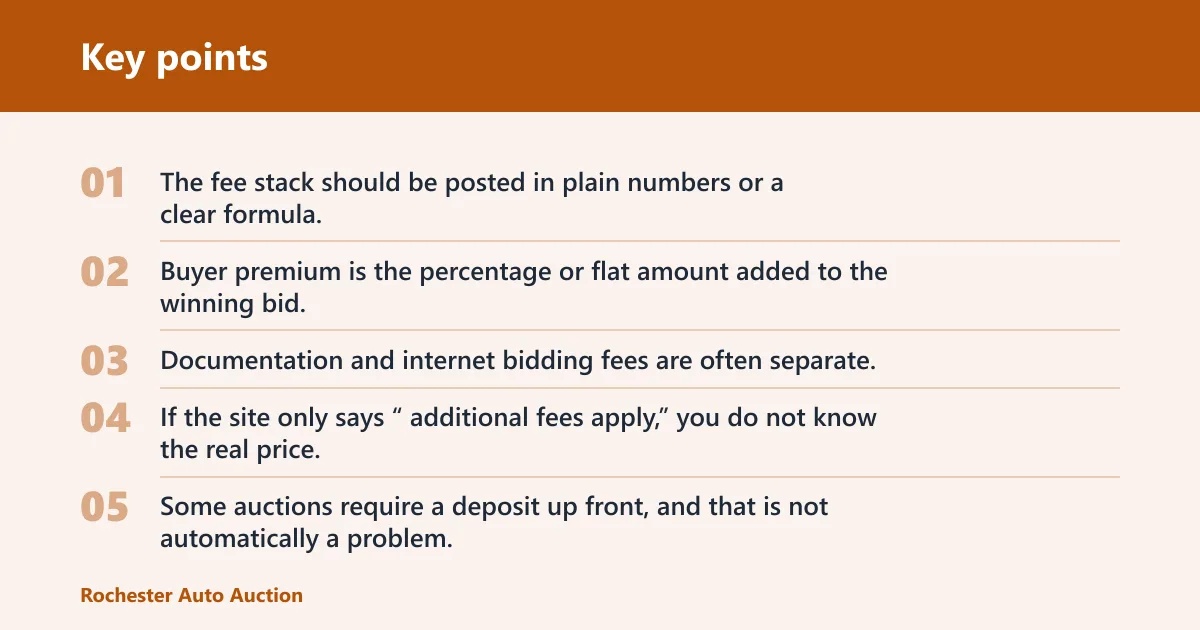
The fee stack should be posted in plain numbers or a clear formula. Buyer premium is the percentage or flat amount added to the winning bid. Documentation and internet bidding fees are often separate. If the site only says “additional fees apply,” you do not know the real price.
Deposit rules, payment deadlines, and nonpayment penalties
Some auctions require a deposit up front, and that is not automatically a problem. The problem is a deposit with unclear refund terms or a deadline that is shorter than the platform’s own support response time. The site should say how many hours or days you have to pay, what payment methods are accepted, and what happens if you miss the deadline.
Nonpayment penalties should also be specific. If the listing or terms do not say whether the deposit is forfeited, whether the account is suspended, or whether you owe a restocking or relisting fee, the site is leaving a major cost undefined.
Pickup deadlines, storage fees, and shipping limits
Check the pickup deadline, yard storage fee, transport eligibility, and any loading restrictions before you bid. A car that must be removed within about 2 business days can become expensive if the carrier is delayed. If the yard only loads during narrow hours or refuses certain transport methods, those limits affect the total cost.
What buyer protections should a real auction site offer?
A real auction site should give you clear dispute terms, a stated claim window, and a way to contact support after the sale. It should say what counts as a misrepresentation, whether returns are allowed, and how arbitration works if the car differs from the listing. Payment security and privacy pages should also be easy to find.
Return limits and arbitration windows
Many auction listings are sold “as is,” but the site should still explain whether any return or arbitration window exists. If there is a post-sale claim process, it should state the deadline in days and the conditions for opening a claim. A no-return clause without an arbitration path is a strong warning sign for public buyers.
Misrepresentation standards and claim deadlines
The terms should say what qualifies as a misrepresentation: wrong VIN, wrong title branding, undisclosed flood damage, incorrect run-and-drive status, or missing major damage disclosure. Without that definition, the site can reject almost any claim. Clear claim deadlines matter because some disputes must be filed quickly after pickup or inspection.
Customer support and payment security
Look for HTTPS checkout, a secure payment flow, a privacy policy, terms and conditions, and a support channel that answers questions before registration. If payment is handled through an unsecured page or a vague external request, stop. Public buyers should not send money through a process that feels improvised.
Frequently asked questions
What are the red flags before registering for an online car auction?
Big red flags include hidden ownership, missing contact details, no privacy policy, vague payment deadlines, and pressure to deposit money before you can review listings. If the site cannot explain its rules in writing before registration, assume the risk is higher than it first appears.
Are online auto auctions safe for public buyers?
They can be, but only if the platform is transparent and each listing has enough detail to judge the car. Public buyers need more caution than dealer users because inspection access, dispute rights, and pickup rules may be tighter. Safety depends on the site’s evidence, not its branding.
What fees should I look for before I bid?
Look for the buyer premium, documentation fee, internet bidding fee, deposit, storage or gate fee, and any transport charge. The key is the full out-the-door estimate, not the hammer price alone. If the fee stack is not posted clearly, your final cost can be much higher than expected.
How can I verify a vehicle’s condition from listing photos and reports?
Match the VIN, odometer, damage photos, airbag status, and run-and-drive note across the listing and report. A good page gives multiple angles, including interior, dash, and damage-area shots. If the page hides those details or the VIN does not match, treat the listing as too risky to bid on.
What should I check in the terms and conditions before I register?
Check payment deadlines, accepted payment methods, refund language, deposit rules, arbitration windows, claim deadlines, and pickup restrictions. Terms should also explain what counts as misrepresentation. If those rules are vague or buried, the site may leave you with little recourse after the sale.