Dealer Auctions Near Me Open to the Public: How to Find Them
Dealer auctions near you are typically public only if the auction lists public registration, published buyer fees, and a public lane or simulcast entry; otherwise, it is usually safest to treat it as dealer-only. Miss that check, and you can waste a trip, get turned away, pay extra fees, or buy a car you cannot legally take home. This guide shows how to verify public access, separate local wholesale lanes from public auctions, and compare fees, pickup rules, and bidding options.
Dealer auctions near me: what counts
Dealer auctions are wholesale sales for licensed dealers. Public auctions are open to anyone who registers, including government, police, and seized-vehicle sales. The fastest way to sort them is to verify the venue’s access rule, not its local advertising.
Wholesale dealer lanes and licensed access
Manheim and ADESA sell to licensed dealers. That matters because a buyer who does not hold the right license usually cannot bid directly in those wholesale lanes. A buyer abroad also gets in only through a licensed US dealer.
Some auctions fit volume buyers better than a one-off purchase. A dealer can absorb lane fees, transport planning, and faster turnover. A retail buyer usually needs clearer title timing, an inspection path, and a pickup plan before bidding.
Public sales and mixed-access venues
Government and public auctions are open to anyone who registers. Their inventory is often late-model daily drivers, with short pickup windows after the sale. Mixed-access venues can host both dealer-only and public lanes, so the lane matters as much as the venue name.
That split is where many buyers get burned. A local ad can be real and still point to a dealer lane. If the rules of sale say “licensed dealers only,” the auction is dealer-only even when the sale page appears nearby and easy to reach.
What local ads can and cannot tell you
Local advertising only proves that a sale exists. It does not prove you can bid, pay, or remove the car as a private buyer. Confirm three items before travel: who may register, what identification is required, and whether the lane or sale is public.
Say your search turns up a “Saturday auto sale” 12 miles away. If the website lists a bidder approval step, dealer verification, and dealer lane rules, that sale is not public in practice, even if the lot is local and the inventory is visible from the road.
Can you bid without a dealer license?
Yes, but only through public registration, a mixed-access sale that explicitly allows retail bidders, or a licensed dealer who bids on your behalf where that is allowed. If the auction requires dealer credentials at registration or checkout, a private buyer cannot legally treat it as open access.
Direct public registration
Public auctions often require pre-sale registration, identity verification, bidder approval, and acceptance of the auction’s conditions of sale. Register early. Approval can take time, and the sale may close online bidding or in-person check-in before the first car crosses the block.
Expect an ID check, a bidder number, and terms that cover payment timing, title release, and pickup deadlines. Those conditions are not decoration. They control whether you can bid, how fast you must pay, and when you can remove the vehicle.
Buying through a licensed dealer
If you want access to a dealer-only venue, the legal path is a licensed US dealer. That dealer may buy the vehicle, handle the paperwork, and release it to you under the venue’s rules. This can be useful, but it changes your total cost and control.
In that setup, the dealer’s fee, auction fees, title handling, transport, and payment timing all matter. The car may still need inspection and a release window before it can move. You should confirm who holds the title and who is allowed to pick up the vehicle.
When mixed-access auctions still block public bidders
Some mixed-access auctions advertise locally, yet block public bidders from certain lanes or from checkout. That can happen when retail bidders may browse the public sale, but dealer credentials are still required for wholesale inventory, arbitration rules, or final paperwork.
A common first-timer mistake is to assume that a public-looking event is open end to end. If the sale page separates “public,” “dealer,” and “simulcast” access, read each lane’s rules before you bid. The lane controls the transaction, not the parking lot sign.
How do you find real public auctions near you?
Search for auctions that publish public registration, bidder terms, and a public lane or public sale calendar. Search for the access rule in writing, then verify fees, title timing, and pickup rules before you plan a trip. Look beyond local ads and confirm whether the auction houses government, police, seized, or consignment inventory.
Search terms that signal public access
Use search phrases that combine location with the access type you want: “public auto auction,” “government vehicle auction,” “police impound auction,” “seized vehicle auction,” and “consignment auto auction.” Add your city or county name, then open the sale rules before you trust the headline.
“Dealer auction near me” can surface wholesale houses first. That is not enough. You need the access rule in writing, plus signs that the public can register without a dealer license.
Venue websites, calendars, and conditions of sale
On the venue site, look for a bidder registration page, a calendar with public sale dates, and conditions of sale that name who may bid. Public auctions often list payment methods, deposit rules, title release timing, pickup hours, and storage charges on the same page or in a linked PDF.
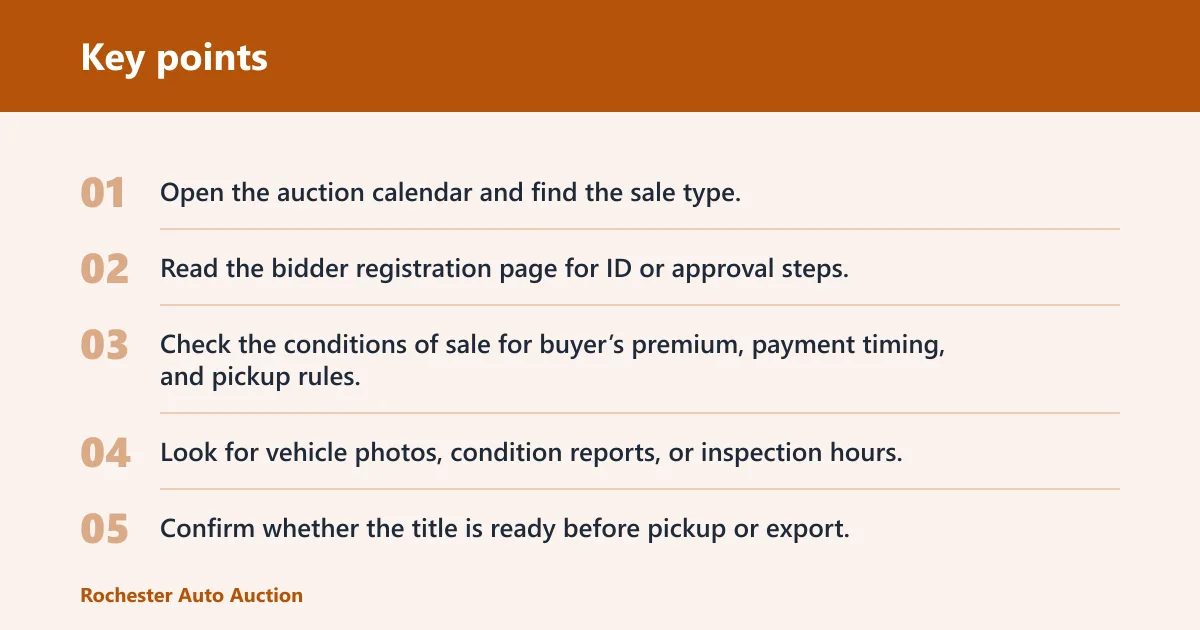
- Open the auction calendar and find the sale type.
- Read the bidder registration page for ID or approval steps.
- Check the conditions of sale for buyer’s premium, payment timing, and pickup rules.
- Look for vehicle photos, condition reports, or inspection hours.
- Confirm whether the title is ready before pickup or export.
Red flags that point to dealer-only lanes
Watch for “licensed dealer only,” “dealer license required,” “dealer registration only,” “wholesale lane,” and “dealer arbitration terms.” Another warning sign is a page that lists inventory but withholds checkout instructions until a dealer account is approved.
If the auction says it wants proof of dealer status before bidding, the sale is not open to the public. If the pickup policy also restricts release to licensed buyers or assigned transporters, treat that as another dealer-only signal.
Dealer auctions near me decision table
| Auction type | Access requirement | Typical inventory | Registration steps | Title timing | Pickup window | Red-flag signs it is dealer-only despite local advertising |
|---|---|---|---|---|---|---|
| Dealer auction | Licensed US dealer to bid | Wholesale units, trade-ins, fleet cars | Dealer account, license verification, bidder approval | Release can wait for auction paperwork and payment clearance | Usually short and tightly scheduled | “Dealer only,” “wholesale,” no public bidder path, lane access blocked at registration |
| Public auction | Anyone who registers | Government, police, seized, late-model daily drivers | Pre-sale signup, ID check, bidder number, conditions of sale | May require paperwork before pickup or export | Short; storage can start quickly | Public ad but dealer-only checkout, hidden fees, or no public lane listed |
| Mixed-access auction | Public registration for some lanes only | Split inventory: retail, wholesale, consignment | Lane-specific approval and buyer status review | Varies by lane and seller | Often short for sold units | Separate rules for each lane, dealer credentials needed for some blocks |
| Consignment auction | Depends on venue rules | Owner-sold vehicles, used cars, specialty units | Register first; some sales need identity approval | Depends on seller release and auction policy | Usually defined in sale terms | Public advertising, but bidder approval or seller approval still required |
What fees change your max bid?
Every auction adds a buyer’s premium on top of the hammer. That fee belongs in your maximum bid before you click, raise a hand, or place an absentee bid. Your landed cost also has pickup, storage, shipping, and taxes.
Buyer’s premium
The buyer’s premium is the extra charge the auction adds after the hammer price. Since it varies by auction house and sale, you should treat the posted premium as part of the bid math, not as a surprise invoice line after the fact.
Example: if your ceiling is $9,000 and the buyer’s premium is 10%, your effective cap is somewhat below $9,000 hammer because the premium comes on top. Add that premium before you bid, or your total can exceed your budget fast.
Pickup and storage fees
Pickup windows at government and public auctions are short. Storage at the auction grounds starts charging fast. If you do not have towing, transport, or a trailer arranged, the car can rack up charges before you are ready to move it.
Suppose a car is sold on Friday and pickup is due by Monday, since storage fees may start as early as Tuesday. If you wait until Tuesday, storage may already be due. That fee can erase the bargain you thought you won.
Shipping, taxes, and landed cost
Landed cost means hammer price plus buyer’s premium, pickup costs, shipping, and taxes. That is the number that matters when you compare one car to another, or a public auction purchase to a retail listing nearby.
For exporters, add the title timing issue to the landed cost. A car that looks cheap at hammer can become expensive if the title release slows shipping or forces extra storage days.
What should you check before bidding?
Check the car’s condition, the title release rule, and the pickup or export window before you bid. Remote buying is where a few missing details turn into extra fees, slow pickup, or a car that cannot move when you planned.
Inspection photos and condition reports
Get eyes on the car or extra photos before bidding. A condition report, walk-around video, or local inspection can reduce risk, especially when the vehicle is far from you or when the sale closes quickly.
Look for body damage, warning lights, tire wear, glass issues, missing keys, and signs of flood or frame damage if those details are available. If the listing is thin, bid lower or skip it.
Title release timing
Title transfer timing can control when you may pick up, ship, or export the vehicle. Some sales release the title after payment clears, while others need extra paperwork before the file is released to the buyer or a transporter.
When the title is delayed, shipment can stall. That matters even more for cross-border moves because the paperwork has to be ready before the car can leave.
Pickup and export logistics
Arrange transport before you bid if the pickup window is short. Confirm who may release the vehicle, what ID is needed at the gate, and whether the transporter must be named in advance. These steps belong in your plan, not after the sale.
For export, timing is tighter. US Customs requires the title at least 72 hours before sailing. The export filing in AES is also required 72 hours ahead. If either step is late, the ship date can slip.
How soon can you export an auction car?
Export timing depends on title release, customs filing, and the auction’s pickup rules. In the United States, US Customs requires the title at least 72 hours before sailing, and the export filing in AES is also required 72 hours ahead. Without those steps, the car cannot sail on schedule.
Paperwork before pickup or shipment
Check whether the auction will release the title before the vehicle leaves the grounds. Some sellers or venues hold title paperwork until payment clears or until a buyer completes a post-sale form. That can delay both shipment and export.
If the car is moving to a port, ask who will handle the title handoff, where the vehicle must be picked up, and whether the paperwork can be sent in time for the 72-hour customs window.
Why delays happen
Delays usually come from three places: missing identity documents, unpaid fees, or a title that has not been released. Any one of those can hold the car at the auction lot while storage fees keep running.
A public buyer should confirm the release rule before bidding. A buyer who plans to export should confirm it twice, because the customs clock is separate from the auction’s own pickup clock.
Frequently asked questions
Are there dealer auctions near me open to the public?
Sometimes, but only if the venue says public registration is allowed. A nearby ad or a local map result does not prove public access. Look for a public bidder path, published fees, and a lane that the conditions of sale say you may use without a dealer license.
What is the difference between dealer auctions and public auctions?
Dealer auctions are wholesale sales for licensed dealers, while public auctions are open to anyone who registers. Dealer houses often move wholesale inventory and may need dealer credentials at bidding or checkout. Public auctions more often sell government, police, seized, or late-model daily drivers.
Which auctions do dealers buy from?
Dealers buy from wholesale dealer auctions, mixed-access venues, and some public sales when the rules allow it. Manheim and ADESA are examples of dealer-focused venues. Dealers also buy at auctions with consignment, fleet, and trade-in inventory when their license grants access.
Can you buy from dealer auctions without a dealer license?
Usually no. A dealer auction normally requires a licensed US dealer to bid. The legal ways around that are direct public registration, a mixed-access lane that explicitly allows retail bidders, or buying through a licensed dealer where the venue permits that arrangement.
How soon can a car bought at auction be exported?
Only after the title and export filings are ready. US Customs requires the title at least 72 hours before sailing, and the export filing in AES is also required 72 hours ahead. If the title is delayed at the auction, shipping and sailing dates can move.
What extra costs should I expect beyond the hammer price?
Budget for the buyer’s premium, pickup or towing, storage if the window is short, shipping, and taxes. Those charges can add up quickly. The safest bidding number is your all-in maximum, not the hammer price alone, because the auction will bill the extra items separately.