Does Seasonality Affect Auction Arbitration Claims?
Yes. Seasonality can change what you can prove in A/C, heating, and cold-start claims, but arbitrators still decide by contract, timing, and evidence of a pre-sale or covered defect, not by weather alone. Miss that distinction and you risk denying a valid claim or filing one that fails on proof. This guide explains what seasonal symptoms mean, what records matter, and when weather shifts the outcome.
Weather and the claim
Hot or cold weather can change whether the symptom appears, how easy it is to reproduce, and what the buyer can document. That matters because arbitration usually turns on a defect that existed at sale, not on a complaint that appeared only after a temperature swing or a long transport delay. Written auction policies and condition reports often use the same logic: they focus on notice, preservation, inspection, and whether the defect was disclosed before sale.
When a symptom appears only in heat or cold
An A/C fault may hide in mild weather and show up once ambient temperature climbs high enough to demand full compressor output. A heater or defroster complaint may do the opposite, because blend-door movement, heater-core flow, and cabin warm-up become easier to judge in cold air. Cold-start complaints are also temperature dependent, since battery load, fuel delivery, and initial combustion behavior change when the engine is cold.
That does not make the claim automatic. It means the buyer should prove the same symptom can be reproduced under similar conditions, with the same warning lights, the same noise, or the same failure to cool, heat, or start.
Why repeatability matters more than the forecast
Weather is evidence of context, not proof of liability. Arbitrators usually care more about whether the condition can be repeated, whether it was present at point of sale, and whether the issue fits the auction’s covered-defect rules and filing window. Condition reports and sale announcements matter here because they can narrow the dispute before arbitration starts by stating whether a system was tested, untested, or sold with a disclosure.
If the complaint only appears once, after a long delay, or after unrelated repair work, the weather may explain the timing without proving a pre-existing defect.
How auction arbitration rules apply

Auction arbitration is a post-sale dispute process with relatively short deadlines, mileage limits, and inspection rules. Buyers usually must notify the auction quickly, preserve the vehicle, and file within the stated window, which may be tied to the delivery or pickup date and sometimes to mileage or odometer thresholds. Sale announcements and condition reports can also shift the proof burden by flagging as-is, AC not tested, or other limits on what was disclosed before sale.
Covered defects versus excluded conditions
Seasonal complaints can qualify when they point to a real failure in a covered system, such as a dead compressor, low refrigerant charge caused by leakage, a heater-core problem, a stuck blend door, or a cold-start fault tied to battery, starter, or fuel delivery. They often fail when the issue is treated as normal wear, lack of maintenance, cosmetic discomfort, or a condition that the auction rules exclude. When the announcement says the system was not tested, the buyer usually has to do more than point to discomfort; the claim must still link the failure to a covered defect rather than to an unverified system.
- Covered examples: compressor not engaging, no heat from a failed heater core, first-start misfire tied to a fault code, or a defroster that will not direct warm air to the windshield.
- Common exclusions: wear and tear, abuse, tires, brakes, cosmetic damage, and items specifically called out in the announcement or sale conditions.
Deadlines, mileage limits, and inspection rules
Most arbitration programs require notice within a short filing window and may require an inspection before any final decision. Some auctions use mileage or odometer limits, plus delivery or pickup timing, to help decide whether a claim stays eligible. Missing one of those checkpoints can end the claim before anyone addresses the symptom itself. The usual burden falls on the buyer to prove timely notice, preserve the vehicle, and provide a repeatable complaint that matches the written policy and the condition report.
- Check the notice deadline. Confirm the filing window from the sale date, delivery date, or pickup date. Seasonal claims often lose on timing first, especially when a buyer waits for weather to change before reporting the fault.
- Confirm mileage status. Compare the odometer reading at sale and at complaint time. If the auction’s rule sets a threshold, record the number exactly, because mileage can decide whether the claim is even reviewed.
- Preserve the vehicle. Keep the condition unchanged until inspection or approval for repair. A repair done too early can erase the proof the auction needs to verify causation.
How announcements and as-is disclosures affect the claim
Announcements can narrow the issue before arbitration starts. Notes such as as-is, AC not tested, run and drive, or seasonal warnings may limit what the buyer can claim, especially when the paperwork already flags that the system was not verified in the relevant weather. In practice, that often means the buyer carries the burden to show the problem is more than an untested feature or a comfort complaint.
That disclosure does not always defeat a claim. It does, however, change the burden. If the auction said the air conditioning was not tested, the buyer needs stronger proof that the compressor, refrigerant charge, blower operation, or condenser performance was defective at sale and not merely untested.
Decision path for seasonal claims
If the symptom appears only in season, start with the announcement or disclosure, then verify the filing window and mileage limit, preserve the vehicle, gather reproducible evidence under the same temperature conditions, and request inspection or arbitration promptly. That sequence matters because seasonal claims most often fail when the buyer skips a procedural step before proving the defect itself.
A/C and heater claims by season
A/C and heater complaints often look minor until the right weather exposes them. In summer, cooling complaints can become easier to prove because high ambient temperature puts load on the compressor and condenser. In winter, heating and defroster complaints become easier to observe because cabin comfort and windshield clearing are immediate safety issues.
Summer A/C complaints and what must be documented
For A/C, the key questions are whether the compressor engages, whether refrigerant charge is present, whether blower operation is normal, and whether the condenser can reject heat. A system that blows warm air in mild weather may still have a real defect, but arbitration will usually want proof that the complaint is repeatable in heat and tied to a measurable failure, not just a comfort preference.
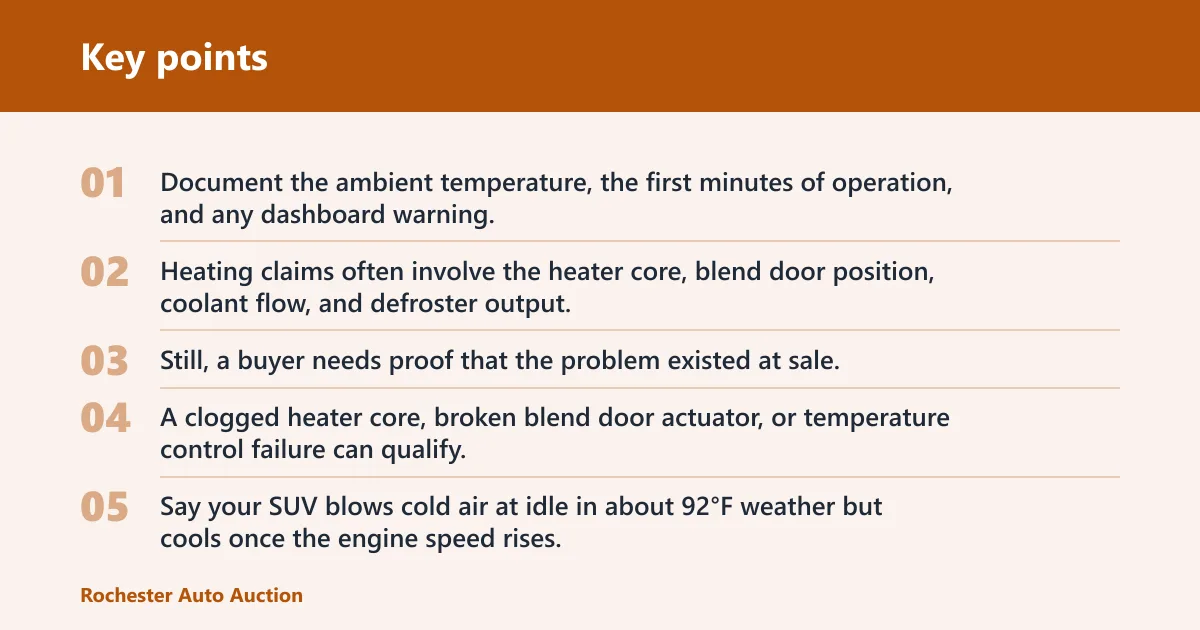
Document the ambient temperature, the first minutes of operation, and any dashboard warning. If the system cools only after extended driving or only at highway speed, that detail matters because it can point to low charge, weak condenser performance, or intermittent control failure.
Winter heat and defroster complaints
Heating claims often involve the heater core, blend door position, coolant flow, and defroster output. A cabin that never warms, or a defroster that does not clear the glass, can be more than a comfort issue when cold weather makes the failure obvious and repeatable.
Still, a buyer needs proof that the problem existed at sale. A clogged heater core, broken blend door actuator, or temperature control failure can qualify. A complaint that the car felt cold during one brief trip may fail if the auction can point to normal operation, incomplete warm-up, or a disclosure that winter function was not verified.
When a climate control issue looks minor but still matters
Small symptoms can point to larger failures. A weak stream from the vents, delayed heat, or A/C that works only intermittently may look inconvenient rather than serious, but the question is whether the defect materially impairs use, value, or safety under the auction’s rules.
Say your SUV blows cold air at idle in about 92°F weather but cools once the engine speed rises. That pattern can support a condenser or fan-related complaint if you can show the same behavior on multiple attempts, not just during one short drive.
What counts as a cold-start defect?
A cold-start complaint focuses on what happens when the engine has sat long enough to cool down. If the starter drags, the battery voltage drops, the engine misfires on the first crank, or it stalls only at initial start, the claim may turn on whether the condition appears at the same ambient temperature and under the same first-start conditions.
Battery, starter, and fuel delivery symptoms
Cold weather can expose weak battery capacity, high starter load, or marginal fuel delivery. Those failures may be real defects, but arbitration usually needs more than a general statement that the car “starts rough in the morning.” The buyer should show whether the symptom is repeatable, whether codes are stored, and whether the failure appears before the engine warms.
Initial misfire, rough idle, and stall on first start
A misfire code on the first start, followed by normal running after warm-up, can still matter. It may point to ignition, fuel, air, or sensor problems that are hidden once the engine stabilizes. The key is to capture the first-start condition, because a later restart can mask the fault and make the problem look intermittent or minor.
Picture a sedan that cranks slowly at about 18°F, fires on the second attempt, then runs normally. If the battery tests weak and the same cold-start failure repeats the next morning, the claim is stronger than a one-time no-start after a single short stop.
Why first-start temperature can change the diagnosis
Temperature changes the load, the symptom, and sometimes the diagnosis. A fault that appears only at 20°F may involve battery capacity or fuel atomization. The same vehicle may start normally at 55°F. That difference does not erase the defect; it means the evidence must tie the failure to the first cold start rather than to a random stall after the engine was already warm.
Seasonality claim checklist
This checklist ties the symptom to proof and to the most common reason the claim fails. Use it before filing, because seasonal cases often collapse when the symptom is not documented under the same conditions that exposed it.
| Symptom | Ambient temperature threshold | First-start or cold-soak requirement | What evidence proves it | Likely covered vs excluded outcome | Who bears the proof burden if the announcement says A/C not tested or as-is | Most common reason the claim fails |
|---|---|---|---|---|---|---|
| A/C | Heat enough to load the compressor and condenser | Not usually a cold-soak issue; best shown on the first hot start after the vehicle has sat | Ambient temperature at failure, compressor engagement status, refrigerant charge evidence, blower operation, dashboard photos or video, technician notes, and any codes related to HVAC control or pressure issues | Likely covered when the system will not cool because of a defect; likely excluded when the complaint is only comfort, wear, or an announced untested system | The buyer usually carries the burden to show a real defect at sale, not just an untested or disclosed condition | The claim is filed after the deadline, the system was not reproducible in summer conditions, or the auction note said AC was not tested |
| Heater | Cold enough to require cabin heat and defroster output | Often requires a cold-soak or first-start check after the vehicle has sat | Cold ambient temperature, first-start cabin temperature, heater core flow evidence, blend door function, defroster output, repair order, and repeatable complaint on more than one cold start | Likely covered when heat is absent because of a defect; likely excluded when it is merely normal cold-weather discomfort or not verified at sale | The buyer usually bears the burden to prove the failure existed at sale despite any disclosure that winter function was not tested | The issue is treated as normal cold-weather discomfort, or the buyer cannot show failed heat at point of sale |
| Cold-start | Cold enough for the vehicle to sit and cool down fully | Yes; the strongest proof is an overnight or similar cold-soak first start | Engine starts when cold, battery load test, starter draw or cranking behavior, fuel delivery or misfire codes, ambient temperature at first start, and video of the initial crank | Likely covered when the defect is repeatable on the first cold start; likely excluded when the problem only appears after later use or cannot be tied to sale | The buyer usually bears the burden to connect the symptom to a pre-sale defect and to the stated filing window | The vehicle starts normally once warm, the symptom cannot be reproduced in the same season, or post-sale transport or storage conditions muddy causation |
What evidence do you need?
The strongest seasonal claims connect the symptom to the exact conditions under which it failed. That means ambient temperature, first-start conditions, codes, and repair records, plus proof that the same problem can be repeated without changing the vehicle’s condition in the meantime.
- Record the temperature. Note the outdoor temperature at the time of failure, along with whether the vehicle was cold-soaked, heat-soaked, or recently driven. That context helps show why the symptom appeared then and not earlier.
- Capture the first failure. Photograph or video the dash warnings, vent output, cranking speed, or no-start condition before any reset or repair. The first failure is often the best proof because it shows the vehicle in the state that triggered the complaint.
- Keep the repair order. Ask the technician to describe the complaint, the codes pulled, and the test conditions used. A repair order that says only “could not duplicate” often does less for a seasonal claim than one with temperature, code, and symptom details.
- Match the symptom to season. Re-test under similar weather if the auction rules allow it. Repeatability in the same season can help show the issue is real, while a one-off failure in different weather may be treated as timing rather than defect.
Diagnostic codes, technician notes, and repair orders
Codes matter when they connect to the claimed defect, such as HVAC control faults, misfire codes, battery or charging issues, or communication errors that affect climate control. Technician notes matter because they document what was checked, what failed, and whether the symptom could be duplicated under the same conditions.
Photos or video that capture the failure
Video can be especially useful for seasonal claims because it preserves the sound of cranking, the vent behavior, the lack of heat, or the dashboard warning at the moment of failure. Still images help too, especially when they show the outside temperature, instrument cluster, or defroster setting at the time of the complaint.
When seasonal claims fail
Seasonal claims often fail for procedural reasons, not because the complaint was imaginary. The most common problems are late filing, weak documentation, a symptom that cannot be reproduced in the same season, or a disclosure that already warned the buyer the system was untested or sold as-is.
Claim filed outside the window
If the filing window has closed, the arbitration process may end before the buyer reaches the merit of the complaint. That is why delivery date, pickup date, and notification cutoff must be tracked from day one, especially when a buyer waits for hotter or colder weather to prove the defect.
Symptom not reproducible in the same season
A claim can fail when the buyer cannot show the fault under the conditions that supposedly trigger it. If A/C only fails in extreme heat, heater complaints only appear in freezing weather, or cold-start issues only happen after an overnight soak, the proof has to match that season and those conditions.
Disclosure, wear, or post-sale damage
Announcements can narrow or defeat a claim, especially when they say AC not tested, winterization notes were given, or the vehicle was sold as-is. Claims also fail when the condition looks like ordinary wear, or when transport damage, storage issues, or later repair work break the chain between sale and failure.
A common first-timer mistake is assuming that a car that ran at the gate must be defect-free. Gate function only shows the vehicle moved that day. It does not answer whether the compressor, heater core, or cold-start system was already weak, especially if the relevant weather had not arrived yet.
Frequently asked questions
Does hot or cold weather change whether an A/C, heater, or cold-start issue qualifies for arbitration?
Yes, but only as part of the proof. Heat or cold can make a defect visible, repeatable, and easier to document. Arbitration still turns on the auction’s rules, the filing deadline, and evidence that the problem existed at sale or fits a covered defect category.
How do auction arbitration rules treat seasonal defects that only show up in winter or summer?
They are treated like any other claim, but proof is harder when the symptom appears only in one season. The buyer usually needs repeatable evidence, timely notice, and records that connect the fault to a pre-sale condition rather than to weather, delay, or later damage.
What proof do I need if the vehicle only fails to start when it is cold?
Collect ambient temperature, first-start video, battery or starter test results, diagnostic codes, and repair notes that describe the cold-start failure. A claim is stronger when the same no-start, misfire, or rough-idle condition can be reproduced after an overnight soak or similar cold conditions.
Can a buyer file arbitration for A/C problems if the car was sold in mild weather?
Yes. Mild weather can hide an A/C defect, so the sale date alone does not defeat the claim. The buyer still has to show the problem existed at sale, document the compressor, refrigerant, blower, or condenser issue, and stay within the auction’s notice window.
How do inspection timing and mileage affect seasonal arbitration claims?
They can decide eligibility before the merits are reviewed. Many auctions require a quick inspection or notice period and may apply mileage thresholds tied to sale or delivery. A claim filed after those limits, or after the vehicle has been driven well beyond the allowed range, may be denied on procedure alone.
Do auction announcements or as-is disclosures override seasonal claims?
They can limit or defeat them, depending on the wording and the auction rules. Notes like as-is, AC not tested, or seasonal disclosure may shift the burden to the buyer and narrow what counts as a covered defect. The exact language matters as much as the symptom itself.