Auction Arbitration at Auto Auctions: Rules and Process
Byline: Jordan Reyes, automotive title and wholesale process writer
Policy interpretation disclaimer: This article explains common wholesale auto-auction arbitration rules for educational purposes, not legal advice. Actual outcomes depend on the specific auction’s written policies, announcements, invoice language, title status, sale format, and evidence file. When a house rule and a general industry standard conflict, the house rule usually controls that sale.
Methodology: The decision matrix below was built by comparing recurring dispute categories across auction house rules and industry arbitration standards, then mapping each issue to four practical questions: what starts the deadline, what proof usually satisfies review, what exclusion most often defeats the claim, and whether the usual remedy is an adjustment, cure period, return, or unwind. Thresholds are stated as “likely arbitrable” only where a claim typically has both a qualifying issue and timely supporting evidence.
Auction arbitration at auto auctions is a deadline-driven dispute process: you usually must report major title, odometer, condition, or announced-item issues within hours to a few days, and the claim survives only if it fits the sale policy and evidence standard. Miss the window or submit thin proof, and you can be left with transport, repair, title, or resale losses. This guide explains qualifying defects, filing deadlines, required evidence, who decides, and the likely remedies.
For dealers and auction staff, the practical question is rarely whether a problem feels serious. It is whether the issue is arbitrable under the house rules, whether the clock started at sale, pickup, or delivery, and whether the file proves an undisclosed defect rather than buyer inspection risk, wear, transport damage, or an announced exception.
What is auction arbitration?

Auction arbitration is a post-sale claim process used when a buyer, seller, and auction disagree over condition, disclosure, title, mileage, or paperwork after the transaction is complete. The case is judged under house rules, not general fairness alone, and the end point is usually a rejection, adjustment, return, or unwind. That framework tracks common industry language in National Auto Auction Association arbitration standards and individual auction terms of sale, which typically define what is arbitrable, who decides, and whether the house decision is final within the auction process.
Where it fits in a wholesale sale
Arbitration starts after the vehicle sale has already closed. It is commonly used in wholesale auto auctions, dealer-to-dealer sales, and online car auction platforms.
That timing matters. Arbitration is not a fresh negotiation. It is a rules-based review of whether the sold unit matched the disclosed terms, announcements, title status, and condition information that controlled the deal. NAAA-style arbitration policies and auction terms of sale generally treat the sale file, announcements, and invoice language as the governing record rather than later impressions of fairness.
What kinds of disputes it is built to handle
Buyer claims often focus on a disclosed-versus-delivered mismatch: damage not announced, a major mechanical defect missing from the file, mileage records that do not match, or title paperwork that arrives late or shows a different status than the sale listing. Title delay, missing documents, salvage or frame disclosure issues, and announcement conflicts also fit the workflow when house policy allows them. Those categories appear repeatedly in auction arbitration rules because they involve objective records such as title status, odometer disclosures, sale announcements, and condition disclosures.
Auction arbitration is narrower than court litigation and more structured than a phone call between dealers. The auction checks the file against sale terms that apply equally to all participants, then issues a ruling under those terms.
Typical outcomes
A typical workflow includes claim submission, condition report review, evidence collection, panel review, and final decision. The file can end in a denied claim, a price adjustment or repair allowance, or a returned vehicle and unwound sale, depending on what the evidence proves and what the policy permits. Those remedy types are consistent with common auction-house terms and NAAA-style arbitration frameworks, which usually distinguish between curable paperwork issues, monetary adjustments, and sale unwinds for material nondisclosure or title failure.
Some houses also use narrower remedies inside those buckets: a repair allowance, a price concession, a return of the unit, or a full unwind of the sale. The available remedy depends on policy, severity, proof, and whether the defect was announced. As one house-rule example, Frontline Auctions states that if title is not provided within its stated deadline, the buyer may choose to return the vehicle and unwind the sale; by contrast, smaller condition disputes are more commonly handled through review and possible adjustment rather than automatic return.
What can be arbitrated after an auction sale?
Claims usually survive review when they show a mismatch between what was disclosed at sale and what the buyer received, especially on title, mileage, major damage, branded history, and material mechanical defects. Claims usually fail when the issue was announced, falls under as-is risk, or cannot be tied to pre-sale condition.
Disclosure and announcement conflicts
Announcements matter because they can narrow or remove claim rights. If a sale-day announcement disclosed frame damage, a salvage history, inoperable air conditioning, or a title problem, the buyer often loses the ability to arbitrate that same item later. That is not just custom; it is a common house-rule principle. Auctions and industry arbitration rules routinely treat oral or recorded announcements as controlling disclosures when they were made before the bid was accepted.
Do not treat the condition report as the only sale document. The report is one record in the file. The lane announcement, online listing note, arbitration light, title announcement, and invoice language can control arbitrability. In practical terms, the sale record hierarchy often works like this: if an announcement clearly discloses the issue, the later claim usually fails even where the condition report was silent.
Title, mileage, and documentation problems
Title cases are often strong when the file is clean and the deadline is missed. As a house-rule example, Frontline Auctions states that title delivery should occur “as soon as possible” and, if delayed, “within 30 days of sale.” Frontline Auctions also states that the buyer may return the vehicle if title is not provided within 30 days and the buyer elects to unwind under that policy. That is the kind of concrete title deadline that creates an arbitrable trigger.
Mileage disputes often turn on document quality. An odometer statement, auction invoice, dash photo, history record, and title paperwork must line up. If they do not, the claim has a clear paper trail. If they do, a later complaint is harder to sustain. This follows standard odometer-disclosure practice: the strongest claims are the ones that identify a documentary conflict, not just a suspicion.
Condition and mechanical issues that may qualify
Mechanical claims are fact-specific. A dead transmission, severe engine knock, or disclosed-versus-actual drivability gap may be arbitrable if policy allows post-sale mechanical review and the buyer preserves the vehicle before repairs. Many auction rules and arbitration guides expressly require the buyer to stop repairs and preserve the unit so the auction can inspect or verify the claimed pre-sale condition.
Condition issues are stronger when the defect is major, pre-existing, and visible in diagnostic records or photos but absent from the disclosure file. Minor wear, age-related seepage, cosmetic defects, and issues that a buyer could have found during the allowed inspection period are less likely to survive. That distinction tracks common “material versus ordinary wear” policy language in arbitration rules.
What as-is terms and policy exceptions usually exclude
As-is terms do real work. They usually push ordinary wear, expected age condition, many cosmetic flaws, and buyer-inspection responsibility back onto the buyer unless the problem crosses a stated policy threshold or conflicts with a clear disclosure duty. That is why auctions often pair “as-is” language with a shorter post-sale claim window and a narrower list of arbitrable defects.
A common first-timer mistake is filing a broad complaint that says only “runs rough” after buying an older unit under as-is terms. Without a diagnosis, timestamped evidence, and policy language that makes the issue arbitrable, the claim often dies before the seller even responds.
How does the arbitration process work step by step?
The workflow starts when the sale closes or when delivery occurs, depending on the auction’s rules. From that point, the buyer must preserve the vehicle, notify the auction, submit a complete claim, support it with evidence, and wait through review, response, inspection, and final ruling before making repairs or retail decisions.
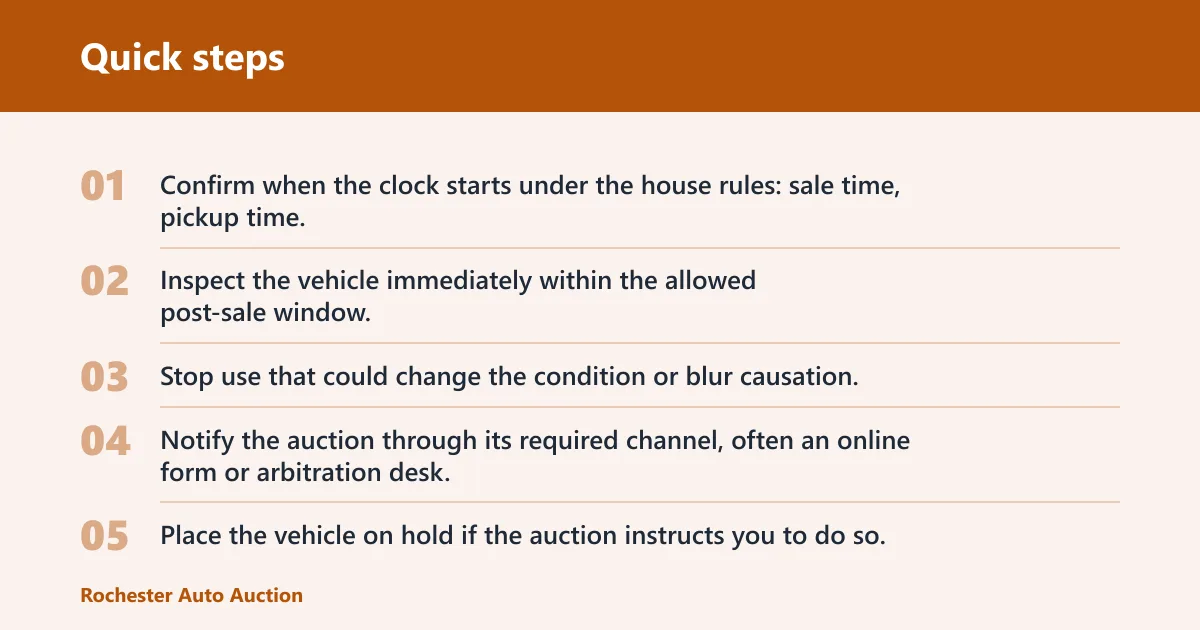
From sale or delivery to notice of claim
- Confirm when the clock starts under the house rules: sale time, pickup time, or delivery time.
- Inspect the vehicle immediately within the allowed post-sale window.
- Stop use that could change the condition or blur causation.
- Notify the auction through its required channel, often an online form or arbitration desk.
- Place the vehicle on hold if the auction instructs you to do so.
Frontline Auctions says a buyer can complete an online arbitration request form immediately after delivery. That is a useful house-rule example of how online transactions shift discovery timing away from the lane and toward the handoff point. If your auction uses online-only filing, the timestamp on that submission may be the key proof that the claim was opened before the deadline expired.
For buyers comparing formats, online claim filing after delivery is often the practical difference between a timely online dispute and a late lane-style complaint.
Building the file
Your evidence package should match the defect category. For physical damage, use wide and close photos with timestamps, transport check-in records, and a copy of the condition report. For mechanical issues, add scan results, fluid findings, and a qualified diagnosis that states the failure and why it appears pre-existing.
For title cases, include the invoice, title status shown at sale, title follow-up emails, shipping records, and any hold notices. For mileage cases, include odometer photos, title and reassignment paperwork, history documentation, and any inconsistency in the auction listing. For announcement disputes, include the archived listing note or title arbitration and announcement hierarchy record if the auction keeps one.
Seller response, inspection, and review
Once filed, the auction usually compares the buyer claim against the sale file, condition report, announcements, and policy rules. The seller may answer with prior disclosure records, a transport argument, or proof that the issue was already announced.
The auction may request a reinspection, outside mechanic statement, scan data, or more paperwork. If the vehicle has already been repaired or altered, the claim weakens fast because the auction cannot verify the original state. That preserve-the-vehicle rule appears in many auction arbitration policies because pre-decision repairs make causation and condition verification much harder.
Final ruling and remedy path
After review, the auction house or panel issues the arbitration decision. Some houses treat that ruling as final and binding under their terms of sale. The remedy may be no relief, a price adjustment, a repair allowance, a return, or a full unwind. Auctions often reserve unwind for material title defects, odometer issues, major structural nondisclosure, or other conditions the policy treats as sale-changing rather than minor-value disputes.
The same source says that in rare cases of excessive repairs, the vehicle is returned to the seller. Severe title failure can also end in unwind, while smaller disclosure gaps may end in a credit rather than a return. Those remedy tiers are more useful than a vague “case-by-case” answer because they show how policy usually scales relief to severity.
Suppose an online buyer receives a crossover with a clean condition report but finds a clear frame disclosure on an archived announcement screenshot from the sale listing. That single record can flip the case from “possible structural nondisclosure” to “claim denied because it was announced.”
How long do you have to file a claim?
The filing deadline depends on the auction’s claim submission window, and that is different from the broader arbitration period used to review and decide the case. The key point is simple: your claim must be opened before the window closes, even if the auction’s final ruling comes later.
Claim submission window versus arbitration period
The claim submission window is the deadline to report the problem. The arbitration period is the time the auction typically uses to review documents, ask for responses, inspect the unit, and issue a ruling.
Competitors often blur those two concepts. They are not the same. You can file on time and still wait days or weeks for a decision, or you can file late and lose even if the defect later proves real. When comparing sources, treat a filing deadline as a buyer obligation and a review period as the auction’s internal processing target.
What starts the clock
In-lane purchases often start the clock at sale because the buyer generally had a chance to inspect before bidding. Online purchases may start at delivery because the buyer could not physically inspect the unit before transport. Title-only or document-driven sales can use title receipt or title due dates as the controlling trigger. Those trigger points appear repeatedly in auction terms because discovery risk differs by sale format.
Read the exact trigger in the house policy. If the policy says delivery starts the window, keep the bill of lading, arrival photos, and receiving timestamp. If it says sale starts the window, same-day or next-day review becomes part of your process. For announcement-heavy disputes, keep the sale-day record too, because the buyer may need to prove what was or was not disclosed at the trigger moment.
How long review can take?
Review timing is often described as a processing goal rather than a buyer deadline. As an example, Reconcash says many settlements are processed within 7 to 30 days depending on complexity and policy, while Frontline Auctions says it aims to complete arbitration in 3 days. Those are operational timelines, not universal legal standards, so the controlling source is still the auction’s own written policy.
Those figures show why dealers should separate filing discipline from cash-flow expectations. A claim may be opened quickly but still tie up transport planning, flooring, title release, recon scheduling, and resale timing while the auction works the file.
Late-filed claims and narrow exceptions
Late claims are commonly denied unless the house rules create a specific exception, such as a title deadline breach that matures later than ordinary condition disputes. Even then, the file needs clean timestamps and documentation. Title policies are the most common example because the breach may not exist until the seller or auction misses the title-delivery deadline.
Picture a buyer who waits to report missing keys until after recon starts and a locksmith invoice is already paid. If the policy required immediate notice and prohibited repairs before review, the late report and changed condition both work against recovery.
What proof makes a claim survive review?
The best proof is the evidence that directly answers the policy question in dispute: what was disclosed, what was delivered, when the issue was found, and whether it likely existed at sale. Strong claims connect the condition report, announcements, timestamps, diagnostics, and paperwork into one consistent record.
The condition report and announcement record
The condition report is the baseline comparison tool. It helps the auction measure disclosed condition against actual condition, but it is not a blanket warranty that every system was fully inspected.
Use it carefully. If the report notes paintwork on the left quarter and the buyer later claims undisclosed refinishing in that same area, the report may weaken the claim. If the report is silent on structural damage and the announcement log is also silent, the buyer position is stronger. In many houses, the best proof set is the condition report plus the announcement record plus intake photos, not any one item by itself.
Evidence types that carry the most weight
- Timestamped photos and intake video: best for body damage, warning lights, missing equipment, and immediate delivery-condition disputes.
- Qualified mechanic findings: strongest for engine, transmission, drivability, and safety-system faults that are not obvious from photos.
- Scan reports: useful for emissions, module communication faults, and stored failure data when taken before repairs.
- Title paperwork: required for title delay, title status mismatch, reassignment gaps, and branding conflicts.
- Odometer and history documents: central to mileage disputes and disclosure mismatch cases.
- Transport receipts and check-in sheets: often decisive when the seller argues damage happened after the sale.
- Announcement records: can win or kill a claim faster than any photo set.
Evidence standards by issue type
Title delay claims rise or fall on paperwork and date stamps. Mileage disputes need matching or conflicting odometer, title, and history records. Mechanical claims often need a diagnosis that explains the defect itself, not just the symptom.
Undisclosed damage cases do best when the buyer can show clean pickup or delivery intake records and immediate reporting. Missing-item claims, such as keys or manuals, usually need proof that the listing or announcement promised those items and that they were absent at handoff. Structural-history claims usually need an inspection report tied to the vehicle identification number plus the sale disclosures and announcement log.
Mistakes that sink good claims
The repeat failure points are predictable: filing after the window closes, repairing before inspection, sending only a repair estimate without diagnosis, omitting delivery timestamps, and ignoring announcements that already disclosed the issue.
Weak causation is another common problem. If the vehicle traveled a long distance after sale and the file cannot separate pre-sale defects from transport damage or post-sale use, the auction has room to deny. That is why immediate intake evidence and no-repair preservation are policy-critical, not just best practices.
Arbitration decision matrix

Auction arbitration at auto decision table
| Issue type | Likely arbitrable status | Deadline trigger | Required proof | Common denial reason | Likely outcome path |
|---|---|---|---|---|---|
| Undisclosed body damage | Likely arbitrable if reported immediately at pickup/delivery or within the house’s short post-sale window, and no announcement disclosed it; likely not arbitrable if first raised after transport, recon, or buyer use | Usually pickup or delivery intake for online/transported units; sometimes sale time for in-lane purchases | Delivery photos, condition report, transport intake sheet | Damage could have occurred after sale or during transport | Adjustment or denial |
| Mileage discrepancy | Usually arbitrable where title, odometer disclosure, dash photo, invoice, or history record conflict; less likely if all records match and the buyer has no documentary inconsistency | Triggered when the documentary mismatch is discovered, often at title review or delivery paperwork intake | Odometer photo, title papers, history record, invoice | Records actually match or buyer lacks source documents | Unwind, adjustment, or denial |
| Title delay | Usually arbitrable under title policy once the stated title deadline passes; not arbitrable before the cure period expires | Title due date under house policy; example: Frontline Auctions states title should be provided within 30 days of sale | Invoice, title status at sale, follow-up records, due-date timeline | Policy deadline not yet reached or buyer lacks timeline proof | Hold, unwind, or denial |
| Missing keys | Sometimes arbitrable if keys were expressly announced or listed and the issue is reported at handoff; usually not arbitrable if keys were not promised or notice came late | Immediate handoff, pickup, or delivery receipt | Listing promise, announcement record, delivery receipt | Keys were never promised or issue reported late | Small adjustment or denial |
| Undisclosed frame damage | Likely arbitrable if the structure issue is material, unannounced, and confirmed by inspection; likely not arbitrable if it was announced or visibly disclosed in the file | Sale file review plus immediate post-delivery inspection | Inspection report, photos, condition report, announcement log | Frame issue was announced or visible in disclosures | Return, unwind, or denial |
| Salvage or branded history mismatch | Often arbitrable where the title brand or history conflicts with the sale listing or invoice; usually not arbitrable where the brand was clearly disclosed before sale | Triggered by title packet review or history/title comparison | Title documents, history record, sale listing, invoice | Brand was disclosed before sale | Unwind or denial |
| Major mechanical defect | Case-specific, but more likely arbitrable if the defect is material, promptly reported, and diagnosed before repair; less likely under as-is terms without proof it predated sale | Usually immediate post-sale or post-delivery discovery window stated by the house | Qualified diagnosis, scan report, fluid findings, immediate notice | As-is exclusion, buyer repaired first, or no proof defect predated sale | Adjustment, return, or denial |
| Announcement conflict | Usually arbitrable if the buyer can show a real conflict between recorded announcements, listing notes, and invoice language; not arbitrable if there is no reliable sale record | Sale-day record review, often as soon as the discrepancy is discovered | Recorded announcement, listing archive, invoice language | No reliable record of the alleged announcement | Correction, adjustment, or denial |
| Missing documents or reassignment gap | Usually arbitrable once the title packet is due and remains incomplete; not arbitrable where the gap was caused by the buyer’s own internal handling | Document due date or title packet receipt review | Title packet, bill of sale, reassignment chain, notice to auction | Buyer has incomplete packet because of internal handling error | Cure period, unwind, or denial |
| Undocumented transport damage | Often not arbitrable against seller unless the buyer can show the damage existed before carrier pickup; more often a carrier issue than a sale-file issue | Pickup and delivery inspection comparison | Pickup photos, carrier inspection forms, delivery photos | No proof damage existed before transport | Denial or carrier claim |
| Emission or warning-light fault | Sometimes arbitrable if captured immediately with scans and no repairs; usually not arbitrable if codes were cleared, the issue appeared later, or policy excludes it | Immediate startup or delivery inspection period | Immediate scan, dash photos, diagnosis, no-repair preservation | Codes cleared after sale or issue falls under policy exclusion | Adjustment or denial |
| Equipment missing from listing | Sometimes arbitrable where the equipment was specifically promised and absence is documented at handoff; less likely if the omission was obvious or the listing made no guarantee | Pickup or delivery handoff inspection | Listing copy, photos, delivery receipt, announcement record | Equipment not guaranteed or omission was obvious at inspection | Adjustment or denial |
Who decides the outcome, and what happens next?
The ruling usually comes from auction arbitration staff, a manager, or a panel working under the house rules. While the case is pending, the vehicle may be placed on hold, funding may pause, title may be withheld, and storage or transport issues can add cost even before the decision arrives.
Decision makers and finality
Some auctions route straightforward matters to staff. Larger disputes, structural issues, title failures, or policy exceptions may go to supervisors or a panel review. The terms of selling vehicles at ascending price auction are set for all participants, so the same written rules should control the review.
Under many house policies, the arbitration decision is final and binding within the auction process. That does not turn it into court arbitration, but it does mean the practical route for relief is usually the house process itself, not endless dealer-to-dealer debate. Where the policy uses “final” language, read that as final inside the auction system unless another contract right expressly applies.
Operational friction while a claim is pending
Pending cases create real cost. The unit may sit in storage, transport may be paused, title may remain on hold, and floorplan or funding timing may slip while the file is open.
That is why fast notice matters even when the buyer still needs a diagnosis. A short, timely notice preserves the claim window. The supporting file can then be completed inside the review process if the house rules allow it. If the house requires all documents at filing, that stricter rule controls, so the buyer should confirm procedure before repairs or resale.
When severe defects lead to return or unwind
Return is most likely when the defect is material, unannounced, well documented, and hard to cure with a modest credit. Structural history mismatch, title failure, mileage problems, and major mechanical breakdowns are the usual candidates.
By contrast, a smaller body repair, missing accessory, or single-condition discrepancy may end in an adjustment. The house looks at severity, proof quality, and whether the issue changes the vehicle’s value or sale eligibility enough to justify unwinding the deal. That is consistent with the remedy ladder used in many auction rules: denial for nonqualifying claims, adjustment for curable value differences, and unwind for sale-changing defects.
How do lane, online, and title-only sales change the rules?
Sale format changes both the buyer’s inspection chance and the moment a defect can reasonably be discovered. Lane buyers usually carry more immediate inspection responsibility, online buyers often rely more on delivery-condition timing, and title-only transactions shift the focus from mechanical condition to documents and deadline compliance.
Lane sales
In-lane buyers typically have the earliest clock because they had some chance to view or inspect before bidding. Visible defects, obvious announcements, and known as-is risks are harder to arbitrate after the hammer falls.
That does not remove claim rights for hidden issues, mileage conflicts, or title failures. It does mean the buyer should inspect fast and document the file before the unit leaves the auction or arrives at the store. In lane environments, a same-day review culture is often the practical way to avoid blowing the post-sale window.
Online sales
Online buyers often gain stronger arguments on delivery-timed issues because condition discovery begins when the vehicle arrives. Receiving photos, transporter inspection forms, and the exact delivery timestamp become central pieces of evidence.
If the platform allows immediate online filing after delivery, use it. That record can separate a clean, timely claim from a late complaint that looks like post-delivery wear or transport damage. For process details, see online claim filing after delivery.
Title-only and document-driven sales
Title-only disputes center on paperwork, branding, reassignment chain, and deadline compliance rather than drivability. The buyer should preserve every document status notice and every date in the title chase.
Say your store buys a title-delayed unit for export inventory and the title status shown at sale does not match the packet received later. In that case, the strongest file is not a mechanic invoice. It is the invoice, title notes, reassignment pages, and date-stamped follow-up trail. If the dispute also turns on what was disclosed before bidding, the announcement hierarchy and title disclosure record may matter as much as the title packet itself.
Frequently asked questions
What is auction arbitration at an auto auction?
It is the auction’s post-sale dispute process for condition, disclosure, mileage, title, and paperwork problems after the transaction closes. The case is decided under house rules and sale records, with possible outcomes such as denial, adjustment, return, or unwind depending on proof and policy.
What issues are not covered by auction arbitration?
Common exclusions include announced defects, many as-is risks, ordinary wear, visible cosmetic issues, late-filed claims, repaired-before-review vehicles, and damage that cannot be separated from transport or post-sale use. The sale format and the auction’s written policy usually decide the exact boundary line.
Do auction announcements override arbitration rules?
Announcements often control whether a claim is eligible in the first place. They do not erase all auction rules, but they can defeat a buyer claim by proving that the disputed issue was disclosed before sale, even when the condition report alone appears silent or incomplete.
What happens after I file an arbitration claim?
The auction typically logs the case, reviews the condition report and announcements, asks for supporting evidence, may request seller input or inspection, and then issues a ruling. During that time, the vehicle may be held from resale, repair, funding, or title release until the file is resolved.
Who decides the arbitration outcome?
The decision usually comes from auction arbitration staff, a manager, or a review panel under house rules. Straightforward claims may be handled administratively, while larger title, structure, or severe mechanical disputes may receive a deeper review before the auction issues a final internal ruling.
Can a vehicle be returned if the issue is severe?
Yes, but return is usually reserved for material defects with strong proof, such as serious title failure, mileage problems, undisclosed structural history, or major repair exposure that policy treats as arbitrable. Smaller issues more often end in a pricing adjustment or repair allowance instead of a full unwind.
Does an online sale give me more time to arbitrate?
Not automatically. Online sales often change the deadline trigger from sale time to delivery time, but the actual window can still be very short. The controlling question is not whether the sale was online; it is what the house rule says starts the clock and how quickly the buyer must open the claim once the vehicle is received.
Can I repair the vehicle before the auction inspects it?
Usually you should not, unless the auction expressly authorizes limited emergency work. Many arbitration rules require the buyer to preserve the vehicle in post-delivery condition so the auction or seller can inspect it. Unauthorized repairs often weaken causation and can be an independent basis for denial.
What is the fastest way to strengthen a claim on day one?
Open the claim inside the deadline, stop repairs, photograph the vehicle at intake, save the sale listing and announcement record, and gather the matching documents for that issue type. For online units, the delivery timestamp and immediate filing record are often just as important as the defect photos themselves.
Sources
- National Auto Auction Association (NAAA) arbitration standards and title arbitration guidance, used here for general industry categories, finality concepts, and common arbitrable issue types.
- Frontline Auctions house-rule examples cited in text, including statements that title should be delivered “as soon as possible” or “within 30 days of sale,” that a buyer may return the vehicle if title is not provided within 30 days and the buyer elects unwind, and that the auction aims to complete arbitration in 3 days.
- Frontline Auctions online arbitration workflow example cited in text, stating that buyers may complete an online arbitration request form after delivery.
- Reconcash timing example cited in text for noncontrolling settlement-processing ranges of 7 to 30 days depending on complexity and policy.
- Announcements matter for how sale-day disclosures can control arbitrability.
- online arbitration request form for how online auction workflows affect delivery timing and notice.