How to Fill Out a Car Auction Consignment Form
A car auction consignment form lets the auction list and sell your vehicle for you. It records the seller, the vehicle, title status, condition, and sale terms, so the office can catalog the car, disclose known issues, and settle the sale correctly.
This is not a buyer registration form. Buyer paperwork identifies who may bid and how payment will be handled; consignment paperwork gives the auction permission to act for the seller, subject to the agreement you sign.
What a consignment form does
What you should have ready before you start
- The vehicle title or other ownership paperwork.
- Your full legal name, mailing address, phone number, and email.
- Business tax details if the seller is a company or dealership.
- Photos of the vehicle, if the auction asks for them.
- Insurance papers or settlement forms, if the auction requires them.
- Any W-9 or W-8 form needed for payout processing.
- Odometer and VIN access so you can copy them exactly.
What you’ll need before you start
Gather the title, seller contact details, vehicle identifiers, and any attachments before you open the form. Missing paperwork slows intake because the office may need to verify ownership, confirm a lien release, or return the submission for correction.
If the form is online, save digital copies of the title front and back, plus clear photos. If it is paper, keep every page in front of you before you begin. That reduces transposed VIN digits, missing signatures, and follow-up calls.
Fill in seller information
Enter the seller’s full legal name exactly as the form asks, then add the mailing address, phone number, and email address. If the seller is a business, mark that status exactly as shown on the form and use the business name that should appear on settlement paperwork.
How to complete this section in order
- Enter the full legal name first.
- Fill in the street address, city, state, and ZIP code.
- Enter a phone number that reaches the person who can answer title or pickup questions.
- Add an email address used for confirmations and corrections.
- Select individual or business exactly as the form instructs.
A name mismatch here can create payout delays later. If the title lists a trust, estate, company, or co-owner, the seller line must match the authority to sell, not a nickname or shorthand.
Where do I find the VIN, mileage, and title details on the form?
The vehicle section usually follows seller information and asks for year, make, model, color, VIN, and mileage. The VIN comes from the dash plate, driver-side door label, registration documents, or the title itself. Mileage should match the odometer reading the form requests, unless the form asks for an exemption or not-actual-mileage disclosure.
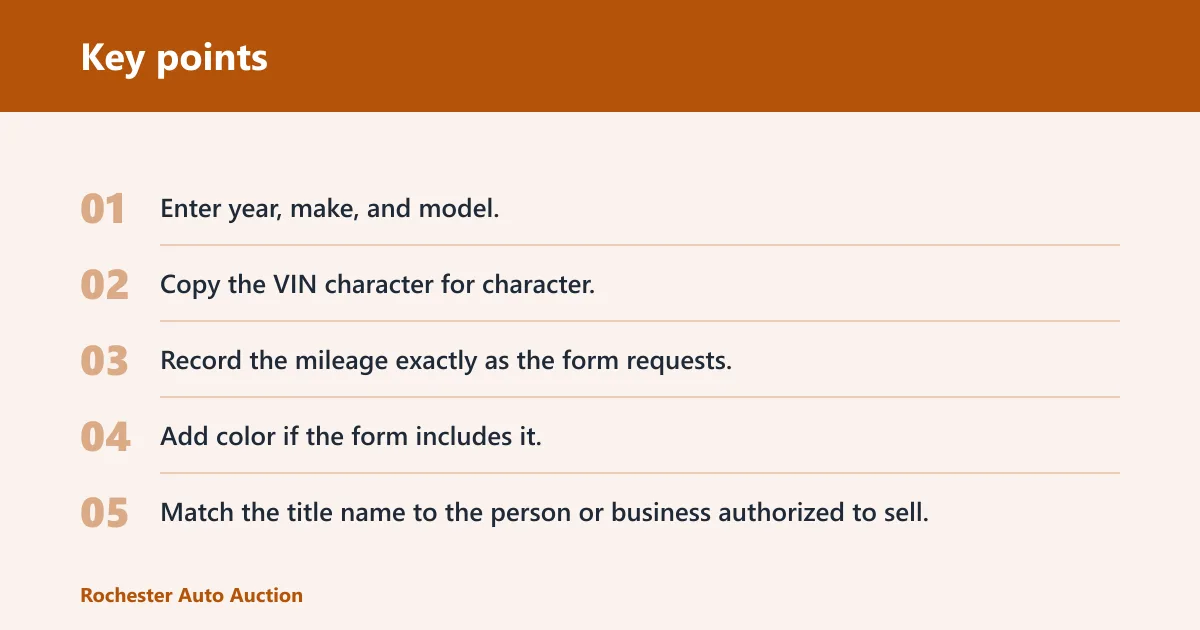
For title details, copy the owner name exactly as printed on the title, note whether a lien is listed, and indicate whether the title is included with submission. The IAA Vehicle Consignment Form includes vehicle details such as make, model, year, VIN, and mileage, and it also requires the seller’s contact information for communication.
Use the same sequence the office uses
- Enter year, make, and model.
- Copy the VIN character for character.
- Record the mileage exactly as the form requests.
- Add color if the form includes it.
- Match the title name to the person or business authorized to sell.
Say your title shows “Gray 4-door sedan” but the form says “blue coupe” because someone guessed from memory. Cataloging staff may flag the entry before listing, since the description no longer matches the ownership record or the vehicle inspection photos.
Do I need to list damage, airbags, or condition when I fill out the form?
Yes. List known damage, airbag status, mechanical issues, body condition, and any warning lights the form asks about. The IAA form includes condition checkboxes for the vehicle, which means the office expects disclosure in a structured way, not buried in comments.
Accurate condition disclosure helps prevent disputes after cataloging or sale. If the vehicle has deployed airbags, flood signs, structural damage, a check-engine light, or a non-running engine, those facts belong on the form. Omissions can lead to corrections, buyer complaints, or a settlement hold.
Common disclosure items that cause corrections
- Front-end or rear-end damage.
- Deployed or missing airbags.
- Mechanical problems that affect starting or driving.
- Body damage, dents, rust, or missing trim.
- Salvage branding or other title brand notes.
Suppose the car runs, but the airbag light stays on. Enter that fact where the condition section asks for warning lights or restraint-system issues. That single detail can change how the vehicle is described in the catalog and reduce post-sale arguments.
What should I review in the terms and conditions before signing?
Review commission, fees, reserve price, unsold-item policy, and the agency language before you sign. Those terms control how the auction may sell the vehicle, what you owe, whether a reserve applies, and what happens if the vehicle does not sell. The signature makes that agreement binding.
Look for the seller-agent relationship, sale authorization, fee responsibility, and transfer-of-ownership language. The form is not complete until you accept those terms, because the auction needs written authority to act for you.
Watch these clauses closely
- Commission rate or fee schedule.
- Reserve price rules, if reserve selling is allowed.
- Unsold-item pickup or relisting policy.
- Administrative charges tied to paperwork or storage.
- Who pays transfer, title, or processing costs.
Some forms are plain about reserve rules. The Auction Mill consignment form says items are sold without reserve, and it uses commission rates based on item value. It may also include extra fees for trash removal and online auctions.
How do reserve price and fee details affect the form I complete?
Reserve and fee terms change what you write in the pricing section and what the auction can do with the car. If a reserve is allowed, you must enter it exactly as the form requires. If the sale is no-reserve, leave reserve fields blank only when the form says so, not as a guess.
Fee details also affect settlement expectations. For example, ACE states vehicle consignments may carry separate fee structures, including 6% no reserve and 10% with reserve, and consignors are paid within 14 business days after cleared funds. ACE also requires a U.S. IRS Form W-9 or non-U.S. W-8 before settlement.
What documents should I attach with a vehicle consignment form?
Attach only the documents the auction asks for, but expect title evidence, photos, ID, and tax or settlement forms to come up often. The title is the central ownership document. Depending on the auction, you may also need a copy of your ID, insurance papers, or seller tax forms before the office will finalize settlement.
The Carlisle Collector Car Auction form asks for owner name and address first, includes vehicle information such as year, make, and model, and references a current vehicle title as required documentation.
Typical attachments by form type
- Front and back of the title, if requested.
- Photos of the vehicle, especially for online cataloging.
- Government ID, if the office needs identity verification.
- Insurance papers, if the auction asks for them.
- W-9 or W-8, if settlement requires tax documentation.
Who signs the auction consignment form and when is it legally binding?
The seller signs, or an authorized agent signs for the seller if the form allows that authority. The form becomes binding when the seller signs and dates it, because the signature confirms the seller understands the sale authorization, fee responsibility, and ownership-transfer terms.
Check the signature block for a legal acknowledgement, because that section usually states that the seller has authority to consign the vehicle and agrees to the auction’s terms. The form captures essential vehicle details and requires the seller’s signature.
What to verify before signing
- Read the full agreement, not only the signature line.
- Check that the vehicle details match the title.
- Confirm the reserve, fee, and unsold-item rules.
- Date the form on the actual signing day.
- Make sure the signer has legal authority to sell.
What happens if I leave a field blank or enter the wrong vehicle information?
Blank fields and wrong vehicle data usually trigger corrections, delays, or rejection. The most common problem is a mismatch between the form, the title, and the actual vehicle, especially for VIN, mileage, owner name, and title status. Offices often stop intake until those details are fixed.
A wrong VIN can misidentify the vehicle in cataloging. A wrong mileage entry can create settlement disputes later. A missing signature can make the form unusable. If the title name, lien status, or odometer reading does not match the supporting records, expect a follow-up request.
If that didn’t work, try this next
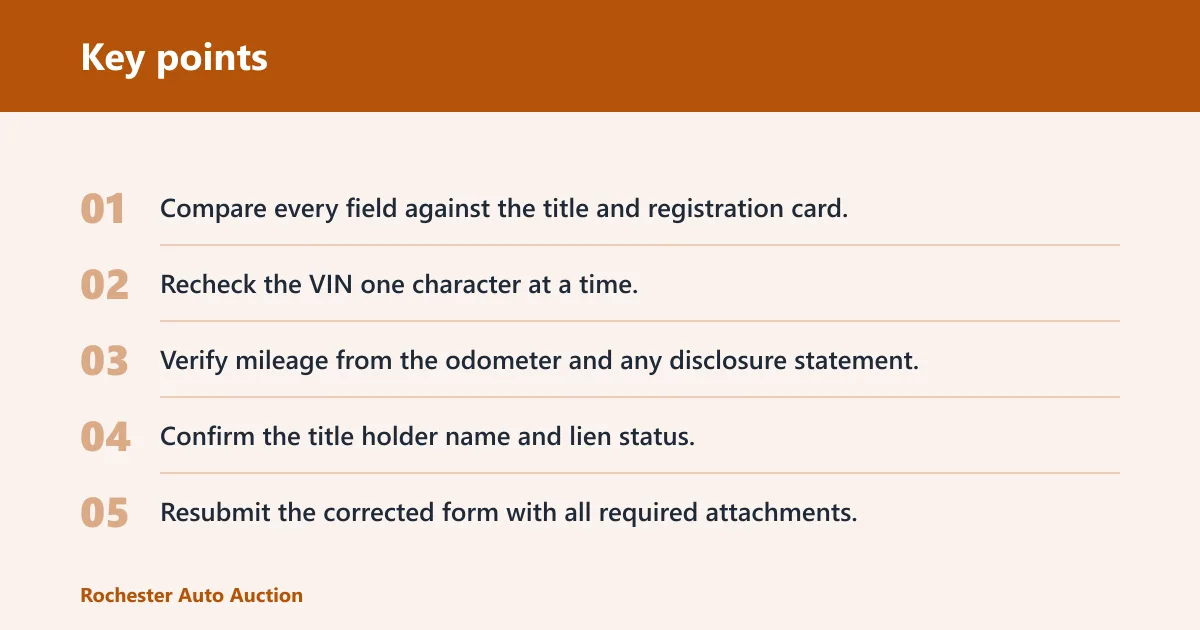
- Compare every field against the title and registration card.
- Recheck the VIN one character at a time.
- Verify mileage from the odometer and any disclosure statement.
- Confirm the title holder name and lien status.
- Resubmit the corrected form with all required attachments.
Common first-timer mistake: entering the VIN from memory after stepping away from the vehicle. One transposed character can force a manual correction and delay cataloging until the office confirms the right unit.
Can I fill out a car auction consignment form online instead of on paper?
Often, yes. Many auctions accept online completion or e-signing, which is useful when you need to submit attachments quickly. The IAA Vehicle Consignment Form can be submitted online through the Insurance Auto Auctions platform.
Online submission does not remove the need to verify the title, mileage, disclosures, and signature block. It only changes the delivery method. Paper forms still matter when the auction wants originals, wet signatures, or in-person review of ownership paperwork.
Submission methods to check
- Online form with e-signature, if available.
- Paper form delivered in person.
- Paper form sent by mail.
- Hybrid submission with scanned attachments first.
Check the deadline before you send anything. A complete form that arrives after the cutoff may be held for the next sale cycle, especially if the office needs title verification or tax forms before settlement.
Car consignment checklist table
Use this checklist in the same order an auction office expects to process the form. It separates what to enter from what usually goes wrong, so you can catch the items that most often create delays or rejected submissions.
| Form section | What to enter | Common mistake | Auction-office consequence |
|---|---|---|---|
| Seller information | Full legal name, mailing address, phone, email, individual or business status | Nickname, old address, or wrong entity type | Contact delay or payout mismatch |
| Vehicle identification | Year, make, model, color, VIN, mileage | Transposed VIN digit or guessed mileage | Catalog correction or intake hold |
| Title details | Name on title, lien status, whether the title is submitted | Leaving lien status blank | Ownership verification request |
| Condition disclosure | Damage, airbag status, mechanical issues, body condition, warning lights | Hiding known defects | Buyer dispute or disclosure correction |
| Terms and conditions | Commission, fees, reserve price, unsold-item rules, agency appointment | Signing without reading fee responsibility | Settlement dispute |
| Signature block | Seller signature, date, legal acknowledgement, authorization to sell | Unsigned or undated form | Form is not binding |
| Supporting documents | Title copies, photos, ID, insurance papers, W-9 or W-8 if needed | Missing attachment referenced by the office | Submission delayed |
Out car auction consignment checklist
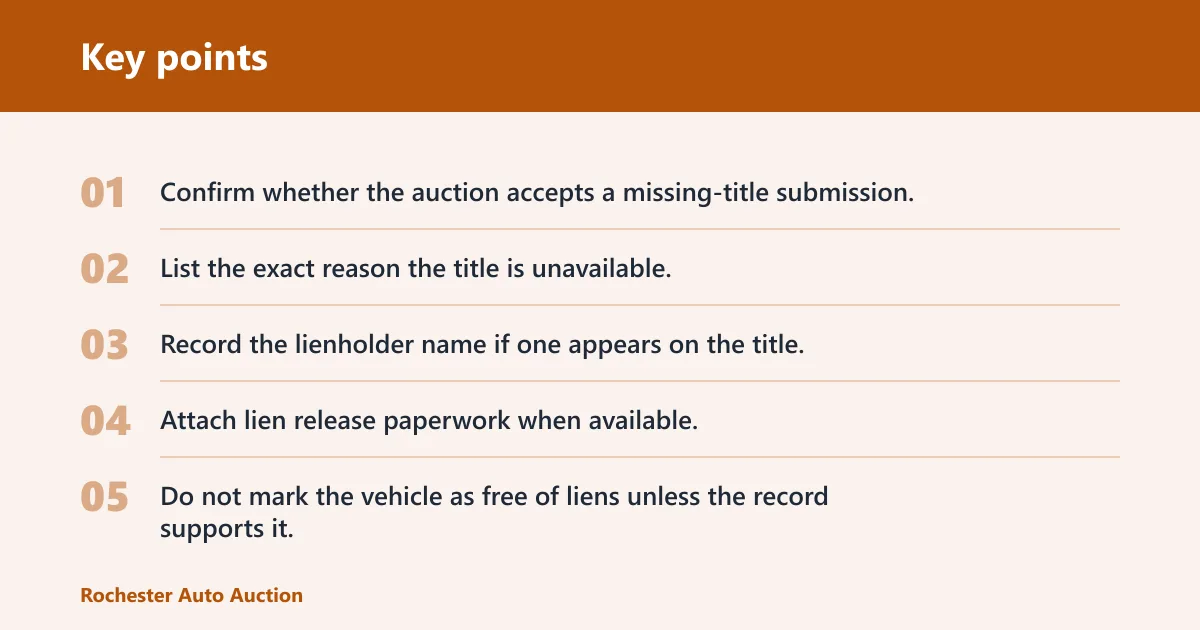
- Confirm whether the auction accepts a missing-title submission.
- List the exact reason the title is unavailable.
- Record the lienholder name if one appears on the title.
- Attach lien release paperwork when available.
- Do not mark the vehicle as free of liens unless the record supports it.
Common mistakes
Leaving a field blank is the fastest way to slow a submission. So is copying the wrong VIN, using a nickname instead of the legal name, or skipping a condition disclosure because the damage seems obvious. Auction staff use the form to catalog the vehicle, prepare disclosures, and settle funds, so incomplete records create avoidable work.
Another frequent error is treating every auction form as identical. Some forms require a title with the submission; others want it later. Some require tax forms before payout. Some allow reserve prices; others do not. Read the form line by line instead of assuming the same rules apply everywhere.
Quick pre-submission review
- Match the seller name to the title or authority to sell.
- Check the VIN, mileage, and year against the vehicle.
- Confirm title status and lienholder information.
- Verify all required attachments are included.
- Review fees, reserve, deadline, and signature fields once more.
Frequently asked questions
What information do I need before filling out a car auction consignment form?
You need the title or ownership paperwork, the seller’s legal name and contact details, the vehicle’s VIN and mileage, and any attachments the auction requests. If the seller is a business, have the business name and tax documents ready so the office can complete settlement without follow-up.
What is a consignment auction and how is this form different from a buyer registration form?
A consignment auction is a sale where the owner places a vehicle with the auction to sell on the owner’s behalf. The consignment form authorizes that sale. A buyer registration form only identifies the person who wants to bid and pay; it does not transfer selling authority.