How to Read a Vehicle History Report Before an Auction Bid
Read the title first, then damage, odometer, and open recalls. If the report shows salvage, flood, junk, or an odometer issue, it is usually safer to walk unless the lot is priced for parts. Bad reads lead to overbids, title problems, and repair costs that erase margin. This guide gives you a fast bid-or-walk method for vehicle history reports so you can act before the auction clock runs out.
Start with the fastest pre-bid scan
The fastest scan is not the most detailed one. It is the one that keeps you from bidding on a vehicle with a clear title problem, major damage, mileage conflict, open recall, theft note, or thin data where risk is hard to price.
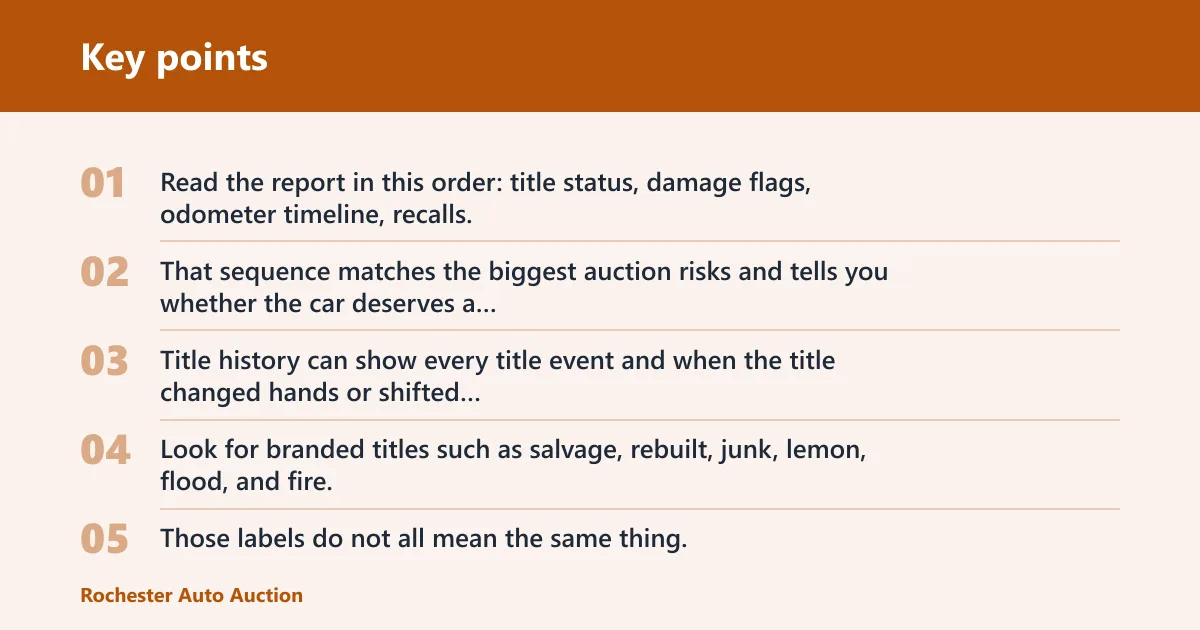
Read the report in this order: title status, damage flags, odometer timeline, recalls, theft, and missing records. That sequence matches the biggest auction risks and tells you whether the car deserves a bid, a cap bid, or a walk.
Check title status first
Title history can show every title event and when the title changed hands or shifted across states or regions. Look for branded titles such as salvage, rebuilt, junk, lemon, flood, and fire. Those labels do not all mean the same thing, and the jurisdiction trail matters as much as the label itself.
Scan for major damage and airbag flags
Accident entries may come from insurers, police, and inspection agencies, so a single report can carry more than one source. Read the severity level, then check whether the report also notes airbag deployment or structural issues. A light fender hit is not the same risk as a crash tied to frame or unibody damage.
Review mileage, recalls, and theft notes next
Mileage readings can be collected from inspections, services, auctions, and registrations. The system checks for suspicious mileage decreases or unusual jumps, which can point to rollback or bad data. Open recalls from the manufacturer or NHTSA matter too, and theft notes can change ownership and title risk fast.
Treat missing records as a risk signal
Missing maintenance or title data does not prove a problem, but it lowers trust in the report. If a vehicle has long gaps, stale entries, or a thin history, price it as a less certain buy and inspect it more closely before you commit.
What title history tells you
Title history is the first hard filter because it can expose branded status, state changes, and title movement that do not show up in a quick lot walk. A clean-looking exterior does not erase a salvage or flood trail.
Read branded title types correctly
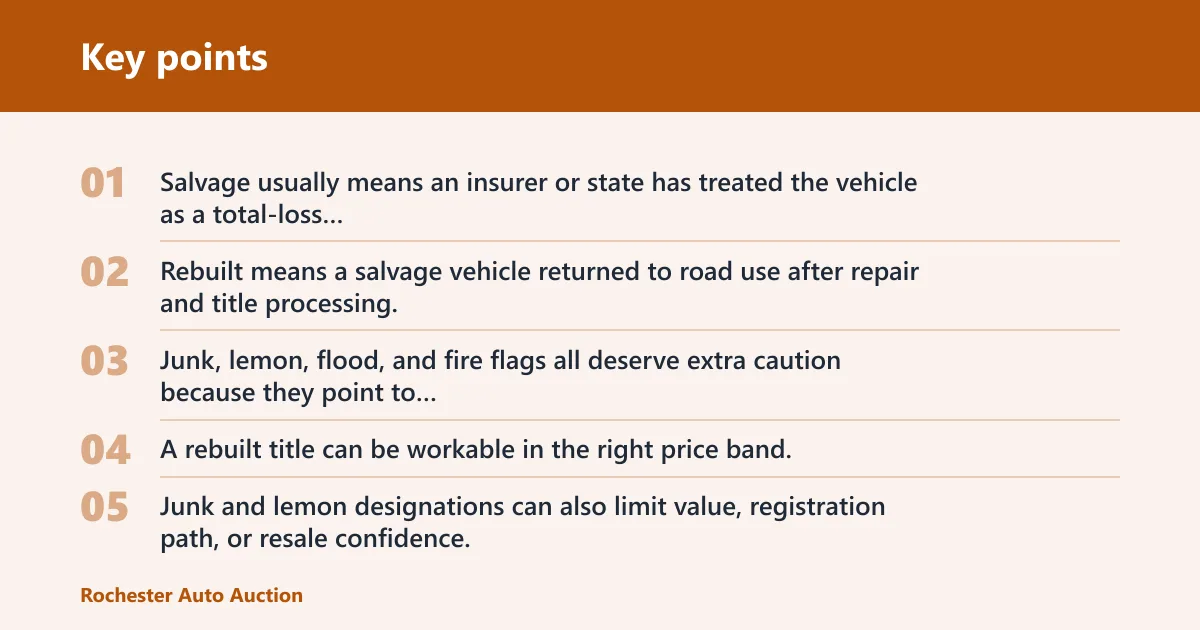
Salvage usually means an insurer or state has treated the vehicle as a total-loss candidate at some point. Rebuilt means a salvage vehicle returned to road use after repair and title processing. Junk, lemon, flood, and fire flags all deserve extra caution because they point to different but serious risk paths.
Do not treat every branded title the same. A rebuilt title can be workable in the right price band, while flood and fire history often create broad, hard-to-see damage. Junk and lemon designations can also limit value, registration path, or resale confidence.
Track title changes across states or regions
Title history can show when the title changed hands or shifted across states or regions. That matters because some buyers move a vehicle through different jurisdictions to change the paper trail or to process a brand in a new location. The move itself is not proof of fraud, but it is a reason to slow down.
Say a truck is branded salvage in one state, then later shows a rebuilt title in another region. That trail tells you the vehicle changed legal status, not just ownership. The right response is to read the entire timeline, not the newest title line by itself.
Why salvage, rebuilt, junk, lemon, flood, and fire matter
These brands affect more than resale. They can influence financing, registration, repair confidence, and who will buy the vehicle later. A branded title is a pricing event, not a free pass to assume the vehicle is sound.
Flood and fire deserve special attention because the damage may spread beyond the visible area. Electrical faults, corrosion, odor, and intermittent failures can stay hidden during a quick auction preview.
How bad is the damage record?
The damage record is serious when the source, severity, and repair clues point in the same direction. A minor incident with no airbag deployment is a different bidding problem from a high-severity event with structural notes or repeated claims.
Separate incident source from severity
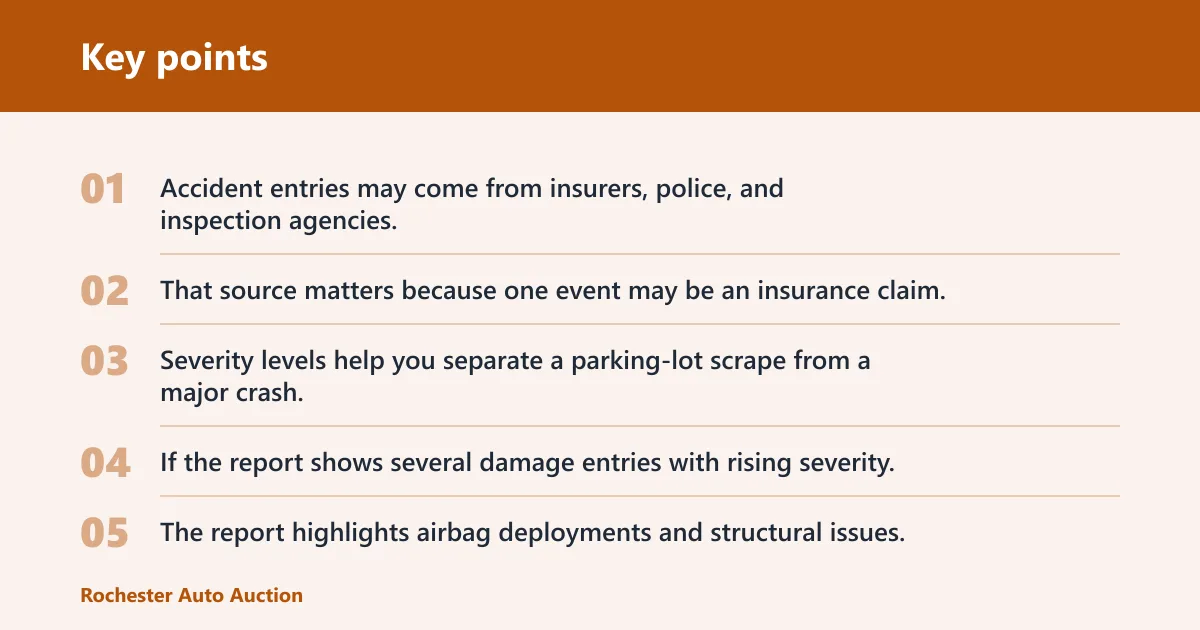
Accident entries may come from insurers, police, and inspection agencies. That source matters because one event may be an insurance claim, another may be a police report, and a third may come from a later inspection that saw visible evidence. Read source and severity together.
Severity levels help you separate a parking-lot scrape from a major crash. If the report shows several damage entries with rising severity, treat the vehicle as higher risk even if the exterior looks acceptable from ten feet away.
Read airbag deployment and structural damage together
The report highlights airbag deployments and structural issues. Those two items together are a stronger warning than either one alone. Airbags can deploy in crashes that also bend structure, and structural notes can indicate a repair path that is difficult to verify at auction.
A common first-timer mistake is to see “airbags deployed” and stop there. The better read is to ask whether the event also touched structure, whether repairs were documented, and whether the title later changed in a way that matches the damage history.
When a past crash should cap your bid
Use a cap bid when the report shows one major accident, moderate severity, and no structural or airbag flags, but the rest of the file is clean. Walk when the vehicle shows repeated severe accidents, airbag deployment with structural notes, or damage history that does not line up with the title trail.
What odometer changes should make you walk?
Use the mileage timeline, not a single reading. Walk when the report shows a clear decrease, a suspicious jump you cannot reconcile, or a pattern that makes annual use look impossible for the vehicle’s type and age.
Use the mileage timeline, not one reading
Mileage readings can be collected from inspections, services, auctions, and registrations. That gives you a timeline, not a snapshot. One reading can be stale, but a pattern of readings is harder to fake and easier to judge.
Spot rollback clues, jumps, and drops
The system checks for suspicious mileage decreases or unusual jumps. A decrease is the strongest alert because odometer rollback can change value, resale, and financing risk. Large jumps can be normal after a gap, but they need context from the record source.
Suppose a sedan shows about 84,120 miles at one service record and about 61,400 miles at a later auction entry; that is not a normal change. That is not a normal drift. It is a walk signal unless the file clearly proves a data entry error.
Compare annual usage for impossible patterns
Annual usage should make sense for the vehicle’s role. A taxi, fleet unit, or commercial van can rack up miles faster than a personal car. If the pattern shows long stretches of little use followed by a sudden leap, or repeated drops, do not assume the numbers are harmless.
Does ownership history matter?
Yes. Ownership history helps you judge wear, turnover, and how often the vehicle may have been passed along for a reason. A long list of short owners is a stronger warning than one long ownership period with steady records.
Count owners and ownership duration
Ownership records can show the number of prior owners and ownership duration. More owners do not automatically mean trouble, but quick turnover often means someone else decided not to keep the vehicle long. That is information worth pricing into the bid.
Read use type and registration locations
Ownership history can show whether a vehicle was personal, rental, fleet, commercial, taxi, or government use. Those categories matter because duty cycle, maintenance style, and wear can differ sharply. Registration locations also help you see whether the vehicle moved through areas with salt, flood exposure, or different title processes.
Why repeated transfers can raise auction risk
Repeated transfers can hide a chain of problems. A car that moves from owner to owner, then across states, can carry title events, auction entries, and missing paperwork that make its real condition harder to read. That does not force a walk, but it should tighten your cap bid.
Auction bid triage checklist
This checklist turns report signals into a bid, cap bid, inspect further, or walk decision. Use it before the lane or online close, then match the action to the weakest item in the file.
| report signal | what it may mean | auction risk level | action |
|---|---|---|---|
| salvage title | Prior total-loss path; value and resale risk | High | Inspect further |
| rebuilt title | Previously salvaged, repaired, and retitled | High | Cap bid |
| flood flag | Water exposure; hidden electrical or corrosion issues | High | Walk |
| airbag deployment | Crash was serious enough to trigger restraint systems | High | Inspect further |
| structural damage | Possible frame or unibody repair burden | High | Walk |
| odometer rollback | Mileage fraud or record error with value risk | High | Walk |
| mileage gaps | Missing history or data lag | Medium | Inspect further |
| repeated title transfers | Short ownership cycles; possible hidden issues | Medium | Cap bid |
| open recall | Unfinished safety or compliance repair | Medium | Inspect further |
| theft record | Possible seizure, recovery, or paperwork risk | High | Walk |
| commercial use | Higher wear and harder-to-price duty cycle | Medium | Cap bid |
| missing history | Thin report; lower trust in the file | Medium | Inspect further |
Use the checklist to set a bid cap
If one high-risk item appears alone, a careful cap bid may still fit the lot. If two or more high-risk signals stack up, especially title plus damage or title plus mileage, the safest action is usually to walk.
Match report findings to inspection priorities
Title brands push you toward paperwork review. Damage and airbag flags push you toward body, frame, and restraint checks. Mileage problems call for a tight odometer and service review. Missing records mean the inspection must carry more weight than the report does.
What else should you verify before bidding?
Check open recalls, theft status, service records, and prior auction entries before you bid. Those items do not replace title and damage review, but they fill gaps that can change the price you should be willing to pay.
Check open recalls and repair status
The recall section can show open recalls from the manufacturer or NHTSA. Open recalls matter because the repair may still be pending, and the report may or may not show whether the fix was completed. If the recall is open, price the vehicle as unfinished work.
Review theft records and possible seizure risk
Theft records can signal active theft history, ownership risk, and possible seizure risk. A recovered vehicle may still bring paperwork trouble if the ownership trail is not clean. If the theft record is tied to title changes or missing records, tighten the bid or walk.
Use maintenance and auction history to fill gaps
Maintenance records can show service history presence or documentation gaps. Good records support condition inference, but missing records do not prove neglect. Auction history matters too, because prior auction entries can show how often the vehicle has moved through channels and whether it has already been passed over.
Picture a fleet van with a clean title, two prior auction entries, and a service gap that runs through the last year. That is not an automatic no, but it is a strong reason to inspect harder and bid lower than you would on a similar van with steady service notes.
Frequently asked questions
How do you read a vehicle history report before an auction bid?
Start with title status, then damage, mileage, recalls, theft, and missing records. That order catches the biggest auction risks first. If salvage, flood, junk, or mileage rollback appears, the safest move is usually to walk unless the lot is priced for parts or a very specific repair plan.
What does a salvage or rebuilt title mean on a history report?
Salvage usually means the vehicle was treated as a total-loss candidate. Rebuilt means that salvage vehicle returned to road use after repair and retitling. Neither label proves the vehicle is unusable, but both demand a tighter price, a deeper inspection, and a clear exit plan if the numbers do not work.
How serious is a past accident on a vehicle history report?
It depends on severity, source, and whether the report also shows airbag deployment or structural damage. A minor event may fit a cap bid. A severe crash with structural notes or repeated incidents is much harder to price and often belongs in the walk category.
What odometer changes should make me walk away from an auction car?
Walk on a clear mileage decrease, especially when the gap cannot be explained by a data error. Large unexplained jumps, repeated missing readings, or mileage patterns that do not fit the vehicle’s use type also raise serious concern. Treat odometer rollback as a hard stop.
How many owners is too many before bidding at auction?
There is no fixed number that ends the deal, but frequent short ownership periods raise risk. A vehicle with many prior owners and short duration between transfers deserves a lower bid cap and closer inspection. Use ownership count with use type, title changes, and maintenance history, not by itself.
Do open recalls matter if I’m buying at auction?
Yes. Open recalls mean the manufacturer or NHTSA has a listed repair that may still be pending. A recall does not always make the vehicle unsafe to move, but it does affect what you should pay and whether you want to bid at all before the repair status is confirmed.