
Why Are Some Car Auctions Dealer Only? Key Reasons
Some car auctions are dealer only because sellers want licensed dealers to bid on wholesale inventory, and access usually requires a dealer license or approved wholesale account. Without that gate, buyers can run into blocked access, higher costs, and weak protection if they miss auction fees or vehicle condition. This guide explains who can enter, what wholesale buying means, and why these auctions move trade-ins, returns, repossessions, and fleet units.
What is a dealer-only auction?
A dealer-only auction is a wholesale auction restricted to licensed car dealers. It is intended to move inventory at wholesale prices rather than for retail shopping, and it may include condition reports, live bidding, online simulcast bidding, and sometimes a buy-it-now option.
How a wholesale auction differs from a public auction
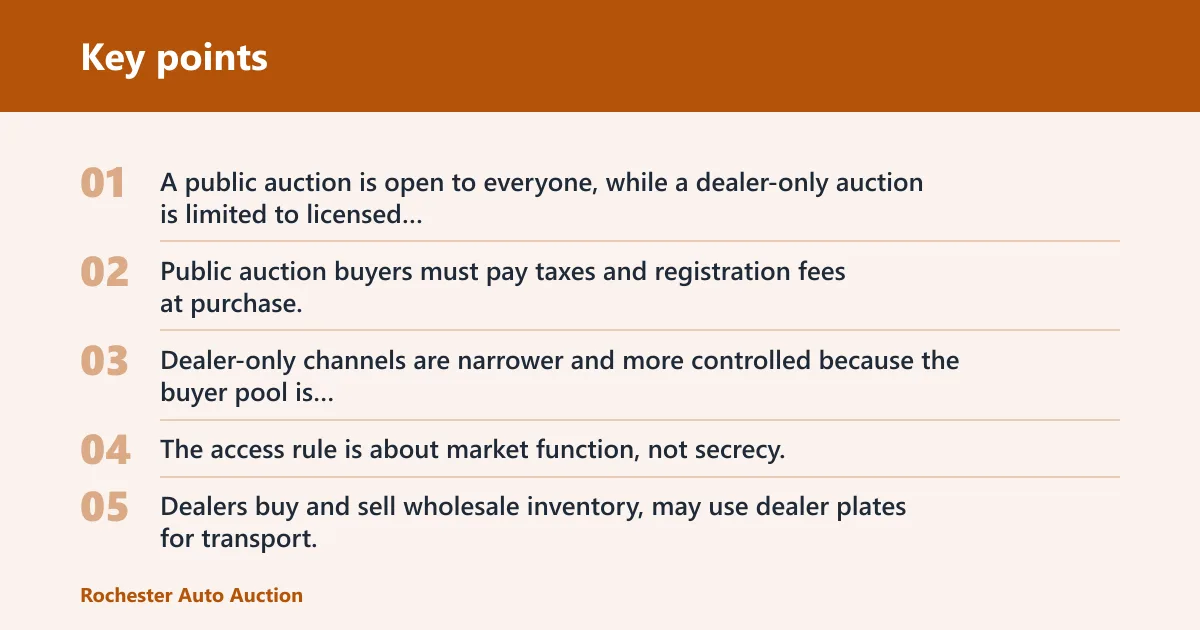
A public auction is open to everyone, while a dealer-only auction is limited to licensed car dealers. Public auction buyers must pay taxes and registration fees at purchase, and the cars often vary widely in quality. Dealer-only channels are narrower and more controlled because the buyer pool is professional and the pricing model is wholesale.
Why access is limited to licensed car dealers
The access rule is about market function, not secrecy. Dealers buy and sell wholesale inventory, may use dealer plates for transport, and are expected to judge risk fast. That lets auction houses move cars with fewer steps between the seller and the buyer.
Why are some car auctions dealer only?
Some car auctions are dealer only because sellers want a wholesale distribution system that protects dealer margin and speeds up resale decisions. The restriction filters the buyer pool to licensed dealers, which cuts retail-channel friction, supports wholesale pricing, and keeps inventory moving through buyers who know how to price repair and reconditioning costs.
Wholesale pricing and dealer margin
Dealer auctions aim to give dealers access to wholesale prices. That matters because many units are not ideal retail cars as they sit, but they may still fit a dealer who can repair, recondition, and resell at a margin. The auction format supports that middle step.
How restricted access reduces retail-channel friction
When a seller sends a vehicle to a dealer-only auction, the process skips some of the back-and-forth that comes with retail selling. There is less time spent on consumer financing, walk-around negotiation, and long condition debates. The auction house can move more units with clearer rules.
Why auction houses route certain inventory through dealers
Not every vehicle fits a dealership’s retail floor. Age, mileage, cosmetic condition, model demand, trim, color, and local market fit all matter. A car that is too old, too high-mileage, or too costly to recondition for a retail lot may still make sense in wholesale, where another dealer can price it differently.
What kinds of vehicles go to dealer-only auctions?
Dealer-only vehicle auctions may feature trade-ins, lease returns, repossessions, fleet liquidations, and insurance vehicles. These sources fit wholesale because they come from inventory turnover, lender recovery, or fleet rotation rather than from a polished retail sales process.
Trade-ins and lease returns
Trade-ins often arrive when a customer replaces a vehicle at a dealership. Lease returns can also enter auction when the lease term ends and the original outlet does not keep the unit for retail. These vehicles may be clean enough for resale, but their fit depends on age, mileage, and condition.
Bank repossessions and fleet liquidations
Bank repossessions are vehicles recovered after a loan default. Fleet liquidations usually involve former rental, lease, utility, or corporate units being sold in volume. Both can be practical wholesale stock because the seller wants fast turnover rather than a retail presentation.
Insurance vehicles and condition-based inventory
Insurance vehicles can enter auction after claims, and they deserve extra caution because damage history can be complex. Condition-based inventory also shows up when a dealer decides that a car is better sold wholesale than fixed for retail. The auction is the exit path.
How do car auctions work?
Car auctions usually work by listing inventory, setting bidding rules, collecting condition information, taking bids, then transferring the unit after payment. Dealer-only auctions may use live in-person bidding, online simulcast bidding, or buy-it-now options. Pickup and transport happen after the sale closes.
Live in-person bidding
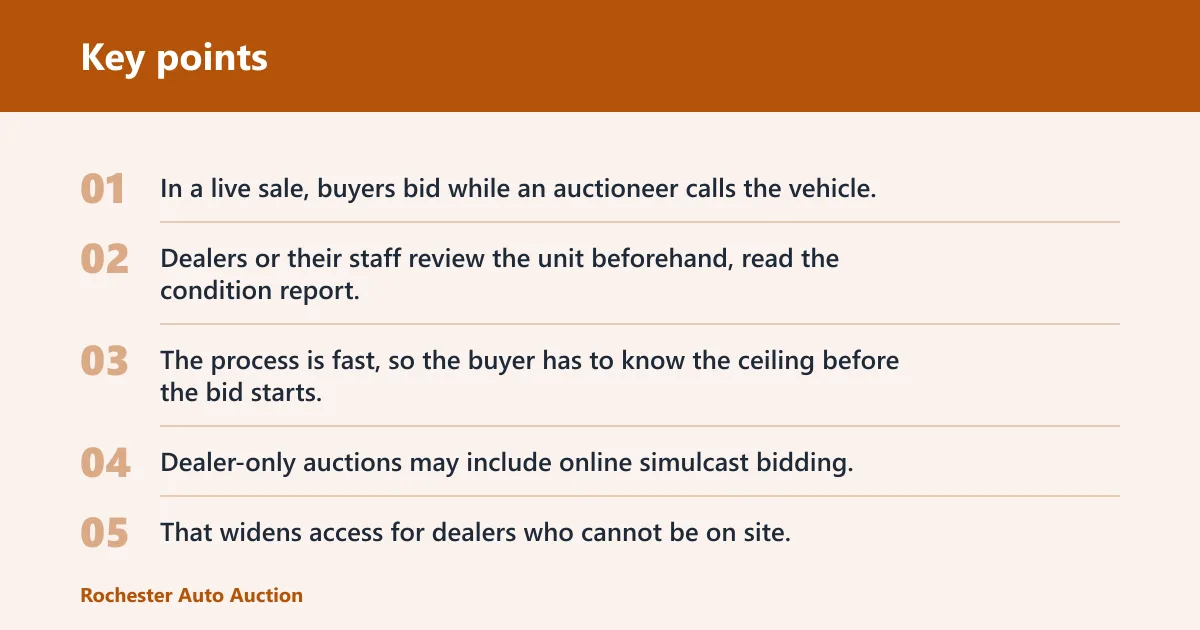
In a live sale, buyers bid while an auctioneer calls the vehicle. Dealers or their staff review the unit beforehand, read the condition report, and set a ceiling price. The process is fast, so the buyer has to know the ceiling before the bid starts.
Online simulcast bidding
Dealer-only auctions may include online simulcast bidding, which lets approved buyers bid remotely while the live sale runs. That widens access for dealers who cannot be on site, but it does not remove the need to judge condition, fees, and transport before bidding.
Buy-it-now options
Some auctions offer a buy-it-now option. That can save time when a buyer already knows the number fits the market. It still requires the same checks on title status, condition report detail, pickup timing, and any transport or reconditioning cost after the sale.
Payment and pickup logistics
Once the buyer wins, payment and pickup follow the auction rules. Dealers can transport vehicles without registration using dealer plates, which is part of the post-sale workflow. That matters because the car may need to move from the auction site to a lot, body shop, or transport carrier.
How do you read a condition report before bidding?
A condition report is a detailed vehicle inspection summary used to evaluate auction inventory before bidding. It helps buyers assess risk, but it is not a warranty. The best buyers use the report to estimate repair cost, transport need, and whether the unit fits their market and budget.
What a condition report usually covers
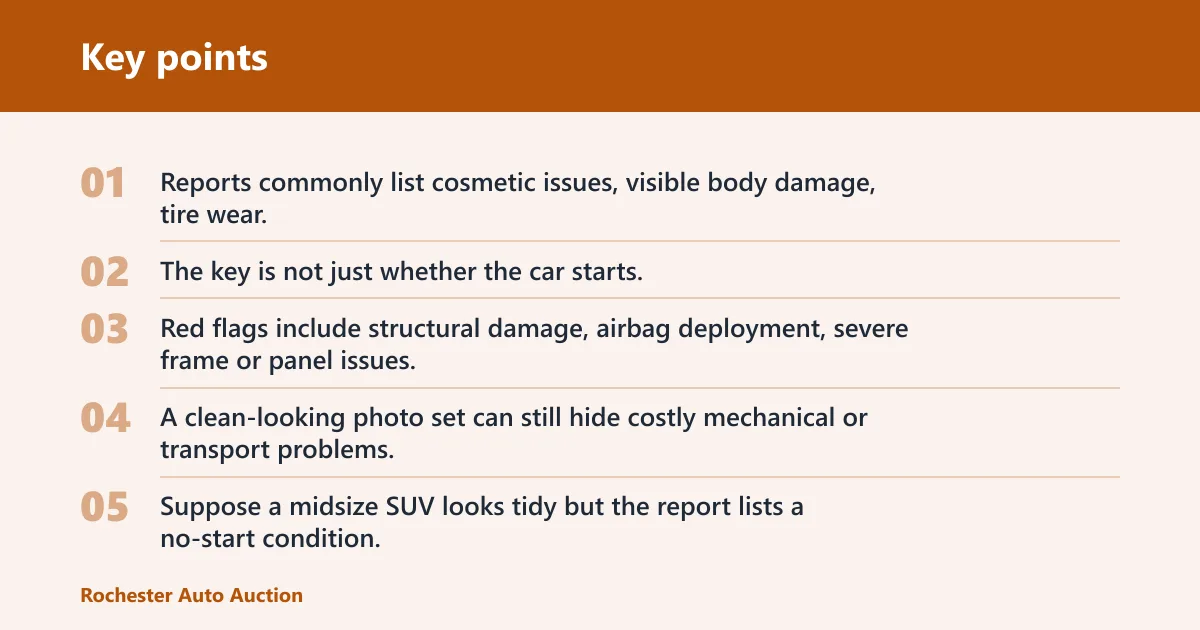
Reports commonly list cosmetic issues, visible body damage, tire wear, interior condition, warning lights, and notes about prior damage or missing equipment. Some also flag title or disclosure issues. The key is not just whether the car starts, but whether the report matches the price and the buyer’s target resale path.
Red flags that can change the real cost of the car
Red flags include structural damage, airbag deployment, severe frame or panel issues, flood or fire history, and signs that the car needs more than routine detailing. A clean-looking photo set can still hide costly mechanical or transport problems. Suppose a midsize SUV looks tidy but the report lists a no-start condition; that can turn a bargain into a tow-and-repair project quickly.
Why a clean report still needs a transport and reconditioning check
A clean report does not erase pickup, transport, or lot preparation costs. Even a solid car may need battery service, tires, fluids, keys, detailing, or body work before it is ready for resale. A common first-timer mistake is to bid on the hammer price only and ignore the rest.
Dealer-only auction decision checklist
Use this checklist before bidding. It helps separate a true wholesale opportunity from a unit that only looks cheap on the screen.
| Check | Yes means proceed | No means pass or reprice |
|---|---|---|
| Inventory type | Trade-in, lease return, repo, fleet unit, or another vehicle that fits your resale plan | Wrong segment for your lot, weak demand, or likely retail-only problem car |
| Access | You have a dealer license or an approved wholesale account for that platform | You would need a public auction path or a licensed partner |
| Condition report | No structural red flags, no major disclosure issues, repair estimate stays manageable | Frame damage, flood signs, airbag hit, no-start with unknown cause, or missing title detail |
| Likely post-sale costs | Hammer price + buyer fee + transport + reconditioning still leaves margin | Fees, tow, taxes where applicable, or repair work erase the margin |
- Confirm the inventory type fits your wholesale plan.
- Verify you have legal access and platform approval.
- Read the condition report line by line.
- Add buyer fees, transport, and repair costs.
- Bid only if the final number leaves room for resale profit.
Can you buy from dealer auctions without a dealer license?
Dealer access to these auctions is generally limited to licensed car dealers, and some platforms may also require account approval. Legal access is limited to licensed car dealers, though some platforms also require account approval beyond the license itself. If you do not have dealer status, you usually need a public auction path instead, where access rules, fees, and vehicle mix are different.
Legal access limits versus platform approval rules
The law and the platform are not the same gate. A dealer license may be required by law, while a site may also ask for registration, business verification, or membership approval. A buyer can have one and still be blocked by the other.
What to expect if you try the public auction path instead
Public auctions are open to everyone, but the buyer still needs to handle taxes, registration fees, pickup, and condition risk. That can work for some shoppers, but it is not the same as dealer wholesale buying. The numbers can move fast once fees are added.
How do I get access to dealer auctions legally?
Legal access usually starts with becoming a licensed car dealer, then registering with the auction platform or house that hosts the sale. Some platforms also approve wholesale accounts for businesses. The exact steps depend on the venue, but the core requirement is valid dealer status.
What the licensing path usually means
Dealer licensing generally requires a business setup, local compliance steps, and paperwork that varies by state or province. Once licensed, a dealer can buy and sell wholesale inventory and may use dealer plates for transport. That status is the main door into dealer-only auctions.
Why some buyers use a licensed partner
If a shopper is not licensed, a licensed dealer partner may be the lawful route, subject to local rules and platform policy. The key is to avoid mixing up a legal workaround with an informal favor. Auction rules, title transfer, and transport responsibility still matter.
Why do dealers send cars to auction?
Dealers send cars to auction when a unit fits wholesale better than retail. Common reasons include age, mileage, cosmetic condition, slow demand, inventory mix, and local market fit. The goal is to free up floor space and turn a vehicle into cash efficiently.
Why does a dealer send a car to auction?
A dealer may send a car to auction because the cost to retail it would be too high relative to expected resale value. If a vehicle needs too much reconditioning, has the wrong trim, or sits outside local demand, wholesale can be the faster and safer exit.
Why age, mileage, and condition matter
Older, high-mileage, or cosmetically tired vehicles can still sell, but not always on the retail lot where the standard is stricter. Auction lets dealers move units that may not justify the time, warranty exposure, or front-end presentation needed for consumer sales.
Why inventory mix matters
Lots need the right mix of used cars. A dealer may have too many similar sedans, too many aging SUVs, or too much capital tied up in the wrong segment. Auction is a pressure valve for stock that no longer fits the plan.
Why are there dealer only auctions?
There are dealer-only auctions because wholesale distribution works better when the buyer pool is limited to people who know the business and accept wholesale risk. That structure helps sellers move vehicles quickly, helps dealers source inventory at wholesale prices, and keeps the process aligned with margin-based buying.
How major auction networks fit in
Dealer-only auctions can provide access to extensive auction networks. Manheim is described as the largest dealer/wholesale vehicle auction. Adesa Auctions offers a wide network of local and online auctions across North America. CarMax Auctions is positioned as a streamlined auction process for dealers. ACV Auctions is described as an exclusively online platform for car auctions.
Picture a dealer lot that needs one midsize crossover by Friday. A wholesale channel can source a trade-in or fleet unit, but only if the buyer understands the report, the fee structure, and the transport timing. Otherwise the “cheap” car becomes the expensive one.
Frequently asked questions
Can you buy from dealer auctions without a dealer license?
Not from a dealer-only auction. Access is limited to licensed car dealers, though some platforms also require separate account approval. Without that status, you usually need a public auction path, where taxes, registration fees, and buyer obligations differ.
How do car auctions work?
Car auctions list inventory, provide condition reports, and accept bids through live or online formats. After the sale, the buyer pays, arranges pickup or transport, and handles any follow-up costs such as registration where applicable, reconditioning, or towing.
How do I get access to dealer auctions legally?
The legal route usually starts with becoming a licensed car dealer and then registering with the auction house or platform. Some venues also require separate approval or business verification. If you are not licensed, the lawful alternative is usually a public auction.