How to VIN Check for Salvage Title Before Bidding
Run the VIN through NMVTIS and a state title lookup. If either record shows salvage, rebuilt, flood, junk, or theft branding, it is commonly treated as a walk-away before bidding. Missing that check can leave you with branded-title repair costs, tougher financing, and weaker resale. This workflow shows the cheapest checks, the damage clues that matter, and the point where a VIN report is enough to stop bidding.
What you’ll need
- The 17-character VIN from the dashboard plate, driver-door jamb label, and title paperwork (Nhtsa)
- An NMVTIS report or other VIN history report that includes title brands and state history
- Auction listing photos, sale notes, and declared damage details
- The current title, if the seller or auction provides one
- A flashlight and a small mirror for frame rails, welds, and hidden seams
- Access to Copart or IAAI records when the listing ties back to an auction sale
- Any rebuilt inspection papers, repair receipts, or state brand history available before release
Does the VIN match every record?
Check the 17-character VIN on the dashboard, driver-door jamb, and title before you bid. If even one digit conflicts, stop. A mismatched VIN can point to a clerical error, a swapped part, or a deeper identity problem, so the report may be unreliable.
Match the hard points first
- Read the VIN on the dashboard through the windshield.
- Compare it with the driver-door jamb label.
- Match both to the title and the auction listing.
- Stop if any digit, letter, or sequence differs across the VIN sources.
A common first-timer mistake is assuming a shiny exterior means the VIN history is clean before bidding on a salvage-title car. A clean-looking body with a mismatched VIN plate is a reason to leave, not negotiate.
What does the VIN history show?
Use NMVTIS and a VIN history report to check for salvage, rebuilt, junk, flood, or theft branding when available across states. Salvage branding can appear differently from state to state, so a clean-looking current title does not always tell the whole story. Auction records from Copart and IAAI can also show declared damage and prior sale notes.
Look for cross-state conflicts
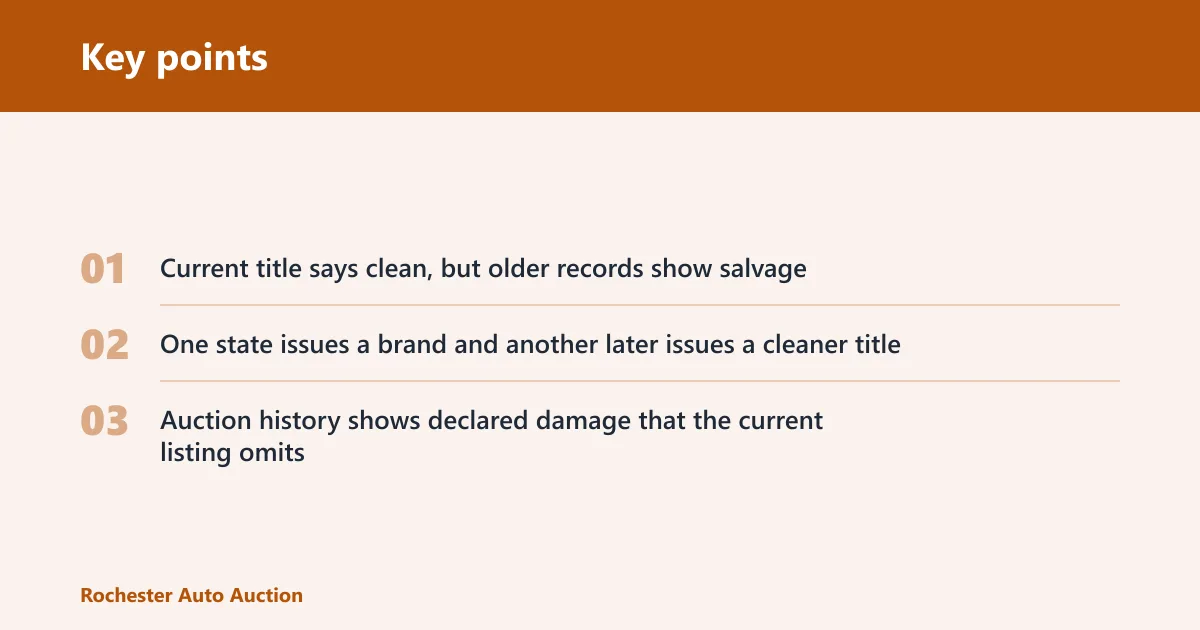
- Current title says clean, but older records show salvage
- One state issues a brand and another later issues a cleaner title
- Auction history shows declared damage that the current listing omits
That pattern points to title washing, a fraudulent practice where a branded title is hidden by moving a vehicle across state lines. If the paper trail conflicts, treat the report as the stronger signal.
Use auction records as a second check
Copart and IAAI records can add declared damage, sale date, and photos that help confirm the brand. If those records show flood or front-end collision damage while the current title looks clean, the safest move is to stop bidding unless the seller can explain every gap in the history.
How should you inspect the car on site?
Inspect the body for panel gaps, paint mismatch, overspray, weld lines, frame rail damage, airbag clues, water lines, hail dents, and smoke residue. These clues do not prove the exact brand, but they can confirm whether the reported damage lines up with the repair quality. VIN plates should also look original and untampered.
Check the body and structure
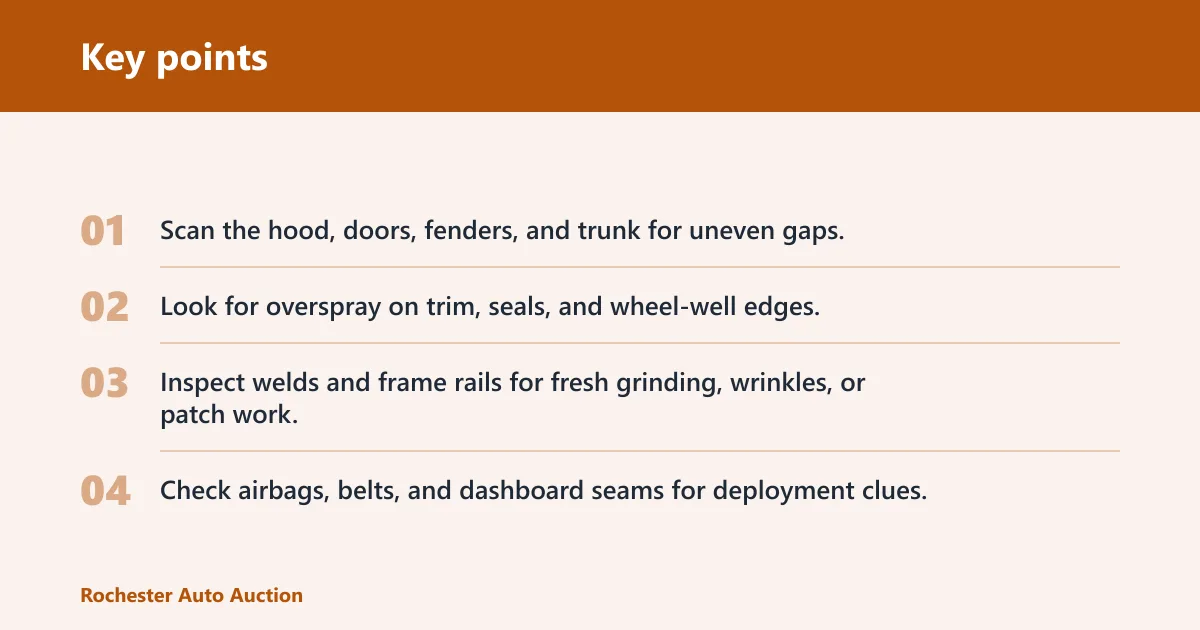
- Scan the hood, doors, fenders, and trunk for uneven gaps.
- Look for overspray on trim, seals, and wheel-well edges.
- Inspect welds and frame rails for fresh grinding, wrinkles, or patch work.
- Check airbags, belts, and dashboard seams for deployment clues.
Suppose a sedan shows a clean title but the right front fender gap is wider than the left and the radiator support has fresh paint on one side. That combination does not prove salvage on its own, but it does make the repair story weaker.
Check damage clues by type
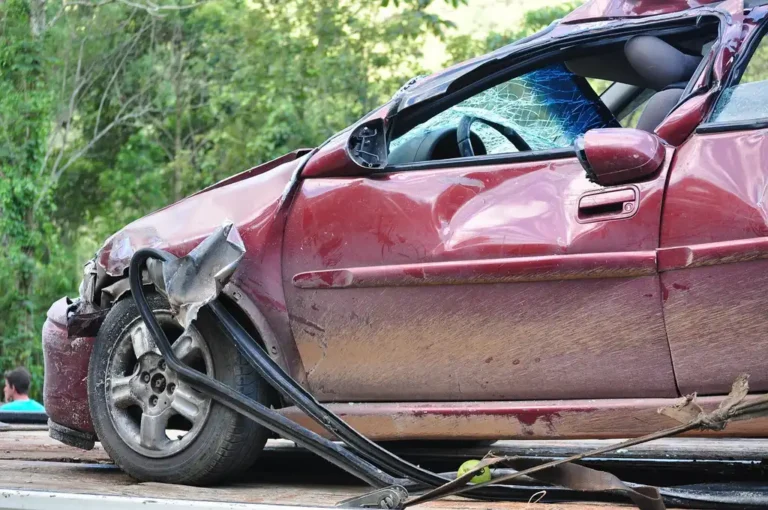
Different damage types leave different traces. Collision often shows crooked gaps, frame repair, and mismatched panels. Flood often leaves water lines, corrosion, mud, and electrical faults. Hail often leaves roof, hood, and decklid dents with no major structural damage. Fire often leaves melted trim, wiring damage, and smoke residue. Theft recovery may show missing parts, ignition damage, or little repair history.
Salvage title bidding checklist
| Signal | What to verify in the VIN report | What to inspect on-site | Bid decision |
|---|---|---|---|
| Collision | Salvage brand, prior collision notes, auction damage photos | Crooked gaps, frame rail wrinkles, fresh welds, uneven paint | Bid lower if repairs look complete; walk away if structure looks off |
| Flood | Flood brand, water-loss notes, repeated title moves across states | Water lines, corrosion, mud under trim, electrical faults, damp odors | Walk away if water intrusion is visible or electrical damage is unresolved |
| Fire | Fire brand, loss notes, prior auction damage photos | Melted trim, heat warped plastics, smoke residue, wiring damage | Bid lower only if repairs are documented and damage is fully traced |
| Theft recovery | Theft recovery brand, salvage history, parts-missing notes | Missing interior pieces, damaged ignition, forced-entry marks | Bid lower if loss is limited to replaceable parts; walk away if identity is unclear |
| Rebuilt title | Rebuilt brand, state reinspection proof, repair paperwork | Quality of repair, VIN plate condition, remaining body or frame clues | Bid lower unless rebuilt paperwork and inspection results line up |
| Title-wash conflict | Clean current title versus older salvage branding in NMVTIS or state records | Signs of major repair that match the older brand, not the current title | Walk away if the history conflict is unresolved |
How should salvage history change your bid?
Bid only when the report and inspection agree. Bid lower when the car is repaired but the work is not fully documented. Walk away when the report conflicts with the listing or when structural, flood, or fire clues do not match the seller’s story. Always account for auction fees, transport, and resale limits before setting a ceiling.
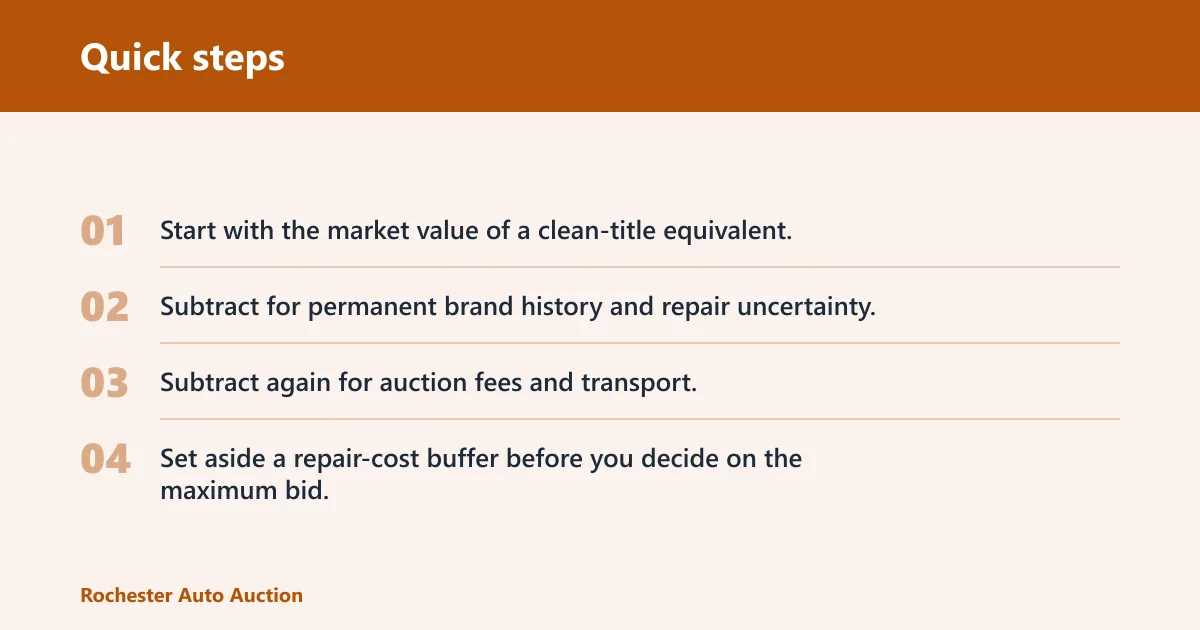
Use a simple bid method
- Start with the market value of a clean-title equivalent.
- Subtract for permanent brand history and repair uncertainty.
- Subtract again for auction fees and transport.
- Set aside a repair-cost buffer before you decide on the maximum bid.
For context, a $20,000 clean-title car might be worth $10,000 to $14,000 with salvage or flood branding. After that, subtract auction fees, transport, and a repair buffer before deciding whether the bid still makes sense. That is not a fixed discount for every vehicle, but it is a useful warning against bidding as if the title were clean.
Request the right papers before release
Ask for rebuilt inspection papers, repair receipts, and state brand history when available. A rebuilt title means the vehicle passed the state inspection required for that title, but that inspection may be limited and does not certify overall roadworthiness. That permanent history often means resale friction and lender caution.
Common mistakes
Do not treat a clean current title as the final answer. Do not skip the report because the car looks repaired. Do not ignore state-to-state brand changes. Do not bid before checking rebuilt proof papers, repair receipts, and auction history.
One common error is seeing a rebuilt badge and assuming the hard part is over. Rebuilt still means prior salvage history, so the question is not whether the car can move under its own power. The question is whether the repair trail is complete enough to justify the bid.
What still counts as a red flag
- Current title looks clean, but older records show salvage
- Damage type in the report does not match the lot photos
- No rebuilt inspection paper is available
- Panel gaps, welds, or frame rails look inconsistent with the claim
Frequently asked questions
How do I check if a car has a salvage title by VIN before bidding?
Run the 17-character VIN through NMVTIS and the state title lookup for the state named on the current title or the state that last issued the title, then compare the result with the dashboard plate, door-jamb label, and title paperwork. If any source shows salvage, rebuilt, flood, junk, or theft branding, use that as your bidding limit, not the current listing.
What does a salvage title mean on an auction car?
It means the vehicle was branded after a total loss event, which can come from collision, flood, fire, hail damage, or theft recovery. The brand can still appear in history records even if later state titles are issued differently.
Can a car have a clean title and still be salvage history?
Yes. Cross-state title history can hide older branding if the vehicle was moved and retitled elsewhere. That is why NMVTIS, state records, and auction history matter together. If older records show salvage, treat the current clean title as incomplete information, not a clean bill of health.
What VIN and title details should match before I bid?
The VIN on the dashboard, the driver-door jamb label, and the title paperwork should all match exactly. The year, make, model, body style, and brand history should also line up with the listing. Any mismatch is a reason to stop and verify before you bid.
How do I tell if a salvage car was rebuilt correctly?
Ask for rebuilt inspection papers and repair receipts, then inspect for even panel gaps, straight frame rails, consistent paint, and untampered VIN plates. A rebuilt title means the vehicle passed the state inspection required for that title, but it does not prove the repair quality by itself.
What should I do if the current title looks clean but the VIN history shows salvage?
Treat the report as the stronger signal and walk away unless the seller can explain the title trail with state brand history and repair documents. A clean-looking current title does not erase a prior salvage brand, and title washing across state lines can hide that history.