Carfax or AutoCheck: Which Is the Better History Report?
For auction buyers, Carfax is often stronger on service records and detail gaps, while AutoCheck is often stronger on auction and title tracking. If your risk is maintenance history, start with Carfax. If it is auction pedigree, start with AutoCheck. Missing the right report can leave you bidding on a car with repair gaps, title issues, or a bad lane history you could have caught before paying. This guide compares the two reports, what each one tracks best, and how to choose the one that matches the car you are evaluating.
| Decision factor | Carfax | AutoCheck | Winner |
|---|---|---|---|
| Service and maintenance records | Usually shows more detailed service entries from dealer and shop reporting. | Often lighter on routine maintenance detail. | Carfax |
| Auction and wholesale movement | Can show auction-related events, but is usually not as strong here. | Usually stronger on auction history and lane-to-lane movement. | AutoCheck |
| Title brands and DMV records | Includes title brands and ownership history. | Usually stronger for title and brand records, plus DMV data. | AutoCheck |
| Accident and damage detail | Often gives more detail when the event was reported, including severity and some damage context. | Also includes accident history, but detail depth varies by source. | Carfax |
| Relative confidence for a quick screen | Stronger when service gaps are the main concern. | Stronger when auction pedigree and title risk are the main concern. | Tie |
Which report fits your buyer type?
For auction buyers, the better report is the one that cuts the specific risk you are paying for. Carfax is usually the better first check for service history and damage detail. AutoCheck is usually the better first check for auction movement and title signals.
The short answer for auction buyers
If the car came from the lane, AutoCheck is often the better first look because it tends to be stronger on auction history, title brands, and DMV records. That matters when you need to know whether the car has bounced through wholesale channels or carries a title issue that could affect resale.
The short answer for private-party buyers
If you are buying from a private seller, Carfax often gives more useful service and maintenance detail. Routine dealer and shop reporting can show oil changes, inspections, and repairs, which helps you judge whether the car has been cared for or simply moved around.
The short answer for dealers
Dealers often get value from both reports, but the first pick depends on inventory source. For retail-ready cars with a paper trail, Carfax can be more useful. For wholesale units and title-sensitive vehicles, AutoCheck can be the better screen before you commit money.
Carfax vs. AutoCheck at a glance
Both reports are vehicle history reports, and both can include accident history, title brands, salvage title checks, recalls, and ownership history. Neither report captures every event or incident, so you still need a VIN check, title review, and inspection before buying.
Side-by-side feature comparison
Carfax pulls information from a large network and often contains detailed service entries. AutoCheck, owned by Experian, includes the AutoCheck Score and tends to be stronger in auction and title-related insights.
Where each report tends to be stronger
Carfax is usually better for detailed maintenance records, repair entries, and accident detail when those events are reported. AutoCheck is usually stronger for auction history, wholesale movement, title brands, DMV records, and odometer history.
Where both reports can miss history
The same source reports can miss unreported repairs, off-the-books damage, and events that never reached a database. If a seller repaired a car privately or a lot never submitted a full record, the report may look cleaner than the vehicle really is.
What Carfax tends to show better
Carfax usually gives more value when you need service and damage context. Its larger proprietary network and detailed service entries make it more useful when the question is not just “was something reported?” but “what was reported, and how often?”
Service and maintenance records
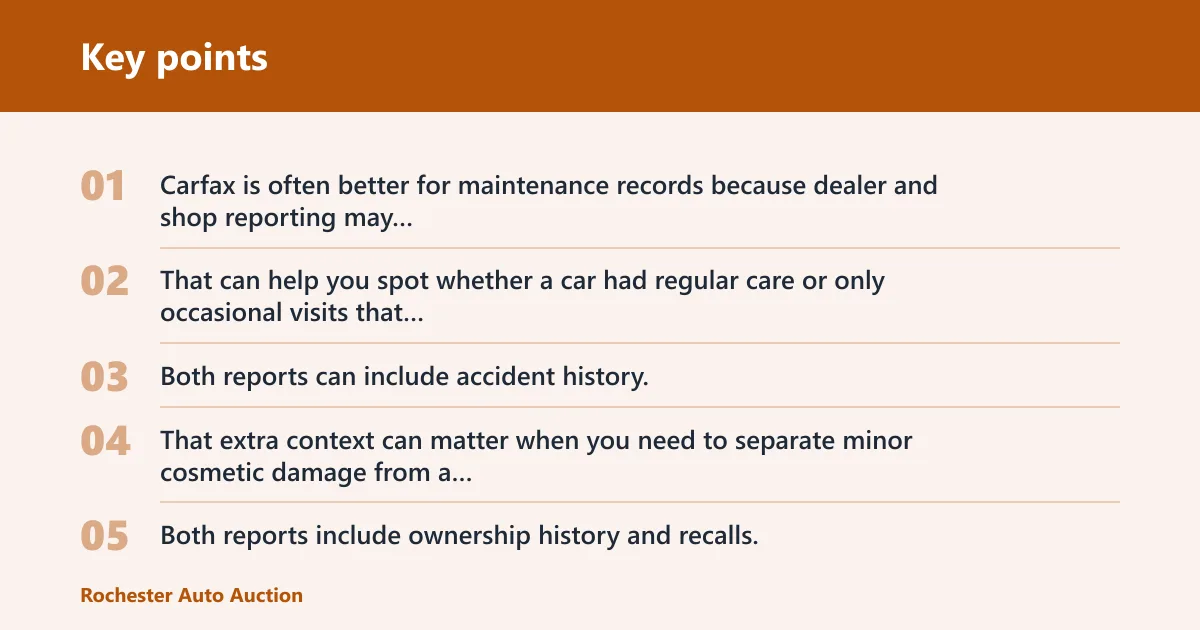
Carfax is often better for maintenance records because dealer and shop reporting may show oil changes, inspections, and repairs in more detail. That can help you spot whether a car had regular care or only occasional visits that leave long gaps.
Accident and damage detail
The same source reports can include accident history, but Carfax often gives more useful detail when the record exists, including severity, location of impact, and airbag deployment when reported. That extra context can matter when you need to separate minor cosmetic damage from a harder hit.
Ownership history, recalls, and buyback information
The same source reports include ownership history and recalls, but Carfax also includes buyback guarantee information. That can add confidence for a retail buyer who wants a familiar brand name and a more detailed paper trail before paying retail money.
Suppose a 2019 sedan shows regular oil changes, brake work, and inspection entries over three years. Carfax is more likely than AutoCheck to surface that pattern in a way a buyer can read quickly, which helps when you are comparing two similar cars with different upkeep.
What AutoCheck tends to show better
AutoCheck is usually the stronger choice when the risk is wholesale movement, title history, or auction churn. Because it is owned by Experian and built around title and auction signals, it often gives auction buyers a clearer first screen on where the car has been.
Auction history and wholesale movement
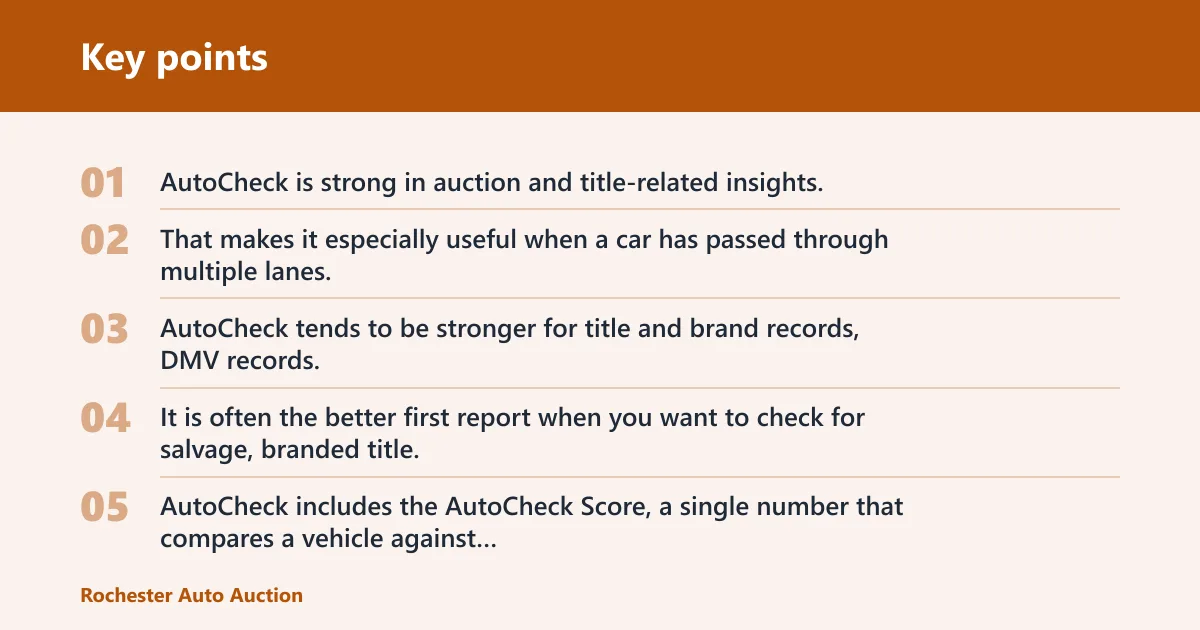
AutoCheck is strong in auction and title-related insights. That makes it especially useful when a car has passed through multiple lanes, because wholesale movement can reveal repeated bids, quick resales, or other pattern signals that matter before you bid again.
Title brands, DMV records, and odometer history
AutoCheck tends to be stronger for title and brand records, DMV records, and odometer history. It is often the better first report when you want to check for salvage, branded title, or title washing risk before deciding whether the vehicle belongs on your bid sheet.
How AutoCheck Score works
AutoCheck includes the AutoCheck Score, a single number that compares a vehicle against similar cars. It considers accident severity, title brands, odometer readings, and ownership history, so the score is most useful as a relative comparison, not as a pass-fail verdict.
Picture a crossover that moved through two auctions in six months and shows a title brand plus uneven odometer entries. AutoCheck is the better first check in that case because the key risk is not whether the cabin had service stamps. It is whether the wholesale record tells a story you should not ignore.
Vehicle history report decision matrix
This matrix turns the comparison into a buying rule. Match the report to the risk you are paying for, then decide whether a second report adds enough new information to justify the extra cost.
| Buyer type | Service history | Auction visibility | Title risk | Decision confidence | One-line recommendation |
|---|---|---|---|---|---|
| Auction buyer | Carfax | AutoCheck | AutoCheck | AutoCheck | Start with AutoCheck, then add Carfax only if service detail could change your bid. |
| Private-party buyer | Carfax | Carfax | AutoCheck | Carfax | Start with Carfax for upkeep clues, then use AutoCheck if title risk needs a second look. |
| Dealer | Carfax | AutoCheck | AutoCheck | Tie | Use both on higher-dollar or faster-turn units; choose the first report by source and risk. |
Which report is better for accidents and title risk?
For accidents and title risk, neither report wins every time because both depend on what was reported. Carfax often gives more accident detail when the event is in the system, while AutoCheck is often stronger on title brands, auction signals, and the kind of wholesale history that can expose title washing risk.
Accident severity and damage detail
The same source reports include accident history, but the amount of detail can differ. Carfax is more likely to show severity and damage context, including location of impact and airbag deployment where reported. AutoCheck may show the event too, but the depth can be thinner depending on the source.
Salvage and branded title checks
The same source reports include branded title checks and salvage title checks. AutoCheck usually has the edge when title history is the main concern, especially if the car has passed through auctions or moved across states where title records can get messy.
Why NMVTIS still matters
NMVTIS is a federal database that helps track title brands, liens, and odometer data. Neither Carfax nor AutoCheck should replace it. If the title picture is the reason you are hesitating, a separate title review is still the safer step.
Choose Carfax if… / Choose AutoCheck if…
Choose Carfax when the car is a private-party buy, the service history matters more than auction movement, or you want more detail on repairs and maintenance. Choose AutoCheck when you are bidding at auction, the title story is the main risk, or you need a stronger screen for wholesale movement and auction pedigree.
Choose Carfax if the car needs a service paper trail
Pick Carfax first when you care about oil changes, inspections, dealer service visits, and repair entries. It is often the better first check for a one-car retail buyer who wants confidence that the car was maintained, not merely transported.
Choose AutoCheck if the car needs a title and lane check
Pick AutoCheck first when the vehicle has already lived a wholesale life. If your risk is title washing, repeated auction moves, or a hidden brand, AutoCheck is usually the safer first report.
Choose both when the extra data could change the bid
Buying both reports makes sense when the car is expensive, the margin is tight, or the first report leaves a clear gap. The extra report is justified when one source covers service detail and the other fills in auction or title blind spots that could change what you are willing to pay.
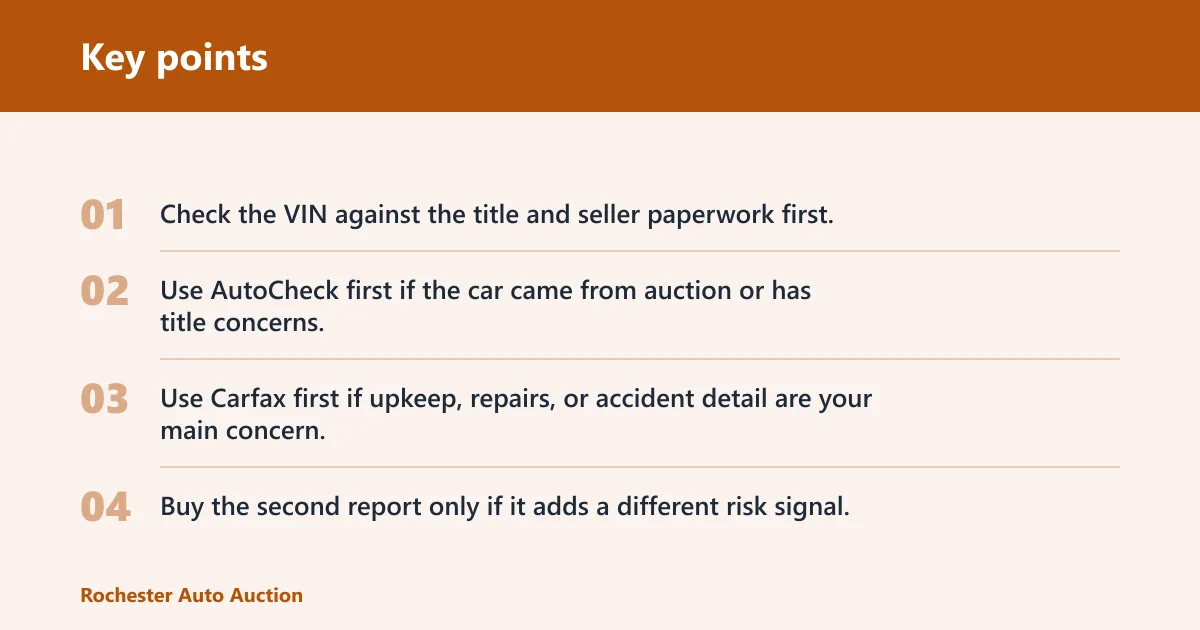
- Check the VIN against the title and seller paperwork first.
- Use AutoCheck first if the car came from auction or has title concerns.
- Use Carfax first if upkeep, repairs, or accident detail are your main concern.
- Buy the second report only if it adds a different risk signal, not just the same event in another format.
Frequently asked questions
Is Carfax better than AutoCheck for a used car?
For many used cars, Carfax is better when the buyer cares most about service and maintenance history. AutoCheck can be more useful when title risk or auction movement matters more. The right answer depends on whether you are worried about upkeep or wholesale pedigree.
Which vehicle history report shows more accidents, Carfax or AutoCheck?
Neither report always shows more accidents. Results depend on who reported the event and which database picked it up. Carfax often provides more accident detail when the record exists, while AutoCheck may still catch the event even if the narrative around it is lighter.
Which report is better for auction buyers, Carfax or AutoCheck?
AutoCheck is usually better for auction buyers because it is stronger on auction history, title records, and wholesale movement. That makes it more useful before bidding on a car that may have already passed through several lanes or crossed state lines.
Does AutoCheck show more title history than Carfax?
AutoCheck is usually stronger for title and brand records, including DMV information and odometer history. Carfax also includes title brands and ownership history, but AutoCheck is often the better first report when title washing or prior branding is the main concern.
Which is cheaper, Carfax or AutoCheck?
Prices change by seller, bundle, and subscription, so there is no fixed answer that stays true everywhere. The better value is the report that removes the risk most likely to cost you money on that specific car, even if the sticker price is a little higher.
Should I buy both Carfax and AutoCheck before bidding?
Buy both only when one report leaves a meaningful gap. That is most justified on higher-value auction cars, title-sensitive units, or vehicles with uneven records. If one report already answers the main risk, the second may add little beyond overlap.
What does the AutoCheck Score mean compared with Carfax?
The AutoCheck Score is a single number that compares a vehicle against similar cars. It factors in accident severity, title brands, odometer readings, and ownership history. Carfax does not use that same single-number score, so the two reports are not direct equivalents.
Which report is better for service records, Carfax or AutoCheck?
Carfax is usually better for service records. Its detailed service entries often make oil changes, inspections, and repairs easier to follow. AutoCheck can still help, but it is usually the weaker choice when the main question is how well the car was maintained.