Do Auction Buyer Fees Count Toward Vehicle Cost Basis?
Yes—auction buyer fees usually belong in vehicle cost basis because they are part of what you paid to acquire the car; transport and other direct purchase costs often belong there too, while recoverable sales tax and routine operating expenses usually do not. If you leave those amounts out, resale profit can look higher than it is, and tax records can be wrong. This guide shows which auction charges go into basis, which belong in expense, and how to track them for resale accounting.
Do auction buyer fees count toward basis?

Yes. When you buy a vehicle to resell or to use in a business, buyer fees and similar auction charges are part of the amount paid to acquire it. The hammer price is only the winning bid; the buyer’s premium, commission fee, and processing charges raise your total acquisition cost and can belong in basis when they are nonrefundable purchase costs.
Hammer price and buyer’s premium
The hammer price is the winning bid. The buyer’s premium is the fee paid to the auctioneer above that bid, and it may be a flat charge, a percentage, or a tiered amount based on the hammer price. Buyer-side fees are platform policy, not built into every marketplace setup, so check the fee schedule before bidding.
A tiered model matters because the premium can change as the hammer price moves. For example, fees can be shown before bidding, and one published example lists a €350 commission on a €10,300 bid, with the total becoming €10,650 after commission. Another published structure increases the fee by €50 for each additional €10,000 above €20,000.
Inventory versus personal-use vehicles
How you treat the cost depends on what the vehicle is for. If you buy inventory for resale, basis feeds into cost of goods sold when the vehicle sells. If you buy a personal-use vehicle, basis still matters for recordkeeping, but a later loss on personal-use property is generally not deductible for U.S. federal taxes.
Suppose your successful bid is about $12,500 and the auction adds a buyer’s premium of about $625 plus an administrative fee of about $175. Your acquisition cost is not $18,000. The purchase record should capture the full $19,150 before you add qualifying transport or tax amounts that are part of acquisition.
Buyer fee and hammer price
Buyer fees are separate from the hammer price for tax tracking. The bid sets the auction result, but the fee schedule sets what you actually pay to close the purchase. When the auction uses a commission, listing fee, or processing fee, each line should be identified on the invoice so you can tell which charges belong in basis and which belong in current expense.
Commission and processing charges
Platforms may charge a buyer’s premium, a listing fee, and a processing fee. Some also show the commission before you place a bid, which helps you estimate landed cost before the sale ends. Buyer fees may include payment-processing charges, and those charges are part of the purchase math when they are required to complete the acquisition.
Pricing models vary, so the same hammer price can produce very different totals. Example auction fees are often around €200-€800 for a €10,000-€20,000 car, but the right comparison is always the full invoice, not the bid alone.
Sales tax, VAT, and import charges
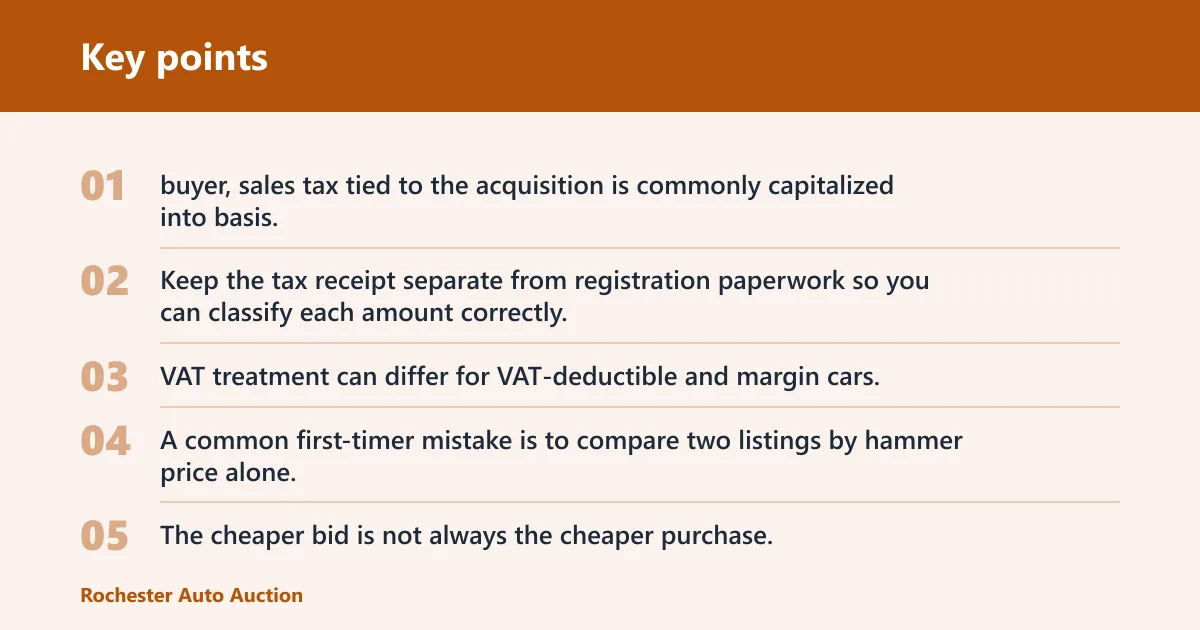
In the U.S., sales tax paid to acquire the vehicle is commonly part of vehicle basis when it is a true purchase tax rather than a recurring ownership charge. VAT works differently by country and vehicle status, and import or customs charges can apply when the car crosses into a destination country. These items can change your all-in vehicle cost fast.
U.S. sales tax treatment
For a U.S. buyer, sales tax tied to the acquisition is commonly capitalized into basis. That is different from annual registration renewals or other recurring charges, which are operating or ownership costs rather than acquisition costs. Keep the tax receipt separate from registration paperwork so you can classify each amount correctly.
VAT and customs on cross-border purchases
VAT treatment can differ for VAT-deductible and margin cars. Import taxes may apply when the car crosses into a destination country, and customs charges are separate from the buyer fee itself. If you buy across borders, keep the auction invoice, export papers, customs entry, and tax paperwork together so the final landed cost can be traced.
A common first-timer mistake is to compare two listings by hammer price alone. Suppose one car bids at €12,000 with a €400 buyer fee and €900 transport, while another bids at €12,500 with no added buyer fee and a shorter delivery route. The cheaper bid is not always the cheaper purchase.
Transport, title, and registration costs
Transport, title, document, and initial tag charges can be part of acquisition cost when they are needed to get the vehicle into your inventory or into service. Recurring registration renewals are different. They are not part of the purchase price, even though they are easy to confuse with the one-time charges that happen at closing.
Freight and delivery to your location
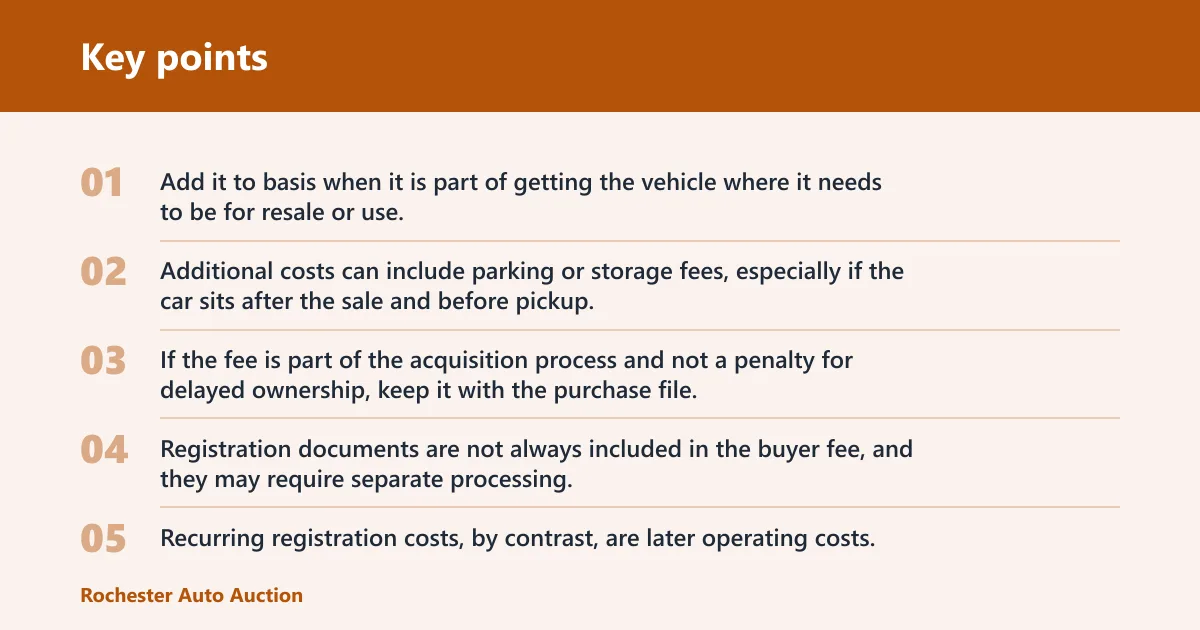
Transport or delivery cost is a separate line from the auction fee, but it can be capitalized when it is incurred to acquire the vehicle. That includes shipping from the auction site to your lot, warehouse, or other business location. Add it to basis when it is part of getting the vehicle where it needs to be for resale or use.
Additional costs can include parking or storage fees, especially if the car sits after the sale and before pickup. If the fee is part of the acquisition process and not a penalty for delayed ownership, keep it with the purchase file.
Initial title, doc, and tag charges
Registration documents are not always included in the buyer fee, and they may require separate processing. Initial title fees, document fees, and first-time tag charges often belong with acquisition records because they are tied to closing and initial registration. Recurring registration costs, by contrast, are later operating costs.
Recurring registration costs
Annual registration renewals, plate renewals, and other ownership-period charges are generally not the same as closing costs. For resale accounting, those later amounts are separate from basis unless they were part of the original purchase and title transfer. Keep renewal notices out of the acquisition worksheet.
Which fees belong in resale accounting?
For resale accounting, capitalize the amounts that bring the vehicle to you and place it in saleable condition. That includes the hammer price, buyer’s premium, qualifying sales tax, transport to your location, and initial title or document charges. Selling expenses, refundable deposits, and unrelated operating costs are tracked elsewhere, not in basis.
Capitalized purchase costs
These are the charges most likely to enter basis: hammer price, buyer fee, commission fee, payment-processing fee, sales tax paid on acquisition, freight or delivery, and initial paperwork charges tied to transfer. For inventory, these amounts build the vehicle’s cost; for a business asset, they build the asset basis.
Current expenses and selling costs
Costs that occur after acquisition and do not improve or place the vehicle into service are different. Advertising, storage while listed for sale, reconditioning done as a later selling decision, and dealer-level selling costs are tracked as current expenses or selling expenses based on the facts and your accounting method. They are not the same as purchase cost.
Refunds, deposits, and sale fall-throughs
Refundable deposits are not basis unless they are kept by the auction house as a fee or applied to the purchase. If a sale falls through and the auction refunds the buyer fee, the refunded amount should not stay in basis. If a partial fee is retained, that retained amount is the piece that remains in your cost file.
Suppose you win a car, pay a deposit, and then the seller cancels before transfer. If the auction returns the deposit and fee in full, there is no capitalized purchase cost from that cancelled deal. If the auction keeps a nonrefundable administrative charge, that retained charge is the amount to record.
Vehicle basis worksheet
| Line item | Example amount | Typical basis treatment | Notes |
|---|---|---|---|
| Hammer price | €10,300 | Part of basis | Winning bid; the base price before buyer fees. |
| Buyer’s premium / buyer fee | €350 | Part of basis | Fee charged on top of the hammer price; may be flat, percentage-based, or tiered. |
| Sales tax / VAT | Varies by transaction | Basis if paid on acquisition | U.S. sales tax commonly belongs in basis; VAT treatment depends on vehicle status and jurisdiction. |
| Transport / delivery | Varies by route | Part of basis when acquisition-related | Include shipping to your lot, warehouse, or service point. |
| Title / doc fees | Varies by title process | Often part of basis if tied to closing | Initial title and document charges are distinct from recurring registration renewals. |
| Inspection | Varies by provider | Current expense or basis, depending on purpose | If it is required to buy the vehicle, document it with the purchase file; if it is a later selling expense, keep it separate. |
| Refundable deposit | Refunded or applied | Not basis unless retained | Track the refund or retained fee so you do not overstate cost. |
What records should you keep?
Keep the invoice trail complete. The best support file includes the auction invoice, buyer fee schedule, payment receipt, shipping bill, title paperwork, tax receipt, and the auction terms that governed the sale. For inventory, keep those records with the stock file; for a fixed asset, keep them with the asset ledger.
Auction invoice and fee schedule
The invoice should show the hammer price and every added charge the platform billed. The fee schedule matters because it explains whether the buyer fee was flat, tiered, or commission-based. If the platform also charged a listing fee or processing fee, keep that page with the invoice.
Shipping, tax, and title documents
Keep the shipping bill or carrier invoice, the tax receipt, and the title or registration paperwork. These records show which costs were paid to acquire the vehicle and which were later operating charges. They also help when a state, auditor, or accountant asks why a number was included in basis.
Notes for inventory or fixed asset tracking
Track the vehicle by use category from day one. Inventory bought for resale goes into cost of goods sold when sold. A business asset stays on the asset schedule. That distinction matters because the resale accounting treatment is not the same as the treatment for a vehicle held for use in the business.
What should you check before you bid?
Before you bid, confirm the fee schedule, the likely transport route, the tax treatment, and any title or document charges. A calculator or budget estimate helps you see the landed cost before the auction closes. The winning bid is only part of the total cost, so your ceiling should be based on the full invoice, not the bid alone.
-
Pull the fee schedule.
Check the buyer’s premium, commission fee, and any processing fee before you place a bid. The platform may show the charge before bidding, and tiered pricing can change the amount as the hammer price rises. -
Add transport and taxes.
Include shipping or delivery to your location, plus any sales tax, VAT, or customs charges that apply to the purchase. These costs can change the landed total more than the bid itself. -
Separate closing from ownership.
Put title, doc, and initial tag charges with acquisition records, and keep recurring registration renewals out of basis. That split keeps your resale accounting clean. -
Save refund evidence.
If the sale falls through, keep proof of any refunded buyer fee, deposit, or retained charge. Your basis should reflect only the amount that stayed with the seller or auction house.
Frequently asked questions
Do buyer fees increase my tax basis when I buy a car at auction?
Yes. When the fee is part of the purchase, buyer fees increase acquisition cost and can be included in basis for inventory or a business asset. Keep the buyer’s premium, commission, and processing charges on the purchase record so the full cost is not understated.
Can I include auction buyer fees in my vehicle cost for resale accounting?
Yes. For resale accounting, buyer fees are part of the cost to acquire the vehicle, so they belong in inventory cost when they are nonrefundable purchase charges. That keeps gross profit and cost of goods sold aligned with the real landed cost.
Are buyer fees separate from the hammer price for taxes?
Yes. The hammer price is the winning bid, and the buyer fee sits on top of it. For tax records, keep both numbers separate so you can identify the bid amount, the auction charge, and the final total paid.
What auction fees should I capitalize when I buy inventory to resell?
Capitalize the charges that get the vehicle to you and ready for sale: hammer price, buyer’s premium, commission or processing fees, qualifying sales tax, freight or delivery, and initial title or document charges. Retain records for any amount that is refunded or later reversed.
Do buyer fees count as part of the purchase price or a selling expense?
Buyer fees are purchase costs, not selling expenses, when they are charged to acquire the vehicle. Selling expenses come later and are tied to disposition, advertising, or later sale activity. The timing and purpose of the charge determine where it belongs.
Are buyer fees refundable if the sale falls through?
Sometimes. Refundability depends on the auction terms. If the buyer fee or deposit is refunded, it does not stay in basis; if the auction keeps a nonrefundable charge, that retained amount remains part of your cost file. Keep the refund notice with the invoice.