Dealer License for Auto Auctions: Requirements and Costs
Editorial note: This guide is written in a compliance-first format for prospective independent dealers and auction buyers. It summarizes common U.S. licensing workflows using state motor vehicle dealer applications, agency guidance, and auction registration standards. Dealer licensing is state-specific, and auctions can impose stricter account rules than the state minimum, so confirm the current requirements with your state licensing agency and each auction before you sign a lease, buy a bond, or register inventory.
To buy at dealer-only auto auctions, a state dealer license is usually needed, often an independent retail or wholesale license. Pick the wrong license class or miss a bond, lot, or education requirement, and you can lose months, filing fees, or auction access.
The real choice is not “license or no license.” It is which license path matches how you plan to buy, hold, and resell vehicles. Retail usually gives you the widest selling rights and broad auction access, but it also brings the heaviest location burden. Wholesale is often leaner for auction sourcing and dealer-to-dealer resale, but it limits who you can sell to. A broker-style path may exist in some states, yet it often does not replace a dealer license for buying and stocking auction inventory.
Start with the right dealer license type
Retail dealer license: public sales and dealer-only buying
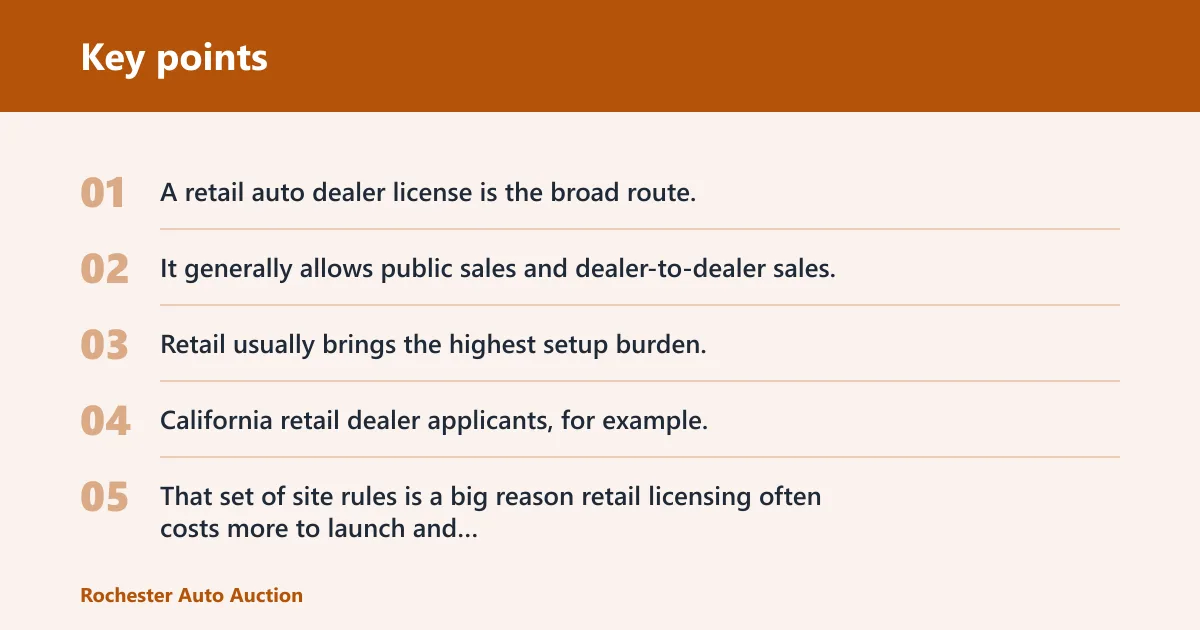
A retail auto dealer license is the broad route. It generally allows public sales and dealer-to-dealer sales, which matters if you want to buy at auction and then sell both retail and wholesale.
Retail usually brings the highest setup burden. California retail dealer applicants, for example, need a compliant commercial location with display area, signage, office, and business hours under California DMV occupational licensing rules for dealers. That set of site rules is a big reason retail licensing often costs more to launch and more to keep year after year.
If your model includes test drives, front-line inventory, and direct consumer sales, retail is usually the clean fit. It also tends to match auction houses that want a clearly active dealer account with standard licensing documents, business credentials, and dealer registration.
Wholesale dealer license: dealer-to-dealer sourcing and resale
A wholesale auto dealer license usually fits an auction sourcing and flipping model. It is commonly limited to dealer-to-dealer transactions, so you buy from auctions or other dealers and resell to licensed dealers rather than to the public.
The main economic draw is lighter fixed cost. California wholesale dealers still need to satisfy the state’s wholesale dealer place-of-business and record-keeping rules, but those requirements are distinct from retail location standards. In states that let wholesale applicants use office-only space, skipping a public display lot can cut rent, frontage, sign, and site-prep costs enough to keep a first-year budget workable.
Wholesale can be the stronger fit if your business plan is built around lane buying, short hold times, and dealer network resale. It is a weaker fit if your real goal is public retail sales.
Broker-style pathways and when they do not replace a dealer license
Some states allow broker-style activity, but you should not treat that as automatic auction access. A broker may arrange transactions without taking full inventory ownership, while an auction buyer planning to bid, title, transport, store, and resell vehicles often still needs the dealer license class the state requires for that conduct.
This is where many applicants get tripped up. An auction may ask for a dealer license number, resale credentials, business documents, and state verification that matches the license class. A broker-style registration that does not authorize inventory ownership can fail that check.
Why the wrong license class causes auction access problems
The wrong class creates two layers of trouble. First, the state can reject the application or restrict what you may legally do after purchase. Second, the auction can refuse registration or limit lane access if the license type does not fit the inventory or sale format.
A common first-timer mistake is applying for wholesale because the rent is lower, then planning to sell two or three units a month directly to consumers. The lower startup cost looks good at filing time, but the license can block the intended revenue model after approval.
What are the requirements for a dealer license to buy at auto auctions?
Most applicants need a business entity registered in the correct legal name, a state dealer application, owner disclosures or background forms where required, a state-approved pre-licensing course in many states, a compliant commercial location, inspection readiness, a dealer bond filed in the right amount, insurance, and final approval from the state DMV or licensing agency. Auction registration comes after that, not before.
Business entity, application, and owner disclosures
The state DMV or licensing agency is the gatekeeper. It issues the license, reviews the application, and in many states coordinates or verifies the site inspection. That means your filing package has to line up across every document: legal business name, entity records, address, ownership information, and the license class requested.
Many states also require background disclosures, criminal history questions, or other owner information. These forms are routine, but they create delays when the address on the application does not match the lease, utility records, bond, or insurance documents.
Illinois, for example, regulates used vehicle dealers through the Illinois Secretary of State, and dealer licensing rules apply well before a business can openly source and resell inventory at scale.
Pre-licensing education and certificate requirements
Pre-licensing education is often a filing requirement, not an optional prep step. In many states, the course must be state-approved or DMV-approved, completed before you apply, and backed by a certificate that goes into the application package.
The direct cost is modest compared with rent or insurance, but a missing certificate can stop the application cold.
Commercial location, zoning, signage, and office setup
Location is the piece many applicants underestimate. A commercial lot or office usually has to meet zoning rules, utility requirements, signage rules, office setup rules, and record-storage expectations. It also has to be inspection-ready.
Retail applicants usually face the stricter standard. California retail dealer applicants need a display area, signage, office, and business hours under California DMV occupational licensing requirements. Wholesale applicants may get a lighter office-only setup in some states, but that does not mean a home address, virtual office, or mailbox will work.
A wholesale application may use a small office suite in a mixed-use building if zoning allows dealer office activity, utilities are active, records can be stored there, and the state accepts that class of location, so the file may move forward. Change only one variable, such as missing zoning approval, and the same office can trigger denial.
Inspection, bond filing, insurance, and final state approval
A dealer surety bond is a condition of obtaining and maintaining a license. It must be filed before licensing in the states that require it. California dealer bond amounts vary by dealer type under California Vehicle Code dealer licensing requirements.
The bond cost is the annual premium, not the full bond amount. Auto dealer bond premiums commonly range from 1% to 10% of the bond amount in the retail surety market, depending on credit, business history, and underwriting. Good credit can reduce dealer bond cost to the low end of that range, while challenged credit can price materially higher.
Insurance is another major line item. Whether a specific policy is required for licensing depends on the state and dealer class. Only after the state accepts the application, confirms inspection compliance where required, and issues the license can you finish auction registration.
State-by-state verification note on variable requirements
Requirements vary enough by state that two applicants with the same business plan can face different education, bond, and location burdens. Before you budget or choose a space, verify the current rule set with the state agency that issues dealer licenses.
| State example | Education requirement | Location requirement trend | Bond requirement trend | Auction eligibility caution |
|---|---|---|---|---|
| California | Pre-licensing education is required for many original dealer applicants through California DMV-approved training | Retail location standards are detailed; wholesale still needs a compliant office and records setup | $50,000 dealer bond requirement is standard for dealer applicants | State approval does not guarantee every dealer-only lane or auction account |
| Texas | Training and application steps differ by license type under TxDMV | Established and compliant business location is required; signage and office standards matter | Bond amount and filing requirements depend on dealer class | Auction account review may require resale credentials and active dealer status |
| Florida | Pre-licensing dealer training is required for independent dealer applicants through FLHSMV-approved providers | Permanent business location and zoning compliance are core filing items | Surety bond requirement applies to independent motor vehicle dealers | Wholesale-style privileges do not automatically equal public retail selling rights |
| Illinois | Application steps run through the Illinois Secretary of State and vary by dealer type | Established place of business requirements still control | Bond filing is part of dealer licensing compliance | Threshold assumptions about “small volume” sales can still create licensing risk |
Do you need a retail or wholesale dealer license for dealer-only auctions?
Usually, either retail or wholesale can support dealer-only auction buying, but they do not create the same selling rights or overhead. Retail fits buyers who plan public sales after purchase. Wholesale fits buyers who plan dealer-to-dealer resale. Auction registration rules then sit on top of the state license and can narrow access further.
When retail makes sense despite higher overhead
Retail is the safer choice if your business model includes selling to consumers. It supports both public sales and dealer-to-dealer sales, which keeps your exit options open after you buy at auction.
The cost penalty is real. Retail space generally needs signage, posted business hours, office setup, and a compliant display area. Those requirements create rent, utility, and inspection-prep expenses that wholesale applicants may avoid in some states.
When wholesale is the leaner fit for auction sourcing
Wholesale is often the leaner fit when the business is built around buying from auctions and reselling to licensed dealers. If you do not need a public lot or showroom traffic, paying retail-level location costs may not make economic sense.
Say your plan is to buy four late-model units a month, store records in a compliant office, and move every vehicle to dealer buyers within two weeks. That is the kind of model wholesale licensing is built to support, assuming the state and auction both accept the setup.
Auction registration rules that sit on top of state licensing
Auction access is not granted by the state alone. Dealer-only auctions often review the license class, resale or tax documents, business identity, and similar verification. Some auctions also apply lane rules that restrict who may bid in certain sales.
That means two wholesale licenses from two states can produce different real-world access if one auction has tighter registration standards. The state license gets you to the door. The auction’s account rules decide whether you can enter every lane you expect.
Sale restrictions that matter after you buy inventory
The biggest post-purchase risk is assuming all dealer licenses allow the same resale path. They do not. A wholesale license can be excellent for sourcing inventory, yet still block direct public sales.
If your business depends on front-end retail margin, that restriction can erase the savings from cheaper office space. The lowest-overhead license is not always the best auction license.
Can you get a dealer license without a lot?
Sometimes, but only for certain license classes in certain states. Retail licenses usually need a compliant commercial location with display area, signage, office, and posted hours. Some wholesale classes may allow a lighter office-only setup, yet zoning, utilities, and inspection standards still have to match the state’s rules.
Retail location standards: display area, posted hours, and signage
Retail applicants should expect the strictest site review. California is a clear example: retail applicants need a compliant commercial location with display area, signage, office, and business hours under California DMV dealer licensing standards. Other states vary, but the pattern is common.
If your goal is public sales, plan for the location as part of the license, not as a later upgrade. Trying to “get approved now and fix the lot later” often fails at inspection.
Wholesale office-only setups in states that allow them
Some wholesale classes can operate from office-only space. That can cut startup cost by avoiding a display lot, larger frontage, and heavier site work.
Even then, the office still has to be real, legal, and inspection-ready. California wholesale dealers still need to satisfy the state’s wholesale place-of-business and record-keeping rules, though physical requirements can be lighter than retail. The lighter standard changes cost, not the need for compliance.
Zoning, utilities, and inspection details that trigger denials
Zoning denial is one of the most expensive early mistakes because it can invalidate the lease, signage spend, and application timing all at once. Utilities, permanent signage, and office setup also matter because inspectors and licensing staff often verify that the business is actually operable.
Picture a 900-square-foot office that looks fine on paper but has no permanent sign installed when the inspection occurs. The missing sign can hold approval even though the lease, bond, and insurance are already in place.
Why location shortcuts can cost more than compliant space
Applicants often focus on low rent and miss the cost of rework. A noncompliant address can mean duplicate filing fees, bond amendments, insurance changes, delayed auction registration, and months of idle time before any bidding starts.
For many buyers, the cheapest acceptable location beats the cheapest advertised location.
License path decision matrix
Path comparison
| Path | Initial cost | Recurring cost | Location burden | Bond impact | Auction access | Common failure points |
|---|---|---|---|---|---|---|
| Retail dealer | Highest of the three in most states because startup usually includes filing, education, lot or office setup, signage, inspection prep, bond premium, and insurance | Highest ongoing burden in most states because rent, utilities, insurance, bond renewal, and plates continue | Heavy; public-facing location commonly needs display area, office, signage, and posted hours | Bond usually required before licensing; premium depends on credit, while face values often fall in the $20,000 to $100,000 range | Broadest fit for dealer-only auctions and later public resale, subject to auction registration and lane rules | Wrong site, zoning denial, missing sign, failed inspection, applying retail without a compliant lot budget |
| Wholesale dealer | Usually lower than retail because some states allow lighter office-only setups | Usually lower than retail, though bond, insurance, rent, utilities, and plates still recur | Moderate; office and records required, lot burden may be lighter depending on state | Bond usually required before licensing; premium still credit-driven | Strong fit for auction sourcing and dealer-to-dealer resale, but resale rights are narrower than retail | Using wholesale for planned consumer sales, weak record-keeping setup, auction account denied for missing credentials |
| Broker-style path | Varies widely by state and structure | Varies widely; may avoid some inventory costs but does not automatically replace dealer operating costs | Light to moderate, depending on state rules | May still need bond or separate licensing depending on state | Often limited; many dealer-only auctions still expect a dealer license for inventory buying | Assuming broker authority equals dealer buying authority, auction registration refusal, mismatch between business model and legal authority |
Auction eligibility checklist
| Checkpoint | Pass | Fail |
|---|---|---|
| License class matches resale plan | Retail for public sales, or wholesale for dealer-to-dealer resale | Buying under wholesale while planning public retail sales |
| Business entity and address match across documents | Application, lease, bond, insurance, and tax records align | Name or address mismatch triggers rework |
| Education completed where required | Certificate included with filing | Course missing or wrong provider used |
| Zoning and location approved | Commercial use, utilities, sign, office, and records setup are ready | Home address, mailbox, or noncompliant office used without state approval |
| Bond filed before licensing | Correct amount and entity name on file | Bond missing, expired, or issued to the wrong applicant name |
| Insurance active | Garage liability and any state-required policies in force | Insurance starts late or documents do not match the application |
| Auction registration complete | License, tax credentials, and any dealer verification accepted by the auction | State license approved but auction account still pending or limited |
How much does a dealer license for auto auctions cost?
The license fee is usually the smallest visible part of the budget. Once location, bond premium, insurance, signs, utilities, and plates are included, many auction-focused startups land far above the filing fee.
One-time startup costs: filing, education, setup, and inspection prep
Startup costs usually include the state filing fee, business formation, pre-licensing education, bond premium, initial insurance payment, location deposit, signage, office furniture or records setup, and inspection prep.
Typical first-year used car dealer license costs can run from $1,500 to $6,000, but that range often assumes a relatively modest setup. The opening paragraph’s broader $2,000 to $15,000 range reflects what happens when commercial rent, a stronger retail location, or higher bond and insurance pricing enter the picture.
As a practical filing example, a lean wholesale applicant in a state that allows office-only space might budget: state filing and entity fees in the low hundreds, first bond premium from a few hundred dollars upward depending on credit and bond amount, initial insurance payment, a small office deposit, permanent sign, and inspection-readiness costs. A retail applicant in a stricter location state can add frontage rent, display-area preparation, larger utility deposits, and more sign or lot compliance work quickly.
Recurring annual costs: bond premium, insurance, rent, utilities, and plates
Annual carrying cost matters more than many first-time applicants expect. Dealer plates may cost about $20 to $90 each in many states, although plate fees, issuance rules, and renewal structures vary by jurisdiction.
The bond also renews. Because the cost is a premium rather than the full bond amount, annual bond spend can stay manageable for strong-credit applicants and climb sharply for weaker-credit applicants.
Why location costs often outweigh the license fee
The license fee itself is often much smaller than the total startup budget, at about $75 to $700 in many states. Rent, utility activation, signage, and inspection fixes can surpass that number quickly, especially on a retail lot.
This is why “How much is the dealer license?” is often the wrong budgeting question. The better question is, “What does this license class force you to carry every month?”
Sample budget ranges by retail and wholesale model
A lean wholesale setup can stay closer to the lower end of the common first-year range if the state allows office-only space and the applicant’s credit keeps the bond premium near the low end. Auto dealer bond premiums commonly range from 1% to 10% of the bond amount, and good credit can reduce dealer bond cost to roughly the low end of that spread.
A retail setup with a compliant lot, signage, office, utilities, insurance, and more inspection prep often pushes well beyond the filing fee and education cost. That is where the economics of license choice become as important as the legal choice.
What bond and insurance do you need for a dealer license?
Most applicants should expect two separate cost items: a dealer surety bond filed as a licensing condition, and insurance carried as an operating expense. The bond amount set by the state is not what you pay upfront; you pay an annual premium, while insurance pricing depends on the policy and risk profile.
Dealer surety bond basics and common face-value ranges
A dealer surety bond is commonly required before the state issues or renews a dealer license. It protects the public and the state against certain dealer misconduct or licensing violations, and it remains a condition of maintaining the license.
Common face values often fall in the $20,000 to $100,000 range across many states. California dealer bond amounts vary by dealer type under California dealer licensing law. Wisconsin applies bond requirements to new/used dealerships and public consignment auction houses under Wisconsin Department of Transportation dealer credential rules.
Why bond premium depends on credit and underwriting risk
What you budget is the premium, not the face amount. Auto dealer bond premiums commonly range from 1% to 10% of the bond amount, and good credit can reduce dealer bond cost to as little as the low end of that market range.
That means two applicants in the same state can face very different first-year costs on the same required bond. Poor credit does not always block licensing, but it can make the economics much tighter.
Garage liability insurance as a recurring operating expense
Insurance often sits next to the bond on the application checklist and next to rent on the annual budget. Urban locations, higher limits, transport exposure, or multiple drivers can increase that premium.
You should treat it as an operating requirement, not a one-time startup box to check. A lapsed policy can create licensing and auction-registration problems later.
How bond and insurance documents affect application timing
Bond and insurance documents have to match the business exactly. If the legal name, trade name, or address differs from the application, the state may require corrected paperwork before approval.
That is one reason sequencing matters. Ordering the bond before the entity name is final, or binding insurance before the address is confirmed, can create avoidable amendment delays. In real applications, that often shows up as a simple mismatch between the LLC name on the Secretary of State record and the applicant name printed on the bond form or insurance declarations page.
Which steps matter most for faster auction access?
The fastest path is the one with the fewest rework loops: choose the right license class first, confirm zoning and location second, complete the state-required prerequisites in the order your state uses, prepare for inspection, file with the state, then register with auctions. Most delays come from doing those steps out of order.
The approval sequence that prevents rework
- Choose the license class that matches how inventory will be resold.
- Confirm zoning and secure the commercial location that fits that class.
- Form the business and make sure the legal name is final.
- Complete any required pre-licensing course and save the certificate.
- Secure the bond and insurance in the exact business name and address.
- Set up signage, utilities, office records space, and any posted business hours.
- Prepare for inspection and file with the DMV or licensing agency.
- After the license is issued, complete each auction’s registration package.
What must be finished before state filing?
The location, education, bond, and insurance usually cannot be treated as afterthoughts. In many states, they are part of the filing package or part of what must be ready for inspection.
If one item is still unsettled, the “submit now and update later” strategy often adds delay instead of saving time.
What auctions usually ask for after the license is issued
After licensing, auctions commonly ask for the dealer license, business identity documents, tax or resale credentials, and any registration forms or deposits they require. Some also verify active status through state systems.
Because auctions have their own account review process, state approval and live bidding approval are not the same clock. If you are comparing account setup requirements, the related cost structure for Dealer-only auctions can affect which lanes are worth opening first.
Common delays between licensing and live bidding access
Common delays include waiting for the physical license, correcting a name mismatch, missing tax credentials, and lane-specific approval rules at the auction. Applicants also get stuck when they assume all auctions accept the same license documents.
There is no reliable one-size timeline. State approval time and auction account approval time are separate, and either one can be slowed by incomplete paperwork.
Where applicants get blocked and how to avoid it
Applying for the wrong license type
The most expensive mistake is choosing a cheaper license class that does not support the actual resale plan. Wholesale may cut overhead, but it is a poor fit if public sales are the business goal.
Zoning denial, signage gaps, and failed inspections
Location failure is the next big blocker. Zoning denial, missing permanent signage, inactive utilities, and incomplete office setup can all delay approval even after the bond and insurance are paid.
Credit-related bond cost shocks
Applicants often budget the bond amount instead of the premium, then still underestimate cost because premium pricing is credit-sensitive. The state-required bond may be the same for everyone in a class, but the annual premium is not.
Record-keeping and office setup mistakes
Wholesale applicants especially can underestimate office compliance because the space looks simpler than retail. Record storage, posted hours where required, business identity, and inspection readiness still matter.
The cleanest way to avoid most denials is to treat licensing as a sequence problem: verify the right class, verify the right site, verify the right names on every document, then apply. That approach is less glamorous than rushing to auction registration, but it is what prevents rework, extra premiums, and dead months before your first purchase.
Frequently asked questions
How long does it take to get auction access after licensing?
There are two timelines: state approval and auction account approval. Even after the license is issued, the auction may still need to review your dealer credentials, tax documents, and registration forms. Delays often come from address mismatches, missing documents, or auction-specific verification rules.
Can one license class work in multiple states?
Not automatically. Dealer licenses are issued by states, and each state sets its own class definitions, bond amounts, education rules, and place-of-business standards. If you plan to operate across state lines, verify both the licensing state’s rules and the destination state’s title, tax, and dealer transaction requirements.
Does an auction account mean I can sell to the public?
No. Auction eligibility and retail selling authority are different questions. An auction may let you buy with a qualifying dealer account, but your ability to resell to consumers still depends on the license class and rules issued by your state.
Sources
- California Department of Motor Vehicles, Occupational Licensing program materials for dealers, including place-of-business standards, education requirements, and dealer bond requirements.
- California Vehicle Code provisions governing dealer licensing and dealer surety bond amounts.
- Texas Department of Motor Vehicles, Independent Motor Vehicle Dealer licensing guidance and established place-of-business requirements.
- Florida Highway Safety and Motor Vehicles, Independent Dealer license application instructions and pre-licensing education requirements.
- Illinois Secretary of State, Dealer/Remitter licensing program materials.
- Wisconsin Department of Transportation, Dealer and auction licensing materials including bond requirements.