How to Check VIN and Reg Match on an Auction Vehicle
Check the VIN on the vehicle, title, auction listing, and registration, and bid only when every visible digit matches exactly; any mismatch or missing paperwork is a stop sign until the seller fixes it. A bad match can mean title delays, transport refusals, or buying a vehicle you cannot properly register. This guide shows where to find each number, how to compare them, and when to walk away.
What you’ll need
- Auction listing or catalog page with the VIN shown in full or in part
- Any registration, title, bill of sale, or seller packet attached to the lot
- A VIN lookup or history report that includes title events and odometer history
- A flashlight for the windshield base, door jamb, and under-hood labels
- A phone camera so you can capture the dash plate, door label, and paperwork
How do you find the VIN first?
Start at the dashboard VIN plate on the driver’s side at the base of the windshield. Then check the driver’s side door jamb label and any under-hood or frame stamp you can access. The VIN should match across the vehicle documents and listing.
Inspect the dashboard plate first
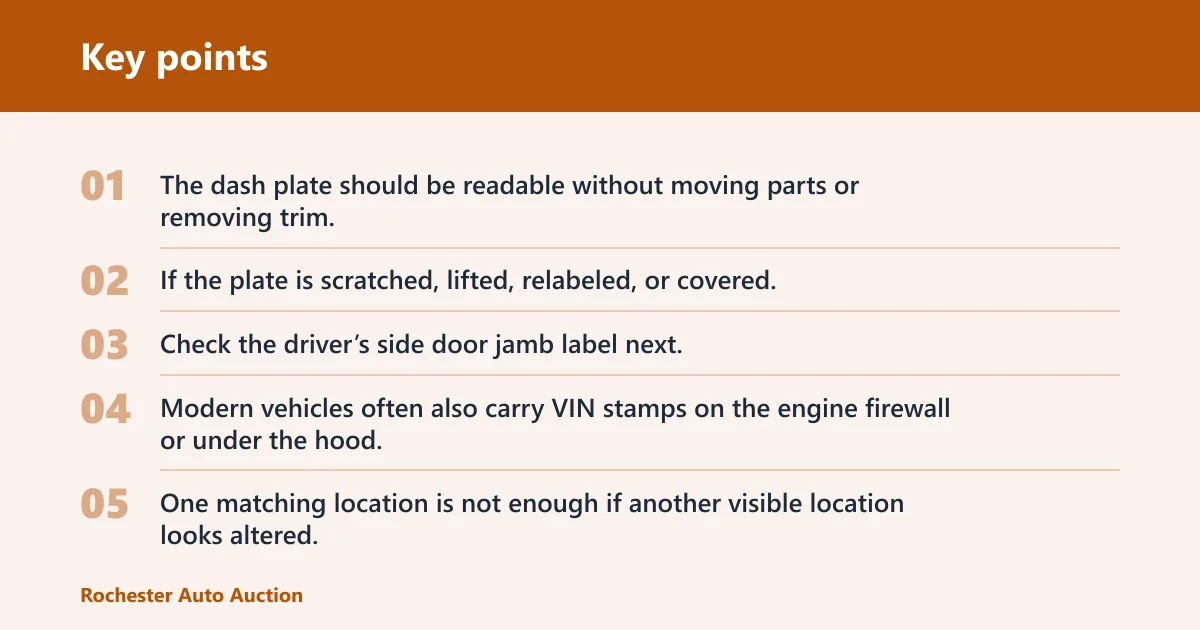
Look through the windshield from outside. The dash plate should be readable without moving parts or removing trim. If the plate is scratched, lifted, relabeled, or covered, treat that as a stop-and-review issue before bidding.
Confirm a second VIN location
Check the driver’s side door jamb label next. Modern vehicles often also carry VIN stamps on the engine firewall or under the hood, and some may have etching on the engine block, frame, or trunk. One matching location is not enough if another visible location looks altered.
Match the physical VIN to paperwork
Compare the physical VIN against the listing, title, registration if present, and any seller paperwork.
Say your auction catalog shows only the first 11 characters of the VIN and the photo of the windshield is blurred. Do not treat that as close enough. Ask for the full VIN, the dash photo, and any title page that shows the same sequence before you place a bid.
How do you check the registration against the vehicle?
Use the registration only as a cross-check, not as proof by itself. The VIN on the registration should match the car exactly, and the make, model, year, and body style should fit the vehicle in front of you. If registration is missing, expired, or unavailable, stop and confirm the title path first.
Match every character, not the general pattern
One digit matters. If even one digit differs between the dashboard VIN and the door VIN, it is a red flag. Treat a one-digit mismatch as a stop-and-review item until the seller explains it with original documents or a state record.
Handle missing or expired registration carefully
Many auction vehicles, especially wholesale, salvage, or dealer units, may not come with current registration in hand. That is not unusual, but it means you need the title, seller packet, or auction release documents to close the identity trail. Do not assume a missing registration is harmless.
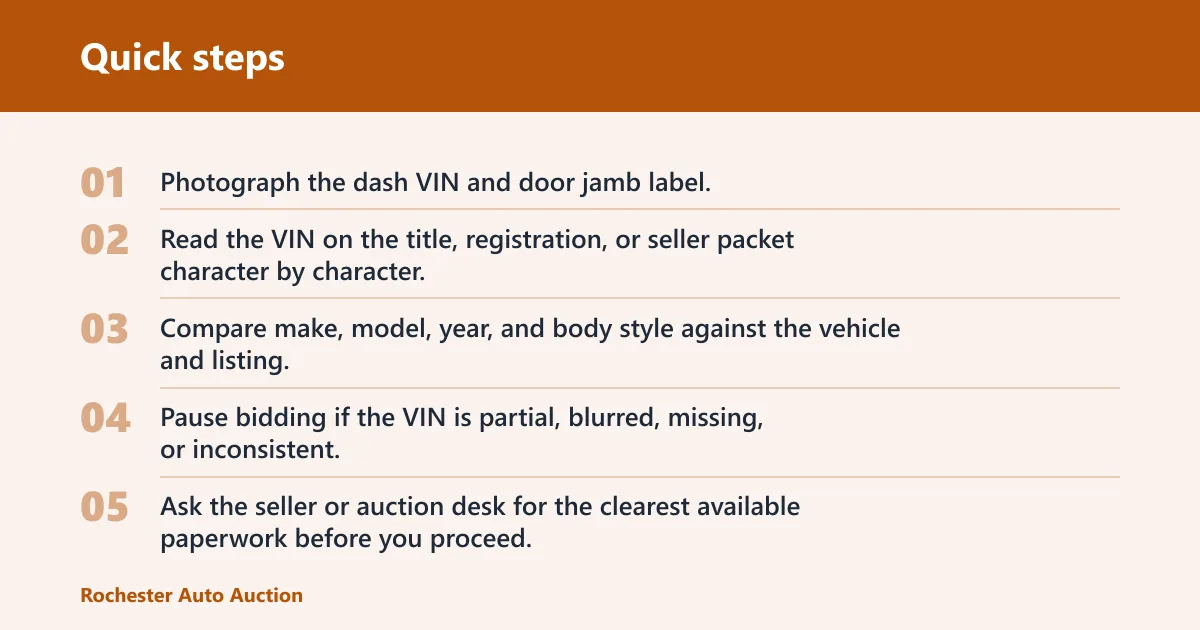
- Photograph the dash VIN and door jamb label.
- Read the VIN on the title, registration, or seller packet character by character.
- Compare make, model, year, and body style against the vehicle and listing.
- Pause bidding if the VIN is partial, blurred, missing, or inconsistent.
- Ask the seller or auction desk for the clearest available paperwork before you proceed.
VIN verification checklist
| Where to check the VIN | What must match on the registration, title, or listing | Exact action if it does not match |
|---|---|---|
| Dashboard plate at windshield base | All 17 characters, in the same order, with no missing or altered digits | Stop bidding and request a clear photo plus seller paperwork |
| Driver’s side door jamb label | Same VIN as the dash plate and the documents | Stop and inspect for swapped labels or prior body work |
| Title or registration | VIN, year, make, model, and body style | Do not bid until the seller explains the mismatch in writing |
| Auction listing or catalog page | Full VIN or a complete, legible partial that can be confirmed | Request the full VIN before bidding; a blurred listing VIN is stop/go hold |
| Under-hood stamp, firewall, frame, or trunk etching | Same sequence as the dash and paperwork | Stop if a secondary stamp is missing, ground off, or inconsistent |
Stop/go verdicts: blurred listing VIN = stop; one-digit mismatch = stop; missing registration = stop; swapped plates = stop; unreadable dash tag = stop.
What records should you compare besides registration?
Compare the title history, NMVTIS-backed history data, odometer readings, and any seller paperwork that came with the lot. Title history can show salvage, rebuilt, flood, junk, or clean events across states. A clean title does not rule out a bad VIN trail or a hidden prior brand.
Check title history and branded events
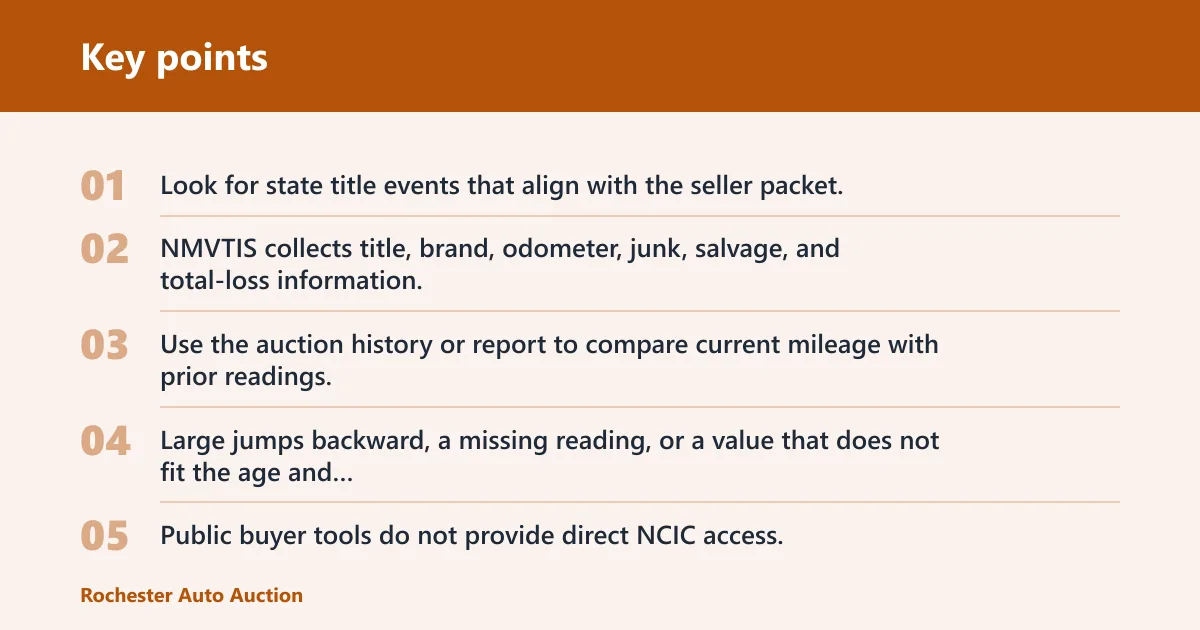
Look for state title events that align with the seller packet. NMVTIS collects title, brand, odometer, junk, salvage, and total-loss information, so a history report built from that data can expose prior brands that do not appear on a single-state document.
Compare odometer readings
Use the auction history or report to compare current mileage with prior readings. Large jumps backward, a missing reading, or a value that does not fit the age and condition of the car should move the lot into a review pile.
Screen for theft or cloning risk
Public buyer tools do not provide direct NCIC access. That means theft screening should rely on available history sources, seller documents, and physical inspection clues such as damaged plates, inconsistent labels, or a VIN that appears to have been reattached. A clean title does not clear that risk by itself.
Suppose a sedan shows a clean title in one state, but the auction history lists a prior salvage event and a lower odometer reading six months earlier. That is not a paperwork detail to ignore. The title path and mileage trail do not line up, so the lot should stay out of the bid pool until the seller explains it with source documents.
Common mistakes
Most mistakes come from trusting one source and skipping the physical vehicle. A blurred listing VIN, a missing registration, or a clean title alone can hide a mismatch. Treat the first inconsistency as a stop point, not as a reason to guess.
Trusting a blurred or partial listing VIN
If you cannot read the full VIN, you cannot verify the lot. Ask for a clearer image or the seller’s document packet. Do not bid on a number you can only infer.
Ignoring a one-digit mismatch
A one-digit difference is enough to change the vehicle identity. It may be a clerical error, a swapped plate, or a tampered tag. The next step is confirmation, not interpretation.
Assuming a clean title means a clean VIN trail
A clean title does not block a history problem. Check prior brands, odometer readings, and the physical VIN locations before you trust the title status.
Treating missing paperwork as minor
If the registration is missing, expired, or not with the lot, do not fill the gap with assumptions. Ask for title pages, seller disclosures, or a state record match before you bid.
Frequently asked questions
How do I check if the VIN matches the registration on an auction car?
Read the full VIN from the dashboard plate and compare it character by character with the registration, title, and listing. Also check the make, model, year, and body style. If anything differs, pause bidding and ask for source paperwork before you continue.
Where on the vehicle should I look for the VIN before bidding?
Start at the driver’s side dashboard at the base of the windshield. Then check the driver’s side door jamb. If accessible, look for under-hood, firewall, frame, or trunk stamps and compare them with the paperwork.
What should I do if the VIN on the dash does not match the title or reg?
Stop bidding and request the seller’s original paperwork, a clearer dash photo, and an explanation in writing. Do not assume the mismatch is clerical or harmless until the source documents prove it.
Can an auction vehicle have a clean title but still have a bad VIN history?
Yes. A clean title can still sit next to salvage events, odometer issues, or a mismatched VIN trail in other records. Check title history, odometer readings, and secondary VIN locations before you bid.
How can I tell if a VIN has been cloned or tampered with?
Look for altered rivets, damaged labels, mismatched VIN locations, and paperwork that does not line up across sources. A cloned or tampered VIN often shows inconsistency between the dash plate, the door jamb label, and the history record.
Can I verify a car’s details from the VIN before I place a bid?
A VIN lookup can often confirm make, model, year, engine, and trim, and it may also show title brands, auction history, damage descriptions, and odometer readings. Use that information to verify the lot, not to replace the physical inspection.