Is a Car Auction Inspection Service Worth Paying for?
Yes, if the inspection fee is small next to your bid ceiling and the report can stop one bad purchase; a $150 to $250 fee pays off fast when it prevents a $1,000 repair or a no-bid mistake. Skip it, and you can overpay for hidden body damage, flood signs, or mechanical faults you cannot verify on auction day. This guide shows when the fee is worth it, when it is not, and which risks an inspection still cannot remove.
What an auction inspection service does
An auction inspection service is commonly a third-party pre-bid condition check arranged before auction day. It usually adds photos and written findings, but it still works within auction access rules, so the inspection is narrower than a private-party shop visit. That limit drives the decision.
The value comes from cutting surprise, not removing it. A good inspection can stop you from bidding on a car with visible body damage, warning lights, fluid leaks, or interior water clues that do not fit the listing.
What the service usually covers
Inspectors normally perform a visual walkaround, check the cabin, look for obvious fluid leaks or missing parts, and try a basic start-up check if the yard allows it. If the vehicle starts, they may also confirm that the transmission engages.
Some services include photos and written notes that help you compare the car against the listing. CarInspector.US says it serves every Copart, IAAI, and Manheim location throughout the United States, while IAA describes the service as an independent, third-party vehicle inspection.
Where access rules limit the inspection
Access rules matter more than marketing copy. CarInspector.US says auctions do not allow test drives of vehicles, do not allow inspectors to carry tools, including scanners, and do not allow inspectors to jump-start dead vehicles. CarInspector.US also says if the engine starts, inspectors can only engage the transmission.
Those limits make the inspection a filter, not a guarantee. It can catch visible damage and some obvious mechanical problems, but it cannot replace road-load testing, lift access, or a full shop diagnosis.
What is an auction condition report, and is it enough?
An auction condition report is useful, but it is not a substitute for hands-on inspection. It is usually seller-provided or auction-provided, and it often misses hidden mechanical issues, especially when the car has a history of damage, storage, or incomplete disclosure.
Use the report as a first filter. Then use an inspection service when the bid ceiling is high enough that a missed defect would hurt, or when the listing is thin and the photos do not answer the obvious questions.
What it can miss
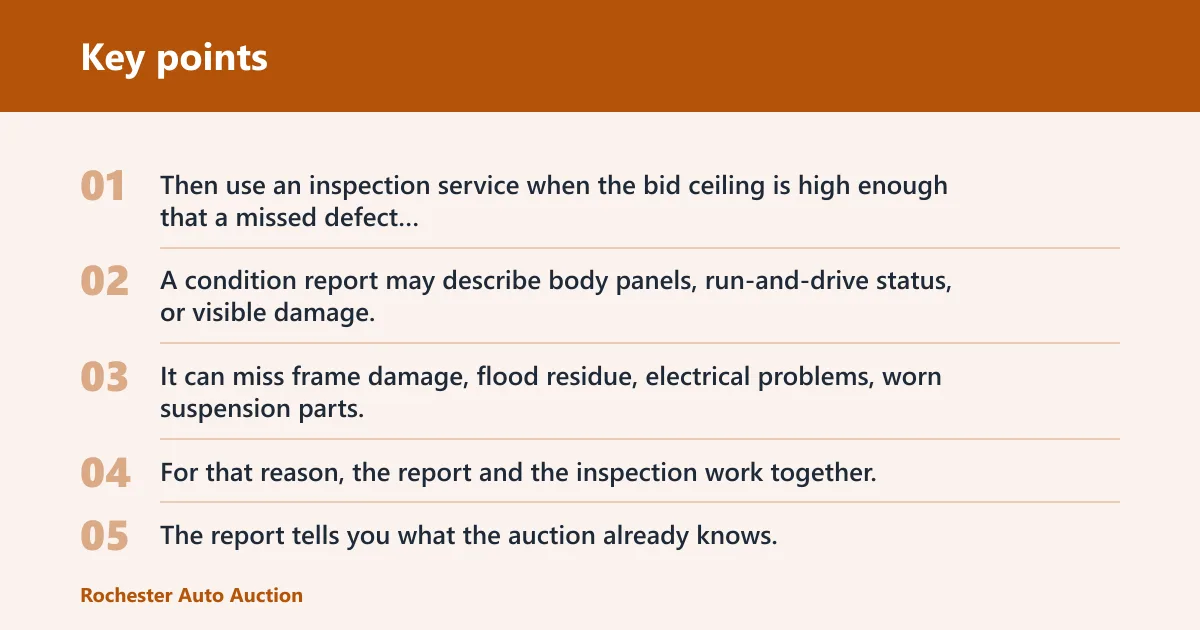
A condition report may describe body panels, run-and-drive status, or visible damage, but it does not remove risk from unseen faults. It can miss frame damage, flood residue, electrical problems, worn suspension parts, or engine issues that only show up under load.
For that reason, the report and the inspection work together. The report tells you what the auction already knows; the inspection checks what the listing may not say.
What can inspectors actually check at the yard?
Inspectors can usually check what they can see and reach without violating yard rules. That includes body panels, glass, tires, underhood condition, fluid leaks, interior wear, dashboard lights, and whether the engine starts. If the auction allows it, an OBD-II scan may add another layer of fault reading.
POMCAR says its professional inspection adds an OBD-II scan, and its starter inspection starts at $180. POMCAR also says most inspections are usually performed within 48 hours of order. The same source says it does not inspect auction vehicles because techs are typically not permitted to properly inspect them.
Body, interior, and basic mechanical checks
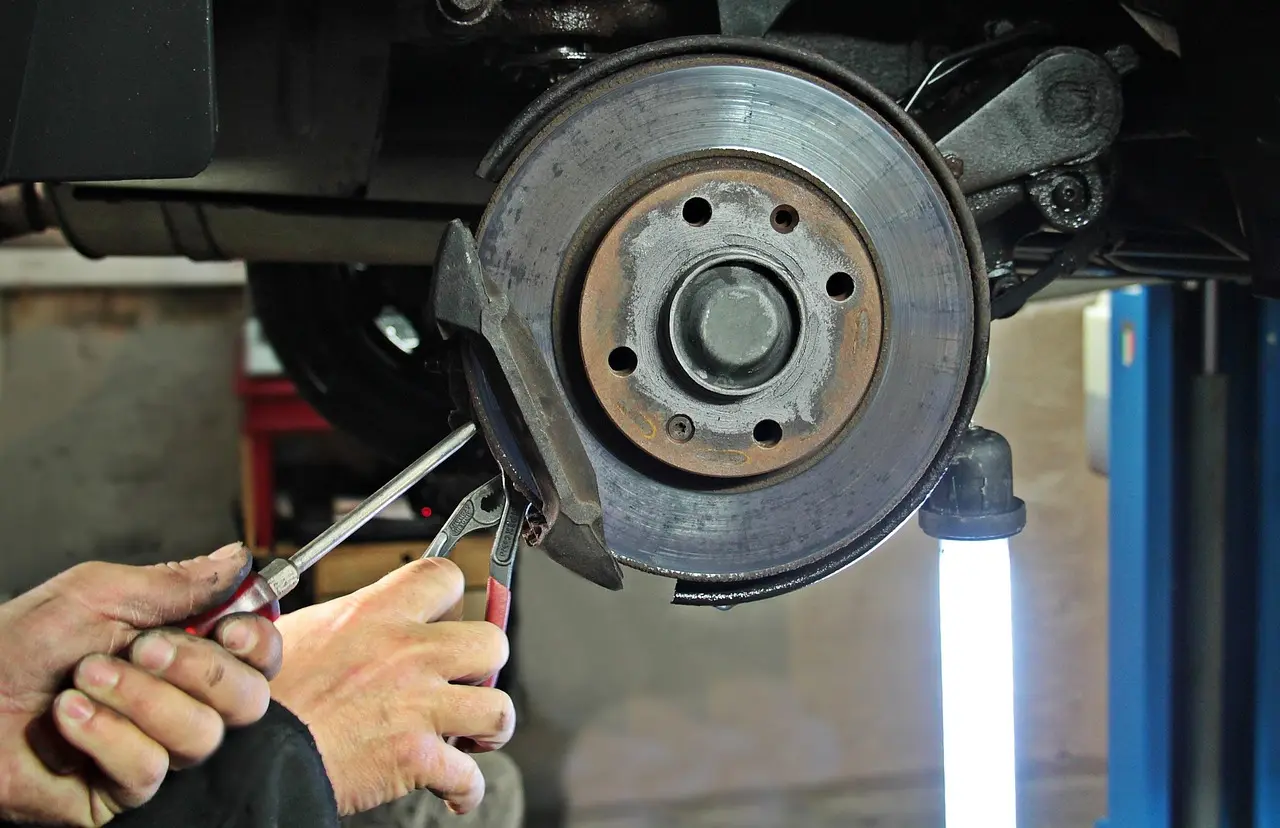
Body work is often the easiest part to verify. Inspectors can spot mismatched paint, broken lamps, bent panels, missing trim, bad alignment at the doors or hood, and signs that a car has been repaired poorly.
Inside the car, they can note torn seats, water staining, mildew odor, deployed airbags, warning lamps, and obvious electrical faults. A common first-timer mistake is assuming a clean cabin means a clean mechanical history. It does not.
OBD-II scan limits and allowed tools
An OBD-II scan can help with engine and emissions faults, but only if the auction allows the tool and the vehicle can be powered up. CarInspector.US says auctions do not allow inspectors to carry tools, including scanners, so the scan may be blocked entirely depending on location and seller rules.
That matters because some faults are electronic before they are physical. A scan may flag a stored code, but it will not tell you whether the issue is a loose connector, a failing sensor, or a deeper problem without more testing.
What an inspection cannot tell you
An auction inspection cannot replace a road test, a lift inspection, or a full diagnostic session. Without those tools, it cannot fully judge transmission slip, brake feel, steering wander, suspension clunks, or intermittent electrical problems that show up only while driving.
It also cannot guarantee that a car with a dead battery, blocked access, or a hard-no-start condition can be evaluated at all. The fee buys information, not certainty.
No road test means limited drivetrain diagnosis
Test drive restriction changes the value of inspection the most on engine, transmission, brake, steering, and suspension faults. An engine may idle fine in the yard and still misfire under load. A transmission may move the car in place and still slip on the road.
Brake pulsation, steering play, wheel bearing noise, and suspension clunks often need motion to confirm. That is why a no-road-test auction makes inspection more useful for visible condition than for deeper drivability problems.
No lift access means weaker undercarriage checks
Frame damage is one of the hardest items to confirm without lift access. An inspector may spot uneven seams, bent rails, fresh undercoating, crushed pinch welds, or misaligned mounts, but those clues are indirect. Hidden structural issues can still survive a curbside look.
Undercarriage corrosion, bent suspension parts, exhaust damage, and impact points are also harder to judge from ground level. The lower the car sits and the less access the yard allows, the weaker that part of the inspection becomes.
Dead battery problems and jump-start policy
Battery jump-start policy can decide whether a car can be evaluated at all. CarInspector.US says inspectors are not allowed to jump-start dead vehicles. If the battery is dead, auction staff may need to handle the jump, and even then the car may not fully reveal its issues.
Suppose a crossover shows up with a dead battery and a lit check-engine lamp in the listing photos. If staff will not jump it, the inspector may be left with only a visual review. If it starts, the inspection can go farther, but still not as far as a road test.
Auction inspection matrix
The fee is easiest to justify when the loss avoided is larger than the inspection cost. Use the table below as a bidding filter, not a guarantee. High-value, long-distance, salvage, and thin-listing purchases benefit the most because the cost of being wrong is larger.
| Vehicle value band | Risk level | Is inspection worth paying for? |
|---|---|---|
| Under $3,000 | Low cosmetic risk, local pickup, repair reserve already built in | Often no, unless the listing is thin or the title history is unclear |
| Under $3,000 | Higher risk, salvage branding, flood clues, or no clear run condition | Often yes if one hidden defect would erase the profit margin |
| $3,000 to $10,000 | Moderate risk, average listing detail, normal dealer or public auction buying | Usually yes if you cannot inspect in person |
| $3,000 to $10,000 | High risk, long-distance bidding, incomplete photos, or questionable condition report | Yes |
| Over $10,000 | Any meaningful mechanical or structural risk | Yes, unless you already have another trusted inspection path |
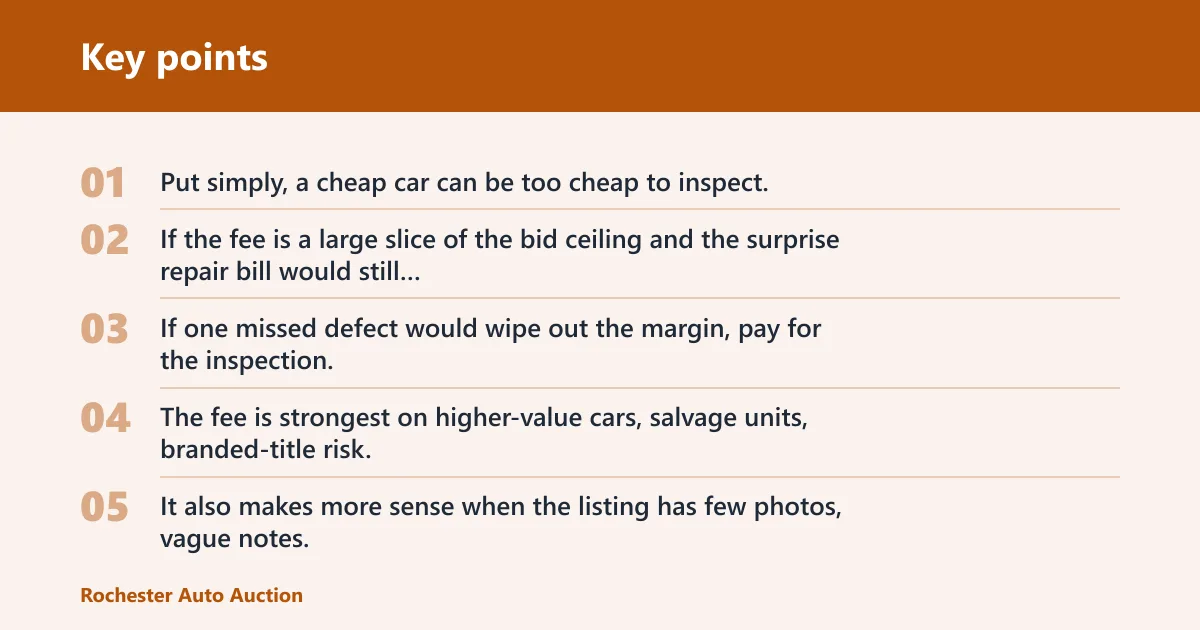
Put simply, a cheap car can be too cheap to inspect. If the fee is a large slice of the bid ceiling and the surprise repair bill would still fit your budget, you can skip it. If one missed defect would wipe out the margin, pay for the inspection.
When the fee pays for itself
The fee is strongest on higher-value cars, salvage units, branded-title risk, and long-distance bidding where you cannot see the car yourself. It also makes more sense when the listing has few photos, vague notes, or a condition report that leaves major gaps.
Say your ceiling is $8,000 and the car is a repaired flood candidate with a thin listing. A few hundred dollars for inspection is easy to justify if it avoids a car that looks fine in pictures but needs electrical repair, interior cleanup, and title caution.
When you can skip it
Inspection may be optional on very low-value cars, especially if you can absorb a surprise repair bill and the downside is mostly cosmetic. It can also be optional when the vehicle is close enough for you to check in person and the auction photos already tell a clear story.
If the car is a cheap parts run and your only concern is a dented fender or worn tires, the fee may not add enough value. The question is not whether inspection helps. It is whether the help is worth more than the fee.
Will inspection catch flood or frame damage?
An inspection can find clues, but it cannot promise a clean answer on flood or frame damage. Flood clues often show up as odor, moisture lines, corrosion, dirty seat tracks, trapped silt, or odd electrical behavior. Frame clues often show up as uneven gaps, bent mounts, or fresh undercoating.
Both are easier to suspect than to prove at auction. Salvage branding still matters because a clean-looking car can still hide prior water exposure or structural repair that only a lift, scanner, or road test would help expose.
Flood damage clues and blind spots
Flood damage often leaves visible signs inside the cabin and around connectors, but those signs are not always obvious. Damp insulation, stained carpet backing, corrosion in seat hardware, and smell can point to water exposure. Electronics may also act strangely after moisture intrusion.
What the inspector may miss is the full depth of the damage. Hidden corrosion inside modules, harnesses, and connectors can stay quiet until the car is back in service.
Frame damage clues and blind spots
Frame damage is partly a visual puzzle. Creased metal, bent brackets, uneven tire wear, or mismatch between body lines can point to trouble. But without lift access, some of the strongest evidence stays out of view.
If you are buying a salvage unit, frame clues deserve extra weight. A structural repair that looks acceptable in photos can still leave the car tracking badly, wearing tires unevenly, or refusing to align correctly later.
Do Copart, IAAI, and Manheim use the same rules?
No. Copart, IAAI, and Manheim can all be serviced by inspection providers, but the access rules, seller rules, and timing can differ by location. CarInspector.US says it serves every Copart, IAAI, and Manheim location throughout the United States, but that does not mean the same inspection depth is available everywhere.
That is why the auction network matters. Salvage, wholesale dealer, and public-facing sales are not identical, and the inspection return on investment changes with each one.
Copart access and salvage limits
Copart is a major salvage auction platform, and it is commonly serviced by inspection providers. Salvage units often carry more structural, flood, or title risk, which makes third-party inspection more useful than it is on a simple cosmetic trade-in.
The tradeoff is access. Salvage lots can be harder to evaluate thoroughly because of yard rules, damage severity, and missing components.
IAAI access and inspection providers
IAAI is another major salvage auction platform, and inspection access is available through CarInspector.US. That matters for buyers who want a third-party pre-bid condition check before committing to a branded-title or repairable loss vehicle.
Salvage buyers should still read the listing carefully. An inspection can support the decision, but it cannot erase the extra uncertainty that comes with salvage inventory.
Manheim wholesale buyer differences
Manheim is a major wholesale dealer auction platform, and inspection services are commonly used there as well. The buyers are often chasing dealer inventory, which means there may be cleaner condition, but there can also be faster bidding and less time to sort through details.
Wholesale cars can still hide mechanical issues. A dealer-only auction inspection can be more valuable than a public auction inspection when the vehicle is priced higher, the auction is farther away, or the condition report is thin.
- Check the listing and the condition report first.
- Compare the ask against your repair reserve and bid ceiling.
- Order inspection early enough for the yard schedule.
- Weight the result more heavily if the car is salvage, branded, or distant.
- Walk away if the inspection reveals a defect that breaks your margin.
Frequently asked questions
Is an auction inspection service worth paying for?
Usually yes when the car is expensive enough that one missed defect would hurt your margin. It is most worth paying for on salvage units, long-distance bids, thin listings, and cars with unclear title or condition history. On very cheap cars, the fee can be harder to justify.
How much does a car auction inspection cost?
Pricing varies by provider, auction, and service level. One public example from POMCAR is a starter inspection at $180. Use the fee as part of your bid math: if the inspection can stop a bad purchase or a repair bill larger than the fee, it is easier to justify.
What do auction inspectors actually check if they can’t test drive?
They usually check the body, glass, tires, interior, underhood condition, fluid leaks, warning lights, and whether the engine starts. If allowed, they may also do an OBD-II scan or confirm the transmission engages. They cannot fully evaluate drivability without road testing.
Do auction inspection services work at Copart, IAAI, and Manheim?
Yes, but the access rules are not identical. CarInspector.US says it serves every Copart, IAAI, and Manheim location throughout the United States, while IAA also describes its service as independent and third-party. Availability and depth still depend on the location and auction rules.
What can an auction inspector not do at the yard?
CarInspector.US says auctions do not allow test drives, tools, scanners, or jump-starts by the inspector. That means no road-load diagnosis, no unrestricted scanner use, and limited troubleshooting if the battery is dead. The inspection can inform your bid, but it cannot fully duplicate a shop visit.
Should I still pay for inspection if the auction listing has a condition report?
Often yes. A condition report is useful, but it is not a substitute for hands-on inspection and may miss hidden mechanical, flood, or frame issues. If the car is low value and the report is detailed, you may skip it. If the bid is high, the inspection is usually better value.