How to Get Access to Dealer Auctions Legally
There are a few legal ways to access dealer-only auctions, such as getting your own dealer license, being added to an existing licensed dealer’s account, or using a platform-approved dealer account. Take the wrong route and you can lose bids, deposits, and account access. This guide covers the documents, timing, and compliance steps for each path, plus which one fits your situation.
Legal auction access paths
This table separates license ownership from auction access. That distinction matters because a dealer license may be required by the state, while the auction platform may still require its own approval, rep agreement, or buyer profile before you can bid.
| Pathway | Who qualifies | Typical documents | Estimated setup time | Common blockers | Unlocks dealer-only auctions? |
|---|---|---|---|---|---|
| Own dealer license | Buyer who wants independent, legal auction access under a state license | Business registration, tax ID, bond, insurance, background check, permits, and any required education | Often weeks to months, depending on state and office review | Missing premises documents, incomplete bond, failed background check, missing tax registration | Usually yes, after state approval and platform registration |
| Added under an existing licensed dealer | Employee, authorized buyer, or dealer representative added to a dealer’s account | Government ID, authorization form, dealer’s account paperwork, platform profile documents | Often faster than licensing, once the dealer approves you | Dealer has not listed you as authorized, platform cannot verify the relationship, access limited to named users | Sometimes, if the dealer account is approved and the platform allows that user |
| Platform-approved dealer account | Already licensed dealer or qualified business that meets the platform’s rules | Dealer license, bond, insurance, tax ID, resale or permit documents, platform registration forms | Depends on document review; often shorter than a new license | State license mismatch, expired insurance, missing resale certificate, incomplete platform packet | Yes, if the platform confirms dealer status and grants bidding rights |
Choose this if… you want full control, get your own dealer license. You want speed and already work with a dealer, get added to that dealer’s account. You already hold valid dealer credentials and want to bid through a marketplace, use a platform-approved dealer account.
What counts as dealer-only access?
Dealer-only auctions are not open to the general public. Access usually depends on approved dealer status, a platform-recognized buyer account, or both. Some platforms also enforce separate registration rules even after a state license is issued, so state approval alone is not always enough.
Why public buyers are usually blocked
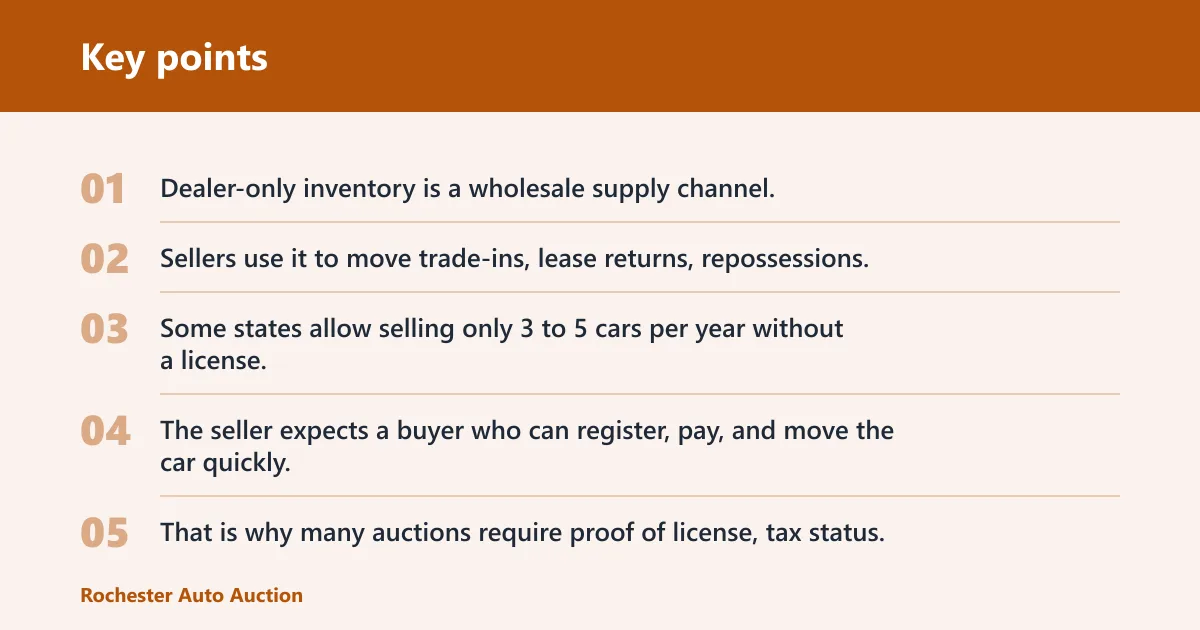
Dealer-only inventory is a wholesale supply channel. Sellers use it to move trade-ins, lease returns, repossessions, and off-lease units to licensed buyers who can meet the auction’s compliance rules. Some states allow selling only 3 to 5 cars per year without a license, which is why unlicensed buying and selling can quickly cross the line.
A dealer auction also shifts risk. The seller expects a buyer who can register, pay, and move the car quickly. That is why many auctions require proof of license, tax status, and buyer identity before bidding opens.
How auction platform approval works
Platform approval is separate from state licensing. A dealer may hold a valid license and still be blocked until the auction verifies identity, business details, resale status, and payment method. SmartAuction, for example, lets buyers place manual bids during the live auction in $100 increments and gives buyers four purchase options, but those features still sit behind account approval.
Platform rules also affect delivery timing. SmartAuction buyers must take possession within 5 business days, so approval is only part of the process. If your transport plan is not ready, a bid can turn into a deadline problem fast.
Where state licensing rules still control access
States control who can hold a dealer license, what kind of license is available, and whether retail, wholesale, or broker-related authority applies. A wholesale dealer license often supports auction buying, but it does not usually authorize retail sales to the public. A retail dealer license may allow broader sales rights, but it also tends to bring more premises and compliance checks.
That is the key point many guides miss: the auction can approve your account, then the state can still say your license type does not support the sale you want to make.
Do you need a dealer license?
For most dealer-only auctions, yes, either your own dealer license or access through a licensed dealer is required. A platform-approved account can help, but it is not a universal bypass. The auction’s rules and the state’s licensing rules both matter, and the stricter one usually controls the transaction.
When a dealer license is required
If you want to bid in your own name, receive the seller’s paperwork directly, and buy repeatedly as a business, a dealer license is usually the cleanest route. The exact license type depends on the state. Some states offer retail dealer, wholesale dealer, and broker variants, each with different rights and limits.
Wholesale dealers are common among flippers because the license is often tied to auction buying rather than public retail sales. That said, wholesale and retail rules are not interchangeable. Check the state licensing authority before you assume one license covers both functions.
When dealer-account approval is not the same thing
Being approved by an auction platform does not erase licensing rules. A platform may let a dealer rep or business user bid, but the platform can still ask for a state license, tax ID, bond, insurance, and other documents. Approval says you can use the system. It does not always say you can buy every vehicle category or resell it however you want.
Picture a first-time buyer who has a business name and tax ID but no dealer license. That buyer may pass a basic platform screen and still get stopped when the auction asks for state dealer credentials and proof of authorization.
Wholesale vs. retail dealer access
Wholesale dealer licenses are usually aimed at business-to-business buying. Retail dealer licenses generally allow public sales, but they can also require more setup, such as a compliant location, local permits, and a stronger paper trail. A wholesale license can help a flipper enter auctions, but it does not automatically create retail rights.
If your plan is to buy and resell to the public, confirm whether your state requires a retail license or a separate retail endorsement. That step avoids a costly mismatch between what the auction allows and what the state allows.
How to get your own dealer license
Start with the state license type that matches your business model, then gather the documents the state requires for entity registration, tax setup, bond, insurance, and background review. Once the license is issued, you still need to complete the auction’s own registration steps before you can bid.
Choose the right license type
Choose between wholesale, retail, or any state-specific broker-related version based on what you plan to do after the auction. If you only want auction buying, a wholesale dealer license may fit. If you want public sales, a retail dealer license may be required. A broker license, where offered, may have narrow authority and should not be treated as a universal shortcut.
Check state entity, tax, and location rules
Most states expect a registered business entity or trade name, a tax ID, and some form of approved business location or office documentation. Do not assume that forming an LLC is enough. A business entity can support a license application, but it does not itself create auction access.
Some states also require a background check or a live inspection of the office or lot. Those requirements vary by license class and by state.
Prepare bond, insurance, and background documents
The auction access checklist usually includes dealer license, bond, insurance, permits, and tax ID. Bond amounts can range from $10,000 to $100,000, depending on the state and license type. Many applications also ask for insurance declarations, owner identification, and any education proof the state requires.
Dealership Licensing says the full process takes about 2 months, the client must visit the office once, and a New York retail dealer license is valid for a full year. That same page says New York typically approves two plates with a retail dealer license. Those details are state-specific, not universal rules.
Submit the application and wait for approval
- Confirm the exact license class with your state DMV or licensing authority.
- Register the business entity and obtain the tax ID the state requests.
- Secure the bond, insurance, permits, and any required education documents.
- File the dealer application and respond quickly to follow-up requests.
- After approval, complete the auction platform registration and buyer verification.
Use the state process first, then the auction process. Reversing that order often wastes fees because the platform can approve a profile that the state later rejects.
Can you buy under an existing dealer?
Yes, if the dealer adds you as an authorized buyer, employee, or staff user and the auction platform accepts that relationship. This route can be faster than getting your own license, but the dealer remains responsible for the account, bidding authority, and paperwork kept on file.
Added as staff or authorized buyer
The dealer should keep proof that you are allowed to act on the account. That usually means a signed authorization, a roster or employee record, and the platform’s own user registration. If the platform checks buyer identity, the name on the account and the person bidding need to match the approved profile.
A common first-timer mistake is showing up to a dealer auction with only a business card and assuming that proves legal bidding access. It is not. If the dealer cannot document your authority, the auction can reject the purchase or freeze the account.
What the dealer must keep on file
The dealer should keep the license details, resale or tax documents, and any platform forms that name you as an authorized user. If the auction requires business verification, the dealer may need to submit insurance and bond documents again. Missing or expired paperwork is a common reason access gets blocked.
Common limits on permissions and bidding
Access under an existing dealer is often more limited than owning the license yourself. Some accounts allow only one registered rep. Others restrict who can sign documents, place deposits, or arrange transport. If the auction platform sees a mismatch between the dealer’s status and your user profile, it may deny bidding rights even when the dealer is valid.
What documents do you need?
The exact packet depends on the state and platform, but most buyers need the same core items: business registration, tax ID, bond, insurance, permits, and platform-specific identity or ownership documents. Missing even one item can delay approval or trigger a rejection.
Business registration and tax ID
Bring the state-registered business name, entity papers if required, and the federal tax ID or state tax registration the auction asks for. Many platforms also want the business address and contact details to match the dealer file exactly. If the address on one form differs from the address on another, the review can stall.
Bond, insurance, and permits
Bond and insurance documents should show the correct business name, effective date, and coverage amount. If the state requires a dealer permit or local business permit, include that too. Some applications fail because the bond is active but the permit is not, or because the insurance certificate names the wrong entity.
Platform-specific documents and IDs
Expect to upload a government ID, signed authorization if you are acting for a dealer, and any account setup forms the platform requests. Some systems also ask for a resale certificate, dealership license copy, or bank verification before allowing bids. SmartAuction’s rules and your state’s rules can both apply at the same time.
State or auction compliance forms
Use the forms the state or auction actually lists. Do not send a generic packet and hope it fits. California Dealer Academy offers seven auction-related resources, which is a reminder that auction prep often needs separate documents, not one universal file.
Suppose a wholesale buyer has the license, but the auction asks for a current insurance certificate and a platform-specific dealer affidavit. The license alone will not clear the account until those two forms are uploaded and matched to the business name.
Auction fees and bid math
Winning the bid is not the same as landing the car at your target price. Your all-in number usually includes the hammer price, buyer fee, auction fee, transport cost, and a reserve for arbitration risk or needed repairs. Do that math before you raise your hand.
Buyer fee and auction fee
Most auctions charge a buyer fee and may also charge an auction fee tied to the sale or buyer account. Those charges vary by platform and vehicle type. Add them to the hammer price before you compare the unit to retail market value or wholesale comps.
Transport cost
Transport can erase a narrow spread. If the car is not local, include towing or carrier cost before bidding. Dealer plates are not a substitute for auction access, and they are not a universal transport pass. Their use depends on state rules, and they do not override registration or title requirements.
Arbitration exposure
Arbitration policy matters because the auction may allow a claim only for undisclosed damage, title issues, or an inspection-report mismatch. The claim window is platform-specific, and the buyer usually has to rely on the report and file on time. Miss the deadline and the claim can be denied.
All-in bid math
Use a simple formula: hammer price + buyer fee + auction fee + transport cost + repair holdback. That holdback should cover anything the inspection report may have missed, plus the chance that arbitration does not apply. If the numbers do not work before bidding, the car is too expensive.
For example, a buyer may see a low hammer price and stop there. After fees, shipping, and a small repair reserve, the deal may no longer beat a local retail alternative. That is the point where auction math protects you from overbidding.
Frequently asked questions
How do I get into dealer auctions legally?
You need one of three legal paths: your own dealer license, access through an existing licensed dealer, or a platform-approved dealer account that meets the auction’s rules. Check your state DMV or licensing authority first, then confirm the auction’s registration requirements before you bid.
Can I buy from dealer auctions without a dealer license?
Usually not in your own name. Some buyers gain access by working under a licensed dealer or by using a platform-approved account tied to valid dealer credentials. Without one of those routes, dealer-only auctions generally block registration and bidding.
How do I get a dealer license for auction access?
Start with the license type your state allows, then complete the business registration, tax ID, bond, insurance, background check, and any required education or location paperwork. After state approval, finish the auction platform’s own account setup and document review.
What documents do I need for dealer auction registration?
Most auctions ask for the dealer license, bond, insurance, permits, and tax ID. They may also request business registration papers, government ID, and platform-specific authorization or bank documents. Exact requirements vary by state and by auction platform.
How long does it take to get a dealer license for auctions?
Timing depends on the state and the completeness of your file. The same source says the full process takes about 2 months, but missing premises documents, bond errors, or background issues can extend that. Plan for review time and platform approval time separately.
What is the difference between auction access and dealer plates?
Auction access is permission to register and bid. Dealer plates are for vehicle transport and state-authorized use, which is a separate issue. Having dealer plates does not by itself give you auction access, and plate use rules vary by state.