How to Sell on ACV Auctions Step by Step
The seller-side ACV Auctions flow is generally: confirm dealer access, build the listing, set a reserve or floor price, accept or reject the bid, confirm title and disclosure records, then release the unit only after payment and transport are confirmed. Missing paperwork or a poor price decision can delay the sale, cut proceeds, or force a rollback. This guide maps the seller workflow step by step and flags the timing and document checks that affect net proceeds.
Dealer account requirements and listing permissions
ACV Auctions is a digital wholesale auto auction marketplace for licensed dealers. On dealer-to-dealer digital platforms, access is limited to licensed dealers, and the inventory is dealer stock or trade-ins rather than retail consumer listings. That matters because the seller workflow starts with account permission, not with a public consumer account.
Dealer-only access and seller eligibility
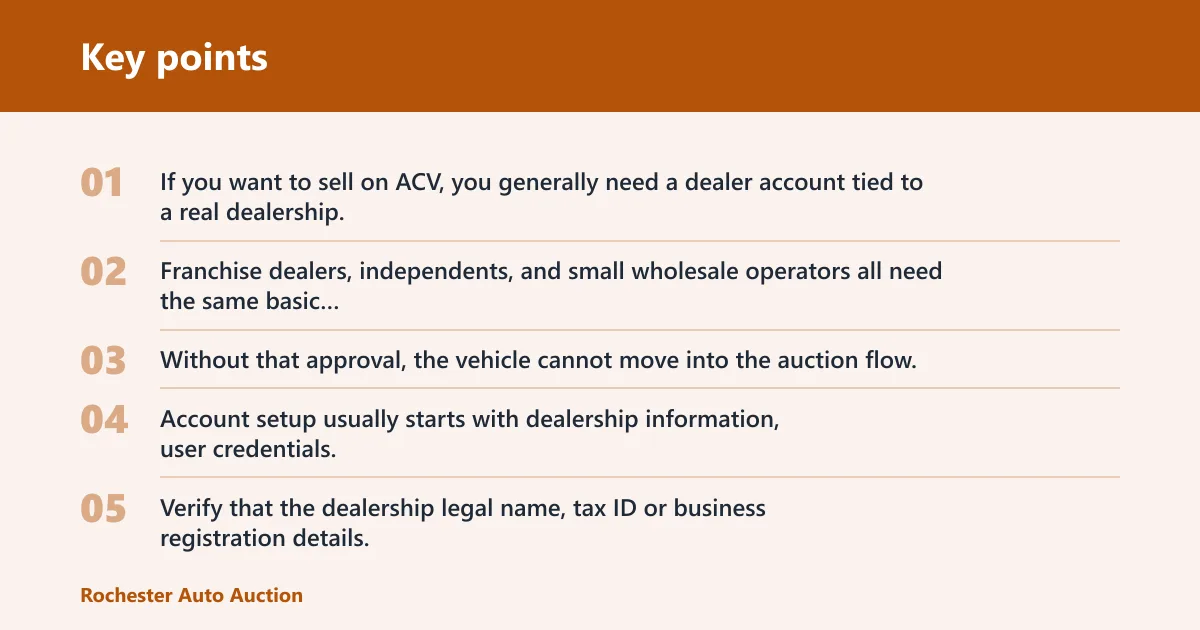
If you want to sell on ACV, you generally need a dealer account tied to a real dealership. Franchise dealers, independents, and small wholesale operators all need the same basic controls: verified dealership identity, approved users, and permission to create listings. Without that approval, the vehicle cannot move into the auction flow.
How dealer accounts and dealership verification work
Account setup usually starts with dealership information, user credentials, and internal approval for who can list, edit, and release units. Verify that the dealership legal name, tax ID or business registration details, and user roles match the records you use for title work. If user access is incomplete, listing and sale actions can stall even when the vehicle is ready.
What listing permissions allow you to do
Listing permissions should let you create the vehicle record, upload photos, enter condition notes, set a reserve price, and respond to offers. Some stores give one user the power to upload and another the power to approve acceptance or release documents. That split is useful when a desk manager needs to review the final net before the unit is committed.
Seller decision checklist
Use this table as a decision tree before you list or accept an offer. Each row shows the action that keeps the deal moving, the document or data point that supports it, the main approval risk, the delay you are most likely to see, and the most common stall point.
| ACV step | Exact dealer action | Required document or data | Approval risk | Expected delay | Most common reason it stalls |
|---|---|---|---|---|---|
| Account setup | Confirm dealership approval and user permissions before you try to list. | Dealership profile, user access details | High if the account is unverified | Same day to several days | User role missing or dealership not yet approved |
| Vehicle entry | Enter year, make, model, VIN, mileage, and reserve price. | Title, odometer reading, inventory record | Medium if data conflicts | Minutes if data is ready | VIN typo or mileage mismatch |
| Photo and condition upload | Post photos that match the vehicle’s current condition and add disclosure notes. | Exterior, interior, dash, tires, damage photos | High if damage is hidden | Minutes to hours | Missing damage photo or vague disclosure |
| Offer review | Check the offer amount, expiration window, and any counteroffer option. | Current offer screen | Medium if the reserve is unrealistic | Immediate, until offer expires | Seller waits too long and the offer expires |
| Acceptance | Accept only after you confirm net proceeds, title status, and release requirements. | Title copy, lien release if needed | High if title is incomplete | Payment timing depends on deal status | Title not ready for transfer |
| Post-sale release | Schedule pickup and hand off the unit only when payment and paperwork clear. | Release order, carrier details, title package | High if paperwork is incomplete | Varies by carrier and title method | Pickup cannot happen because the title packet is still pending |
How to read the table before you list
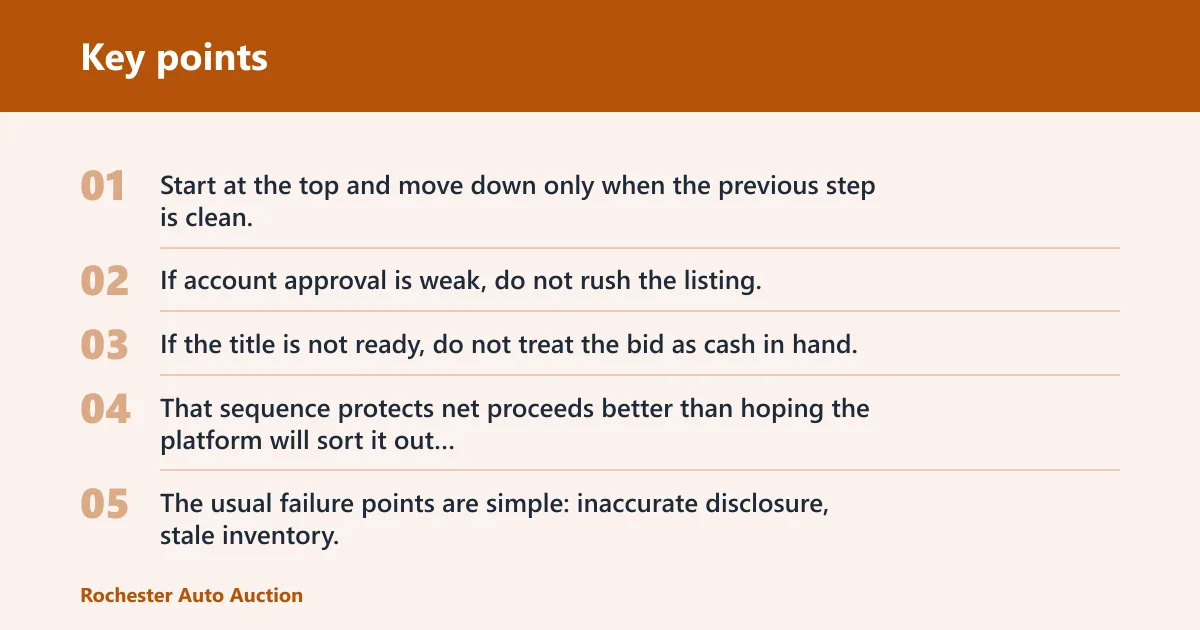
Start at the top and move down only when the previous step is clean. If account approval is weak, do not rush the listing. If the title is not ready, do not treat the bid as cash in hand. That sequence protects net proceeds better than hoping the platform will sort it out later.
Where deals most often stall
The usual failure points are simple: inaccurate disclosure, stale inventory, reserve set too high, title not available, or a carrier cannot pick up on the agreed window. A common first-timer mistake is listing a unit with a clean front photo set while the rear bumper damage is only noted in one short line. That invites disputes later.
How do I sell on ACV Auctions step by step?
Sell by moving in order: verify your account, build the listing, set the reserve, publish the vehicle, review offers, accept or counter, then clear title and arrange pickup. The key is to treat each step as a gate. If one gate is incomplete, the next one usually slows down.
Create the dealer profile
Enter the dealership profile first. Confirm the store name, address, tax or business information, and the user who has authority to post a vehicle. If your group stores multiple rooftops under one account, make sure the right rooftop owns the title and the inventory record.
Verify the dealership and user access
Before listing, confirm the account can actually sell. Dealer-to-dealer digital platforms are licensed-dealer only, and ACV is part of that category. If the seller user cannot create listings or cannot approve a sale, the vehicle sits while the buyer side keeps moving.
Confirm listing permissions before upload
Check whether the user can edit the reserve, respond to offers, and release the vehicle after sale. Some stores use limited permissions for recon staff and full permissions for managers. That separation helps, but it also means a missing approval can cost a day.
Build the listing correctly
The listing should match the car in front of you, not the unit as it looked last week. Enter the exact year, make, model, VIN, mileage, photos, condition notes, and reserve price. A clean listing shortens review time and reduces the chance of a later dispute.
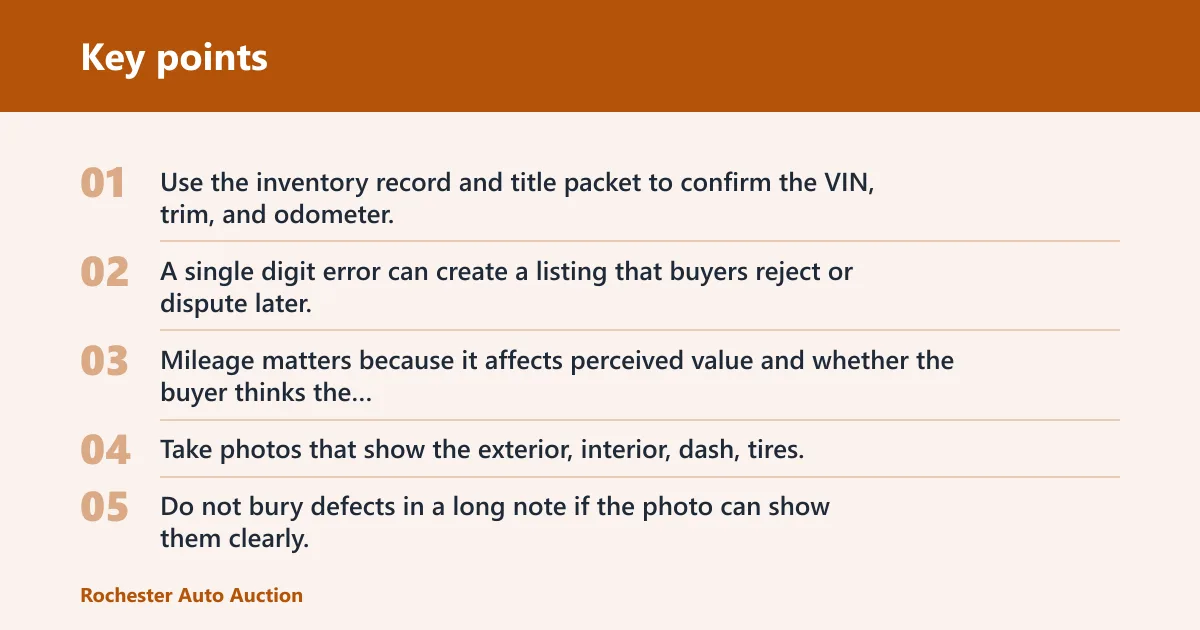
Enter year, make, model, VIN, and mileage
Use the inventory record and title packet to confirm the VIN, trim, and odometer. A single digit error can create a listing that buyers reject or dispute later. Mileage matters because it affects perceived value and whether the buyer thinks the vehicle was described accurately.
Upload photos that match the car’s actual condition
Take photos that show the exterior, interior, dash, tires, and any damage the buyer should know about. Do not bury defects in a long note if the photo can show them clearly. The listing should make the condition report easy to verify, not difficult to question.
Add condition notes and reserve price
Condition notes should mention damage disclosure, title status, and anything that affects mileage verification or inspection limits. Set the reserve price as the floor below which you are not willing to sell. If the reserve is too high, the listing may draw attention without producing a closeable offer.
Suppose a 2021 midsize SUV has 74,320 miles, a branded rear bumper cover, and a clean title in hand. If the reserve ignores the bumper damage and local wholesale demand, the listing can sit unsold while the same unit would have moved at a lower floor with clear disclosure.
How does the condition report affect the sale?
The condition report affects both buyer confidence and seller liability. It should cover disclosed damage, title status, and mileage verification, while also reflecting any inspection limits. If the report is thin or inconsistent with the photos, expect tougher offers and a higher chance of post-sale friction.
What damage disclosure should include
Disclose body damage, frame or structural concerns if known, warning lights, flood or theft history, repainting, missing keys, and obvious cosmetic issues. The point is not to over-explain every scratch. It is to prevent a later claim that the buyer was surprised by something the seller knew.
Mileage verification and inspection limits
Match the odometer photo, inventory record, and title packet as closely as possible. If the vehicle has an odometer issue, note it clearly. Inspection limits matter because a buyer may rely on the seller’s report rather than a full physical inspection, so the report must be accurate enough to stand on its own.
How title status changes buyer confidence
A paper title in the dealership file gives buyers more confidence than a title that still needs a lien release or state processing. Electronic title work can also move well, but only when the transfer path is clear. Any uncertainty about ownership usually lowers the offer or slows acceptance.
Review offers before you accept
Read the offer amount against your reserve, then check the expiration window and any counteroffer option. Do not accept on price alone. The real question is whether the offer appears to clear your expected fees, transport exposure, title hold risk, and reconditioning cost.
Read the offer amount and expiration window
The offer amount is the starting point for net proceeds, not the final number. If the window is short, decide quickly or be ready to relist. Offers that expire before your title or approvals are ready create wasted listing time.
Accept, decline, or send a counteroffer
Accept if the net works after all deductions. Decline if the reserve is too far from market. Counter if the bid is close enough that a small adjustment could close the deal. A counteroffer is useful when the vehicle is desirable but the initial number ignores condition or title friction.
Check net proceeds after fees and expected holdbacks
Before you accept, calculate all-in cost. That means sale price minus auction fees, transport, recon already spent, and any title-related holdback. Digital dealer platforms can include gate fees, documentation fees, and condition report fees, so do not treat the hammer number as what lands in your account.
For context, digital dealer platforms can show 1,000–5,000+ vehicles live simultaneously, so pricing discipline matters. If your reserve is out of step with similar units, the listing can disappear into the noise even when the car is marketable.
What happens after the sale closes?
After the sale closes, payment release, title transfer, and pickup all become linked. Payment may not move until title conditions are satisfied, and the unit should not leave the lot until the release path is confirmed. That is the point where bad paperwork turns into real delay.
Payment release timing and hold conditions
Payment in dealer digital auctions is often expected within 24–72 hours, but the actual release depends on deal status, title receipt, and platform policy. If the title is incomplete or a dispute opens, funds can be held until the issue clears. Do not plan cash flow on the assumption that every sale releases on the same timeline.
Title transfer: paper title, e-title, and lien release
If you hold a paper title, sign it exactly as required and send any supporting documents with it. If the title is electronic, follow the transfer instructions and confirm the receiving party can process it. If there is a lien, the lien release must be ready or the sale can stall at the finish line.
Pickup scheduling, carrier booking, and storage risk
Once the sale is confirmed, arrange pickup quickly and keep the vehicle in the agreed load-out window. Transportation costs on wholesale moves can range from $500–$2,500+ depending on route and unit, so the carrier should be booked with the final unit location in mind. Delays can create storage charges or missed pickup slots.
What documents do I need to sell a car on ACV Auctions?
You need the dealership account details, accurate vehicle data, photos, disclosure notes, and the title packet that proves transferability. If there is a lien, add the lien release. If the title is electronic, make sure the transfer path is ready. Missing documents are the most common reason a sale slows down.
What fees, transport, or title steps should I expect as a seller?
Plan for auction fees, possible transport coordination, and title-related work. Auction fees can include gate fees, documentation fees, and condition report fees. Transport and title handling can each delay release if they are not ready when the sale closes. Calculate the net before you accept so the gross price does not mislead you.
What happens if the buyer raises an issue after the sale?
If a buyer raises an issue, ACV arbitration rules decide whether the claim is eligible, whether it is filed on time, and what proof is required. Keep the listing photos, title records, and disclosure notes because they become the main evidence. The seller-side risk is simple: weak documentation makes disputes harder to defend.
Arbitration rules, time limits, and documentation
Disputes usually turn on whether the issue was disclosed, whether it falls inside the eligible window, and whether the buyer can document the claim. Save the condition report, photos, mileage proof, and title paperwork. If the claim is outside the rule window or the issue was already disclosed, the seller position is stronger.
Frequently asked questions
What is acv auctions?
ACV Auctions is a digital wholesale marketplace for licensed dealers. Sellers use it to move dealer inventory and trade-ins online. The seller side depends on dealership verification, listing accuracy, and title readiness, because the platform is built for dealer-to-dealer transactions rather than public retail sales.
How long does it take to get paid after selling on ACV Auctions?
Do not assume a fixed payout window. Payment release depends on deal status, title receipt, and platform policy, and title problems can hold funds. In dealer digital auctions, payment is often due within 24–72 hours, but sellers should treat that as a planning range, not a guarantee.
What should I check before I accept an ACV seller offer?
Check the offer amount, the expiration window, your reserve, expected fees, transport exposure, and any title holdback. Then compare the net to your floor. If the title is not ready or the disclosure is incomplete, the offer may look better than the final proceeds really are.