Should You Sell Your Car at Auction with No Reserve or a Reserve?
Use a reserve if you need downside protection. Choose no reserve only when buyer demand is broad, bidding is active, and speed matters more than holding out for a minimum price. Pick wrong and you can leave money on the table or fail to sell at all, which can add fees and delay your next move. This guide explains how each format works, when each fits, and how to judge the tradeoff before you list.
When no reserve aligns with your goals
Choose no reserve only when you can accept price risk in exchange for speed and attention. It fits best when buyer turnout is strong, the vehicle is easy to value, and the auction has enough active bidders to support competitive bidding. If you need a floor, use a reserve.
What seller goals point toward no reserve
No reserve can make sense when your main goal is a quick sale, a clean exit, or broad bidder interest. Because the highest bid wins, the format removes the hidden minimum that can slow some buyers. That can work well for common cars with clear market value and steady demand.
When speed matters more than price protection
If you care more about closing the sale than protecting a minimum return, no reserve may be worth the risk. That tradeoff is easier to justify when the car is ordinary, the lot is well viewed, and the inspection window gives bidders enough confidence to bid without hesitation.
When reserve is the safer choice
Reserve is safer when the car is niche, modified, older, or likely to split opinion. It also fits when storage, re-entry, transport, or listing costs would hurt too much if the first sale attempt falls short. If the number matters more than speed, protect the downside.
Reserve price vs no reserve
A reserve price is the seller’s confidential minimum acceptable price. If bidding does not reach it, the car does not sell. A no reserve auction, also called an absolute auction, means the highest bid wins regardless of the final price. A low starting bid does not prove no reserve.
How a reserve price works
The reserve sits behind the scenes. Buyers may not know the exact number, but they do know the car will only sell if bidding clears that floor. In practice, that can keep a seller from accepting an outcome that is too low for the vehicle’s condition or market position.
How a no reserve auction works
No reserve means there is no hidden minimum price. The hammer price is the final winning bid when the auction closes, and the car sells to the highest bidder. That can be useful when the seller wants certainty of sale, but it also means the final number can land below expectations if turnout is thin.
Why starting bid can mislead buyers
The starting bid is the opening price. It may be set low to attract attention while a reserve still exists. That is why buyers and sellers should read the terms carefully instead of guessing from the first bid. Subject to confirmation is also different from no reserve, because the seller may still approve or reject the winning bid.
Suppose a sedan opens at a low bid and climbs quickly to a strong number. That does not prove it was no reserve; the seller may still have a confidential minimum that has not been disclosed.
How buyer turnout changes results
Buyer turnout is one of the biggest variables in a no reserve sale. More active bidders often lead to more competitive bidding. Fewer bidders can do the opposite. That matters most for niche, modified, and collector vehicles, where only a small pool may understand the car well enough to bid hard.
Why turnout matters more for niche cars
A common commuter car often has a broad audience and easier price discovery. A modified coupe, rare trim, or collector car may have a much smaller bidder pool. If only a few qualified bidders show up, the hammer price can fall faster than the seller expects, especially with no reserve.
How inspection windows affect bidding confidence
The inspection window can affect how secure buyers feel before the auction closes. A clear preview period lets bidders assess condition, title status, and any visible faults. A weak or rushed inspection window can reduce confidence, especially when the car is unusual or the photos leave questions unanswered.
How buyer’s premium changes bid behavior
Buyer’s premium is an added charge on top of the hammer price, and it should be disclosed upfront. Buyers factor it into their true cost, so a bid that looks strong may feel more expensive once the premium is added. That can soften bidding, especially near the top end.
Say a buyer plans to spend a fixed total and sees a premium on top of the hammer price. That buyer may stop bidding earlier than expected, because the final out-of-pocket number rises faster than the bid itself.
Is no reserve better for sellers?
No reserve is better for sellers only when the market is likely to support active bidding and the seller values speed over a guaranteed floor. It is often a fair fit for common cars with broad appeal. It is usually a weaker fit for collector, modified, or thin-demand vehicles.
When common cars can fit no reserve
Common cars with clean title status, familiar trim levels, and easy-to-check condition can work well in a no reserve format. Buyers know how to price them, so the bidding can move quickly. Even then, the seller still needs to watch fees, premium effects, and the possibility of soft turnout.
When collector or modified cars need a reserve
Collector and modified cars can attract strong interest, but that interest is often narrower and less predictable. If the right bidder does not appear, the final hammer price may not reflect the vehicle’s real value to the seller. A reserve keeps that risk in check.
What weak turnout can do to hammer price
Weak turnout can pull the hammer price down fast. That is the main downside of no reserve. A car may still sell, but the result may be far below the seller’s target once the final bid is set and the buyer’s premium is added on the buyer side. For a seller, that can mean a disappointing net outcome after fees.
Traditional car auctions can also bring travel, entry fees from £15 or more, re-entry fees if the car does not sell first time, and storage fees while the car sits on site. Those costs change the real net proceeds, so the sale price alone does not tell the full story.
Reserve decision matrix
Use this matrix to match the format to the vehicle, the bidder pool, and the amount of downside you can tolerate. The recommendation is not about getting the highest possible headline price. It is about balancing sale certainty, price risk, and the likely strength of demand.
| Scenario | Car type | Urgency | Bidder depth | Expected price risk | Recommended format | One-line recommendation |
|---|---|---|---|---|---|---|
| 1 | Common commuter car with good history | Low | Deep | Low | No reserve | Use no reserve if the car is easy to value and turnout is likely to stay strong. |
| 2 | Older high-mileage car | Moderate | Uneven | Medium | Reserve | Use a reserve if you need protection from a thin crowd and uncertain bidding. |
| 3 | Modified car with aftermarket parts | Moderate | Narrow | High | Reserve | A reserve can make sense because the right bidder may be rare and the price spread can be wide. |
| 4 | Collector car with verified interest | Low | Deep, qualified | Medium | Either, lean reserve | Use reserve unless the turnout is proven and the seller accepts a fast-sale risk. |
| 5 | Seller needs a quick sale | High | Deep enough | Medium | No reserve | Use no reserve only if the seller can accept the chance of a lower hammer price. |
| 6 | Seller can wait for a better result | Low | Any | High downside sensitivity | Reserve | Use a reserve when timing is flexible and protecting net proceeds matters most. |
How do you set a reserve?
Set the reserve from the bottom up: market value, floor price, and acceptable downside. Start with what the car should realistically bring, then subtract the costs that will hit your net proceeds. The reserve should protect your minimum acceptable outcome without being so high that it scares off serious buyers.
Start with market value and floor price
First, identify a realistic market range for the car’s trim, condition, mileage, title status, and demand. Then define your floor price, which is the lowest net result you are willing to accept after costs. The reserve should sit near that floor, not far above the market range.
Account for fees and net proceeds
Do not set a reserve from the headline sale price alone. Factor in entry fees, possible storage charges, transport, re-listing costs, and any re-entry fee if the car comes back unsold. Those charges can eat into the result quickly, especially when the first auction does not clear.
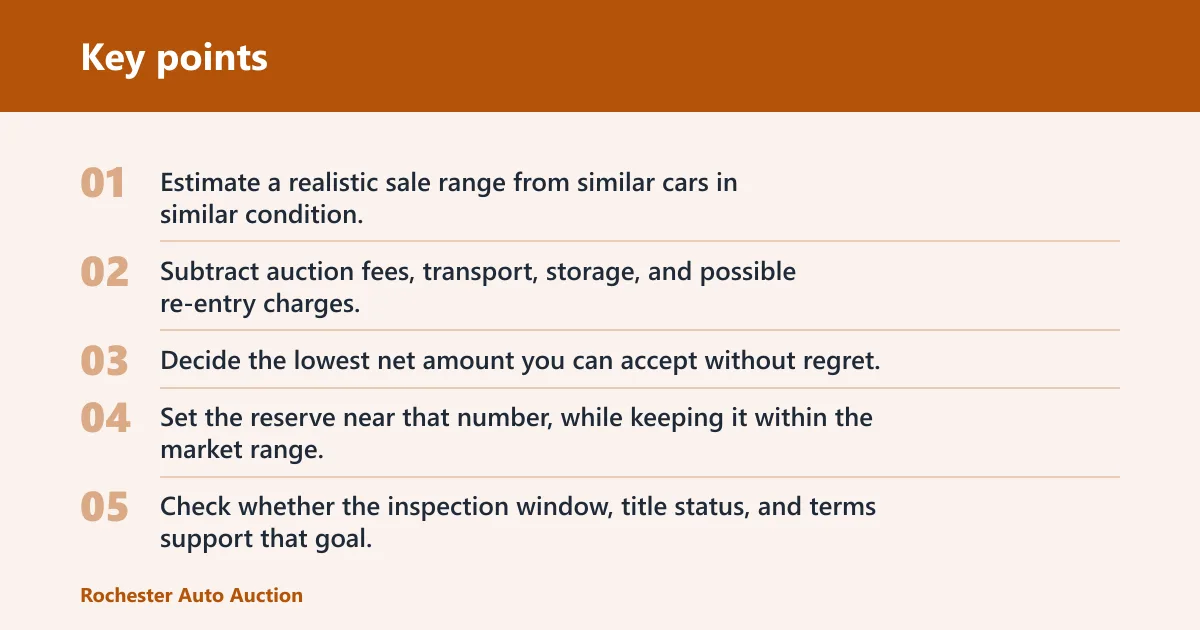
- Estimate a realistic sale range from similar cars in similar condition.
- Subtract auction fees, transport, storage, and possible re-entry charges.
- Decide the lowest net amount you can accept without regret.
- Set the reserve near that number, while keeping it within the market range.
- Check whether the inspection window, title status, and terms support that goal.
Set a reserve buyers can still reach
A reserve that sits too high can block a sale. A reserve that sits too low can defeat the point of using one. The right number is usually one that protects against a bad outcome while still leaving room for active bidders to cross the line during the auction.
Frequently asked questions
Should I sell my car at auction with no reserve or a reserve?
Use reserve if you need downside protection or if the car has a narrow bidder pool. Use no reserve only when demand is strong, the vehicle is easy to value, and speed matters more than holding out for a minimum. The right choice depends on your risk tolerance and turnout expectations.
Is a no reserve auction better for sellers?
Not always. No reserve can help move a car quickly and may draw more bidder attention, but it also exposes the seller to a lower final hammer price if turnout is weak. It works best when the market is broad and active, not when the audience is thin or uncertain.
What happens if my car does not reach reserve at auction?
If bidding does not reach reserve, the car does not sell. That can mean a second auction attempt, a change in the reserve, or a different selling channel. Ask about re-entry fees, storage charges, and the timing for relisting before you commit, because those costs affect the net result.
Will a reserve price put buyers off at auction?
It can, if buyers think the reserve is too high or the seller is unlikely to move. But a reserve does not automatically scare off serious bidders. Clear photos, a solid inspection window, and accurate disclosures matter more than the hidden floor when bidders trust the listing.
Can I sell a car below reserve price at auction?
Usually no, because the reserve is the seller’s confidential minimum and the car should not sell unless bidding reaches it. A separate term such as subject to confirmation is different, because the seller may still choose to approve or reject the winning bid. Read the auction terms carefully.
How does no reserve change the final hammer price?
No reserve makes the highest bid the sale price, so the hammer price can end wherever bidding stops. That can work well in strong turnout, but it also means the final number may come in below expectations if the bidder pool is thin. Buyer’s premium still affects total cost.
When is a reserve price safer than no reserve?
A reserve is safer when the vehicle is rare, modified, older, or hard to price, or when you cannot tolerate a low sale. It is also safer if the inspection window is short, buyer turnout is uncertain, or auction fees would make a weak result too costly to absorb.
How do I choose a reserve for a car auction?
Start with market value, subtract your costs, and set a floor you can live with. Keep the reserve close enough to reach in normal bidding, but not so low that it leaves you exposed. If the reserve is far above likely demand, the car may simply fail to sell.