How to Set a Reserve Price When Selling a Car at Auction
Set your reserve at the lowest price you can accept after you subtract auction fees, transport, and condition repairs from a realistic market value. For many private sellers, that lands around 85% to 95% of adjusted value, not a round number. Set it too high, and the car may miss the sale and lose buyer attention. This guide shows how to build a reserve band from market data, fees, and condition.
What a reserve price means at auction

A reserve price is the fixed minimum amount you want for the car. If bidding stops below the reserve price, the sale usually does not go through. Auction house advice helps because the house can compare your car with current demand, condition, and recent bids before you set that floor.
Do not confuse reserve with the opening bid. The starting bid is only the first number in the room or on the screen. The reserve is the seller’s private bottom line, and it may sit well above the opening bid if the car is desirable, or close to it if you want a quick sale.
What you’ll need
- Trade value for the same model, trim, mileage, and age band.
- Retail value for the car in similar condition.
- The auction house estimate and condition report.
- Vehicle paperwork: V5C registration certificate, vehicle handbook, garage receipts, and service book.
- Fee details for commission, reserve charge, transport, and any detailing or prep costs.
- A realistic target for your net proceeds after every cost is deducted.
How do you gather the right numbers?
Start with the auction house inspection and damage assessment. Auction houses inspect the car before listing it in the auction guide, and technicians create an accurate description before the car is listed. Damage found during assessment cuts the price, so condition belongs in reserve setting from the start.
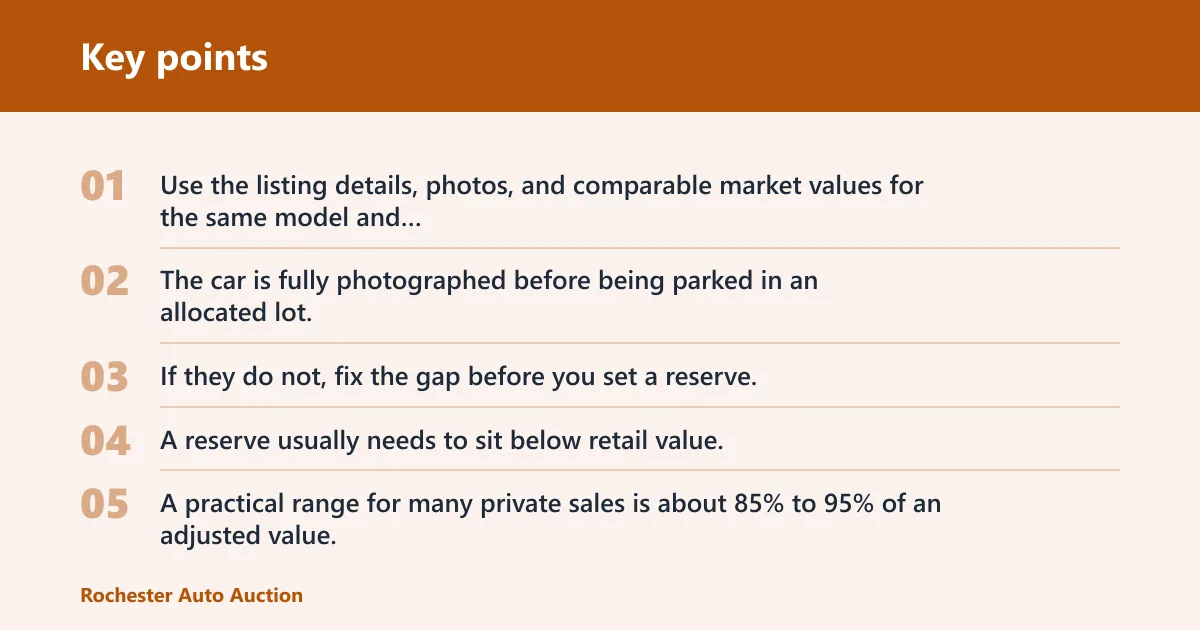
Use the listing details, photos, and comparable market values for the same model and trim to check whether the house estimate is realistic. The car is fully photographed before being parked in an allocated lot, so the images and description should match the condition report. If they do not, fix the gap before you set a reserve.
How far below market value should a reserve price be?
A reserve usually needs to sit below retail value, because auction buyers expect room for their own margin and any reconditioning. A practical range for many private sales is about 85% to 95% of an adjusted value, but the right band depends on condition, demand, and fees. A rare, clean car can sit nearer the top end; a rough car should not.
Suppose a 2019 hatchback has a retail value of £12,000, but the auction house expects the trade spread and buyer margin to pull it lower. If the car also needs tyres and a valet, the reserve should reflect that cost before bidding starts. Otherwise, the seller may chase a number the market will not pay.
How do you turn value into a reserve band?
Work from net proceeds, not the headline price. The final bid is only part of the story, because auctioneer commission is tied to the vehicle’s final value when sold, reserve pricing may cost extra, and transport or detailing can eat into the result. The correct reserve is the price that still leaves the seller where they need to be after those deductions.
Use three condition bands rather than one fixed guess. Clean, average, and rough cars should not share the same floor, because condition changes both demand and the likely bidding spread. The auction house estimate should guide the range, but your own bottom line decides whether the reserve is worth setting at all.
Reserve price worksheet
| Scenario | Trade value | Retail value | Expected auction discount | Auction fees | Transport/detailing costs | Target net proceeds | Recommended reserve band |
|---|---|---|---|---|---|---|---|
| Clean | £8,200 | £10,000 | 15% | £350 | £180 | £8,600 | £8,300 to £8,700 |
| Average | £7,000 | £8,600 | 18% | £350 | £300 | £7,000 | £6,500 to £6,900 |
| Rough | £5,400 | £6,800 | 22% | £350 | £500 | £5,200 | £4,700 to £5,100 |
In this worksheet, the reserve band is lower than retail value because the auction discount, fees, and prep costs are already stripped out. If the calculated band falls below the likely hammer price, reserve may be unnecessary. That is often the better answer for a tired car with little buyer interest.
Should you choose reserve or no reserve?
Choose reserve when you need a minimum net outcome and can afford the car to wait for the right bid. Choose no reserve when speed matters more than price protection, or when the model is weak, common, or expensive to hold. Private sellers can sell via auction if they are the registered keeper and sole owner, but the sale format should fit the car, not the other way round.
No-reserve selling can avoid the extra cost that comes with reserve pricing. It can also suit a seller who just wants to be rid of the car. The trade-off is simple: you give up a floor in exchange for a better chance of a sale.
What happens if your car does not reach reserve at auction?
If bidding stalls below reserve, the car stays unsold. The auction house may invite post-auction negotiation, but that depends on bidder interest and house policy. If the gap is only a little short, you may choose to lower the reserve before the next sale date. If the gap is large, a reserve reset usually is not enough.
A common first-timer mistake is setting reserve at the exact amount the seller wants to receive, before fees. Picture a family hatchback with a target around £6,000 and costs of about £400. If bids stop at £5,900, the seller is still short once commission is taken. The reserve should have been set from net proceeds, not wishful gross proceeds.
Can you lower your reserve price if bidding is slow?
Often, yes, but only before the auctioneer closes the sale. A practical adjustment is to lower the reserve in increments of about £100 to £250, then recheck the likely net after commission and fees. Once bidding starts, do not assume the floor can always be changed in time.
If that did not work, leave the reserve unchanged and wait for the next sale if the current market is weak. Lowering too far can erase the protection you set in the first place. If the bids are already close, a small reduction may be enough to reopen the market.
Common mistakes
- Setting reserve above realistic auction value, which can block a sale.
- Ignoring the reserve fee, auctioneer commission, transport, or detailing costs.
- Treating the auction estimate, starting bid, and reserve as the same number.
- Listing the car without the V5C registration certificate and other paperwork.
- Skipping the condition report when damage or missing items are already affecting value.
Another error is assuming a clean retail figure translates directly into the auction room. It does not. The buyer needs margin, and the auction house needs room for fees. If you ignore that spread, your reserve may sit where the market will not go.
What paperwork should you have ready before setting a reserve for auction?
Have the V5C registration certificate, vehicle handbook, garage receipts, and service book ready before you commit to a reserve. Those documents support the listing description and help buyers trust the car’s history. Missing paperwork does not always kill a sale, but it can lower confidence and lower bids.
Also check that the inspection notes match the paperwork. If the service book shows regular maintenance but the car has a major warning light or unresolved body damage, the reserve should reflect the gap between history and present condition. Clean documents do not cancel out damage.
How should you compare reserve price, starting bid, and estimated value?
Use estimated value as the market reference, starting bid as the opening point for competition, and reserve as your private floor. They are related, but they are not interchangeable. A low starting bid can draw attention without meaning the seller will accept it, and a high estimate does not guarantee the same result.
The safest comparison is to ask three questions in order: what buyers may pay, what the auctioneer expects, and what you must net after fees. If those three numbers do not overlap, the reserve is probably too high or the sale format is wrong for the car.
Frequently asked questions
How do I decide the right reserve price for my car at auction?
Start with a realistic market value, subtract auction fees, transport, and any reconditioning cost, then set a floor that still meets your net target. For many cars, that produces a reserve below retail and above a weak trade-in figure. The auction house estimate should confirm whether that floor is workable.
Should I set a reserve price or no reserve when selling a car at auction?
Use reserve if you need price protection and can tolerate the car not selling. Use no reserve if speed matters more, if the model is hard to value, or if you want to avoid the reserve charge. A no-reserve sale can be the better choice when the car is cheap to move and unlikely to attract strong bidding.
What does an auction house use to value my car before setting reserve?
The house uses the inspection, condition report, photos, mileage, history, damage assessment, and current market demand for the same model and trim. Technicians create the description before listing, and any damage found during assessment reduces value accordingly. That is why reserve should follow the report, not the owner’s hope.
Does setting a reserve price cost extra when selling a car at auction?
Yes. Placing a reserve price on a car auction involves an extra fee, while not setting one can avoid that cost. The seller should also factor in commission, because auctioneers benefit from at least 10% of the vehicle’s final value when sold. Fees matter as much as the hammer price.
What happens if my car does not reach reserve at auction?
If bidding does not reach the floor, the car does not sell at auction. The seller may be able to renegotiate after the event, lower the reserve for the next sale, or withdraw the car. The best response depends on how close the bids came to the floor and how strong demand looked in the room or online.