What Extra Seller Fees Can Be Added After Your Car Sells?
After a car sells, seller fees may still be deducted for arbitration, title or title-brand problems, transport, run fees, condition-report corrections, and approved post-sale repairs, if the auction contract allows them or the issue is documented before payout closes. Miss one, and your net proceeds can drop without warning. This guide shows which post-sale deductions can appear, when they trigger, and how to verify or dispute them before final settlement.
Why your payout can change after sale
Your payout can be lower than the winning bid because the settlement statement shows the gross sale price first, then subtracts approved deductions before listing net proceeds. A seller reserve only protects the minimum sale price; it does not block later administrative charges, title charges, storage, or claim-based deductions if the auction rules allow them.
Gross sale price versus net proceeds
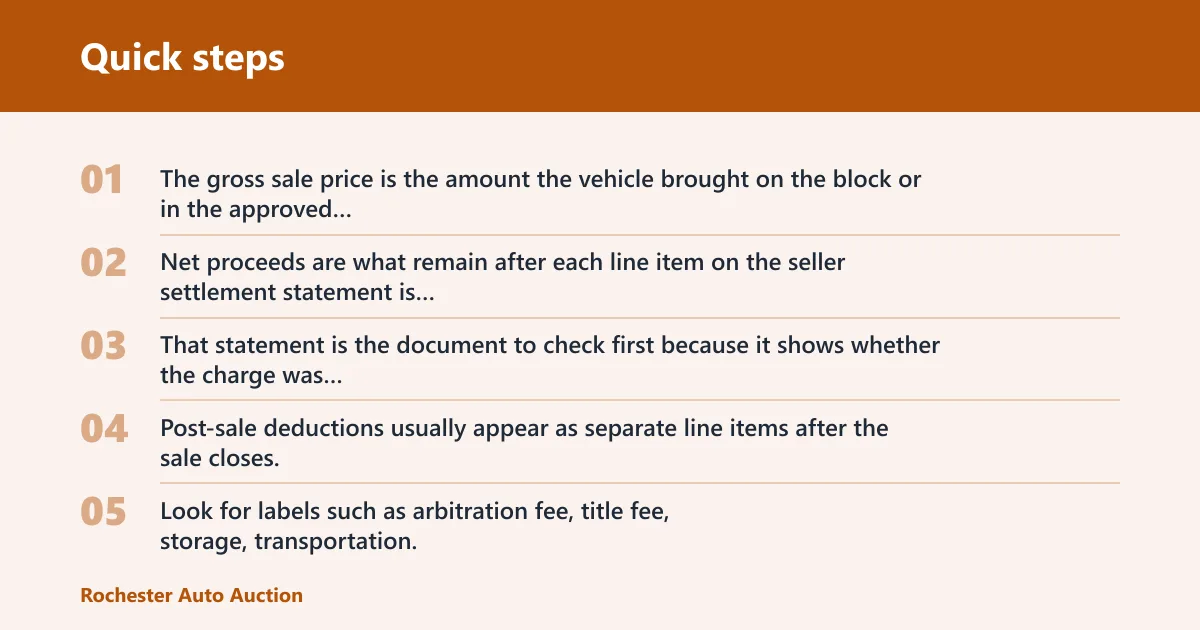
The gross sale price is the amount the vehicle brought on the block or in the approved sale channel. Net proceeds are what remain after each line item on the seller settlement statement is applied. That statement is the document to check first because it shows whether the charge was taken from seller funds, buyer funds, or split under the contract.
Where post-sale deductions appear
Post-sale deductions usually appear as separate line items after the sale closes, not as part of the hammer price. Look for labels such as arbitration fee, title fee, storage, transportation, inspection adjustment, or reconditioning charge. If the line item is missing from the settlement statement, ask for the supporting rule and claim record before the payout is finalized.
Why the reserve does not stop later charges
A seller reserve sets the lowest acceptable sale price, but it does not freeze every later cost. If title work stalls, the vehicle sits past the free hold period, or a valid claim is approved after inspection, those charges can still reduce proceeds. The reserve controls price acceptance, not every post-sale expense.
Can fees be added after the auction closes?
Auction fees can be added after the auction closes when the auction terms and conditions allow later billing for a specific event, such as a buyer claim, missing title item, or pickup delay. The key question is not whether the sale is closed, but whether the contract gives the auction authority to assess that charge after settlement.
What auction terms and conditions control
The auction terms and conditions decide who pays for what after sale, which claims are allowed, and which deadlines apply. They also set the process for disputes, inspection rights, title delivery, and pickup. If the terms assign a charge to the seller only under certain facts, the auction must show those facts in the file.
Which charges are tied to later events?
Later-event charges include arbitration, post-sale inspection or reconditioning, title delay costs, storage, and transportation arranged after sale. These are not always known at the moment of sale because the trigger happens later. For example, a buyer claim may arise after inspection, or storage may begin only after a missed pickup window.
When a fee is final versus still disputable
A fee is closer to final when the auction has a contract basis, a dated support record, and a clear notice period that has run. It remains disputable when the charge lacks a linked document, exceeds policy caps, or appears after a deadline without notice. The settlement statement should match the claim file line by line.
What extra seller fees checklist
This checklist helps you verify the charge type, the event that triggered it, and the document that proves the charge is valid. Keep the settlement statement, sale record, and related claim papers together before payout closes.
| Charge type | What triggers it after sale | What document proves whether it is valid |
|---|---|---|
| Arbitration fee | Buyer dispute after inspection or claim review, based on auction rules and sale type | Seller settlement statement plus arbitration notice and condition report |
| Title fee | Title processing is incomplete, delayed, or needs duplicate title or lien release handling | Settlement statement plus title request log, title copy, or lien release record |
| Storage fee | Vehicle stays on-site past the free hold period, often after pickup delay | Settlement statement plus in-yard inventory record and pickup log |
| Transportation fee | Auction arranges movement of the vehicle after sale or to another location | Settlement statement plus transport order, bill of lading, or dispatch record |
| Condition-report correction | Post-sale inspection finds omitted damage or a disclosure mismatch | Condition report, post-sale inspection photos, and claim decision |
| Reconditioning charge | Undisclosed mechanical or cosmetic issue falls under warranty or disclosure rules | Repair authorization, inspection notes, and policy limit sheet |
| Gate or run fee | Pickup, movement, or sale handling charge is allowed by the auction policy after sale | Settlement statement and the fee schedule or sale terms |
Use the checklist in this order
- Match the charge name on the settlement statement.
- Find the event that supposedly triggered it.
- Check the auction terms and conditions for that exact charge.
- Pull the supporting document, such as a claim notice or pickup record.
- Confirm the amount, date, and party responsible before payout closes.
Arbitration fees and condition claims
An arbitration fee can be charged to the seller when a buyer disputes condition or description after inspection or claim review, but only if the auction rules and sale type allow that result. The fee is usually tied to a documented claim, not to a buyer’s general complaint. The condition report often decides whether the charge holds.
When a buyer dispute can create a seller charge
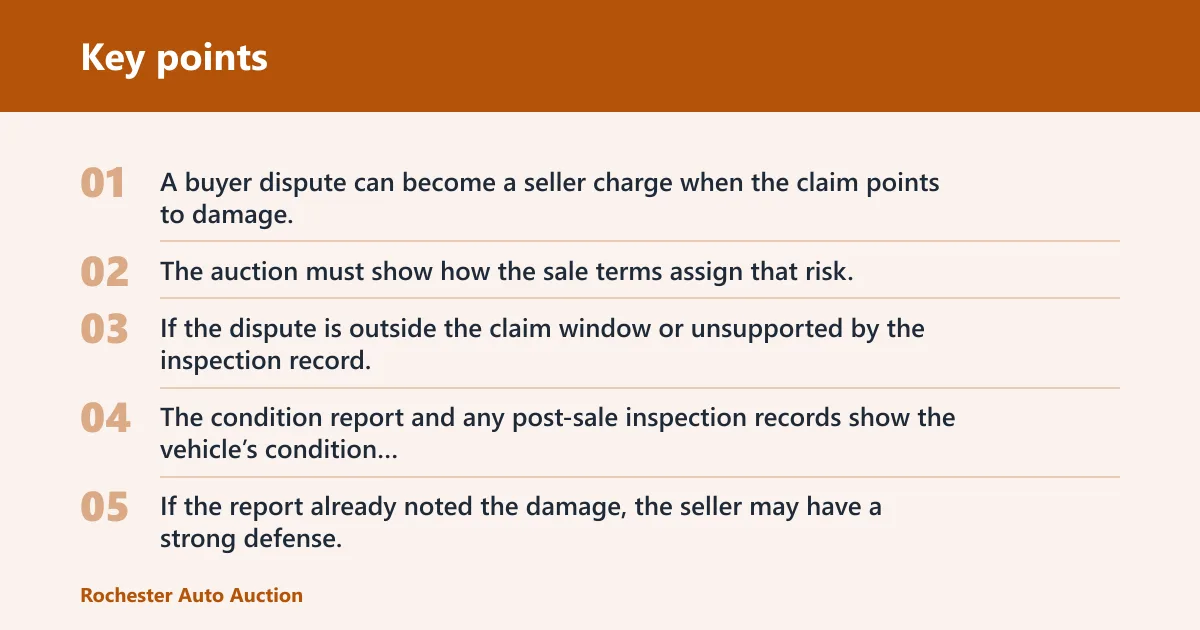
A buyer dispute can become a seller charge when the claim points to damage, disclosure error, or another listed condition issue that existed at sale. The auction must show how the sale terms assign that risk. If the dispute is outside the claim window or unsupported by the inspection record, the deduction should be challenged.
How the condition report supports or weakens the claim
The condition report and any post-sale inspection records show the vehicle’s condition at sale. If the report already noted the damage, the seller may have a strong defense. If the claim is for a problem that appears only in the later inspection file, the auction should show why the issue still falls under seller responsibility.
Say your sedan sold with a roof dent already marked on the condition report, but the buyer later claims the same dent as new damage. In that case, the report may defeat the charge if the photos and notes match the sold condition. The result turns on the record, not on the complaint itself.
What to check before accepting the deduction
Check the date of the claim, the inspection findings, the sale type, and any cap stated in the policy. Also verify whether the auction terms require notice before billing the seller. If the settlement statement lists arbitration without the supporting file, request the claim packet before approving the deduction.
What happens if title or paperwork is missing?
If title or paperwork is incomplete after the car sells, the auction may charge title handling fees, duplicate title costs, or lien release processing charges, depending on state rules and auction policy. These charges usually appear only when missing documents delay transfer or make the file more work to close.
Title delay, duplicate title, and lien release handling
Title fees can cover duplicate title requests, lien release follow-up, or other processing needed to finish transfer. They are not automatic in every sale. The auction must point to the actual delay or missing paper and to the policy that allows the charge. State requirements can change what counts as valid title handling.
How delays show up on the settlement statement
Title-related deductions often appear as separate line items or a hold against final proceeds until the file is complete. A seller settlement statement should show the amount withheld and the reason code. If the statement shows a title fee but the file has proof of timely delivery, that mismatch needs review.
What documents prove the charge is valid
Look for the title receipt, release request, correspondence showing the missing item, and the auction rule that shifts the cost to the seller. If the issue is a duplicate title request, the record should show why the original was unusable. If the issue is lien release handling, the release date and request trail matter.
Can storage, transport, or gate fees be added after sale?
Yes, storage, transport, or gate-related charges can be added after sale when the vehicle stays on-site past the free hold period or when the auction arranges movement after the sale. These charges are common post-sale deductions because the trigger is a later event, such as delayed pickup or a requested transfer.
Pickup delays and storage accrual
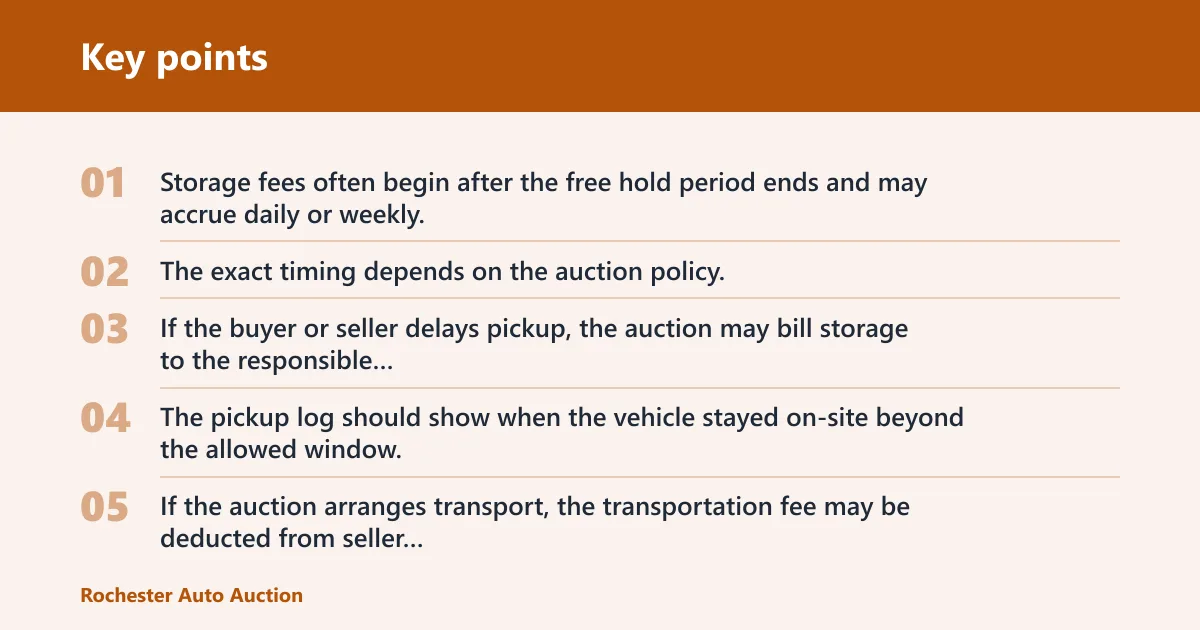
Storage fees often begin after the free hold period ends and may accrue daily or weekly. The exact timing depends on the auction policy. If the buyer or seller delays pickup, the auction may bill storage to the responsible party named in the terms. The pickup log should show when the vehicle stayed on-site beyond the allowed window.
Transportation arranged by the auction
If the auction arranges transport, the transportation fee may be deducted from seller proceeds when the contract assigns that cost to the seller or when the seller requested movement after sale. The amount often depends on distance and service level, so the dispatch record and transport order should match the settlement statement.
A pickup delay of about four days after the free hold period ends can cause a storage fee to appear later. If the vehicle remained in the yard and the terms assign storage to the responsible party, the fee can appear later even though the sale already closed. The proof should be the inventory record, not a generic billing line.
How to tell who is responsible for each charge
Read the fee schedule and the sale terms together. If the charge stems from buyer pickup, it may belong to the buyer unless the contract shifts it. If the auction arranged transport, the party named in the order usually controls payment. The settlement statement should make the payer clear; if it does not, ask for the backing record.
How to verify or dispute a post-sale deduction
Start with the settlement statement, then compare each deduction to the auction terms and conditions, the sale record, and the supporting document for that specific charge. A valid deduction should have a matching trigger, a matching date, and a clear policy basis. If any one of those is missing, request a correction before payout closes.
Match each fee to the contract and sale record
Every post-sale charge should connect to a contract clause or policy line. The sale record should show the vehicle, the sale date, and the reason for the deduction. If the amount appears without a related clause, the seller has a basis to ask for review. The settlement statement alone is not enough.
Use inspection notes, title records, and pickup logs
Condition report notes help with arbitration and reconditioning charges. Title records help with title delays and duplicate title charges. Pickup logs help with storage. Transport paperwork helps with movement charges. Each document should answer the same question: did the trigger really happen, and did the auction follow its own rules?
Deadlines matter
Most auctions set a deadline for disputing a charge before the payout closes. Missing that window can make a correctable charge harder to reverse. Check the notice date, the claim period, and the payment hold status. If you wait until after funds release, the recovery process is usually slower.
Frequently asked questions
What extra seller fees can be added after my car sells at auction?
After sale, extra seller fees can include arbitration, title handling, storage, transport, inspection corrections, and approved reconditioning charges. The exact list depends on the auction terms and conditions, sale type, and supporting documents. Check the seller settlement statement for each line item before payout is final.
Why is my payout lower than the winning bid after my vehicle sells?
Your payout can be lower because the auction subtracts approved deductions from the gross sale price. Common reasons include title delays, storage after the free hold period, transport arranged by the auction, or a valid claim. The seller settlement statement should show the full calculation from sale price to net proceeds.
Can an auction charge fees after the sale is complete?
Yes, if the auction terms allow later billing for a specific event. A closed sale does not prevent a post-sale deduction when a title issue, claim, pickup delay, or transport request happens afterward. The charge still needs a matching document and should appear on the settlement statement or a related billing notice.
What happens if title or paperwork is missing after the car sells?
Missing title or paperwork can create title fees, duplicate title costs, or lien release handling charges. The auction must show why the file was incomplete and how the charge fits the policy. Compare the title record, any release requests, and the settlement statement to see whether the deduction is valid.
How do I know which fees are seller responsibility versus buyer responsibility?
Start with the auction terms and conditions, then check the settlement statement and the specific charge document. Seller responsibility depends on the contract, not on the fee name alone. A buyer-side charge can shift only if the sale rules say so. If the record is unclear, ask for the written basis before payout closes.