Seller Fees at Car Auctions: Complete Guide
Byline: Updated by the Rochester Auto Auction editorial team
Reviewed by: Senior auction-operations reviewer for fee schedules, title flow, and post-sale settlement controls
How this page was sourced: This article separates general auction rules from platform-specific examples. General explanations are based on standard auction concepts such as hammer price, reserve price, title release, and settlement timing. Any specific dollar amount, percentage, timing rule, or deadline is identified as a platform example and cited to the relevant fee page, terms page, or auction rules page.
Seller fees at car auctions can range from about $0 to over $500 per vehicle, sometimes plus optional charges, and a practical rule of thumb is to compare total seller fees against the expected hammer price and any reserve risk before listing. Ignore the fee sheet, and a sale that looks strong on auction day can shrink into a much smaller net payout. This guide maps each seller-side charge, explains when it applies, and shows which fees you can avoid by auction type.
The key split is simple: buyer premiums belong on the buyer side, while seller fees cover listing, selling, relisting, paperwork, delayed payment, storage, or cancellation on the seller side. The winning bid, or hammer price, is not your take-home amount, and a completed auction does not always trigger immediate release of funds.
For closely related pricing context, compare seller-side charges here with Car auction fees overall and the buyer-side schedules discussed in Public physical auctions tend and Dealer-only auctions often run.
What counts as a seller fee at a car auction?

Seller fees are charges billed to the person consigning the vehicle, not the buyer placing bids. They may be due before listing, deducted after a sale, or billed later if the deal stalls, the reserve is missed, the vehicle is relisted, or the buyer fails to pay on time.
Seller fees versus buyer premiums
Start by separating seller charges from buyer costs. A buyer premium is added to the buyer’s bill, often as a percentage model on online auctions, and it may shift more of the auction’s revenue to the buyer side. That matters because a platform with a strong buyer premium may keep seller commissions low, flat, or even at zero in some categories.
The split is not cosmetic. If an auction advertises low seller fees but funds itself with a buyer premium, that can still shape bidding behavior and your hammer price. The fee still does not belong in your seller worksheet unless the schedule says it is charged back to the seller. For a side-by-side look at fixed versus flexible terms, see seller fees.
Fees charged before listing, at sale, and after sale
Seller charges usually fall into three timing buckets.
- Before listing: entry fees, listing fees, reserve-setting fees, photography or condition-report extras, and title-processing setup charges.
- At sale: seller commission, flat sale fee, documentation fee, and title-handling fee.
- After sale: late-payment fees, storage, cancellation, relist fees, gate or pickup charges, and invoice corrections caused by title or release problems.
Some platforms waive upfront listing costs. As a platform-specific example, Classic Trader says auction adverts are always free of charge, sellers can create auction listings without upfront costs, auctions typically run for 12 days, and each late bid extends the auction by 2 minutes, according to its auction rules and seller information pages (Classic Trader Auctions: buying and selling made easy; Classic Trader Auctions). Those facts show why fee timing matters as much as fee amount.
Which charges reduce proceeds and which are billed separately?
Do not assume every seller fee is deducted from sale proceeds. A commission usually is. A documentation fee often is. A reserve-setting fee may be prepaid. A cancellation charge may be invoiced separately after a failed payment or seller withdrawal.
That distinction changes cash flow. A deducted fee lowers payout at settlement, while a separately billed fee can arrive even when you never received sale proceeds. Sellers comparing auctions should read each charge line for collection timing, not just amount. If you are also comparing buyer-facing economics that may affect bidding appetite, review Car auction fees alongside the seller worksheet below.
How seller fees change your net payout
Hammer price versus net payout
A car sells to the highest bidder when the hammer comes down. But the highest bid only completes if any reserve price has been met. That means the hammer price is the winning bid number, while net payout is the money left after every seller-side deduction and any post-sale charges.
If the hammer is strong but the fee stack is heavy, your result can disappoint. If the hammer is modest but the fee schedule is light, your net may compare well against a higher-bid venue.
Reserve price and whether the vehicle actually sells
The reserve price is the seller’s floor, the minimum bid the auction must reach before the vehicle can sell under the listed terms. If bidding ends below reserve, the vehicle usually does not sell at that bid, and seller fees can still apply through no-sale, reserve, or relist charges.
Reserve choices also affect payout. A low reserve may improve the odds of a completed sale. A high reserve may protect price but raise the chance of a no-sale outcome and a second round of fees.
Say your reserve is set at $9,000 and bidding stops at $8,800. The hammer event ended, but the sale did not complete because the reserve was not met. Your payout is not delayed, it is zero until a post-auction deal, relist, or another sale path is completed.
A simple net-payout formula sellers can use
Use this formula:
Net payout = hammer price – seller commission – flat sale fee – documentation/title fee – reserve fee – relist or no-sale fee – storage – late-payment-related seller charges – cancellation charge – pickup/gate/other conditional charges
If a fee is paid upfront, remove it from the settlement line and count it in total selling cost instead. If a fee is billed later, it still belongs in your total proceeds calculation for the transaction.
Why payment release can lag behind the sale
Winning or selling does not always put money in your account right away. Funds may be held until the buyer pays, title clears, identity checks finish, lien paperwork is complete, or release conditions are met.
As-is sale rules also matter here, but mainly because they can limit disputes rather than erase fee exposure. Sellers should confirm payment timelines, title requirements, any arbitration rules, and release conditions before listing.
Which seller fees are most common?
The most common seller fees are listing or entry charges, seller commission, documentation or title fees, reserve-related charges, relist or no-sale fees, and post-sale add-ons such as storage or cancellation. The exact mix changes by platform, but those categories explain most of the gap between hammer price and actual seller proceeds.
Listing, entry, and seller commission fees
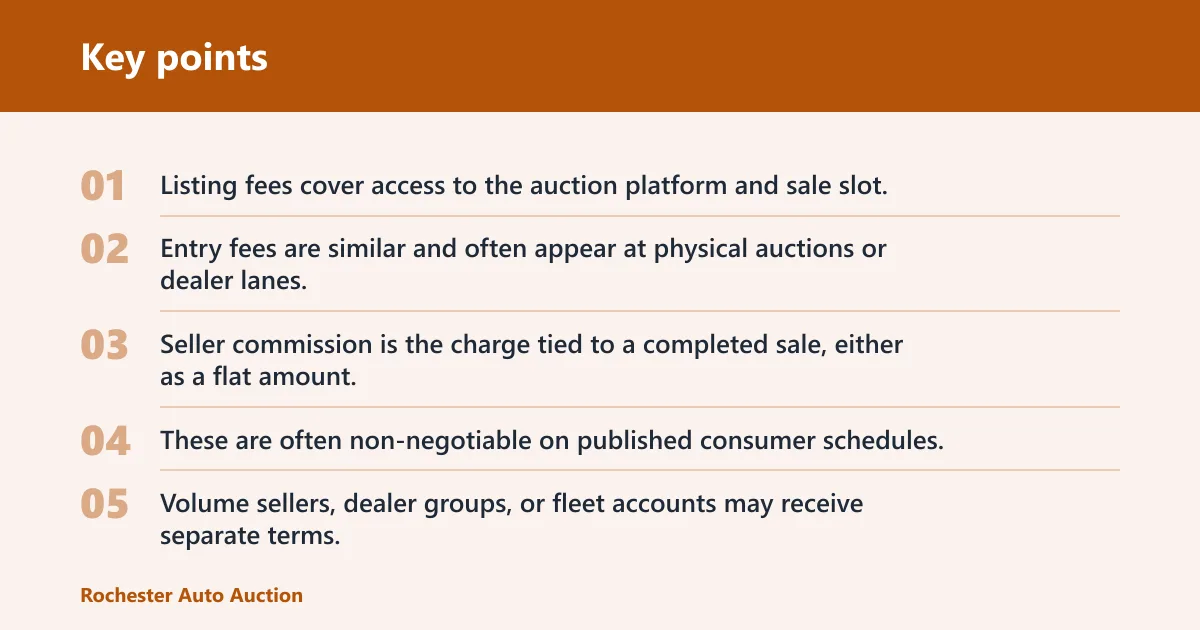
Listing fees cover access to the auction platform and sale slot. Entry fees are similar and often appear at physical auctions or dealer lanes. Seller commission is the charge tied to a completed sale, either as a flat amount, a percentage, or a tiered schedule.
These are often non-negotiable on published consumer schedules. Volume sellers, dealer groups, or fleet accounts may receive separate terms, but private sellers usually do not.
Some published schedules are very direct. As a platform-specific example, AuctionExport’s seller fee schedule states $195 for cars priced at $2,999.99 or less and $295 for cars priced at $3,000 and more (AuctionExport Fees). Those are seller-side sale fees, not buyer premiums.
Documentation and title-handling fees
Documentation fees cover paperwork, title handling, transfer processing, and sale records. They may be separate from the main seller fee, which is why a low headline commission can still lead to a higher-than-expected final cost.
A verified platform-specific example: AuctionExport also lists a $95 documentation fee on its fee schedule (AuctionExport Fees). If a seller compares only the base sale fee and misses the paperwork charge, the net-payout estimate will be wrong before storage or relist fees even enter the picture.
Reserve, relist, and no-sale charges
Reserve fees are tied to setting or protecting a minimum price. No-sale charges can appear when the car crosses the block or online close without meeting reserve. Relist fees apply when the car goes back into another event after a failed sale or buyer default.
These charges are where many competitor pages go soft. They mention that fees vary, then stop. What matters to you is whether the charge is triggered by bidding activity, by failure to meet reserve, or by a second listing attempt.
Picture a seller who accepts a low upfront listing cost but sets a hard reserve twice. The first event misses reserve, the second event sells, and the total seller cost ends up higher than a single-sale auction with a larger initial commission.
Pickup, gate, transport, and other conditional add-ons
Some auctions add yard handling, release, gate, pickup, or transport coordination charges. These are not universal, but they are common enough to ask about before listing, especially at physical yards, salvage sales, and dealer-only auctions.
If the buyer does not pay and the vehicle sits, storage can quickly matter more than the listing fee. If title problems delay release, the car may remain in yard status while other charges continue.
When do fees apply if your car does not sell?
If your car does not sell, seller fees can still apply through upfront listing charges, reserve fees, no-sale fees, withdrawal fees, or relist charges. Whether you owe anything depends on the fee schedule and the reason the sale failed, so “no sale” does not mean “no cost.”
Reserve not met
If the reserve is not met, the vehicle usually remains unsold unless the parties later reach an agreement. In that case, seller commission tied to a completed sale may not apply yet, but reserve, listing, or no-sale charges may still stand.
This is where access type matters. Public auctions often publish consumer-facing fee schedules. Dealer-only lanes can be harder to read from the outside, and some charges show up in account terms rather than public fee pages.
No-sale and relist outcomes
A no-sale may end the matter, or it may lead to a relist. Relisting can carry a fresh fee, a reduced repeat-entry fee, or no new fee at all if the platform is promoting relists.
Classic Trader’s published model is a useful contrast point because it says auction adverts are always free of charge and sellers can create auction listings without upfront costs (Classic Trader Auctions: buying and selling made easy). That does not make every auction free, but it shows why sellers should compare the full schedule instead of assuming all auction models bill the same way.
Withdrawal and seller-initiated cancellation
If the seller pulls the vehicle before the auction closes, a withdrawal or cancellation charge may apply. This is different from a buyer default cancellation after the sale. The schedule should state whether the fee is flat, percentage-based, or triggered only after bidding activity has started.
Most published schedules treat these fees as fixed terms, not open for case-by-case bargaining. If flexibility exists, it usually appears in account agreements for high-volume commercial sellers.
What happens to upfront fees
Upfront fees are usually the least recoverable part of the transaction. If the auction took the listing, condition report, photo, or reserve fee in advance, a failed sale often does not reverse those charges.
A common seller mistake is assuming the auction’s listing fee will be refunded if the vehicle fails to meet reserve. They often are not. Sellers should verify which amounts are refundable, which are credited to a later sale, and which disappear once the listing goes live.
What extra charges can appear after the sale?
After the sale, extra seller charges can appear if the buyer misses the payment deadline, the car remains in storage, the deal is cancelled, or title and release conditions are not met. These are the fees most likely to surprise sellers because they show up after bidding has ended.
Late payment fees after buyer deadline
Late payment fees usually start after the buyer’s payment deadline passes. Depending on the auction, the charge can hit the buyer, the seller, or both through pass-through consequences tied to a failed transaction.
A verified platform-specific example shows how fast delay costs can build. AuctionExport states that late payment is subject to a daily fee of 0.125%, and that the selling auction may also charge 2% with a minimum of $50, according to its terms and conditions (AuctionExport Terms and Conditions). Even if those charges initially target the buyer side, sellers need to know the rule because a prolonged delay can lead to storage, cancellation, and relist consequences that do affect seller proceeds.
Storage fees during payment delays
Storage is one of the most common post-sale add-ons after non-payment. It is often a daily yard charge that starts once the free holding period ends, and it can continue until payment, release, pickup, or cancellation is complete.
Storage may be charged to the buyer first. But if the transaction collapses and the car stays on site, the seller can still be exposed through reduced proceeds, a separate invoice, or a lower-value relist window after delay.
Cancellation fees after buyer default
If the buyer never completes payment, the auction may cancel the sale and charge a cancellation fee. The amount may be fixed, percentage-based, or subject to a minimum.
As a platform-specific example, AuctionExport states that cancellation can trigger a minimum fee of $600 or 10%, according to its terms and conditions (AuctionExport Terms and Conditions). That is exactly the kind of post-sale term sellers need to read before listing, because the cancellation event can happen after bidding looked complete.
Chargebacks, title problems, and release holds
Some payment or paperwork issues do not look like fees at first, but they can hold proceeds or create new costs. A missing title signature, lien release problem, VIN mismatch, or failed identity check can delay release and force storage or correction fees.
For sellers, the practical rule is simple: do not treat “sold” as “settled” until the payment timeline, title acceptance, and release conditions are complete in writing.
Seller fee worksheet
Seller fees at car table
| Fee type | When it applies | Trigger | Deducted from proceeds or billed separately? | Refundability |
|---|---|---|---|---|
| Listing or entry fee | Before the vehicle goes live or enters the sale lane | Creating the listing or booking the sale slot | No, if paid upfront; yes, if billed at settlement | Usually nonrefundable once the listing is live or the sale slot is assigned |
| Seller commission or flat sale fee | After a completed sale | Vehicle sells under the auction’s completion rules | Usually yes | Usually not refundable after a valid completed sale, unless reversed under platform rules |
| Documentation or title fee | At settlement for paperwork and transfer handling | Title processing, sale records, and transfer administration | Often yes | Sometimes refundable if the auction never processes the transaction; often not once work is performed |
| Reserve fee | When a reserve is set or when a reserved sale runs | Choosing a reserve or entering a reserve-protected sale | Sometimes; can also be prepaid | Often nonrefundable, but some auctions may credit it to a later relist |
| No-sale fee | If bidding ends without reserve being met or no deal closes | Auction ends without a completed sale under the schedule | No, if invoiced later; yes, if taken from account credit | Usually nonrefundable once the no-sale event occurs |
| Relist fee | When the vehicle is entered into another auction event | Second listing after a no-sale, cancellation, or buyer default | No, if prepaid; yes, if deducted from later proceeds | Usually nonrefundable after the relist is posted, though some auctions waive or discount repeat entries |
| Late-payment-related charge | After buyer payment deadline passes | Buyer misses the stated payment deadline | Sometimes indirectly, depending on cancellation and storage outcome | Rarely refundable unless the platform reverses the default determination |
| Storage fee | Per day after free yard period or after default delay | Vehicle remains on site beyond the free holding or release period | Often yes if sale later settles; otherwise often billed | Usually nonrefundable once storage days accrue |
| Cancellation fee | After buyer default or seller withdrawal, by schedule | Transaction is cancelled under auction rules | Can be deducted if funds exist; otherwise often billed separately | Usually nonrefundable unless the platform determines the cancellation was processed in error |
| Gate, pickup, transport coordination | At release or physical yard handling | Vehicle release, loading, or third-party transport coordination | Varies by auction | Usually nonrefundable once the service is performed |
Net-payout calculator formula
Net payout = hammer price – all seller-deducted sale fees – all seller-deducted paperwork fees – any reserve, no-sale, relist, storage, cancellation, gate, pickup, or other conditional charges tied to this transaction
If some charges were paid earlier, add them to total selling cost even though they do not reduce settlement directly.
Scenario examples
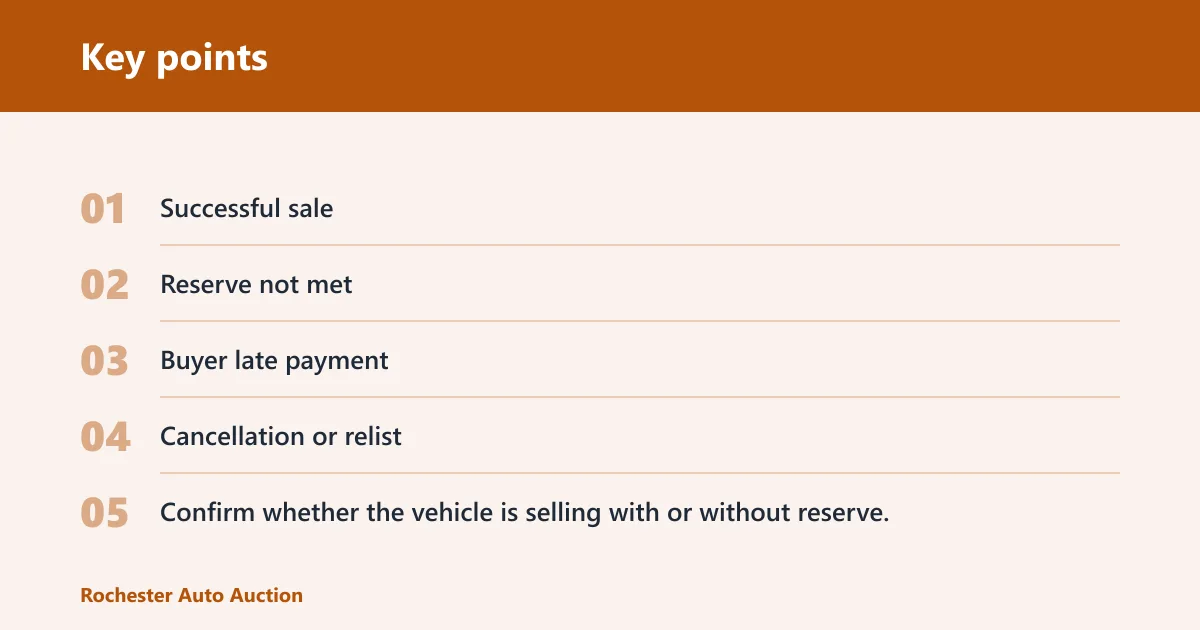
- Successful sale: Hammer price is $12,000. Seller fee is $295, and documentation is $95. Net payout is $12,000 – $295 – $95 = $11,610.
- Reserve not met: Reserve is $10,500. Highest bid stops at $10,200. The vehicle does not sell because reserve was not met. Net payout is $0 until a later deal closes, and any listing, reserve, or no-sale fees still count as selling cost.
- Buyer late payment: Hammer price is $8,000 and the sale appears complete, but payment misses the deadline. A daily late fee of 0.125% starts, and the selling auction may also charge 2% with a minimum of $50. Funds may be held while storage risk grows.
- Cancellation or relist: Buyer defaults and the sale is cancelled. A cancellation fee can trigger a minimum fee of $600 or 10%. If the vehicle is relisted after that, a second round of listing or relist charges may also apply.
The dollar and percentage figures in the examples above are platform-specific examples drawn from AuctionExport’s published fee and terms pages, not a universal rule for all auctions (AuctionExport Fees; AuctionExport Terms and Conditions).
Suppose a seller sees an $8,000 hammer and assumes that is the check amount. Once the $295 sale fee, the $95 documentation fee, and later yard storage are counted, the result is lower. Change only one variable, like a payment delay, and the seller’s outcome changes again without any change to the hammer price.
Operational seller checklist before consigning
A short auction-house workflow can prevent most fee surprises:
- Confirm whether the vehicle is selling with or without reserve, and whether reserve itself adds a charge.
- Verify the exact title status before listing: clear title, lien payoff, signatures, payoff letter, and release authority.
- Read the settlement page for three separate items: seller fee, documentation/title fee, and post-sale default terms.
- Ask when buyer payment is due, when late status begins, and when storage starts running.
- Confirm who pays if the buyer never funds: buyer only, seller only, or a mix through cancellation and relist charges.
- Get written confirmation on whether no-sale, withdrawal, relist, and storage charges are deducted from proceeds or invoiced later.
Are seller fees negotiable at auto auctions?
Most seller fees at auto auctions are fixed by published schedule, especially for private sellers using consumer-facing platforms. Negotiation is more common for dealers, fleets, and high-volume consignors with account agreements, but ordinary listing, documentation, reserve, and cancellation terms are usually not open to one-off bargaining.
Fees that are usually fixed by published schedule
Flat seller fees, documentation charges, reserve fees, and cancellation rules are typically written into the platform terms. That matters because sellers sometimes focus on the percentage headline and miss the flat charges that do not move.
Non-negotiability is also a timing issue. Once the auction closes, arguing over a printed schedule rarely works. The moment for comparison is before listing, not during settlement.
Where volume accounts may get different terms
Franchised dealers, independent dealers, fleets, lease returns, and finance-company consignors may receive custom pricing based on volume or lane participation. That does not mean the fee categories disappear. It means the schedule may be private, rebated, or scaled.
Private sellers should not assume those commercial rates apply to public access listings. Dealer-only auctions often have account-level pricing that outsiders cannot see in full.
Questions to ask before you list
- Which seller fees are deducted from proceeds, and which are billed separately?
- Does a reserve trigger any extra charge, even if the car does not sell?
- What happens if the buyer pays late or never pays?
- When does storage start, and who is billed first?
- Is there a relist fee after a no-sale or cancellation?
- What title, payoff, and release conditions must be complete before funds are sent?
How fee rules differ by auction type
Online consumer-facing auctions
Online platforms often separate buyer premium from seller charges more clearly than physical lanes, but not always more completely. Many car auctions are open to the public, in person and online, and auction houses may allow sellers to sell quickly to a wider pool of buyers.
Online listings can be low-cost upfront while shifting revenue to buyer premiums. That may reduce direct seller fees, but sellers still need to check reserve terms, documentation charges, and failed-transaction rules.
Public physical auctions
Public physical auctions tend to add yard handling, release timing, and storage questions because the car is on site. Fee transparency may be decent, but the seller should still ask who pays for gate, pickup, and post-sale holding if the buyer delays.
Dealer-only auctions
Dealer-only auctions often run on account schedules that are less transparent to non-members. The fees may be efficient for repeat commercial sellers, but private sellers comparing channels can struggle to see the full cost map in advance.
That access limit matters. It affects who can bid, how broad the buyer pool is, and how easy it is to verify whether a lower commission is offset by other account charges.
Salvage and insurance auctions
Salvage channels often bring tighter title rules, yard deadlines, and handling charges. Sellers in this segment should pay special attention to storage, release conditions, and relist terms because vehicles may stay on site longer and paperwork issues are more common.
How to compare auctions before you list
Check the full fee schedule, not the headline commission
A low seller commission does not settle the question. Compare listing fees, documentation charges, reserve fees, no-sale fees, relist costs, cancellation terms, and storage exposure on the same worksheet.
Confirm reserve rules, payment deadlines, and title requirements
Ask whether the vehicle sells automatically once reserve is met, how long the buyer has to pay, when late charges begin, and what title condition is required for payment release. Those details affect risk as much as the posted sale fee.
Compare fee transparency in public versus dealer-only channels
Public channels often publish consumer-facing schedules. Dealer-only channels may rely more on membership terms. If a fee cannot be confirmed before listing, treat that as part of the cost risk.
Use projected net payout, not expected hammer price
The cleanest comparison is a projected net-payout sheet for each auction. Put the same expected hammer price beside each fee stack, then add reserve risk and failed-sale consequences. That turns a marketing claim into an actual seller decision.
Frequently asked questions
How much are car auction fees?
Car auction fees can range from zero upfront to more than $500 per vehicle on the seller side, before optional add-ons. The amount depends on whether the auction uses a flat sale fee, a percentage commission, separate documentation charges, reserve fees, storage risk, and cancellation or relist rules. Platform-specific examples cited on this page include Classic Trader’s no-upfront auction-ad model and AuctionExport’s published seller fee tiers.
What are seller fees at a car auction?
Seller fees are charges billed to the person consigning the vehicle. They can include listing or entry fees, seller commission, documentation or title fees, reserve charges, no-sale or relist fees, and post-sale costs such as storage or cancellation after a failed payment.
How do seller fees work at online car auctions?
Online car auctions often split charges between a buyer premium and seller-side fees. The seller may face low or no upfront listing cost, but still owe sale, documentation, reserve, or failed-transaction charges. Always check whether each fee is deducted from proceeds, prepaid, or invoiced later.
Do seller fees come out of your auction proceeds?
Some do, and some do not. Seller commission and documentation fees are often deducted from the sale proceeds at settlement. Listing fees, reserve fees, storage, relist charges, or cancellation fees may instead be prepaid or billed separately, especially if the sale never fully settles.
Do you pay seller fees if your car does not sell at auction?
Yes, possibly. If the reserve is not met or the auction ends without a completed sale, you may still owe listing, reserve, no-sale, withdrawal, or relist fees. Upfront charges are often not refundable, so a failed sale can still leave a real selling cost.
Are seller fees negotiable?
Usually not for private sellers on published consumer schedules. They may be negotiable for dealers, fleets, lenders, and other high-volume consignors with account agreements, but ordinary listing, documentation, reserve, and cancellation terms are commonly fixed. For more detail, see seller fees.
Who pays if the car does not sell or the buyer never pays?
The answer depends on the trigger. If the car does not sell because reserve was not met, the seller may still owe listing, reserve, no-sale, or relist fees. If the buyer wins but never pays, the buyer may face default fees first, but the seller can still be exposed to storage, cancellation, or relist costs under the platform’s rules. Do not assume the auction absorbs those costs.
When are seller fees billed separately instead of deducted from proceeds?
Fees are commonly billed separately when there are no sale proceeds to deduct from, such as after a withdrawal, no-sale, buyer default, cancellation, or storage accrual after the transaction stalls. Upfront listing and reserve charges are also often billed before any sale happens.
How long does it take to get paid after a car auction sale?
There is no universal deadline across all auctions. Payment release often depends on the buyer paying on time, the title being accepted, any lien payoff being cleared, identity checks being complete, and the vehicle being eligible for release. That is why sellers should confirm the settlement timeline before listing rather than treating the hammer as the payout date.
Sources
- AuctionExport Fees
- AuctionExport Terms and Conditions
- Classic Trader Auctions: buying and selling made easy
- Classic Trader Auctions