Best Vehicle History Report for Auction Buyers
The best vehicle history report for auction buyers is the one that flags title brand, odometer issues, theft, and auction history first, then adds service and accident detail only if the expected bid spread justifies the cost. Miss those basics and you can overbid on a title problem or bid blind on a unit that will not retail cleanly. This guide compares report types, what each catches before bidding, and when the cheapest acceptable report is enough.
Best vehicle history report for auction buyers
For auction-first buying, AutoCheck is usually the stronger first pull because it is built around auction-centric data and costs less per single report than CARFAX. CARFAX is the stronger choice when the vehicle is higher value or service history matters enough to justify the extra cost. NMVTIS data is the federal title-and-odometer foundation, but it is not a full auction report by itself.
That trade-off matters because auction buyers need a fast bid-or-walk answer. A clean title on paper does not tell you whether the car has repeated wholesale sales, stale mileage patterns, or a service gap that changes the risk. A report should help you decide to bid, inspect, or walk away.
What auction buyers need that retail shoppers often do not
A retail shopper may care most about ownership count and service stamps. An auction buyer often needs something narrower and faster: wholesale sale records, auction frequency, sale prices, auction photos when available, title brands, and mileage events that show whether the car has moved through the lanes too often or too recently. That is why report selection changes at auction.
All major reports use overlapping core data sources like state DMV and NMVTIS records. They can all surface some accidents, title history, theft, and ownership history. But the depth and timing of those fields vary, and that gap is what matters before you place a bid.
Vehicle history report comparison
Here is the practical comparison for auction buyers. AutoCheck costs $29.99 per single report and offers a 25-report unlimited pack for $49.99, which fits buyers screening many VINs. CARFAX costs $44.99 for a single report and is often provided at no cost by dealers. Bumper uses a subscription model with 50 reports during the subscription period.
| Provider | Single-report price | Auction data focus | Service history depth | Best use case |
|---|---|---|---|---|
| AutoCheck | $29.99 | Strong auction-centric data, including wholesale patterns when available | Useful, but not the deepest service network view | Best for auction-heavy purchases |
| CARFAX | $44.99 | Broad history, but not as auction-centered | Deep, with 35 years of direct integrations with dealer service-management systems | Best for higher-value cars where service records matter |
| NMVTIS-based reports | Varies by provider | Foundation for title and odometer data | Limited compared with full commercial reports | Budget check for title-brand and odometer screening |
| Bumper | Subscription model | Useful for repeated checks, with title history and branded title detection | Depends on the plan and underlying data source | Best for buyers running multiple reports |
Independent studies cited in the guide find only 60% overlap between CARFAX and AutoCheck incident records. That is a useful warning sign: one report can miss something the other catches, especially when the vehicle has been through wholesale channels or has incomplete reporting history.
Which report shows auction history best?

AutoCheck is usually the better auction-history tool because it is built around auction-centric data and tends to surface wholesale sale records, auction frequency, and price movement more directly. CARFAX may still show some auction-related events, but it is not the clearest first stop when your main question is whether the car has already cycled through the lanes too often.
Wholesale sale records and auction frequency
Wholesale sale records matter because they show how often the car has changed hands at auction. Repeated wholesale transfers can indicate dealer unwinding, condition concerns, or a unit that was hard to place. Auction frequency is not proof of damage, but it is a useful risk signal before you bid.
Suppose a midsize SUV shows two wholesale events in six months, then a third listing with a fresh paint smell and no matching service records. That does not prove a problem, but it should lower confidence and make a higher bid harder to justify.
Sale prices and auction photos when available
Sale prices help you judge whether the unit has been trading below normal expectations, while auction photos can show body damage, panel alignment issues, missing trim, or water-line clues that text fields miss. Not every report includes those photos, and not every auction event is captured the same way. That is why an auction report should be read as evidence, not as a promise.
A common first-timer mistake is assuming a seller PDF with one clean page is enough. If it lacks auction photos, wholesale transfers, or recent sale history, it may answer only a small part of the bid question.
Why auction-facing data can change the bid
For auction buyers, a single extra wholesale event can matter more than a long ownership list. The vehicle may still be clean enough to retail, but the risk spread changes. If the expected resale margin is thin, auction data should push you toward a lower bid or a walk-away decision.
Which report handles title and odometer risk best?
NMVTIS is a federal title-and-odometer database used as part of many vehicle history reports. It is the best starting layer for title-brand and mileage screening, but it is not enough on its own for an auction buy. Use it to catch salvage, flood, rebuilt, odometer, and DMV-reported title brands, then add auction or service depth when the vehicle value justifies it.
NMVTIS, title brands, and DMV-reported records
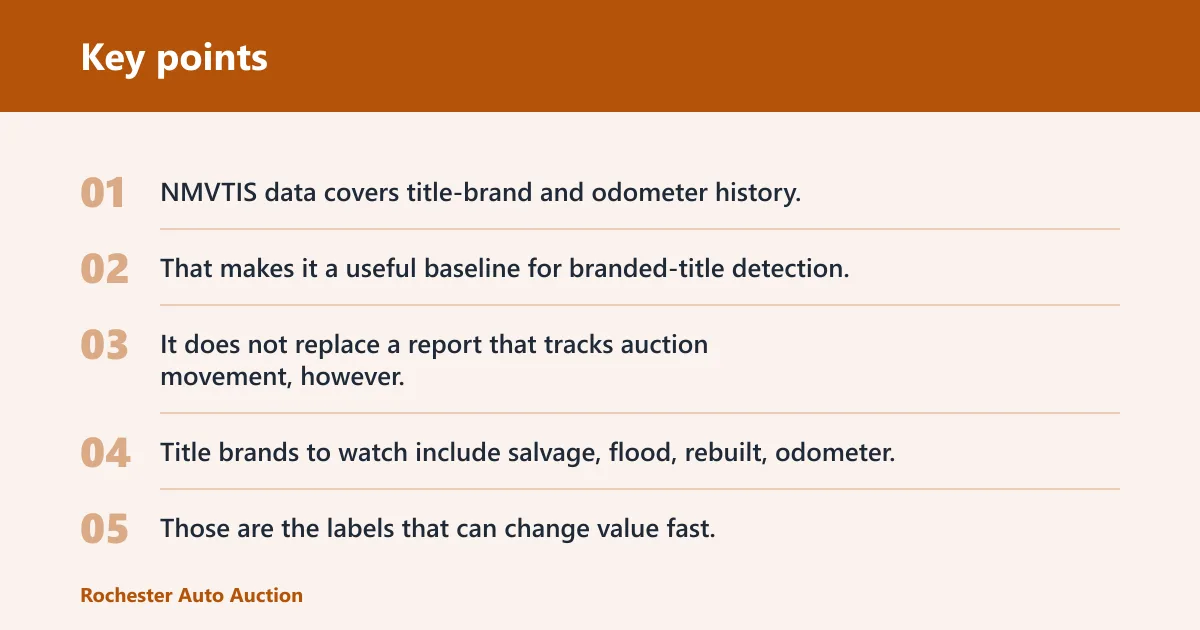
NMVTIS data covers title-brand and odometer history, and all six providers in the guide are federally NMVTIS-authorized. That makes it a useful baseline for branded-title detection. It does not replace a report that tracks auction movement, however, because a title can be clean while the vehicle still has repeated wholesale history or fresh damage clues.
Title brands to watch include salvage, flood, rebuilt, odometer, and other DMV-reported title brands. Those are the labels that can change value fast. If the seller’s report does not show the latest title event, do not assume the car is clear.
Odometer history and rollback clues
Odometer history becomes more useful when it combines mileage records, state inspections, and registration events. A jump backward, a long gap, or a flat mileage line across multiple events can signal a rollback question or a data problem that needs more checking. No report can prove rollback by itself, but it can show whether the mileage pattern makes sense.
If a car shows 82,400 miles at a state inspection, then 79,900 miles on a later record, that should slow you down immediately. The mismatch may be clerical, but it is a reason to demand more evidence before bidding.
When a clean title still needs caution
A clean title does not eliminate risk. The car may still have flood exposure, frame damage, or prior repairs that were never branded the way you would expect. If the price band is high enough, a second report or a pre-purchase inspection is justified even when the title page looks clean.
Which report is strongest on service and accident records?
CARFAX is usually the stronger choice when service history matters, especially for higher-value cars. It has 35 years of direct integrations with dealer service-management systems, and Bumper notes that CARFAX service records come from tens of thousands of participating facilities. That depth can help when you want maintenance and recall history, not only title events.
Dealer service network depth
Service records can show oil changes, recall completions, and dealer maintenance history. CARFAX is better positioned here because its data comes from participating dealerships and service facilities, not just title events. That matters when you are deciding whether a higher-priced car has been maintained on a normal schedule.
But service records still have limits. They reflect participating facilities only. A car serviced at independent shops, quick-lube chains, or by a private owner may have gaps even if the vehicle was maintained properly.
Insurance claims, accidents, and total loss data
Insurance records can show reported accidents and total loss records, but the coverage is claim-based and incomplete. A minor hit that never reached insurance may never appear. A report can support your decision, but it cannot rule out hidden damage by itself.
That is why accident data should be ranked against auction photos and title status. If the photos show quarter-panel repair and the report is clean, the photo evidence deserves attention. If the report shows a total loss record, the bid should change immediately.
What participating-facility service records can miss
Service data can miss work done outside the network, and that gap matters on auction vehicles that move through many owners. A clean service timeline is useful, but it is not the same as a verified mechanical inspection. If the purchase price is high or the condition is uncertain, require a pre-purchase inspection.
Auction report decision matrix
This matrix maps vehicle value, auction source, minimum report needed, when to add a second report, and when to require a pre-purchase inspection. Use it as a bid filter, not as a substitute for an on-site look or mechanic review when the price band is high.
| Vehicle value | Auction source | Minimum report needed | When to add a second report | When to require a pre-purchase inspection |
|---|---|---|---|---|
| Under $5,000 | Lane-only or dealer auction listing | NMVTIS-based title and odometer check | Add AutoCheck if the unit has repeated wholesale history or unclear mileage | Require inspection if the title is branded or the photos show possible structural repair |
| $5,000 to $15,000 | Online auction with photos | AutoCheck | Add CARFAX if service history or accident depth could change the bid | Require inspection if auction photos and report data disagree |
| $15,000 to $30,000 | Dealer consignment or mixed-source auction | CARFAX or AutoCheck, depending on whether service or auction history matters more | Add the other commercial report when the spread between bid and retail is thin | Require inspection when mileage, title, and photo evidence do not align |
| Above $30,000 | High-line auction or specialty sale | CARFAX first, then AutoCheck if auction movement needs confirmation | Use both reports when the vehicle has a narrow margin or conflicting evidence | Require inspection before bidding if condition uncertainty could erase profit |
How to use the matrix before bidding
- Start with the vehicle value and auction source.
- Pull the cheapest report that answers the main risk question first.
- Add a second report only when the first one leaves a real gap.
- Require inspection whenever the bid spread is too small to absorb surprise repairs.
- Walk away if the title, mileage, and photo evidence do not match.
Choose AutoCheck if… / Choose CARFAX if…
Choose AutoCheck if you buy auction-heavy inventory, want lower per-report cost, or need a quick read on wholesale history before you bid. Choose CARFAX if the car is higher value, service records matter, or you want the deeper dealer-service network view. Bumper fits best when you are checking many VINs and want 50 reports during the subscription period.
Choose AutoCheck if…
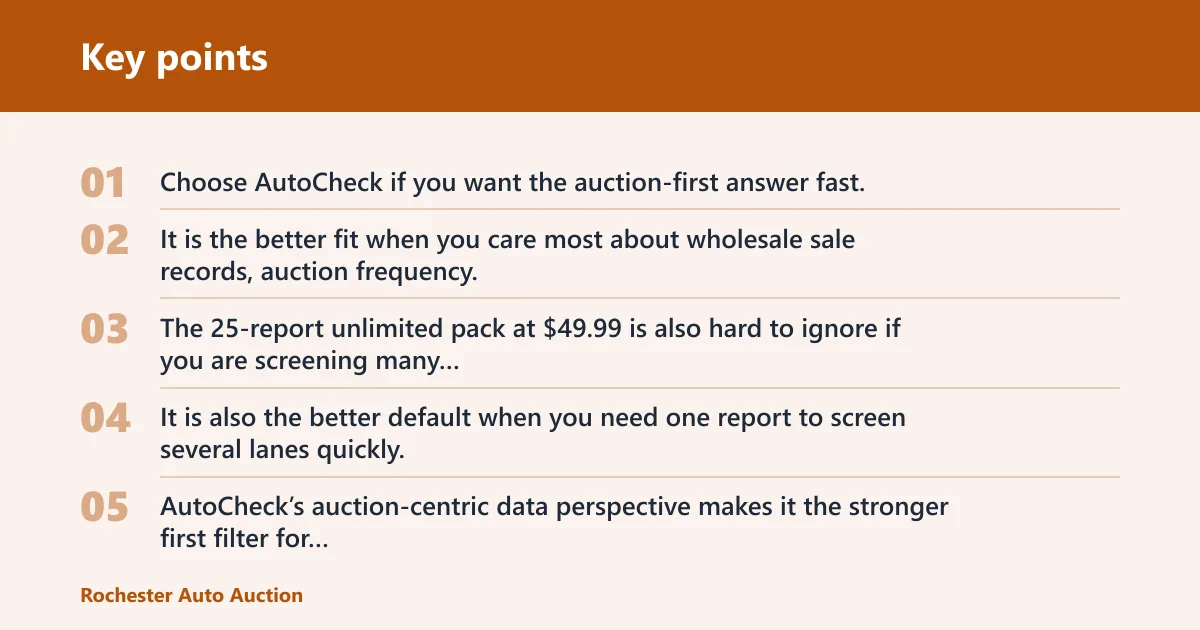
Choose AutoCheck if you want the auction-first answer fast. It is the better fit when you care most about wholesale sale records, auction frequency, and a lower single-report cost of $29.99. The 25-report unlimited pack at $49.99 is also hard to ignore if you are screening many units in one buying cycle.
It is also the better default when you need one report to screen several lanes quickly. AutoCheck’s auction-centric data perspective makes it the stronger first filter for bid-or-walk decisions.
Choose CARFAX if…
Choose CARFAX if the vehicle is higher value or if service depth could swing the decision. At $44.99 for a single report, it costs more, but it brings 35 years of direct integrations with dealer service-management systems and strong service-record depth from participating facilities. That can matter more than auction frequency on premium units.
CARFAX also makes sense when you expect oil-change history, recall completion, or dealer maintenance records to support a higher bid. It is often provided at no cost by dealers, which can change the economics if you already have access to a current copy.
When Bumper or an NMVTIS-based report fits the budget
Use Bumper when you are checking multiple VINs and want a subscription model rather than paying per report. Its 50 reports during the subscription period can suit broad shopping. Use an NMVTIS-based report when the main question is title-brand and odometer risk, and the car does not justify a deeper commercial pull yet.
That budget path works best for lower-value units or early screening. It is not enough when auction photos, wholesale history, or service records could materially change the bid.
Frequently asked questions
What is the best vehicle history report for auction buyers?
AutoCheck is often a strong first report for auction buyers because it is more auction-centered and typically less expensive than CARFAX for a single report. CARFAX becomes the better choice when the vehicle is higher value or service history matters enough to justify $44.99 for the report.
Is AutoCheck better than CARFAX for auction cars?
For auction cars, AutoCheck is often the better first pull because it focuses on auction-heavy use cases and wholesale history. CARFAX is not worse overall; it is stronger when you need deeper dealer service records or when the vehicle’s value makes a more complete history check worth the extra cost.
Do I need more than one vehicle history report before bidding?
Sometimes, yes. One report is enough when the vehicle is low value and the main risk is title or odometer screening. A second report is worth it when the first report leaves gaps, when mileage and auction evidence conflict, or when the bid spread is too thin to absorb a surprise.
Can a vehicle history report miss damage on an auction car?
Yes. A report can miss damage when repairs were not claimed, when a facility did not report the event, or when the issue never hit the data source. That is why auction photos, title brands, odometer history, and a pre-purchase inspection still matter when the car is expensive or the story is unclear.
How fresh should a vehicle history report be before I bid?
Fresh is better. A report should be pulled close to the bid date because auction inventory moves fast and new title, mileage, or sale events can appear after an older PDF was generated. If the seller-provided report is old, partial, or missing auction-relevant fields, treat it as incomplete.
Is the seller-provided report enough for an auction purchase?
Only if it is current and complete. A seller-provided PDF can be useful, but it is not automatically enough if it is stale, missing auction history, or lacks the title and odometer detail you need. Pull your own report when the margin, title status, or mileage pattern matters.
Which vehicle history report is cheapest for checking auction VINs?
AutoCheck is the cheapest named single-report option here at $29.99, and its 25-report unlimited pack is $49.99. For the narrowest budget check, an NMVTIS-based report may cost less depending on the provider, but it will not replace auction history or deeper service data.