Online Auto Auctions: How They Work and Where to Buy
Online auto auctions let you bid remotely, but access often splits into public marketplaces and dealer-only sales that require a license or broker; budget about 10% to 20% above the hammer price for fees, transport, and title work. Miss those checks, and a low winning bid can turn into an expensive car with limited inspection rights, delayed pickup, or title problems. This guide follows the buyer workflow from registration and access rules to bidding, fees, inspection limits, shipping, and title transfer.
What kinds of online auto auctions are there?
Online auto auctions fall into three buyer-facing formats: fully online timed sales, live online bidding tied to scheduled lane events, and hybrid auctions with physical storage yards plus remote bidding. Public buyers can use some platforms directly, while dealer-only wholesale auctions usually require a dealer license or broker access.
100% online, live online, and hybrid formats
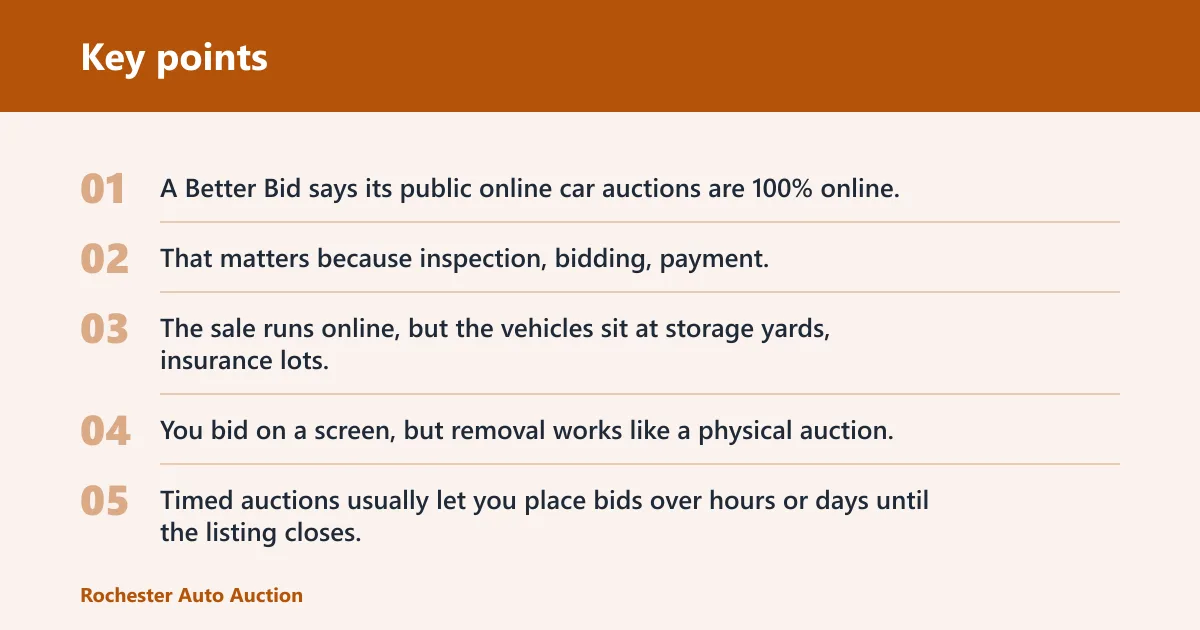
Some platforms handle every step online. A Better Bid says its public online car auctions are 100% online, and it separately says its live auctions are held 100% online. That matters because inspection, bidding, payment, and release procedures all run through the account workflow instead of a live gate.
Other auctions are hybrid. The sale runs online, but the vehicles sit at storage yards, insurance lots, or local auction facilities where pickup rules, loading charges, and appointment windows still apply. You bid on a screen, but removal works like a physical auction.
Timed auctions usually let you place bids over hours or days until the listing closes. Live online sales run at a set time, often with fast bid increments and short decision windows. Some sites also post buy-now inventory, which lets you skip bidding if the unit is available at a fixed price.
Public platforms versus dealer-only wholesale auctions
For most used-car shoppers, public-access platforms are the more direct option because you can register as a retail buyer without adding a broker or dealer-license step. A Better Bid says public buyers do not need a dealer license. It also says it offers over 150 weekly live auctions open to the public and advertises 300,000+ repairable, wrecked and salvage title cars.
Dealer-only auctions are different. Nexus describes online car auctions as a source for dealers buying inventory, and it says wholesale auto auctions are dealers-exclusive auctions. If a platform is wholesale-only, a retail buyer usually needs either a dealer license, a registered business that qualifies, or a broker who buys on the buyer’s behalf.
Which auction type fits a public used-car buyer?
If you want a clean-title commuter with lower paperwork risk, public auctions with clear fee schedules and title disclosures are the safer starting point. If you are comparing repairable or salvage inventory, insurer-linked auction channels often have more volume but also more damage exposure, stricter as-is terms, and less room for post-sale complaints.
Say your budget is tight and the target is a ten-year-old sedan for daily use. A public platform with title status, fee calculator, and shipping options visible before registration is usually a better fit than a dealer-only wholesale sale that requires a broker and adds another layer of cost.
Who can buy and what do you need to register?
Public buyers can register on some online auction platforms with an account, identity details, and any required deposit, while dealer-only auctions may ask for a dealer license or broker arrangement. Complete registration before sale day, because buying power, ID review, and membership setup can delay or block bidding.
Account creation and identity verification
Registration usually starts with a basic account, then moves to ID checks and bidding approval. A Better Bid says it requires a free bidder account and membership type selection. Platforms may also ask for a driver’s license, address match, tax information, or card verification before they activate bidding.
Signing up early matters because an open account may still lack deposit credit, ID approval, or bidding activation, which leaves you unable to bid when the sale starts. Some auctions review documents manually, especially for first-time bidders, higher-value vehicles, or interstate title transfers.
Dealer license requirements and public-buyer exceptions
Do not assume every online listing is open to retail buyers. Public auctions can be open to anyone who meets the platform’s registration rules. Wholesale auctions often require a dealer license, and some local auction houses accept retail bidders only on selected sale days or only through a broker.
If the platform uses a broker model, ask who is the legal buyer on the invoice, what extra broker fee applies, and whether the title will be reassigned before it reaches you. That affects timing and registration paperwork.
Membership tiers, deposits, and buying power
A Better Bid says it offers Standard, Premium, and Pro membership types. It also says it uses a refundable security deposit to set Buying Power. That means the amount you can bid may depend on how much money you place on account before the sale.
Other auctions use credit-card preauthorization, proof-of-funds review, or bidder score rules based on past transactions. Check the platform’s buying-power formula, deposit schedule, and bid caps before you pick a vehicle, because your bid can fail if the account limit sits below the current asking price.
Why signup timing matters
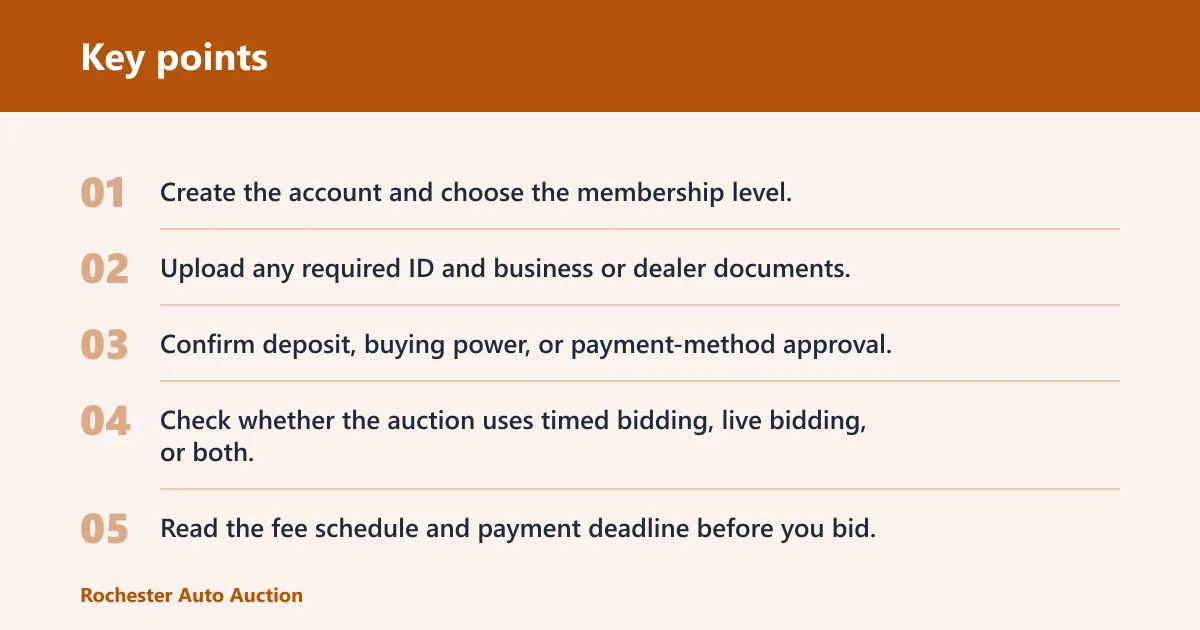
- Create the account and choose the membership level.
- Upload any required ID and business or dealer documents.
- Confirm deposit, buying power, or payment-method approval.
- Check whether the auction uses timed bidding, live bidding, or both.
- Read the fee schedule and payment deadline before you bid.
A common first-timer mistake is opening an account an hour before a live sale, then finding out the deposit has not posted and the account cannot place bids above a low ceiling. The listing may still be visible, but the buyer is effectively locked out.
How does the bidding process work from listing to sale?
The bidding path starts with the lot page, then moves through pre-bids or live bids, reserve review, and final sale confirmation. A high on-screen bid does not always mean the vehicle is sold, because reserve prices, seller approval, bid rejection, and payment rules can still stop the deal.
Reading the lot page before you bid
Check the VIN, title brand, odometer disclosure, seller notes, primary damage area, secondary damage area, start status if listed, key status, and photo count. If the lot page does not clearly state title type, sale format, and fee schedule, treat that as a stop sign until you have answers.
Many listings are sold as-is. In practice, that means the platform may disclose visible damage and title status, but it usually does not promise roadworthiness, complete parts inventory, or future registration success in your state.
Pre-bids, live bids, proxy bids, and extensions
A Better Bid says bidders can place preliminary bids before the live auction. Pre-bidding can put you in position before the sale clock starts, but the live phase may still push the price above your opening number. Some platforms also let you set a maximum bid so the system raises your offer automatically up to your limit.
Timed sales may use lot extensions. If a bid lands near closing, the auction can add time so other bidders can respond. Read that rule closely, because a vehicle that looked seconds from closing may stay active several more rounds.
Reserve price, no-sale outcomes, and seller approval
A reserve price is the seller’s minimum acceptable sale amount. If bidding stops below reserve, the vehicle may show as reserve not met, no sale, or pending seller approval. The highest bidder can still lose the car or spend extra time waiting on a post-auction decision.
Suppose a vehicle closes at about $7,800 and the lot page later changes to seller approval pending. That usually means your bid led the field, but the seller has not accepted it. Until approval clears, you should not assume the title, pickup slot, or final invoice is secure.
When a winning bid becomes a binding purchase
The deal typically becomes binding only after the auction marks the unit sold, generates the invoice, and your account remains compliant with payment rules. A bid can still unravel if reserve was not met, the seller declines, the platform flags the account, or payment misses the deadline.
How do you inspect a car when the auction is online?
The inspection process is document-heavy because the car may never be seen in person before purchase. Use the condition report, photos, VIN data, title brand, odometer disclosure, and history records together, then assume as-is terms still leave gaps that the auction may not cover after sale.
What a condition report usually includes
A condition report commonly lists visible damage, basic equipment, title type, odometer status, and photo sets taken at the yard. It may also note whether the engine starts, whether keys are present, or whether the vehicle was listed as run and drive. Those notes are useful, but they are not blanket guarantees.
If the photos are sparse, old, poorly lit, or inconsistent with the written notes, pause. Missing underbody shots, missing interior images, or one-angle exterior photos can hide expensive issues.
How to verify VIN, title brand, odometer, and history
Match the VIN across the listing, windshield photo, and any attached report. Confirm whether the title is clean, salvage, rebuilt, flood, theft recovery, or parts-only, because registration and financing options change sharply by title brand. Check odometer wording too: actual, exempt, not actual, or mileage discrepancy are not equivalent.
The same source says salvage car auctions involve vehicles deemed a total loss. That does not tell you whether the car is repairable in your state, whether airbags deployed, or whether high-voltage EV components were affected. You still need the title brand and damage notes.
Red flags in photos and disclosures
- Airbags deployed but no interior detail photos
- Front-end hit with no radiator support image
- Water line, mud, or corrosion hints with no flood note
- EV listed with underbody damage near battery pack area
- Luxury car with missing modules, screens, or key fobs
- Motorcycle or RV listing with very limited photo coverage
As-is sales and arbitration limits
Most online auction vehicles are sold as-is, and arbitration rights are often narrow. You may be able to dispute a major title-brand mismatch or a missed disclosure that the platform’s rules specifically cover. You usually cannot return a vehicle because transport exposed more wear, a battery was dead, or repairs cost more than expected.
What fees should you expect beyond the bid price?
The hammer price is often only the starting number. Expect a buyer’s premium plus possible internet, documentation, loading, storage, tax, title, and shipping charges; a practical planning rule is 10% to 20% above the hammer price, though the exact total depends on vehicle price, location, and delay costs.
Buyer’s premium and why it changes the real price
The buyer’s premium is added on top of the hammer price, often as a percentage, a tiered schedule, or both. That means two cars with the same winning bid can have different total invoices if the auction site, membership level, or sale channel uses different fee rules.
Picture a $9,000 hammer price. If the all-in add-ons land near the low end of that 10% to 20% planning range, the working total becomes about $9,900 before registration costs; near the high end, it becomes about $10,800 before any later surprises. That gap is why fee math belongs before the bid, not after it.
Other common charges
Beyond the buyer’s premium, many auctions add internet bidding fees, documentation charges, loading charges, gate or yard fees, and storage after the pickup window. Late payment penalties and relist fees can appear if the buyer misses the deadline and the auction cancels the sale.
State sales tax, title fees, temporary tag costs, and emissions or registration charges depend on where the buyer registers the vehicle. Those charges may be collected by the auction, by a third-party service, or later at the motor vehicle office.
Payment methods and restrictions
Wire transfer, ACH transfer, certified check, and cash where allowed are common. Credit cards are often limited to deposits or small fees rather than full vehicle balances. The same source says some auctions sell vehicles through escrow or approved payment methods, which means the site may reject unapproved forms even if the buyer has funds available.
How to estimate landed cost before bidding
Use a five-part check: hammer price target, buyer’s premium schedule, auction-side extra fees, transport, and title or registration costs. Then add a delay cushion if the yard charges storage quickly or if pickup requires a tow, forklift, or appointment-only release.
Online auto auctions decision table
| Stage | Exact action | Required document | Typical fee | Risk to watch | Go/no-go checkpoint for public buyers |
|---|---|---|---|---|---|
| Platform selection | Confirm whether the sale is public, dealer-only, or broker-mediated | Government ID for public sales; dealer license if required | Membership fee on some platforms; often free account creation on public sites | Registering for a dealer-only sale you cannot use directly | No-go if access rules or broker costs are unclear |
| Registration | Create account, choose membership tier, submit ID, and activate bidding status | Driver’s license, address details, business documents if requested | Refundable deposit or buying-power hold on some platforms | Approval delay leaves the account unable to bid on sale day | Go only when buying power is visible and active |
| Listing review | Check VIN, title brand, odometer status, photos, damage notes, and sale type | VIN history report if you buy one separately | History-report cost if purchased outside the platform | Missing title data, weak photo set, reserve hidden, or key status absent | No-go if title brand or VIN details do not line up |
| Bid planning | Set maximum all-in number before bidding starts | Fee schedule and shipping quote | Buyer’s premium plus internet, doc, loading, and tax where applicable | Budget built from hammer price only | Go only if the landed cost still fits the budget |
| Bidding | Place pre-bid, live bid, proxy bid, or buy-now order if offered | Approved account with active buying power | Usually no extra bid-entry fee beyond auction charges | Bid rejection, lot extension, or reserve not met | No-go if the current price exceeds your capped all-in number |
| Sale confirmation | Wait for sold status, reserve clearance, or seller approval result | Invoice or sale confirmation | None at this step unless a buyer cancels improperly | High bid fails because seller rejects or account is flagged | Go only when invoice shows the unit as sold to you |
| Payment | Pay by wire, ACH, certified funds, cash where allowed, or approved method | Invoice and payment instructions | Wire fee, late fee if deadline is missed | Payment failure can trigger relist fee, account suspension, or loss of deposit | No-go if the payment method is not accepted by the platform |
| Release and pickup | Book pickup, towing, or shipping after funds clear and release is issued | Release form, photo ID, transporter details | Loading, gate, storage, and transport charges | Title delay, missed pickup window, same-day removal rule, storage accrual | Go only when release paperwork and transport timing are confirmed |
| Title transfer | Receive title or reassignment paperwork and register in your state | Title, bill of sale, odometer statement if required | Title, registration, tax, temp-tag, and inspection costs | Out-of-state title mismatch or delayed document release | No-go if the state will not register that title brand for your intended use |
What happens after you win an online auto auction?
After a win, the real work starts: invoice review, accepted payment, title-release timing, pickup scheduling, and transport. Missing any of those deadlines can add storage fees, relist charges, or account suspension, and a paid invoice still may not mean immediate title release if seller paperwork is pending.
Accepted payment methods and payment deadlines
Most auctions set a short payment window and specify exact methods. Wire transfer and ACH are common for larger balances. Certified checks may be accepted in person, and cash may be limited to certain locations or lower amounts where allowed by law. Credit cards often cover deposits or fees only.
Pay attention to when the deadline starts. Some auctions count from invoice issue, not from the end of the live sale stream.
Title release and document timing
You typically need a paid invoice before the release team issues pickup papers. The title itself may arrive later, especially if the seller, insurer, lender, or prior state file still needs processing. Read whether the auction releases the car before title shipment or waits until all paperwork clears.
Key documents usually include the invoice, bill of sale, release form, and title or title reassignment. Check names carefully. A typo in the buyer name can slow registration later.
Pickup windows, same-day removal rules, and storage
Some yards want same-day removal after release; others use a short appointment window measured in business days. If the vehicle does not run, you may need a tow truck rather than a standard carrier. Storage starts fast at some facilities, and weekends or holidays can tighten the timeline further.
Shipping and delivery options
Options usually include self-pickup, third-party shipping, brokered transport, or door-to-door delivery where routes and vehicle condition allow. A non-running salvage unit, an oversized RV, or a motorcycle may have different loading needs and carrier availability than a clean-title compact car.
Before you hire transport, confirm whether the yard loads vehicles, whether the carrier needs an appointment, and whether loose parts inside the vehicle can travel with it. Those details affect both price and release timing.
Where can you buy online auto auction vehicles?
Public buyers have the broadest access through retail-friendly auction platforms, local auction houses with online bidding, and some salvage channels; dealer-only wholesale marketplaces remain mostly closed without a license or broker. The best fit depends on title risk, fee transparency, vehicle type, and post-sale logistics.
Public online auction platforms
These are built for retail access. They usually spell out account setup, fee schedules, and deposit rules before bidding. Public platforms can include clean-title used vehicles, repossessions, salvage units, motorcycles, RVs, EVs, and luxury vehicles, but inventory mix varies sharply by seller base.
Dealer-only wholesale auctions and broker access
Wholesale marketplaces are mainly inventory channels for dealers. The same source describes them that way, and it says wholesale auto auctions are dealers-exclusive auctions. If you use a broker, compare the broker fee, title path, inspection limits, and whether the broker adds another payment deadline on top of the auction’s own rules.
Salvage and repairable sources
Salvage auctions are common online and can offer large selection. A Better Bid advertises 300,000+ repairable, wrecked and salvage title cars. These channels can be useful if the buyer understands title brands, parts availability, body repair economics, and state registration limits for rebuilt vehicles.
Local auction houses, lender sales, and government surplus
Some local houses now stream live bidding online while keeping in-person preview or yard pickup. Lender repossession sales and government surplus channels can also appear online, but terms, disclosures, and title-release timing vary. Compare access rules first, then the fee sheet, then the vehicle quality signals.
Frequently asked questions
How do online auto auctions work from signup to payment?
You register, clear identity checks, fund any deposit or buying-power requirement, review listings, and place bids in timed or live sales. If the lot clears reserve and is confirmed sold, the platform issues an invoice. You then pay by approved method, wait for release paperwork, and arrange pickup or shipping.
Do I need a dealer’s license to buy from an online auto auction?
Sometimes, but not always. Public platforms let retail buyers register directly, while dealer-only wholesale auctions usually require a dealer license or a broker. Check access rules before you sign up, because a visible listing does not mean the platform will let a public buyer complete the purchase.
What fees should I expect when I win an online auto auction?
Expect a buyer’s premium on top of the hammer price, then possible internet, documentation, loading, storage, title, tax, and transport charges. A practical planning range is 10% to 20% above hammer price, though location, delay penalties, and shipping distance can push the total higher.
How do I inspect a car if the auction is fully online?
Use the lot photos, condition report, VIN, title brand, odometer disclosure, and any history data together. Look for gaps such as missing angle photos, unclear damage notes, or inconsistent VIN details. Then assume the car is sold as-is unless the auction’s written arbitration rules say otherwise.
How do online auto auctions differ from dealer-only wholesale auctions?
Public online auctions are built for retail access and explain account setup, deposits, and fees for non-dealers. Dealer-only wholesale auctions are mainly inventory channels for licensed dealers and often limit public access. The vehicles can overlap, but the access rules, arbitration terms, and transaction structure differ.