Buyer Fees at Car Auctions: What You’ll Actually Pay
At car auctions, the buyer fee is only one part of the bill: your real out-the-door cost is the hammer price plus the buyer fee, taxes, title and registration, and any gate, internet, payment, storage, or document charges. Miss those add-ons and a winning bid can run hundreds over your cash-on-hand, or thousands on a higher-priced vehicle. This guide is a general framework, not a Rochester Auto Auction fee sheet, so use Rochester Auto Auction’s current terms and fee disclosures for sale-specific numbers before you bid.
Hammer price vs all-in price
What the hammer price includes
The hammer price is the winning bid before fees. It is the number the auctioneer accepts, or the final accepted online bid, and it is the base many auctions use to calculate the buyer’s premium.
That matters because online platforms may display the winning bid before the buyer’s fee. If you stop the math at the hammer price, you are budgeting to the wrong number.
What the all-in price adds
The all-in price starts with hammer price plus buyer fee, then can add sales tax, title and document fees, and transport. It may also include payment surcharges, release charges, storage, or event-specific internet, online transaction, or gate fees depending on the sale terms.
Auction-controlled charges and state-controlled charges do not work the same way. The auction sets its premium schedule and many administrative charges; the state or local jurisdiction controls tax, title, and registration treatment.
Why the gap matters before you place a bid
The gap between hammer and all-in price is where buyers come up short. A low-price car can get hit hardest by a minimum buyer fee, while a high-price car may benefit from a premium cap that lowers the effective fee rate.
Suppose your cash limit is $9,500 and you bid a car to $9,500 because that number feels like the budget. Add a minimum buyer fee, tax, title, and a short-haul transporter, and the invoice can land well above the money you planned to bring.
What is a buyer fee at a car auction?

A buyer fee, often called a buyer’s premium, is the charge added to the hammer price only if you win the vehicle. It appears as its own invoice line, and it is separate from tax, title, registration, transport, and most payment-related charges.
Where it appears on the invoice
Treat the buyer fee as one invoice line, not the whole cost story. On many auction invoices, you will see the hammer price first, then a buyer premium line, then separate lines for tax, title or document work, and any post-sale services.
When the fee is charged and when it is not
You do not pay a buyer’s premium for simply registering, watching, or bidding unsuccessfully. The premium applies when you are the winning bidder and the sale stands under the bidder conditions of sale.
That distinction also matters when a sale is canceled. Some charges may be refunded, some may not, and arbitration, relist, or administrative charges can follow a different rule than the buyer premium itself.
How auctions calculate the fee from the hammer price
The common structure is a percentage of the hammer price, sometimes with a minimum floor or maximum cap. Bring a Trailer charges buyers 5% of the winning bid, sets a $250 minimum buyer premium, and caps the buyer premium at $7,500.
Other venues use different schedules by channel. Mecum charges 10% for in-person bidders on collector cars and motorcycles, and 12% for telephone and internet bidders on collector cars and motorcycles. Mecum also has a minimum premium of $1,000 on vehicles.
How do buyer fees work at auto auctions?
Buyer fees usually start as a percentage of the hammer price, then the auction checks whether a minimum fee or a maximum cap changes that result. The exact schedule can also change by event, sale channel, bidder type, vehicle category, and online versus in-lane bidding.
Percentage fees, flat fees, and tiered schedules
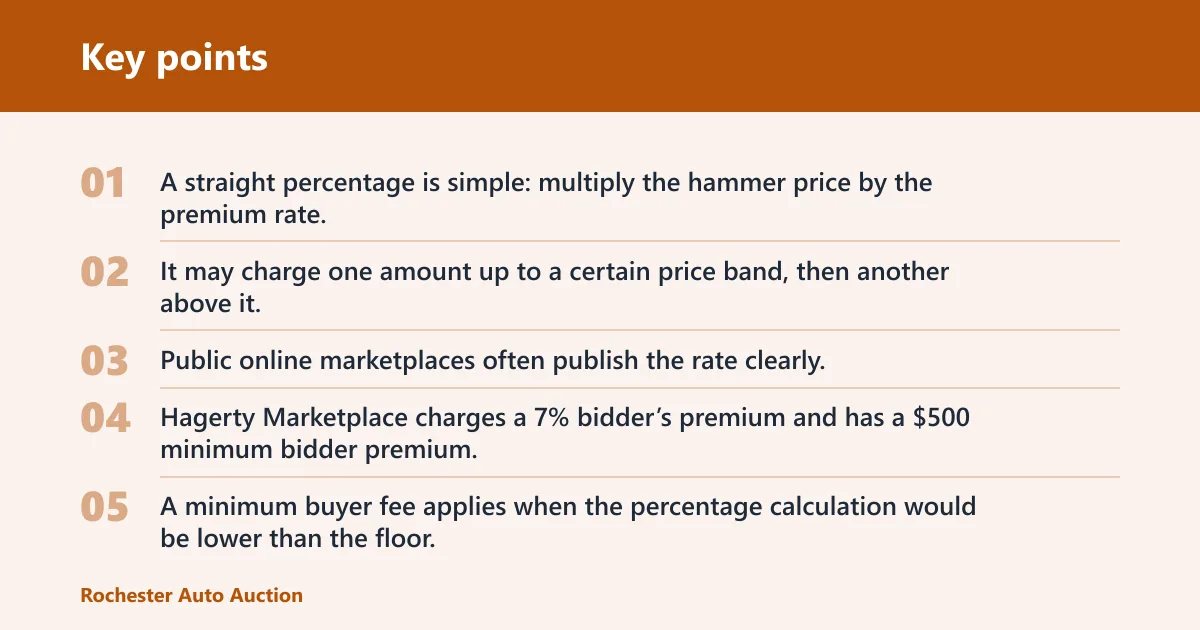
A straight percentage is simple: multiply the hammer price by the premium rate. A tiered schedule is different. It may charge one amount up to a certain price band, then another above it, or use fixed brackets instead of one simple percentage.
Public online marketplaces often publish the rate clearly. Bring a Trailer uses 5%. Hagerty Marketplace charges a 7% bidder’s premium and has a $500 minimum bidder premium.
Minimum buyer fee floors on low-priced vehicles
A minimum buyer fee applies when the percentage calculation would be lower than the floor. That makes cheap cars look cheaper on screen than they are on the invoice.
If the hammer price is about $3,500 on a platform with roughly a 5% premium and a $250 minimum, the buyer fee comes out to about $250. Five percent of $3,500 is $175, so the minimum controls and the buyer fee becomes $250. Your effective premium rate is no longer 5%; it is about 7.1% of the hammer price.
Maximum fee caps on higher-priced vehicles
A maximum cap limits how high the premium can climb on an expensive vehicle. That lowers the effective fee rate as the hammer price rises past the cap threshold.
Bring a Trailer’s 5% premium is capped at $7,500. On a $200,000 hammer price, an uncapped 5% premium would be $10,000, but the cap holds the buyer fee at $7,500. That changes the effective premium rate to 3.75%.
Why channel matters
Do not assume in-person, phone, simulcast, and online bidding cost the same. Mecum’s published collector-car schedule shows that directly: 10% in person and 12% by telephone and internet. For a $50,000 winning bid, Mecum’s in-person premium adds $5,000.
That is why you need the bidder conditions of sale for the exact event and bidding channel, because the posted terms set the fee for that sale and vehicle type. The applicable fee is the one attached to that event, that bidding channel, and that vehicle type.
How much are buyer fees at public and dealer-only auctions?
Public auction fees are often easier to preview because online marketplaces publish the premium, minimum, and cap structure upfront. Dealer-only auction costs can be less uniform, with event rules, buyer status, services used, and membership-related charges changing the real invoice even when the premium itself looks familiar.
Public auction fee patterns and common add-ons
Public marketplaces and live collector auctions often publish a clear premium schedule.
Those numbers are facts about those named channels, not a national average. Another public auction can use flat fees, brackets, or event-specific internet or online transaction charges.
Dealer-only auction fee patterns
Dealer-only auctions commonly layer the premium with access and transaction costs tied to the dealer account and post-sale services. Concrete examples can include a membership charge to access the sale, a gate or release fee at pickup, an inspection or title-processing fee on the invoice, and an arbitration charge if a post-sale dispute arises.
The key point is not to guess a universal dealer fee. You need the lane or event fee schedule, the account-level terms, and the specific title-processing rules for the vehicle you want to buy.
How to compare effective fee rate by vehicle price band
A headline percentage tells only part of the story. Compare the buyer fee as a share of hammer price in three bands: under $5,000, roughly $5,000 to $25,000, and above that. Minimums dominate the first band; published percentages matter most in the middle; caps change the math at the top.
- Low-priced vehicles: check whether the minimum fee pushes the effective premium above the headline rate.
- Mid-priced vehicles: the stated percentage usually drives the fee, so transport and tax start deciding whether the deal still works.
- Higher-priced vehicles: look for a cap, because a cap can cut the effective premium by several points.
What extra charges can appear after you win?
After you win, the invoice can grow through sales tax, title and document work, transport, storage, release fees, and payment surcharges. Some of those charges are controlled by the auction, while tax and registration treatment usually depend on the state, local jurisdiction, and how the vehicle will be titled.
Sales tax and taxable-fee treatment by jurisdiction
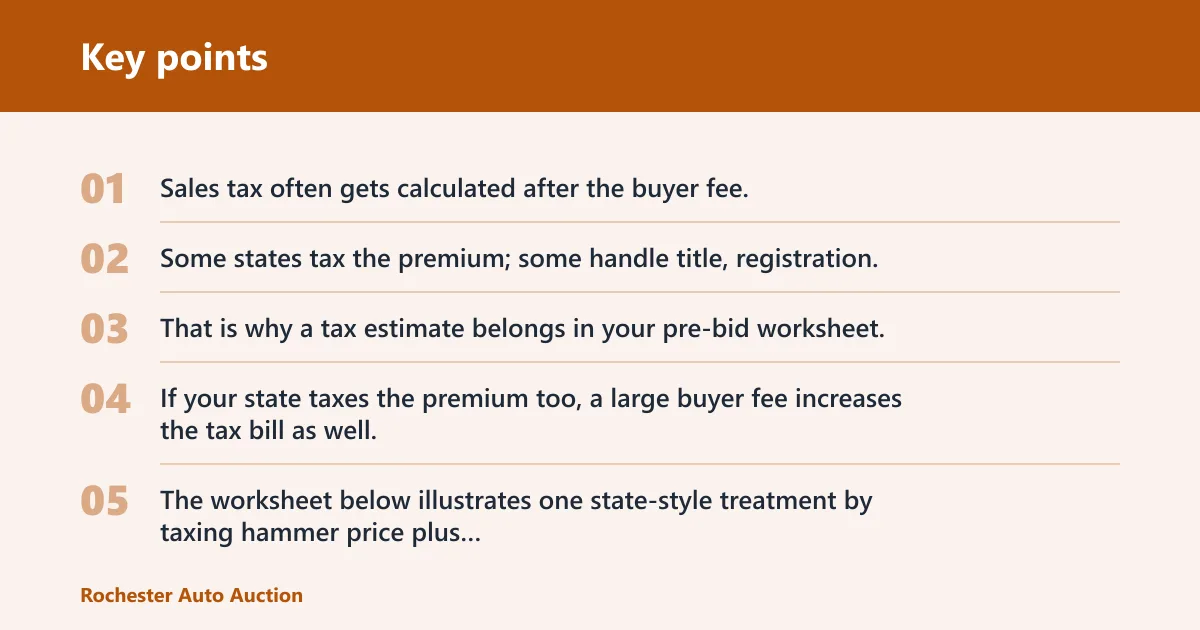
Sales tax often gets calculated after the buyer fee, but not every jurisdiction taxes the same items the same way. Some states tax the premium; some handle title, registration, or dealer-facilitated paperwork differently; and exemptions can depend on who is buying and where the vehicle will be registered.
That is why a tax estimate belongs in your pre-bid worksheet, not a guess that tax applies only to the hammer price. If your state taxes the premium too, a large buyer fee increases the tax bill as well. The worksheet below illustrates one state-style treatment by taxing hammer price plus buyer fee at 7%, but your state may not use that same base or rate.
Title, registration, and document fees
Title and registration costs are separate from the buyer fee. They may be charged by the auction, a broker or intermediary, or later through the DMV process, depending on how the sale is structured and whether the auction handles paperwork for you.
Do not assume these are bundled. If the fee schedule lists title, document, or administrative charges separately, budget them separately.
Transport, storage, and release charges
Transport is a post-sale cost, not part of the hammer price, and it changes with distance, route, vehicle size, running condition, and carrier timing. A local haul can be manageable; a cross-country move or a non-running car can reshape the whole deal.
Storage starts when pickup deadlines pass. Release, gate, or loading charges may also appear if the venue uses them. Separate internet-bid or online transaction fees can also appear on some sales even when a buyer premium already applies. These are exact line items to check for, not vague “hidden fees.”
Picture a non-running SUV bought at an auction 400 miles away. The hammer price may fit the budget, but enclosed or winch-required transport can erase the apparent savings before the title even reaches you.
Payment surcharges, wire fees, deposits, and late penalties
Auctions may charge for certain payment methods. Credit card processing surcharges, wire transfer fees, deposit requirements, and late-payment penalties are all possible, and they may differ by platform or by the amount charged to a card versus by wire.
If the auction requires a deposit before bidding approval, count that as cash tied up before the sale. If the terms impose late-payment or storage penalties, count the timing risk too.
Bidder conditions of sale
Where to find the current fee schedule
Read the bidder conditions of sale and the event fee schedule for the exact sale, because those pages spell out the premium, any minimum or cap, channel-specific pricing, deposit terms, payment methods, pickup deadlines, and title-processing steps. Do not rely on a forum summary or an old screenshot.
That matters especially for Rochester Auto Auction buyers: use the current Rochester Auto Auction sale terms and fee disclosures for Rochester-specific charges rather than importing a fee example from another platform.
Which charges the auction controls and which the state controls?
The auction generally controls the buyer premium, many internet or administrative charges, payment method rules, and storage or release policies. The state or jurisdiction usually controls sales tax treatment, title fees, registration charges, and whether certain exemptions apply.
Separating those buckets helps you estimate what is fixed by the venue and what may change when you title the vehicle in your home state.
Canceled sales, refunded fees, and arbitration exceptions
Failure cases matter because they affect real cash needed. If a sale is canceled for title problems, seller default, arbitration, or post-sale disputes, some charges may be reversed and others may not be. Storage, relist, transport dispatch, or administrative work can follow their own refund rules.
Read the section covering canceled sales, arbitration, title delay, and non-payment. That is where the difference shows up between “premium refunded” and “all costs refunded.”
Auction cost worksheet
Full invoice view
Use one worksheet for the whole deal. Start with hammer price, then add the buyer fee, then estimate the charges outside the premium. The table below uses concrete sample numbers to show how minimums and caps change the effective fee rate.
| Scenario | Hammer price | Buyer fee | Sales tax estimate | Title/doc fees | Transport | Payment fee | Final all-in total |
|---|---|---|---|---|---|---|---|
| Low-priced car | $3,500 | $250 | $262.50 | $180 | $450 | $25 | $4,667.50 |
| Mid-priced car | $18,000 | $900 | $1,491 | $220 | $650 | $30 | $21,291 |
| High-priced car | $200,000 | $7,500 | $16,600 | $300 | $1,200 | $35 | $225,635 |
How to read the sample scenarios
The low-priced example assumes a 5% premium schedule with a $250 minimum. Since 5% of $3,500 is $175, the minimum fee controls. The tax estimate here is 7% of the hammer price plus buyer fee, shown as one possible jurisdictional treatment, not a universal rule.
The mid-priced example uses a straight 5% buyer fee calculation: 5% of $18,000 equals $900. Because no minimum or cap changes the result, this is the cleanest band for comparing one published fee schedule against another.
The high-priced example applies a 5% schedule with a $7,500 cap. That lowers the effective premium rate and shows why expensive vehicles need cap math, not just percentage math.
How can you set a maximum bid before the auction starts?
Set your maximum bid by working backward from your final all-in budget, not forward from the hammer price you hope to win at. Subtract taxes, title and document costs, transport, and payment fees first, then account for the buyer premium structure to find the highest hammer bid you can afford.
Back into the hammer bid in four steps
- Choose your hard all-in budget. Use the total cash you can actually deploy, including deposit timing.
- Subtract non-auction and state-driven costs. Estimate tax, title, registration, document charges, and transport.
- Subtract auction-controlled extras. Include payment surcharges, internet or gate fees, storage risk, and any required service charges.
- Solve for the hammer price under the premium rules. Apply the published percentage, then test whether a minimum or maximum cap changes the result.
Worked bidding logic
If your all-in ceiling is $20,000, and you expect $1,200 in tax, $220 in title/doc fees, $500 in transport, and $30 in payment costs, you have $18,050 left for hammer price plus buyer fee. On a simple 5% premium schedule with no minimum or cap effect, divide by 1.05. That gives a maximum hammer bid of about $17,190.48.
If the fee schedule uses a minimum buyer fee, test that case separately. A low hammer bid can make the flat minimum the right answer instead of the percentage.
A quick decision rule by price band
Judge buyer fees by the vehicle price band, not the headline rate alone.
- Under $5,000: the minimum fee matters most. If the floor pushes the effective premium well above the stated rate, the car needs to be priced that much lower to remain viable.
- About $5,000 to $25,000: the published percentage usually tells the story, so compare total invoice impact including tax and transport.
- Higher-priced vehicles: a cap can make one venue materially cheaper than another even when the headline percentage looks the same.
A common first-timer mistake is choosing a maximum bid from market value alone, then adding fees afterward. Reverse that order. Start with the all-in ceiling, because that is the number your bank balance has to cover.
Frequently asked questions
Are title and registration costs included in buyer fees?
No. Title and registration are usually separate from the buyer fee, even when the auction helps process paperwork. They may be charged by the auction, a dealer intermediary, or later through the DMV process, so they belong in your budget as separate line items.
Do auto auctions charge sales tax on the buyer fee?
Often yes, but not everywhere in the same way. Many jurisdictions calculate tax on the transaction after the buyer fee is added, while others treat taxable items differently. Use your state’s rules and the auction invoice format to estimate tax before you bid.
What extra fees can be added after you win a car at auction?
Beyond the buyer premium, the invoice can pick up sales tax, title and document fees, transport, storage, release or gate charges, and payment surcharges. Separate internet-bid or online transaction fees can also appear, and late-payment penalties, arbitration-related charges, or relist and administrative fees can matter if the sale runs into problems.
Do auto auctions charge payment or credit card processing fees?
Some do. Credit card processing surcharges, wire fees, deposit requirements, and late-payment penalties are common enough that you should check the bidder conditions of sale for that event or platform. Do not assume a card payment costs the same as a wire.
How much are buyer fees at public car auctions?
It depends on the sale channel and event.
How can you estimate the full auction cost before you bid?
Start with your hard all-in budget, then subtract estimated tax, title and document fees, transport, and payment costs. After that, solve for the hammer price under the published premium rules, checking whether a minimum fee or cap changes the result for your price range.