How Much Do Car Auction Consignment Fees Cost?
Car auction consignment fees usually total 5% to 10% of the sale price, but the seller’s all-in cost can rise once listing, storage, transport, title, and post-sale fees are added. Miss one charge and your net payout can shrink fast. This guide breaks down each line item so you can estimate your real proceeds before you sign.
What a consignment fee covers
A consignment fee is the seller-side charge taken from sale proceeds when the vehicle sells. Auctions may charge a flat amount or a percentage of the hammer price, and many contracts set a minimum fee, a maximum cap, or both. The rate often changes by vehicle value and auction house.
Flat fee vs percentage fee
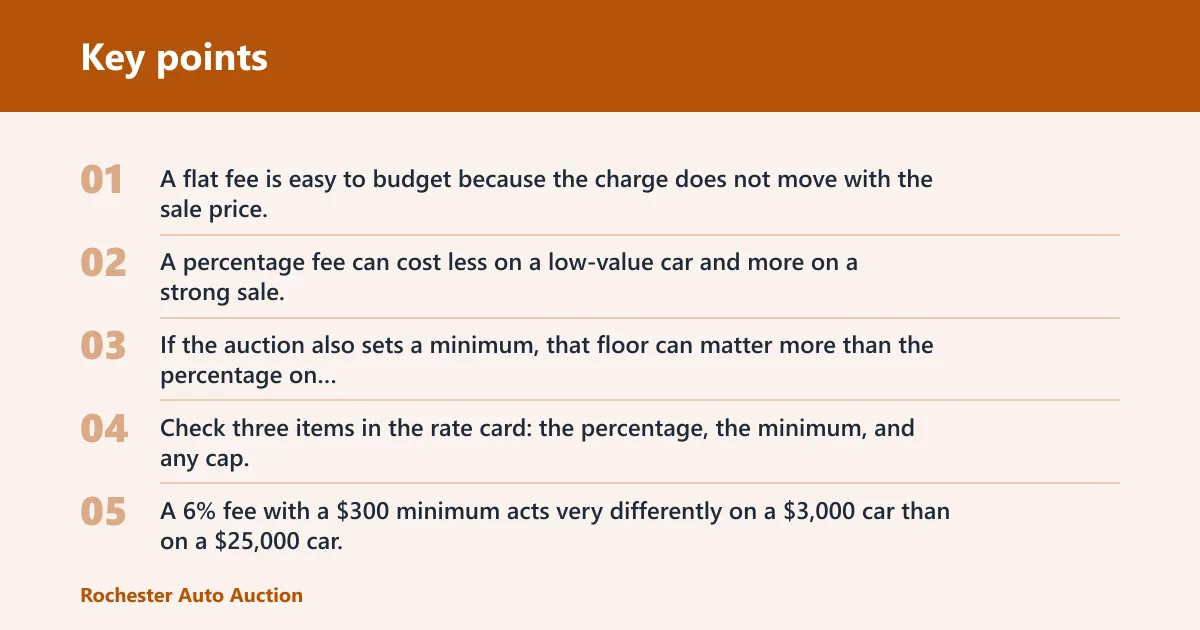
A flat fee is easy to budget because the charge does not move with the sale price. A percentage fee can cost less on a low-value car and more on a strong sale, so you need the contract terms to know where you stand. If the auction also sets a minimum, that floor can matter more than the percentage on cheaper vehicles.
Check three items in the rate card: the percentage, the minimum, and any cap. A 6% fee with a $300 minimum acts very differently on a $3,000 car than on a $25,000 car. The same is true for caps, which limit how much the seller pays on higher-priced units.
Minimums, caps, and vehicle value
Vehicle value changes how a fee feels in practice. On a lower-priced car, a minimum can take a larger share of gross proceeds. On a higher-priced car, a percentage fee can climb until a cap limits it. That is why the same auction can be fair on one car and expensive on another.
Ask if the auction uses a different schedule for dealer consignments, private sellers, classics, or fleet units. Those categories often have different fee tables and different no-sale terms.
Do buyers pay part of the cost?
The buyer premium is usually paid by the buyer, not the seller. Even so, it can affect your results because it changes the buyer’s all-in price and can shape bidding behavior. A seller who ignores the premium may misread the market and set expectations too high.
How buyer premium affects hammer price
Buyer premium is a separate percentage added to the winning bid. A bidder may stop earlier if the premium pushes the total above their target. That can soften the hammer price, which is the number that usually drives your seller proceeds.
Say a buyer premium is 10% and a bidder wants to stay near a $9,000 total spend. That bidder may top out around $8,200 before premium, not $9,000. The seller still receives the hammer-based proceeds, but the premium can influence how far the auction runs.
Why seller expectations can be off
Sellers sometimes focus on the buyer’s total payment and assume the hammer price will land there. It usually will not. Compare hammer price minus seller-side charges first, then adjust for reserve risk, storage, title handling, and any reconditioning approved before the sale.
What fees are included in auction consignment?
Besides the consignment fee itself, many auctions charge for transport, storage, title work, admin processing, photos, detailing, inspections, relisting, or no-sale outcomes. The exact mix depends on the auction house, the vehicle, and whether the car sells on the first run. Read the fee schedule line by line, and match each charge to the contract before you sign.
Transport, storage, and reconditioning
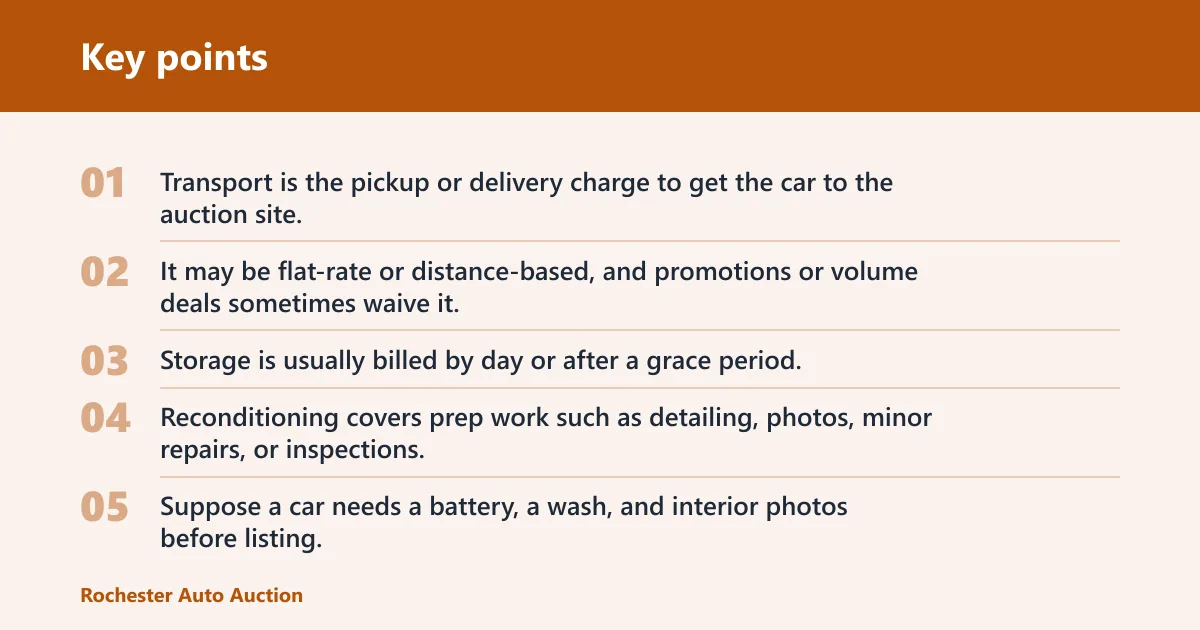
Transport is the pickup or delivery charge to get the car to the auction site. It may be flat-rate or distance-based, and promotions or volume deals sometimes waive it. Storage is usually billed by day or after a grace period, so delays and failed sales can keep adding cost. Reconditioning covers prep work such as detailing, photos, minor repairs, or inspections, and it should be itemized before you approve it.
Suppose a car needs a battery, a wash, and interior photos before listing. If the auction bundles those tasks without itemizing them, you lose the ability to judge whether the prep cost is justified or whether another venue would price the same work lower.
Admin, listing, no-sale, and title fees
Admin and listing fees are common because the auction has to catalog the vehicle, process the paperwork, and manage the sale. No-sale fees may apply if the reserve is not met or the car fails to sell. Title handling can also carry a charge if the auction prepares documents, verifies a lien release, or manages state-specific transfer steps.
Are reserve prices extra with auction consignment?
Often, yes. A reserve price can come with an extra listing fee, a stricter contract, or a lower sale probability if the reserve is set too high. The reserve is the lowest acceptable sale price, so it protects the seller from a weak result, but it can also block a sale and trigger storage or relist costs.
How reserves change sale odds
A reserve that sits above realistic market demand may keep the car from selling on the first attempt. If that happens, ask whether the auction charges a no-sale fee, a relist fee, or additional storage while the car waits for another run. Those costs can turn a “protected” reserve into a more expensive outcome.
When relist fees and storage start
Some auctions charge storage after a short grace period, while others begin charges immediately after the sale date or after the car misses a scheduled run. The contract should say when relist fees apply, whether a reserve review is included, and how long the car can sit before your net payout starts shrinking.
Other fees that cut net proceeds
Seller proceeds are not just the hammer price minus a single fee; they are usually the hammer price minus the seller-side charges allowed by the contract. They are the hammer price minus every seller-side charge that the contract allows: consignment, transport, storage, prep, admin, title handling, no-sale fees, and sometimes arbitration-related holdbacks. That is the number you need before you sign.
Arbitration and post-sale dispute policy
Arbitration rules decide what happens if a buyer disputes the vehicle’s condition after the sale. In as-is sales, the policy may be narrow; in guaranteed-condition sales, it may be broader. Either way, a dispute can delay payout, reduce proceeds, or require the auction to hold funds until the issue is resolved.
Title transfer and paperwork
Title transfer controls when the auction can release your money. If the title is not clean, if a lien release is pending, or if the state requires specific disclosure forms, payment can wait. The contract should state who holds the title before sale, what paperwork is required, and whether missing documents pause the payout clock.
How much car auction worksheet
This worksheet shows how a single used car can net different amounts depending on the hammer price and the fees triggered by the sale. It uses one example vehicle and the same cost stack in three price scenarios so you can see how quickly the payout changes.
| Line item | Low hammer price | Expected hammer price | Strong hammer price |
|---|---|---|---|
| Hammer price | $6,000 | $8,500 | $11,000 |
| Consignment fee | 7% = $420 | 7% = $595 | 7% = $770 |
| Buyer premium impact | $0 seller charge | $0 seller charge | $0 seller charge |
| Transport | $180 | $180 | $180 |
| Storage | $140 | $70 | $0 |
| Reconditioning | $250 | $250 | $250 |
| Title/admin | $95 | $95 | $95 |
| No-sale risk reserve | $150 expected-value reserve | $75 expected-value reserve | $0 |
| Final seller payout | $4,965 | $7,305 | $9,705 |
Two points matter here. First, the buyer premium does not come out of your payout directly, but it can still affect the hammer price. Second, the no-sale reserve line is not always a billed fee; it is the expected cost of a weak sale outcome, such as extra storage, relisting, or a missed bid cycle.
When will you get paid?
Payout usually happens after the buyer’s payment clears, the title paperwork is accepted, and any dispute window closes. Some auctions pay sooner, while others wait for the full arbitration period and all transfer documents. Missing title paperwork can delay payment even after the car sells.
How title and arbitration delays affect release
If the buyer opens a condition dispute, the auction may hold proceeds until the issue is resolved. If the title is incomplete, signed wrong, or tied to a lien, the funds may also stay on hold. Ask for the payout trigger in writing: sale date, buyer clearance, title receipt, or dispute expiration.

The cleanest comparison is a line-by-line contract review. Ask each auction house for the full rate card, then compare consignment fee, minimums, caps, buyer premium, transport, storage, prep, admin, no-sale fee, relist fee, and title handling. The cheapest headline rate can hide the highest net cost.
- Get the consignment fee schedule in writing.
- Ask whether the fee is flat, percentage-based, or both.
- Check the minimum fee and any maximum cap.
- Confirm who pays the buyer premium.
- Ask when storage starts and what the grace period is.
- Request transport pricing for your exact location.
- Require itemized reconditioning before approval.
- Ask what happens if the reserve is not met.
- Confirm payout timing and title requirements.
- Ask about no-sale, relist, and arbitration charges.
How can you tell if an auction consignment company is overpriced?
It is overpriced when the total seller-side stack is higher than the value the auction adds. Compare the full net payout, not the headline consignment fee. If another venue offers similar exposure, faster payout, lower storage exposure, or clearer title handling at a lower total cost, the first quote is expensive.
A common first-timer mistake is accepting a low consignment fee and ignoring the rest of the bill. A $0 transport promo can still lose to a high storage rate, a relist fee, and a title hold. Look at the complete payout math before you decide.
Frequently asked questions
How much do car auction consignment fees usually cost?
Car auction consignment fees often total around 5% to 10% of the sale price. Some auctions use a flat fee, while others use a percentage with a minimum or cap. The real cost depends on the vehicle value, the auction house, and whether extra services are bundled into the contract.
What fees are included in auction consignment?: common seller-side fees include
Common seller-side fees include the consignment fee, listing or admin charges, transport, storage, reconditioning, title handling, no-sale fees, and sometimes relist fees. The exact package varies by auction house, so the only safe comparison is the written rate card and contract terms.
Do consignment auctions charge seller fees or buyer premiums?
They can charge both, but they are not the same thing. Seller fees come out of your proceeds. Buyer premiums are paid by the buyer. Even so, buyer premiums can affect bidding behavior and may change the hammer price you end up receiving.
What other costs can come out of my sale proceeds?
Beyond the consignment fee, your proceeds can be reduced by transport, storage, reconditioning, admin fees, title work, and no-sale or relist charges. Arbitration holds can also delay payout, which matters if you need cash quickly or if paperwork is incomplete.
When do I get paid after a consignment auction sale?
Payout usually follows buyer payment clearance, title acceptance, and the end of any arbitration window. If the title has lien issues, missing signatures, or state-specific paperwork gaps, the auction may delay payment until those items are resolved. Always ask for the release trigger in writing.