Why Does a Car Get a Salvage Title Without an Accident?
A car can get a salvage title without a crash when repair costs, theft recovery rules, flood damage, fire damage, or other total-loss criteria lead the insurer or DMV to brand it salvage; the trigger is often when repairs meet or exceed a percentage of actual cash value, commonly around 70% to 75%. Miss the paperwork, and you can overpay, miss hidden title brands, or buy a car that is hard to insure or register. This guide explains each non-crash pathway, the records that create salvage branding, and the title checks buyers and sellers should verify.
What a salvage title means
A salvage title is a state title brand issued by a DMV or similar agency after a vehicle meets that jurisdiction’s total-loss rule. It is not the same thing as an insurer’s internal damage note, and it is not a repair grade. A car can be branded salvage even if it still starts, rolls, and drives short distances.
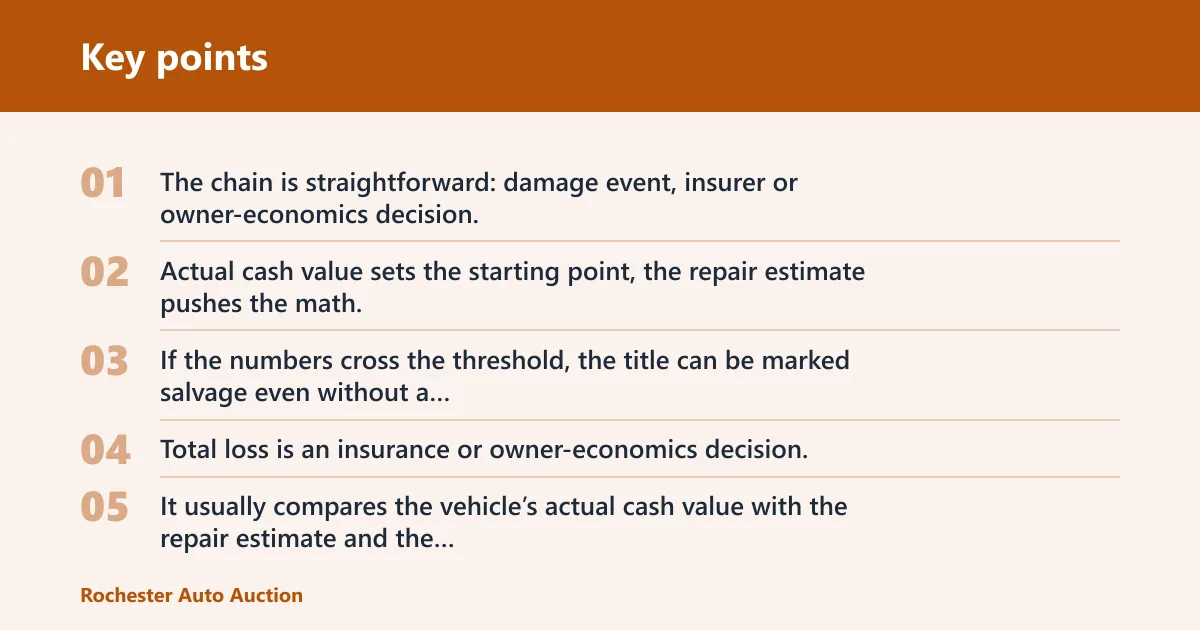
The chain is straightforward: damage event, insurer or owner-economics decision, then state branding. Actual cash value sets the starting point, the repair estimate pushes the math, and salvage value is part of the settlement. If the numbers cross the threshold, the title can be marked salvage even without a collision.
Total loss versus salvage value
Total loss is an insurance or owner-economics decision. It usually compares the vehicle’s actual cash value with the repair estimate and the expected salvage value. State thresholds vary, but once repair cost is high enough relative to value, the vehicle may be declared a total loss and then branded by the title authority.
That brand can later change to rebuilt or reconstructed after repair and inspection, depending on state rules. The rebuilt brand does not erase the salvage history. It only means the vehicle passed the steps required for road use or retitling in that jurisdiction.
Why a car can be drivable and still branded
Drivable does not mean clean titled. Hail can leave a car mechanically sound but expensive to repair. Theft recovery can return a car that starts and moves, yet it may still have missing airbags, broken locks, or stripped parts. Fire and flood can leave a vehicle running today and failing later because hidden damage may spread.
Say your 2019 sedan is hit by hail that dents every roof panel and cracks the windshield. If the body and glass estimate rises above the state or insurer threshold, the car can be totaled even though the engine and transmission still work.
Can a car get salvage without a crash?
A salvage title can follow non-collision losses when the insurer declares a total loss or state law treats the damage as salvage-worthy. Flood, fire, hail, theft recovery, vandalism, and mechanical failure can all trigger that outcome if the repair bill and policy rules justify it.
The important part is the paperwork chain. The insurer decides whether the claim is a total loss under its valuation method, then the DMV or similar agency applies the title brand when the vehicle is retitled, surrendered, or reported under the state’s branding process.
Non-collision losses that still trigger total loss
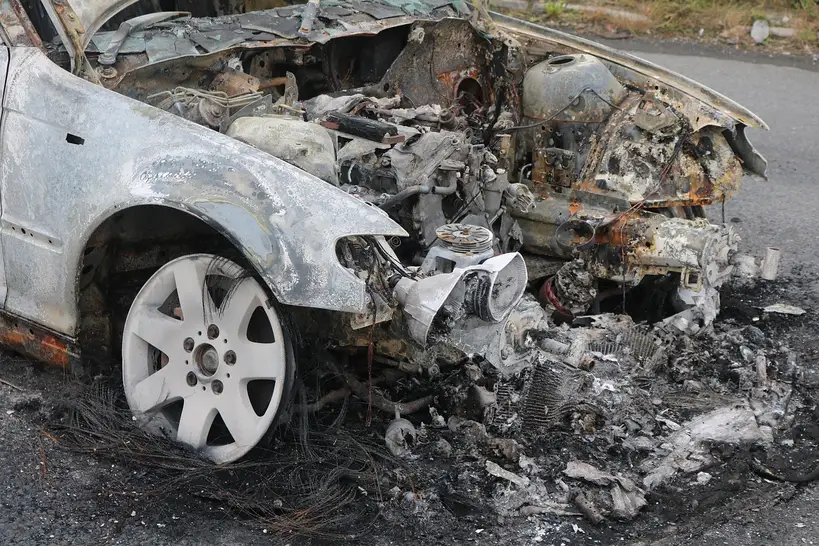
Flood damage can involve wiring corrosion, wet modules, contaminated upholstery, and mold. Fire damage can destroy insulation, plastics, sensors, and electrical looms. Hail can overwhelm sheet metal, glass, and trim. Theft recovery can reveal stripping or ignition damage. Vandalism and mechanical failure can also cross the value threshold.
That is why a clean-looking body is not enough. A car can look minorly damaged on the outside while the estimate includes hidden electrical repair, teardown labor, paint, parts, and diagnostic work that pushes it over the total-loss line.
When the insurer pays out
Once the carrier settles as a total loss, the vehicle may be paid off to the owner or lienholder and assigned salvage value. After that, the title brand process is usually a DMV matter, not an insurance label. If the vehicle is later repaired, the buyer should look for rebuild paperwork and inspection records.
How insurers decide a total loss
Insurers usually compare actual cash value, repair estimate, and salvage value. If the estimate reaches a state or policy threshold relative to ACV, the vehicle can be declared a total loss. The formula changes by state and carrier, so the exact cutoff is not the same everywhere.
The estimate is not just visible damage. It can include labor, parts, paint, diagnostics, alignment checks, scan work, and the extra findings that appear during teardown. That is why a car may move from “repairable” to “total loss” after a shop opens it up.
Actual cash value and repair estimate
ACV is the pre-loss market value used in the settlement. Repair estimate is the projected cost to return the vehicle to its prior condition. If a ten-year-old SUV is worth less than the cost of airbags, wiring, and interior drying after a flood, the numbers may support salvage branding even without a crash.
Role of labor, parts, paint, and teardown findings
Labor rates add up quickly. Paint work, blend panels, calibration, and part replacement often cost more than shoppers expect. Hidden damage found during teardown is a major reason a vehicle gets written off. A bent radiator support, wet control module, or broken cable can change the math in one inspection visit.
State threshold rules
State DMV title laws control when salvage branding is issued. Some states use a percentage of ACV, some use different formulas, and some treat specific loss types more strictly. Buyers should never assume one state’s rule applies everywhere. The title brand follows the jurisdiction that brands the vehicle, rather than a general national standard.
Salvage title decision table
| Non-accident pathway | Typical insurer action | DMV title outcome | Buyer red flags |
|---|---|---|---|
| Flood damage | Total loss if water intrusion, corrosion, or electronics repair exceeds ACV threshold | Salvage brand, later rebuilt brand only after required steps | Musty odor, water lines, corroded connectors, wet foam, interior mildew |
| Fire damage | Total loss when wiring, plastics, safety systems, or structure need extensive replacement | Salvage brand if the state accepts the loss as total | Heat marks, melted trim, smoke smell, wiring repairs, scorched insulation |
| Hail damage | Total loss when panel, glass, and trim repairs exceed the threshold | Salvage brand even if the car still runs | Roof dents, cracked glass, overspray, repeated panel replacement claims |
| Theft recovery | Total loss if the claim was paid, or if recovery damage makes repair uneconomical | Salvage brand may remain after recovery and retitling | Missing airbags, broken ignition, stripped interior, bad key history |
| Vandalism | Total loss when glass, paint, interior, or electronics repair crosses value threshold | Salvage brand if state law treats the claim as total loss | Key scratches, broken glass, fire setting, broken modules, repeated claims |
| Mechanical failure | Total loss if engine, transmission, or major systems cost more than ACV to fix | Salvage brand in states that allow economic total loss branding | Overheating history, internal noise, engine replacement paperwork, low compression |
Why flood damage often triggers salvage
Flood damage often triggers salvage because water gets into places that are hard and expensive to restore. The exterior may look minor. The inside may not be. Water intrusion can damage wiring, control modules, seat motors, connectors, carpets, and insulation, and it can leave corrosion that appears later.
Mold and odor are also real buyer issues. A car that dried out on the outside can still carry contamination under trim panels or in foam. If you see water lines, silt in the cabin, or corroded fasteners, treat that as a paperwork and inspection problem, not just a cosmetic issue.
Picture a compact SUV that sat in 18 inches of floodwater for two days. The paint looks fine after a wash, but the shop teardown finds wet floor insulation, a corroded body module, and contaminated seat wiring. That combination can easily support a total-loss decision and a salvage brand.
Why theft recovery can still end up salvage
Theft recovery can still end up salvage when the vehicle was already paid out as a total loss or when recovery damage makes repair uneconomical. A car recovered after a theft may have stripped interior parts, damaged locks, ignition issues, missing wheels, or airbag-related tampering.
The paper trail matters here. Buyers should check whether the insurer paid the claim before recovery, whether the title was branded salvage afterward, and whether the state requires proof of repair before retitling. A recovered vehicle can look complete and still carry a salvage history.
Paper trail to check
- Ask for the current title and prior brand history.
- Verify whether the insurer declared a total loss before recovery.
- Look for theft-recovery statements, salvage receipts, and repair invoices.
- Check for missing keys, ignition work, airbag repair, or module replacement.
- Confirm whether the state requires rebuilt inspection paperwork.
What state laws change
State laws change when a car becomes salvage because each jurisdiction sets its own threshold, branding rule, and inspection path. One state may brand a car at a lower percentage of ACV than another. One may require a rebuilt title inspection, while another may have different proof and documentation rules.
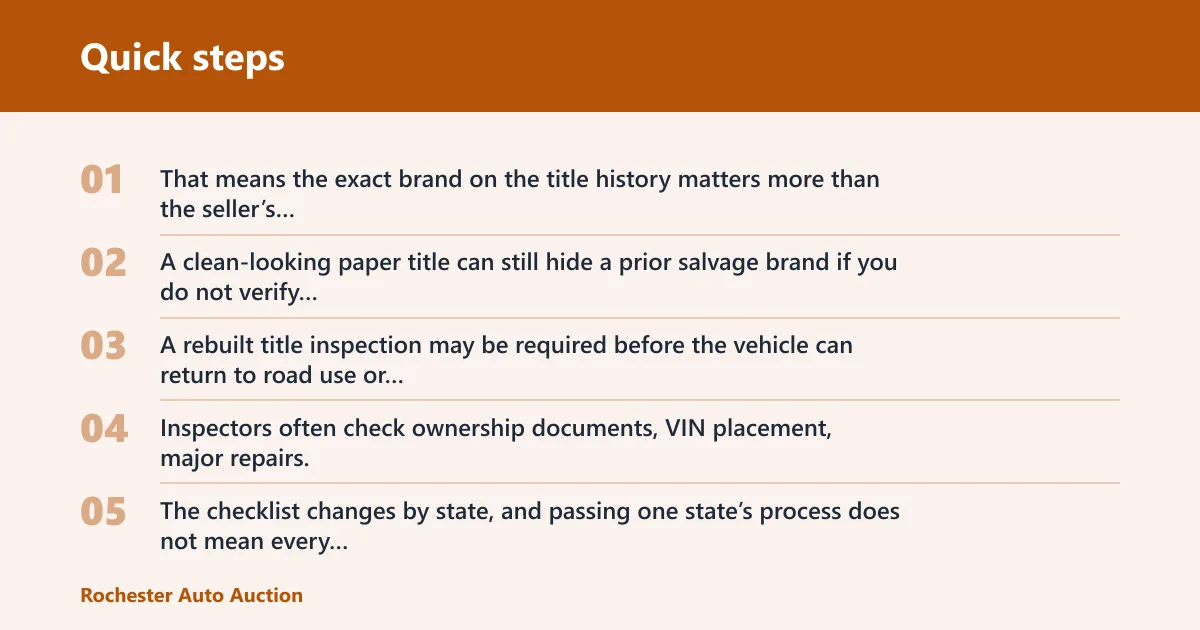
That means the exact brand on the title history matters more than the seller’s description. A clean-looking paper title can still hide a prior salvage brand if you do not verify the history report, the prior state, and any rebuild filings.
Rebuilt title and inspection rules
A rebuilt title inspection may be required before the vehicle can return to road use or be retitled after repair. Inspectors often check ownership documents, VIN placement, major repairs, and safety-related items. The checklist changes by state, and passing one state’s process does not mean every other state will accept the same paperwork.
A common first-timer mistake is to assume a salvage title only comes from collision damage, when a flood-damaged or stolen-and-recovered car can be totaled without a crash. A seller can replace panels and polish paint, but the title history still shows salvage if the car went through a total-loss brand. The buyer should verify the title record, not just the exterior finish.
Where to verify the exact brand
Start with the title itself, then confirm the brand through the vehicle history record and the state DMV file if available. If the car has crossed state lines, check for brand translation issues. Some states carry forward the prior brand, while others use their own wording for the same loss history.
Frequently asked questions
Can a car have a salvage title without being in an accident?
Yes. Flood, fire, hail, theft recovery, vandalism, and mechanical failure can all lead to a salvage brand if the insurer or state treats the vehicle as a total loss. A collision is common, but it is not required for salvage branding.
Why does a car get a salvage title without an accident?
Because the brand follows loss economics and title law, not just crashes. If repair cost, salvage value, and actual cash value push the claim past the threshold, the insurer may total the vehicle and the DMV may brand the title salvage, even after a non-crash event.
How to get a salvage title for a totaled car?
In most cases, you do not “apply” for it like a standard title. The insurer declares the total loss, the owner or lienholder settles the claim, and the state title authority brands the vehicle based on the surrender, insurance report, or retitling paperwork required in that jurisdiction.
Can you salvage a car without title?
That depends on state law and the reason the title is missing. Some jurisdictions require proof of ownership and a salvage process before a title can be issued. A missing title is a separate problem from salvage branding, so buyers should verify ownership documents before paying.
Does a salvage title mean the car is unsafe to drive?
Not automatically. A salvage title means the vehicle met a total-loss or equivalent threshold, not that it will fail immediately. Safety depends on the quality of repair, inspection rules, and the type of damage. Flood and airbag-related cars deserve especially careful review.
How do state laws change when a car becomes salvage?
States differ on thresholds, reporting rules, and rebuilt inspections. Some require a formal inspection before a rebuilt title is issued; others use different documentation or brand names. The practical step is to confirm the exact brand on the title history and the local retitling rules before buying or selling.