Best Online Auto Auctions for Public Buyers: How to Compare
Use a 5-part scorecard: access, total cost, condition transparency, logistics, and buyer protection. Skip it, and you can overpay in fees, miss title or condition issues, or buy a car you cannot move. This guide shows how to compare platforms, score each category, and choose the best fit for your budget and risk tolerance.
How public auto auction platforms are evaluated
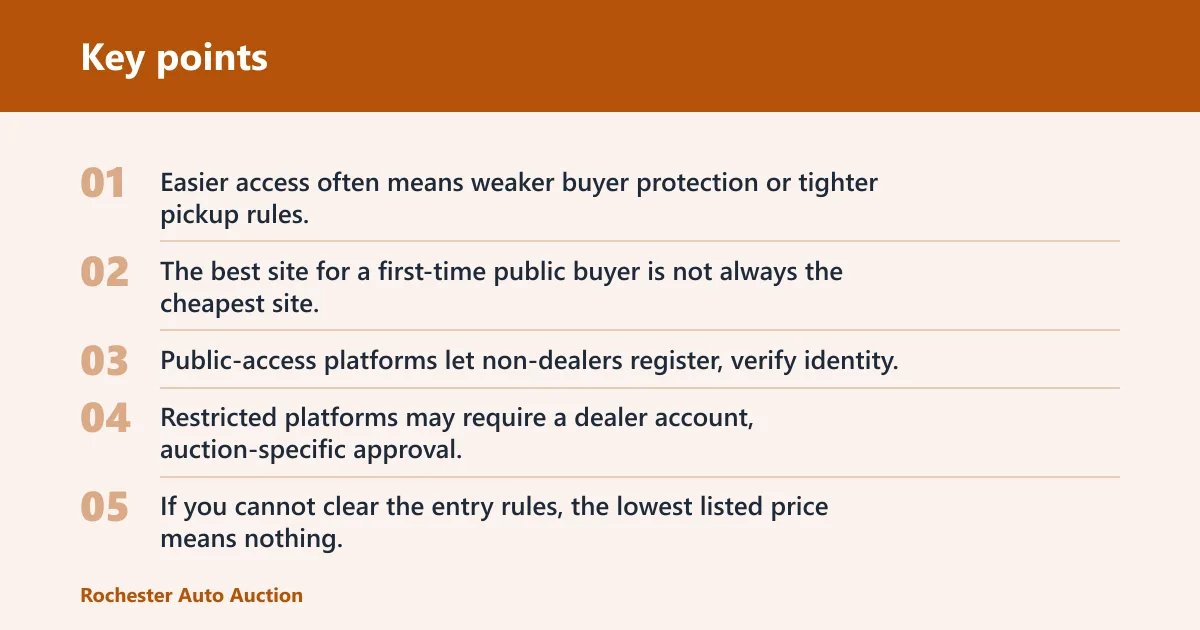
The trade-off is straightforward. Easier access often means weaker buyer protection or tighter pickup rules, while stronger documentation and dispute options can add fees or more steps before you can bid. The best site for a first-time public buyer is not always the cheapest site, and the cheapest win is not always the cheapest car after fees, transport, storage, and payment charges.
Public access versus restricted access
Public-access platforms let non-dealers register, verify identity, and bid without a dealer license. Restricted platforms may require a dealer account, auction-specific approval, or extra business documents. If you cannot clear the entry rules, the lowest listed price means nothing.
The five-part scorecard used in this guide
Each platform is typically scored from 1 to 5 in five areas: access, total cost, condition transparency, logistics, and buyer protection. A higher score means a better fit for public buyers, not necessarily the lowest hammer price. The same listing can be a good deal on one site and a poor deal on another once fees and transport are included.
What the comparison does and does not measure
This comparison focuses on buyer fit, not inventory count alone. It does not treat a large catalog as an advantage if the site hides fee terms, gives thin condition notes, or allows only a short pickup window. It also does not assume that a clean title means low risk if the car is not road-ready or the transport bill is high.
Public buyer comparison matrix
The matrix below shows how to compare public-access auction types before you bid. The goal is to estimate landed cost, not just winning price. Use the scorecard to separate public-friendly sites from sites that look cheap until the invoice arrives.
| Option | Access requirements | Fee types | Condition report quality | Title clarity | Shipping or pickup rules | Buyer protection | Access score | Total cost score | Condition score | Logistics score | Protection score | Estimated landed-cost formula |
|---|---|---|---|---|---|---|---|---|---|---|---|---|
| Public-access salvage marketplace | Open to non-dealers; identity verification; may restrict bidding by state or lot location | Buyer premium, administrative fee, payment processing fee, late payment penalties | Usually stronger photo sets; damage disclosure; often run-and-drive status; odometer disclosure varies; video may be limited | Often clean, salvage, rebuilt, or bill of sale only, depending on listing and state rules | Transport usually available; pickup window often limited; storage fees can start after the free window; non-running cars may need tow handling | Inspection allowance may be limited; disputes often time-bound; arbitration rules vary; returns are rare | 5 | 3 | 4 | 3 | 2 | Hammer price + buyer premium + admin fee + payment fee + shipping + storage + tow fees |
| Public-consignment auction marketplace | Open to non-dealers; registration and bidder verification; some lots may block certain states | Buyer premium, document fee, processing fee, late payment penalty | Condition notes may be thinner; photo count varies; run status and odometer disclosure may be inconsistent by seller | Title status can be clear, but buyers must verify lien and transfer timing | Pickup is often buyer-arranged; transport may be optional; storage charges can apply quickly | Protection may be lighter than salvage platforms; inspection windows and returns are often narrow or unavailable | 5 | 3 | 2 | 2 | 2 | Hammer price + buyer premium + document fee + shipping + storage + payment fees |
| Dealer-restricted auction | Dealer license or business verification is usually required, and public buyers are often excluded. | Often lower visible premiums for qualified members, but access barriers apply | Condition reports can be detailed, yet public buyers cannot use the platform directly | Title handling may be strong, but eligibility is the barrier | Transport and pickup rules vary by lane and seller; storage charges still matter | Arbitration may be structured, but only for approved buyers | 1 | 4 | 4 | 3 | 3 | Hammer price + buyer premium + admin fee + shipping + storage + payment fees |
How to read the scores: access measures whether you can bid without a dealer license; total cost measures the likely fee burden; condition scores reflect disclosure depth, not perfection; logistics scores reflect pickup pressure and transport clarity; protection scores reflect inspection, arbitration, and return rules.
Which platforms are open to you?
Public buyers can use online auto auctions when the site allows non-dealer registration, verifies identity, and permits individual bidding on at least some inventory. Your main check is not only whether the site says “open to the public,” but whether your state, the lot location, and the title type are eligible for your account.
Registration and bidder verification
Expect at least an email account, government ID, contact details, and a payment method. Some sites also ask for phone verification, tax information, or a deposit before bidding. If a platform will not explain the verification steps in advance, treat that as a warning sign.
State limits and location rules
Some auctions limit public bidding by state, branch, or vehicle location. A listing may be visible nationwide but still blocked in checkout for your ZIP code. That matters most when a car is close to a storage deadline or must move by tow.
When non-dealers can bid without a license
Non-dealers can usually bid on public-access inventory, but not always on every lot. A clean-title car may be open while a salvage or paperwork-sensitive car is restricted. Read the lot rules before you bid, because the registration screen often says less than the lot terms.
How do fees change the final price?
Fees can change the final price more than a small bidding gap. Compare buyer premium, administrative fee, payment processing fee, and late payment penalties before you place your max bid. The car is not your total cost until it is paid for, released, and moved.
Buyer premium and admin charges
The buyer premium is usually the largest visible fee after the winning bid. Administrative or document fees can add a fixed charge per vehicle. If a site publishes a premium schedule, use that schedule in your math before you bid.
Payment processing and late fees
Some platforms charge card processing fees or limit how much you can pay by card. Many require wire transfer, cashier’s check, or ACH for the balance. Miss the deadline, and late penalties can stack with storage charges.
How to estimate total landed cost
Use this formula before you bid:
Landed cost = hammer price + buyer premium + admin fee + payment fee + transport + storage + tow/non-running handling.
Say a sedan closes at $4,500, with an $850 buyer premium, a $75 admin fee, a $30 payment fee, $650 transport, and no storage charge. The landed cost is $6,105 before repair or registration costs. A car that looks $400 cheaper can end up costing more if the fee schedule is worse.
How reliable are condition reports?
Condition reports are useful, but they do not replace due diligence. Focus on damage disclosure, run-and-drive status, odometer disclosure, photo count, and whether the platform offers video or inspection notes. Thin media and vague wording raise risk, even when the listing looks clean.
Damage disclosure and run-and-drive status
Damage disclosure should tell you where the car was hit and whether airbags deployed, structural areas were affected, or body panels were replaced. Run-and-drive status means different things on different sites, so treat it as a short movement check, not a promise of roadworthiness. A car that “runs and drives” can still need towing.
Odometer disclosure and photo count
Check whether the odometer is disclosed as actual, exempt, branded, or not reported. Photo count matters because one angle can hide roof damage, underbody rust, or interior wear. A listing with 6 photos gives you far less to work with than a listing with 30 detailed images.
Video, inspection notes, and missing data
Video helps, but only if it shows cold start behavior, warning lights, and panel gaps clearly. Missing data is not neutral. If a listing omits odometer notes, key-run status, or underhood photos, assume the risk is higher than the title line suggests.
A common first-timer mistake is bidding on a 2017 crossover with 28 photos, a “run-and-drive” note, and no undercarriage shots. The car may arrive with suspension damage that never showed in the top-side photos, which turns a modest buy into a tow-and-repair project.
Title status, pickup, and shipping
Title status changes the risk profile immediately. Clean title, salvage title, rebuilt title, and bill of sale only each create different registration and insurance challenges. Add pickup windows, transport options, and storage fees, and two similar cars can have very different landed costs.
Clean, salvage, rebuilt, and bill of sale only
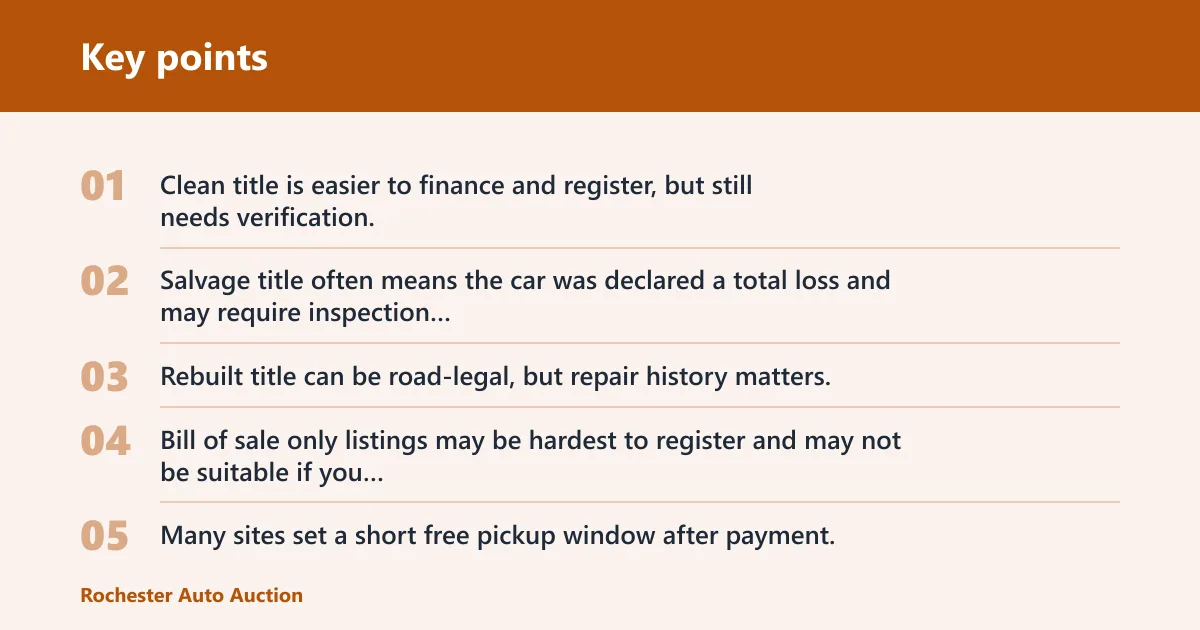
Clean title is easier to finance and register, but still needs verification. Salvage title often means the car was declared a total loss and may require inspection before road use. Rebuilt title can be road-legal, but repair history matters. Bill of sale only listings may be hardest to register and may not be suitable if you need quick, predictable title transfer.
Pickup windows, transport options, and storage fees
Many sites set a short free pickup window after payment. After that, storage fees can begin daily or by lot rule. If you cannot pick up quickly, confirm whether the site offers transport and what it costs for your ZIP code. Shipping quotes should be part of the bid, not an afterthought.
Non-running cars and tow handling
If the car will not start, has flat tires, or cannot roll, you may need special handling. That can mean a forklift, winch, or flatbed tow, each with extra charges. A non-running car can be a good deal only if the pickup and tow rules are clear before the auction ends.
Suppose a hatchback sells for $2,900 with a salvage title and a weak battery. If the yard gives about three business days for pickup and storage starts on day four, a delayed tow can erase the discount quickly. The lowest bid is not the lowest outcome.
Choose public-access auctions or restricted auctions
Choose public-access auctions if you want simpler entry and clearer buyer rules. Choose restricted auctions if you can handle extra verification and more variable terms. The right path depends on whether your main risk is access friction or fee and logistics complexity.
Choose public-access auctions if you want simpler entry and clearer buyer rules
Pick public-access sites if you are a first-time buyer, want a direct path to registration, and need a clearer view of buyer premiums and pickup rules. These platforms are also easier when you want a landed-cost estimate that includes transport and storage before you commit.
Choose restricted auctions if you can work with extra verification and more variable terms
Pick restricted platforms only if you already understand title issues, transport handling, and bid discipline. They can make sense for experienced buyers who can manage payment deadlines, inspection limits, and title timing without relying on broad consumer-style protections.
How do I know if an auction site is legit?
A legit auction site publishes its bidder rules, fee schedule, payment deadlines, pickup terms, and dispute policy in plain language. It should also show lot-level details, title status, and a real contact path for questions. If the site hides fees until after you win, be careful.
- Check whether the site explains who can bid and whether non-dealers are allowed.
- Confirm the fee schedule before registration, including buyer premium and payment charges.
- Read pickup, storage, and tow rules for your state or lot location.
- Look for title status, odometer disclosure, and condition notes on every lot.
- Review dispute windows, arbitration terms, and refund rules.
Frequently asked questions
Which online auto auctions are best for public buyers?
The best public-access auction is the one that matches your risk tolerance. First-time buyers usually do better on platforms with stronger condition reports, clear title status, and a simple pickup policy. Experienced bargain hunters may accept thinner disclosures if the fee schedule and transport rules are still transparent.
How do I compare fees across online car auction sites?
Build a landed-cost estimate for each site using the same bid amount. Add buyer premium, administrative fee, payment processing fee, transport, storage, and any late penalty risk. A lower hammer price can lose if the site charges more to pay, release, or move the car.
Can public buyers use online auto auctions without a dealer license?
Yes, on public-access platforms that allow non-dealer registration and verification. Some sites still restrict certain lots, states, or title types. Always confirm whether the specific vehicle is open to your account before you bid, because visibility and eligibility are not the same thing.
What should I look for in condition reports before bidding?
Check damage disclosure, run-and-drive status, odometer disclosure, photo count, and whether video or inspection notes are available. Look for missing front, rear, underbody, and interior shots. If the report is thin, assume more uncertainty and reduce your max bid accordingly.
How much does shipping add after winning an online auction?
Shipping can add a modest amount on a local move or a large amount on a cross-country haul. The real number depends on distance, vehicle size, operability, and whether the car needs non-running handling. Get the transport estimate before bidding, not after you win.
What happens if the car needs pickup instead of shipping?
If pickup is required, the car must leave within the site’s window or storage fees can begin. You may need a trailer, tow truck, or transport company if the car does not run. Confirm gate hours, release steps, and any non-running handling charge before you place a bid.