How to Buy Cars at Dealer Auctions Without Overpaying
Buy at dealer auctions by setting a hard all-in ceiling: retail value minus reconditioning, auction fees, transport, and your profit buffer; if the number does not work, skip the car. Bidding on excitement instead of a resale formula can turn a “deal” into an overpay once fees and repair costs hit. This guide shows how to price auction cars from retail value backward, estimate real costs, and cap your bid before bidding starts.
What dealer auctions
Dealer auctions are wholesale markets where inventory changes hands below retail pricing, but the low hammer price is not the real price. You still pay fees, transport, title or paperwork costs, and often immediate recon. That is why a cheap run can become an expensive buy.
Who can usually bid at dealer auctions?
Many dealer-only auctions require a dealer license, and some online platforms also limit access to licensed dealers. For example, ACV says its wholesale inventory is sold through a dealer-only online auction platform, and dealers can register for free with a dealer license. Public auctions and online auctions also exist, but the rules and fees differ.
What you’ll need
- Access to the run list for the sale
- Vehicle history report access
- Condition report photos or inspector notes
- A fee chart from the auction
- Transport estimate for your route
- Recon budget for tires, brakes, glass, and detailing
- Calculator or spreadsheet for max-bid math
- Payment and pickup plan for a winning bid
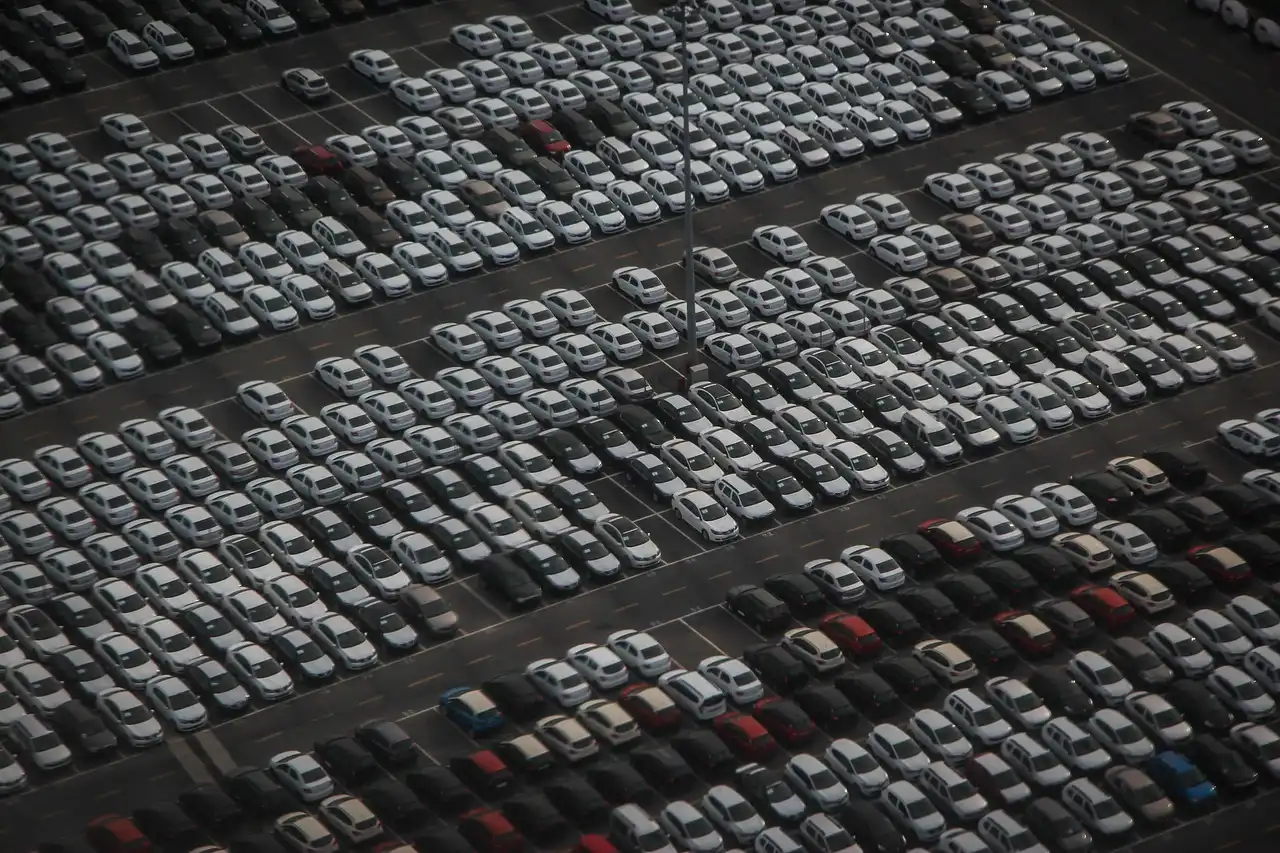
Start with retail value, subtract your target gross, then subtract recon, fees, transport, title, and paperwork. The number left is your hard all-in ceiling. If the car needs more than you planned, or the sale disclosures do not line up with the photos, walk away.
- Find retail comps first. Use recent retail listings for the same year, make, model, trim, and mileage band. Separate clean-title cars from branded-title or high-mileage units before you compare prices.
- Set your target gross. Pick the profit buffer you need after fees and repairs. In wholesale buying, a car that only clears a tiny margin is still a bad buy if the market softens.
- Estimate recon before bidding. Budget tires, brakes, windshield work, detailing, and any obvious mechanical issue. Add each item now, not after the sale.
- Add auction fees and transport. Buyer fees can significantly change the real purchase cost. Add the auction’s fee chart plus shipping or pickup costs to the number you can spend.
- Subtract title and paperwork costs. Include doc fees, temp tags, and any title transfer charges you expect to pay. Keep the ceiling conservative if the title status is unclear.
- Write down your final maximum bid. Use the hammer price only as the bid cap, not the total cost. Stop when the lane gets hot. Do not add more than your ceiling.
Cars at dealer auctions worksheet
Use this table before the sale. The final maximum bid is the amount you can raise your hand to, not the amount you hope to pay after the hammer falls.
| Example | Retail comps | Target gross | Recon estimate | Buyer fee | Transport | Title/paperwork | Final maximum bid |
|---|---|---|---|---|---|---|---|
| Sedan | $15,800 | $2,000 | $1,100 | $650 | $300 | $150 | $11,600 |
| SUV | $23,500 | $2,500 | $1,600 | $725 | $450 | $175 | $18,050 |
| High-mileage as-is unit | $9,400 | $1,500 | $2,300 | $575 | $250 | $125 | $4,650 |
For the sedan, the math is about $15,800 minus about $2,000, minus about $1,100, minus about $650, minus about $300, minus about $150. That leaves $11,600 as the most you should bid. The SUV stays above the same method, but the higher recon and fee load pulls the ceiling down faster than many first-time buyers expect.
How to read the run list
The run list is the published lineup of vehicles scheduled to sell. Most auctions publish it a few days ahead of the sale, which gives you time to sort the good candidates from the weak ones. Check lot order, sale lane, and sale day first.
Flag any unit with thin photos, missing service data, or a title status you do not understand. Pre-screen only the vehicles that still fit your ceiling after fees and recon. A long list is not an excuse to bid on cars you did not price.
What condition reports or announcements should I trust?
Use the condition report to verify what photos do not show, then treat announcements as binding sale disclosures. If they conflict, trust the more specific disclosure. A listed grade is a summary; it is not a promise that the car will need little work.
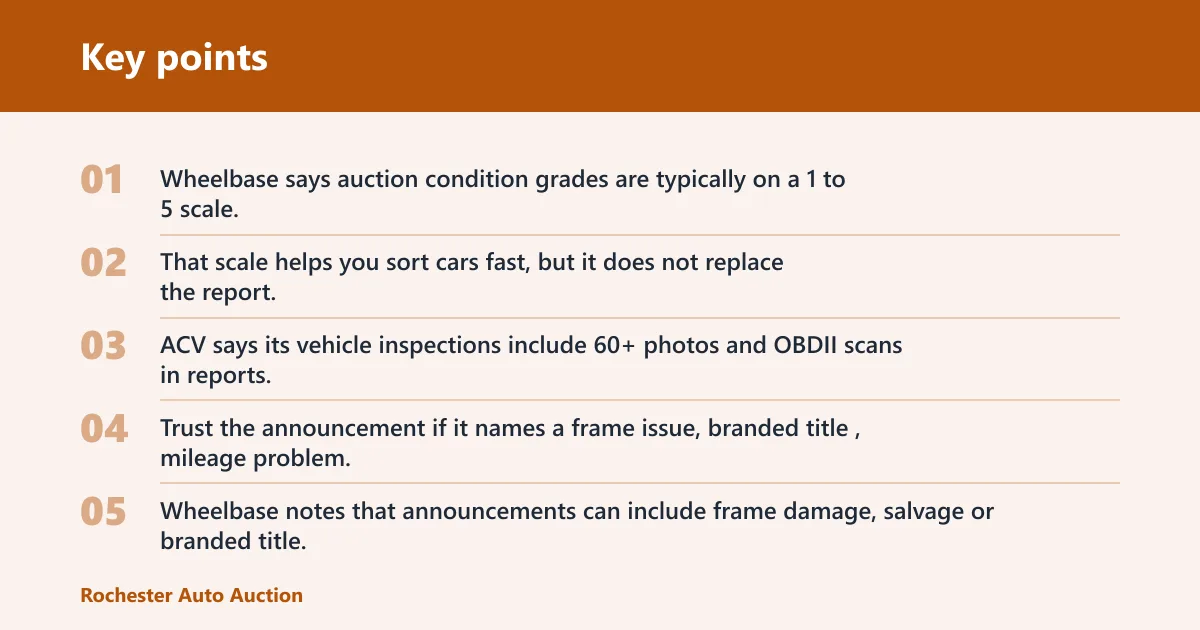
Wheelbase says auction condition grades are typically on a 1 to 5 scale. That scale helps you sort cars fast, but it does not replace the report. ACV says its vehicle inspections include 60+ photos and OBDII scans in reports, which is the kind of detail that helps separate cosmetic wear from a deeper fault.
How do you decide what to do when report and announcement disagree?
Trust the announcement if it names a frame issue, branded title, mileage problem, or as-is status. The same source notes that announcements can include frame damage, salvage or branded title, and mileage that does not add up. If the grade looks clean but the announcement says otherwise, price the worse case or skip the car.
Say your condition report shows a 4.1-grade midsize sedan with 72 photos, but the run announcement adds “mileage not actual.” That car is no longer a simple clean-title buy. Reprice it as a risk unit, or do not bid.
What do you need to know before bidding in a dealer auction?
You need the sale rules, payment rules, pickup timing, and arbitration terms before you bid. Those details affect whether a cheap car is actually usable. If you cannot pay on time, move the car on time, or dispute a hidden issue under the auction’s rules, your margin can disappear fast.
Check whether the auction allows arbitration for the defect you are worried about. Some issues are covered, some are not, and the claim window can be short. Know that before the lane starts moving.
- Open the run list and mark your targets. Keep only the units that fit your ceiling and sale day.
- Pull the condition report and photos. Match damage, tire wear, warning lights, and title notes to the listing.
- Read every announcement. Treat the spoken disclosure at sale time as binding.
- Set your ceiling in writing. Put the final number where you can see it during bidding.
- Bid only to that number. If the car crosses it, stop.
Common mistakes that cause overpaying
The biggest mistake is bidding from the hammer price instead of the all-in cost. The second is ignoring buyer fees and transport. A third is assuming a good grade means low recon. None of those assumptions holds up once the bill arrives.
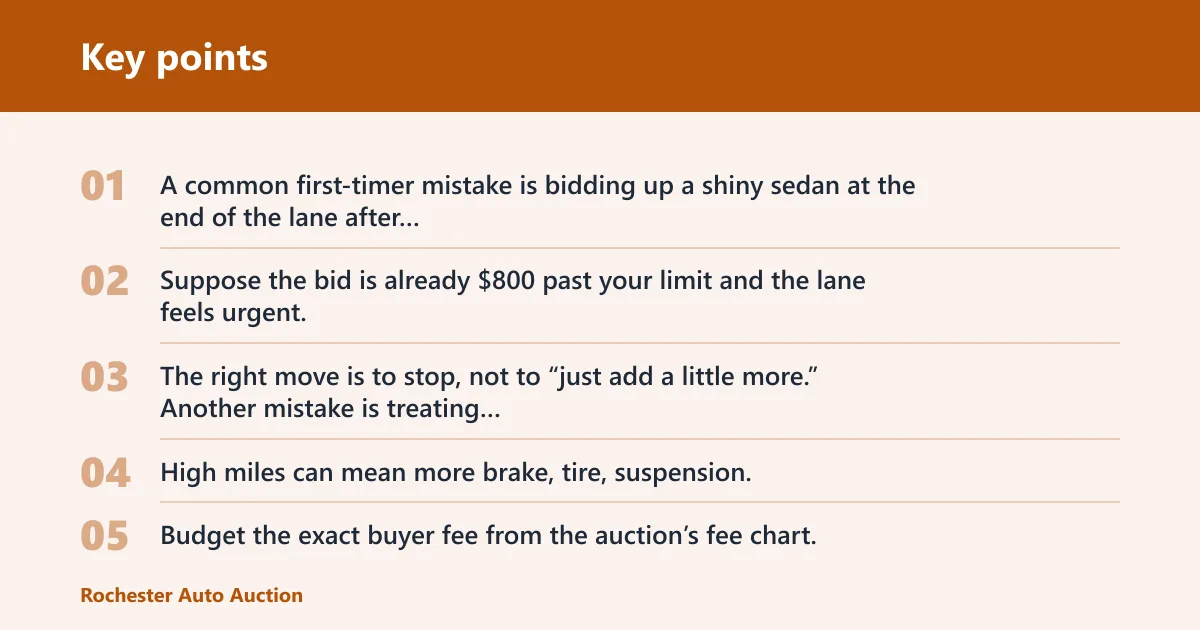
A common first-timer mistake is bidding up a shiny sedan at the end of the lane after the budget limit has already been passed. Suppose the bid is already $800 past your limit and the lane feels urgent. The right move is to stop, not to “just add a little more.”
Another mistake is treating high-mileage inventory like a normal clean-title unit. High miles can mean more brake, tire, suspension, and cooling system work even when the exterior looks fine. Price that work before you bid.
How much should you budget for auction fees and transport?
Budget the exact buyer fee from the auction’s fee chart, then add transport based on route and distance. If you do not have the exact numbers, use a conservative estimate and reduce your bid ceiling. Fees can materially change a decent deal into an expensive one.
For a long-distance buy, transport may be enough to erase the margin you thought you had. If pickup is easy and local, the damage is lower. Either way, put it into the formula before the sale.
Can I buy auction cars without a dealer license?
Sometimes, but not at every dealer-only auction. Public auctions and certain online channels may allow non-dealers, while dealer-only lanes usually require licensing or a registered dealer partner. Check the auction’s access rules before you assume you can bid.
ACV’s wholesale inventory is sold through a dealer-only online auction platform, and ACV says dealers can register for free with a dealer license. That kind of access rule is common for many wholesale lanes.
How do I tell if an auction car is worth the price?
It is worth the price only if the retail comp minus recon, fees, transport, and your target gross still leaves room. If the math fails, the car is too expensive at that bid. The grade alone cannot make it a good buy.
Use wholesale logic, not retail wishful thinking. Compare against dealer-to-dealer pricing and then subtract the costs that the next buyer never sees. If the car needs immediate tires and brakes, the ceiling should fall fast.
Picture an SUV with a good-looking exterior, a 3.5 grade, and an announcement for frame damage. The exterior does not matter as much as the disclosure. That is a walk-away unit unless the price is far below your normal ceiling and the risk is fully understood.
Prevention
Before sale day, build a short watch list with the exact max bid beside each unit. That simple step keeps the lane from setting your price for you.
Frequently asked questions
How do I buy cars at dealer auctions without overpaying?
Start with retail comps, subtract recon, fees, transport, title, and your profit buffer, and write down the result as a hard ceiling. If the auction price or the run disclosures push the car past that ceiling, pass. The best protection against overpaying is refusing to bid after the math is done.
How do I set a maximum bid for an auction car?
Take the retail comp, subtract your target gross, then subtract recon, buyer fee, transport, title, and paperwork. The remaining number is your maximum bid. Use a calculator or spreadsheet and keep the result in front of you during the sale.
What mistakes make buyers overpay at car auctions?
Overpaying usually comes from chasing the hammer price, ignoring fees, undercounting recon, and bidding after the ceiling is gone. A good-looking grade can also hide expensive work. The fix is simple: price the car from retail backward and stop at your number.