Auction Consignment: How It Works for Car Sellers
Auction consignment generally involves transferring vehicle ownership to the auction house, which handles bidding and payment, and sellers may net roughly 5% to 15% of the final hammer price after fees. Ignoring prep requirements or title discrepancies often results in your car being held back, costing you thousands in lost sales and extended storage fees. This guide maps the exact workflow from intake to payout, identifying the decision points that directly impact your final cash and timeline.
What Is Auction Consignment for Car Sellers?

Auction consignment places your vehicle in the hands of a licensed auction house that markets, sells, and remits payment after the sale closes. You remain the owner until the hammer falls and the auction processes the paperwork. The auctioneer acts as your agent under a signed consignment agreement rather than buying the car outright.
Consignment differs from a private sale because the auction house controls the listing format, bidder pool, and sale day execution. It also differs from a trade-in because you set the terms, including reserve price when available, and the auction house earns a commission rather than paying you wholesale. Dealers and private sellers both use consignment, though private sellers gain access to a larger buyer network they could not reach independently.
Consignment makes sense when you want maximum exposure without managing showings, negotiations, and financing logistics yourself. It also helps when the vehicle needs specialized marketing or when you have multiple cars to sell through a single channel. Consignment may not make sense if your car has a lien you cannot clear, if storage costs exceed expected proceeds, or if you need same-week cash and cannot wait for auction settlement windows.
The distinction matters because control shifts at each stage. You surrender physical possession and marketing authority once the agreement is signed. In return, the auction house assumes responsibility for lot presentation, bidder communication, and sale-day operations. Understanding who controls each step determines where risks accumulate and where you can intervene.
How Does Auction Consignment Work From Drop-Off to Payout?
The consignment flow commonly moves through five stages: intake and inspection, condition reporting and photography, listing and marketing, sale day and bid outcomes, and post-sale settlement with title release. Each stage contains decision points that affect whether your car sells, at what price, and when you receive payment.
Intake begins with vehicle drop-off or scheduled transport to the auction facility. The auction team conducts a walk-around inspection, verifies the VIN, checks odometer readings, and notes any damage or mechanical concerns. You provide keys, the title or title documentation, and any existing service records. The auction house then assigns the vehicle to an upcoming sale date based on lot capacity and your preferences.
Condition reporting follows immediately. The auction house photographs the exterior, interior, engine bay, and any damage. They record mileage, mechanical status, and known defects. Some houses perform a basic mechanical check; others rely on seller disclosures alone. Photo quality and disclosure depth directly influence bidder confidence and final bid levels.
Listing and marketing place the vehicle on the auction catalog, both online and in-house lots. Auction platforms like AuctionZip promote both online and in-person bidding formats, and categories such as Automobiles organize vehicle listings alongside other used goods. HiBid includes a dedicated category for vehicle listings and features auctions that can end on a specific day, giving sellers predictable timing. A common first-timer mistake is submitting vague photos that hide dents or skip the engine bay, which reduces bidder trust and suppresses final bids.
Sale day executes the live or timed auction. Bidders inspect the vehicle, place bids, and the highest qualifying bid wins. If a reserve price is set and unmet, the car does not sell. The auction house records the hammer price and issues a buyer invoice. Settlement paperwork begins immediately.
Post-sale settlement involves processing the buyer’s payment, resolving any holds or liens, deducting seller fees, and releasing your net proceeds. Title transfer occurs according to state law and the terms specified in your consignment agreement. Payment timing can vary by auction house, from same-day wire to about a 30-day waiting period, depending on clearance protocols.
Seller Workflow Timeline
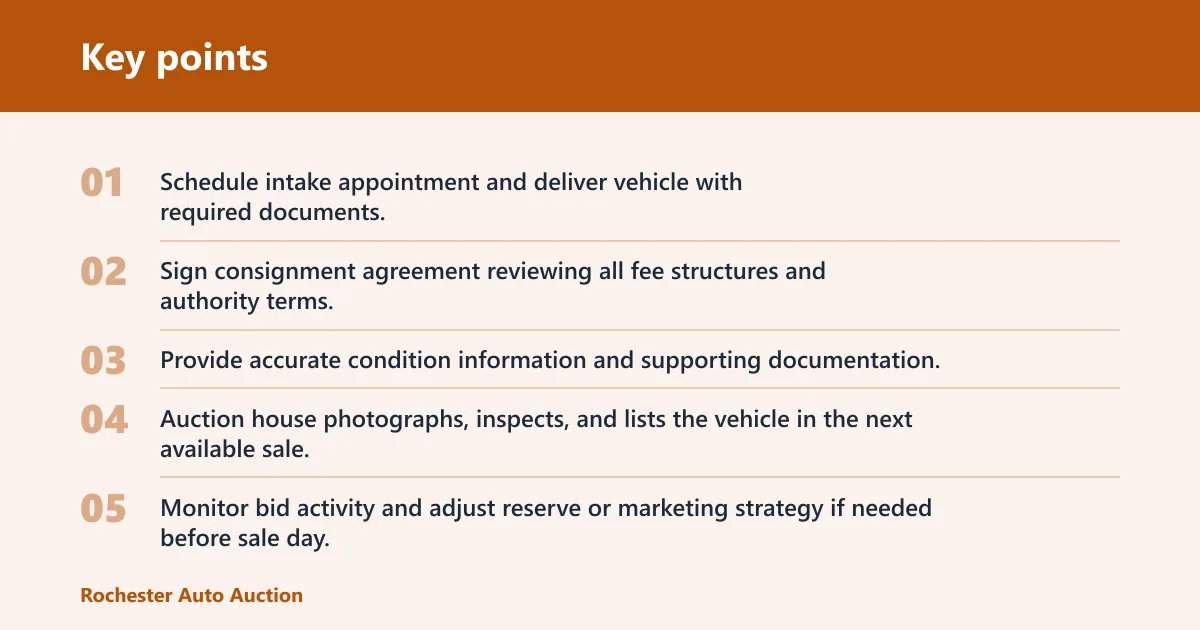
- Schedule intake appointment and deliver vehicle with required documents.
- Sign consignment agreement reviewing all fee structures and authority terms.
- Provide accurate condition information and supporting documentation.
- Auction house photographs, inspects, and lists the vehicle in the next available sale.
- Monitor bid activity and adjust reserve or marketing strategy if needed before sale day.
- Vehicle sells at auction; buyer payment processes through auction escrow or settlement account.
- Auction house deducts agreed commissions, fees, and charges from gross proceeds.
- Net proceeds transferred to you via check or wire within the stated settlement window.
- Title released to buyer and confirmation sent to you.
Who Keeps the Title While My Car Is on Consignment?
Title holding practices vary by auction type and state law, but the most common arrangement requires you to retain the original title and present it to the auction house only at point of sale, or to surrender it into escrow under agreement terms. Some auction houses require the physical title before they will accept the vehicle for listing. Others allow consignment without title submission until the sale completes.
If you hold a lien, the situation becomes more complex. Lienholders typically retain the title electronically or physically, and the auction house may require lien payoff verification before accepting the vehicle. A common scenario involves a seller who delivers the car but cannot produce a clear title because the loan balance was miscalculated. The auction house holds the vehicle pending payoff documentation, and storage fees continue to accumulate daily.
When the car sells, title transfer timing depends on your agreement and state requirements. Some auction houses submit title transfer paperwork immediately upon payment clearance. Others wait 5–10 business days to ensure buyer funds have fully settled. The consignment agreement should specify exactly when and how the title moves from your name to the buyer’s name.
If you sign over the title before sale day, understand that you are transferring legal ownership prematurely. The auction house may hold the title in a secure vault, but early transfer creates risk if the sale falls through or disputes arise. Most sellers and experienced auction professionals recommend retaining title until the buyer’s payment clears and the auction house confirms the transfer is ready to file.
Can I Set a Reserve Price on a Consignment Auction?
Reserve prices are permitted at many auction houses, but policies differ significantly. Some facilities allow reserves on all vehicle types. Others restrict them to high-value or specialty cars. Some do not offer reserves at all and require a no-reserve format to maximize bidder participation.
A reserve price sets the minimum acceptable bid. If bidding does not reach that threshold, the vehicle remains unsold regardless of how close the final bid comes. Setting a realistic reserve matters because an inflated reserve discourages early bidding activity and increases no-sale probability. Picture a seller who sets a reserve 20% above market value on a popular crossover: the engine purrs, the photos are sharp, but bidders scroll past because the starting bid signals unrealistic expectations. The car sits unsold.
Reserves also affect bidding dynamics. Some auction platforms display the reserve status transparently so bidders know whether the minimum has been met. Others keep reserve details hidden until the bid reaches that level. Hidden reserves can create frustration when bidders believe they have won only to discover the reserve was unmet. Transparent reserve systems tend to generate more confident bidding and fewer post-sale disputes.
The cost of a no-sale outcome includes missed auction fees, possible re-listing fees, and ongoing storage charges. Many auction houses charge a seller commission or minimum fee even when the vehicle does not sell. Before setting a reserve, calculate whether the potential extra revenue justifies the risk of additional costs from a failed sale. A conservative reserve near current market value usually produces faster sales and lower total costs than an aggressive one.
Fees Breakdown: Seller Commission, Admin, Reconditioning, Storage, and Transport Charges
Seller-side fees in auction consignment come from several distinct categories. Understanding each one prevents surprises during net proceeds calculation.
Seller Commission Structure
The seller commission is the primary fee charged by the auction house. Seller commission rates often fall in the rough range of about 5% to 15% of the hammer price, depending on vehicle value, auction type, and negotiated terms. Higher-value vehicles often qualify for lower commission percentages. Some auction houses tier their rates: for example, 10% on the first $5,000 and 8% on amounts above that threshold.
Buyer Premium Impact on Your Side
The buyer premium is charged to the purchaser, not the seller, but it affects final bid behavior. A buyer paying a 10% premium on a $20,000 hammer price adds $2,000 to their total cost, which may discourage higher bids. Sellers benefit from understanding how buyer premiums compress effective bid prices because this knowledge helps set competitive reserves and realistic seller expectations.
Admin and Reconditioning Fees
Administrative fees cover catalog processing, buyer documentation, and lot management. These range from flat fees of $100 to $500 per vehicle or percentage-based charges. Reconditioning fees apply when the auction house performs minor repairs, detailing, parts replacement, or mechanical preparation before listing. Sellers should request an estimate before authorizing reconditioning work because unexpected charges reduce net proceeds.
Transport and Storage Charges
Transport fees cover vehicle pickup and delivery to the auction facility. Rates depend on distance and accessibility. Storage charges accrue daily when the vehicle sits on the lot before sale day and sometimes after a no-sale outcome. A common scenario involves a seller whose car sells but the buyer fails to arrange timely pickup. Storage fees mount quickly, sometimes exceeding hundreds of dollars before the buyer resolves the delay.
Net Proceeds Calculation
Net proceeds equal the hammer price minus seller commission, minus admin and reconditioning fees, minus storage and transport charges, plus any buyer premium rebates if applicable, and minus any outstanding liens the auction house pays on your behalf. A simple example: a $25,000 hammer price with about an 8% seller commission ($2,000), a $250 admin fee, about $150 in reconditioning costs, and about $75 in storage would yield net proceeds of about $22,525 before taxes and lien payoff.
Consignment Agreement Essentials
The consignment agreement is the controlling document for your entire auction experience. It defines obligations, authority scope, fee structures, and dispute resolution procedures. Signing without reading every clause invites costly misunderstandings later. Before you put pen to paper, review the entire agreement line by line. Ask for explanations on anything unclear. Walk away from any contract that pressures you to skip the fine print.
Seller Obligations and Representations
You must represent that you hold clear ownership authority, that disclosures are accurate, and that the vehicle is free of undisclosed encumbrances except as noted. Seller obligations typically include providing the title, cooperating with inspections, responding to bidder inquiries through the auction house, and removing personal belongings before drop-off.
Auctioneer Authority Scope
The agreement specifies what decisions the auction house can make without your approval. Standard authority includes setting the starting bid, accepting bids, negotiating with buyers, and processing payment. Limited authority agreements require your sign-off before accepting bids below a certain threshold or changing marketing strategy mid-sale. Define the boundary clearly in writing.
Fee and Commission Terms
All fees should appear in the agreement with specific dollar amounts or percentage rates. Vague language like “standard auction fees apply” leaves room for unexpected charges. The agreement should itemize seller commission, admin fees, reconditioning authorization limits, storage rate per day, and transport costs.
Reserve Price Terms
If your agreement allows a reserve, the document should state the reserve amount, who can modify it after signing, and what happens if the reserve is not met. Some agreements permit reserve adjustments only with written consent from both parties.
Title Transfer Timing
The agreement should specify when and how the title transfers from seller to buyer. Look for clauses describing whether the auction house holds the title in escrow, submits it directly to the state, or requires your signature at pickup. Title transfer timing also determines when your liability exposure ends.
Payment Timing Provisions
Payment terms define the settlement window, often about 3 to 30 business days after sale close. The agreement should state the payment method offered, any holdback conditions, and whether interest accrues on delayed payments. Some auction houses withhold payment until the buyer’s check clears or funds settle in full.
Liability and Insurance Terms
Liability provisions allocate responsibility for damage, theft, or loss while the vehicle is in the auction house’s custody. The agreement should reference the auction house’s insurance coverage and any exclusions that leave you exposed. Sellers should never assume blanket protection exists without verifying policy terms in writing.
Insurance Coverage and Liability During Consignment
On-lot insurance coverage varies significantly between auction houses. Most reputable facilities carry garage keeper’s liability insurance that protects vehicles in their care, custody, or control. Coverage limits typically range from $10,000 to $100,000 per vehicle, though policies often exclude certain damage types.
Policy exclusions to watch for include consequential damage from pre-existing mechanical issues, damage caused during test drives by unauthorized drivers, vandalism during off-hours, and weather-related flooding if the facility lacks proper drainage. Some policies exclude cosmetic damages like paint chips unless they result from collision events. Read the actual policy language rather than relying on verbal assurances from auction staff.
Responsibility for damage during display or transport depends on who controlled the vehicle at the time of loss. If the auction house arranged transport and the carrier caused damage, their insurance should cover it. If you delivered the vehicle personally and a parking lot accident occurred, your own insurance may be the primary source. Clarify this before drop-off day.
Test drive limits represent another coverage gap. Auction houses that permit prospective buyers to test drive your vehicle should require licensed drivers, documented waivers, and proof of insurance. Verify whether the auction house’s policy extends to damage occurring during authorized test drives or whether those events fall outside coverage entirely.
When Do You Get Paid After a Consignment Auction Sale?
Payment timing depends on the auction house’s settlement schedule, buyer payment clearance, and any holds triggered by documentation issues. Most auction houses remit seller proceeds within 3 to 14 business days after the sale closes. Faster settlements occur with wire transfers and electronic payment verification. Slower settlements involve paper checks, lienholder coordination, or disputed transactions.
Common holdback reasons include unresolved title discrepancies, pending lien payoff verification, incomplete odometer disclosure forms, buyer payment failures requiring resubmission, and state-mandated waiting periods for title processing. An auction house may also retain a small portion of proceeds as security against post-sale disputes, releasing it after a defined review period.
Payment methods typically include mailed check, direct deposit, or wire transfer. Wire transfers provide the fastest access but may incur banking fees. Checks arrive within standard postal delivery windows. Direct deposit requires provided bank routing and account numbers and usually posts within 1–3 business days after authorization.
Conditions that delay payout deserve careful attention before you consign. If your lienholder requires a specific payoff letter format, obtain it before sale day. If your state requires notarized title signatures, complete that step beforehand. Addressing documentation gaps proactively eliminates the most common causes of payment delays.
Vehicle Condition Report Requirements
Accurate condition reporting protects you from post-sale disputes and ensures bidders make informed decisions. Auction houses typically require standardized disclosure forms covering specific vehicle attributes.
Odometer Disclosure Obligations
Federal law requires odometer disclosure on title transfer for most vehicles under 16,000 pounds. The report must indicate whether the mileage is actual, excess, or not actual. Sellers who misrepresent odometer status face legal liability and potential fraud claims. Always verify the reading matches the title before submission.
VIN Verification and Matching
The Vehicle Identification Number on the report must match the dashboard plate, door jamb sticker, and title documents. Mismatches trigger holds that delay both listing and sale. A common discrepancy arises when replacement doors or dash panels bear different VIN plates. Resolve inconsistencies before drop-off.
Damage Disclosure Standards
Damaged areas must be photographed and described with specificity. General terms like “some scratches” create buyer suspicion and invite renegotiation after purchase. Detailed descriptions like “three-inch scuff on rear driver quarter panel, approx. two inches from taillight assembly” build credibility and reduce post-sale dispute risk.
Mechanical Status Reporting
Report engine performance, transmission operation, brake function, electrical systems, and any warning lights. Vehicles sold with known mechanical faults should carry appropriate disclaimers. Misleading mechanical representations can void consumer protection remedies and expose sellers to repair cost claims.
Photo and Documentation Expectations
Professional-quality photos improve bidding engagement significantly. Expected angles include front three-quarter, rear three-quarter, interior driver view, center console, instrument cluster showing mileage, engine bay, tire tread, and any damage areas. Supplemental documentation may include service records, window stickers, and prior inspection reports.
How Do I Choose a Car Auction Consignment Company?

Selecting the right consignment partner requires evaluating transparency, track record, fee structure, and operational capabilities. Below is a comparison framework you can use to assess candidates systematically.
| Criterion | What to Look For | Red Flag |
|---|---|---|
| Fee transparency | Itemized fee schedule in written agreement | Vague references to “market rate” commissions without specifics |
| Payout speed | 3–14 business day settlement window clearly stated | No defined payment timeline or promises of “immediate” payment without conditions |
| Sales success rate | Published or verifiable sell-through percentage above 70% | Inability or refusal to provide historical performance data |
| Reserve flexibility | Clear policy on reserve availability and adjustment process | Either hard no-reserve policy without explanation or unlimited reserve changes after signing |
| Insurance coverage | Written proof of garage keeper’s liability insurance with per-vehicle limits disclosed | Verbal assurances only or policy exclusions that leave common damage types uncovered |
| Marketing reach | Active listings on major platforms including automobile directories and multi-format auction access | Limited online presence or reliance solely on local foot traffic |
| Communication protocol | Designated account representative with response time commitments | No single point of contact or inconsistent messaging between staff members |
| Title handling procedure | Clear written process for title retention, escrow, and transfer timing | Pressure to surrender title before sale or unclear transfer responsibilities |
| Dispute resolution | Documented process for handling post-sale disagreements and damage claims | No formal dispute procedure or requirement to arbitrate exclusively at auction house expense |
Questions to Ask Before Signing
- What is your exact seller commission rate and how does it scale with vehicle value?
- Do you offer reserve pricing, and under what conditions can it be modified after signing?
- What is your average settlement window, and what events commonly trigger holds?
- Can you provide written proof of insurance coverage including per-vehicle limits and exclusions?
- How do you handle lienholder payoff coordination and title transfer sequencing?
- What marketing channels and platforms do you use to promote consigned vehicles?
- What is your typical sell-through rate for vehicles in my price range and condition?
- What documentation do you require before accepting a vehicle for consignment?
Comparing Fee Transparency
Request a detailed fee breakdown from each candidate before committing. Compare total cost assumptions using the same hypothetical hammer price across all providers. A $20,000 vehicle at 8% commission plus $200 admin and $150 reconditioning totals $2,150 in fees. Another house charging 6% commission but $500 in mandatory reconditioning totals the same $2,150. The headline commission rate alone does not tell the full story.
Reviewing Past Payout Speed and Success Rate
Ask for documented examples of recent sales in your vehicle category. Request average days-to-sale and average net-to-seller ratios. Cross-reference online reviews and Better Business Bureau ratings when available. Consistent patterns of delayed payments or complaints about undisclosed fees signal operational problems worth avoiding.
Failure Cases: No-Sale, Reserve Not Met, Title Issues, Lien Delays, Post-Sale Disputes
Understanding what goes wrong prepares you to avoid those scenarios and respond effectively if they occur.
No-Sale Outcomes and Residual Costs
When a vehicle fails to sell, you typically owe a no-sale fee or minimum commission regardless of the hammer price. Storage continues accruing until you arrange removal. Re-listing may incur additional catalog and marketing charges. Evaluate whether the expected incremental sale price justifies repeating these costs in a subsequent auction cycle.
Reserve-Not-Met Procedures
If the reserve is not met, the auction house notifies you promptly. You can choose to adjust the reserve downward, withdraw the vehicle, or re-list at the next available sale. Adjusting the reserve carries momentum advantages because registered bidders receive notification and may return for the revised auction. Withdrawing avoids further fees but resets your market exposure completely.
Title Discrepancies and Holds
Title problems include missing signatures, incorrect VIN entries, lienholder mismatches, and branded titles not disclosed upfront. Auction houses typically halt the sale process until discrepancies resolve. Sellers should prepare for potential delays by gathering all title-related documentation before drop-off and confirming state-specific transfer requirements in advance.
Lien Payoff Delays and Escrow Scenarios
Lien payoff creates the most common delay chain. The auction house may escrow sale proceeds to satisfy the lienholder directly, but the payoff amount must match the lender’s requirements exactly. Shortfall payments force sellers to cover the difference before receiving any net proceeds. Overpayment returns flow to the seller after lien satisfaction. Confirm the payoff figure with your lender before sale day and bring written confirmation to the auction house.
Post-Sale Dispute Resolution Paths
Disputes arising after sale typically involve misrepresentation claims, undisclosed damage discovered post-purchase, or title transfer errors. Most consignment agreements include arbitration clauses requiring dispute resolution through designated channels rather than litigation. Document every interaction, preserve all communications, and understand your contractual rights before any disagreement escalates.
Consignment Decision Checklist
- Confirm title is current, accurate, and matches all VIN plates on the vehicle.
- Obtain lien payoff quote from your lender and bring written confirmation to the auction house.
- Research at least three auction houses and compare itemized fee schedules side by side.
- Verify insurance coverage in writing with per-vehicle limits and exclusion details.
- Negotiate reserve price terms before signing and confirm modification procedures are documented.
- Prepare professional-quality photos covering all required angles before drop-off day.
- Complete odometer disclosure, condition report, and damage inventory accurately and thoroughly.
- Clarify settlement timeline, payment method options, and holdback conditions in the agreement.
- Remove all personal items and register devices from the vehicle before auction house takes possession.
- Request written acknowledgment of all verbal promises made by auction house staff.
Frequently Asked Questions
How does auction consignment work for a car seller?
Auction consignment involves delivering your vehicle to a licensed auction house under a signed agreement. The auction house markets the car to its buyer network, conducts the sale, deducts agreed fees and commissions, and remits net proceeds to you after settlement. You retain ownership until the sale closes and title transfers according to state procedures.
What happens from drop-off to payout in a consignment auction?
The process moves through intake inspection, condition reporting and photography, catalog listing and marketing, sale day execution, buyer payment clearance, fee deduction, and net proceeds transfer. Each phase has specific documentation requirements and timeframes. Delays most commonly stem from title discrepancies, unresolved liens, or incomplete condition disclosures submitted at intake.
What fees do auction consignment companies charge?
Primary fees include seller commission ranging from 5% to 15%, administrative processing fees, optional reconditioning charges, daily storage fees after sale or no-sale, and transport costs if the auction house arranges pickup. Buyer premiums are charged to purchasers and indirectly affect bidding behavior. Total costs reduce gross hammer price to net proceeds, making fee comparison essential before selecting a provider.