How to Read an Auction Report Without Missing Red Flags
Read the condition report in three passes: body, mechanical, and disclosures. If two sections conflict, or one safety item appears, treat the car as high risk and inspect further or walk away. Missed clues turn cheap bids into repairs, title headaches, and resale losses. This guide shows how to score contradictions, spot red flags fast, and decide whether to bid, verify, or pass.
What an auction inspection report covers
What the report usually includes
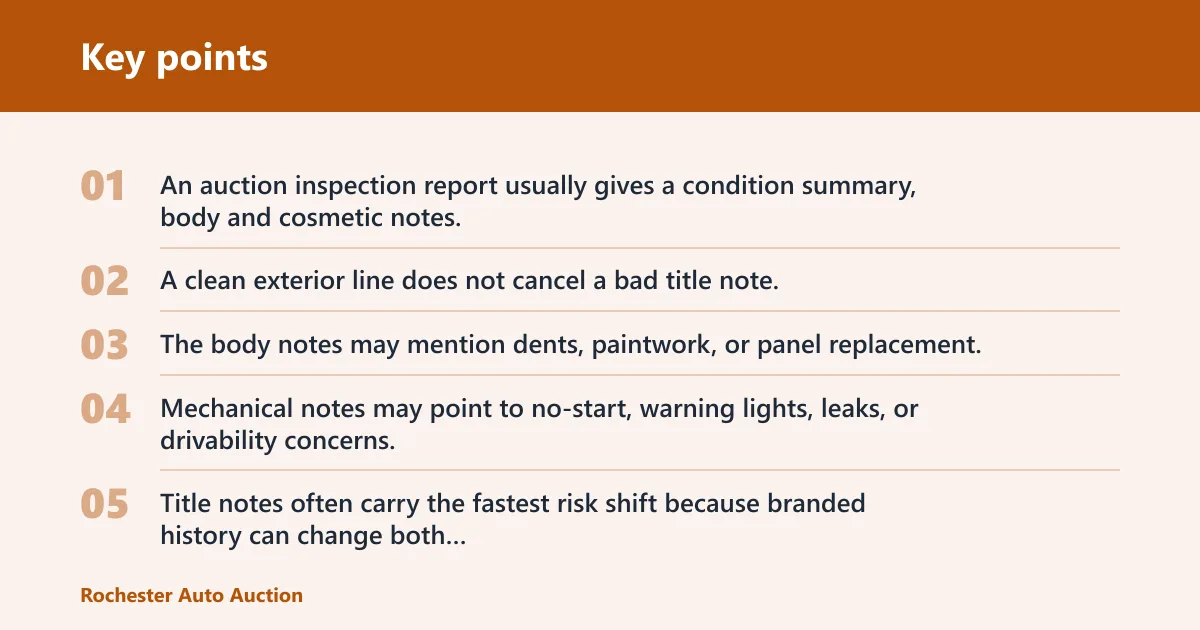
An auction inspection report usually gives a condition summary, body and cosmetic notes, mechanical notes, title or ownership notes, damage disclosures, items not checked, and report limits. Those sections matter together. A clean exterior line does not cancel a bad title note, and a good start note does not erase flood residue or airbag clues.
Read each section as a clue, not a verdict. The condition summary is broad. The body notes may mention dents, paintwork, or panel replacement. Mechanical notes may point to no-start, warning lights, leaks, or drivability concerns. Title notes often carry the fastest risk shift because branded history can change both financing and resale.
Why blank space is not clean space
“Items not checked” and report limits matter because they define blind spots. No-start vehicles, short inspection windows, and poor undercarriage access can leave major damage unseen. Hidden frame bends, corrosion, intermittent electrical faults, and sealed interior water damage often sit outside what a quick lane inspection can confirm.
Picture a sedan listed with “run and drive,” “left front bumper scuff,” and “no undercarriage inspection.” That sounds mild until the title line says salvage and the airbag light is on in the photo set. The clues do not agree. That mismatch deserves a much lower bid ceiling, or a pass.
How do you read the grade?
Read the grade as a rough condition score, not a repair bill. A higher grade usually means fewer visible flaws, but it does not rule out hidden damage, warning lights, flood exposure, or title problems. A lower grade can still be worth bidding on if the notes are honest and the repair path is simple.
What the condition scale usually signals
Many auction grade scales run from poorer condition to better condition, often with half-point steps. The exact scale can vary by auction, but the logic stays similar: a lower grade suggests more visible wear or damage, while a higher grade suggests fewer obvious defects. The grade alone never confirms mechanical health.
Grade versus repair cost often disagrees. A clean-looking 4.5 can hide expensive electronics, a weak transmission, or a branded title. A rough 2.5 may need only cosmetic work and tires. That is why you should read the grade next to the notes, photos, and title line, not instead of them.
When grade inconsistency is a warning sign
Watch for a high grade paired with major body language such as “frame pull,” “airbag deployed,” or “structural repair.” Also watch for a low grade with almost no visible explanation. Either pattern can mean the report is incomplete, the vehicle was reconditioned, or the most expensive damage is not shown in the grade.
- Check whether the grade matches the body notes.
- Check whether the grade matches the photos.
- Check whether the grade matches the title status.
- Check whether the grade matches the warning lights or run-and-drive note.
- If two of those conflict, lower the bid or walk away.
Run and drive: what it really means
“Run and drive” generally means the vehicle started and moved under its own power during the auction’s check, but it does not say much more than that. It does not guarantee roadworthiness, smooth shifting, safe braking, cooling-system health, or long-term reliability. A run-and-drive vehicle can still have major electrical, structural, or flood-related problems.
What the label confirms, and what it does not
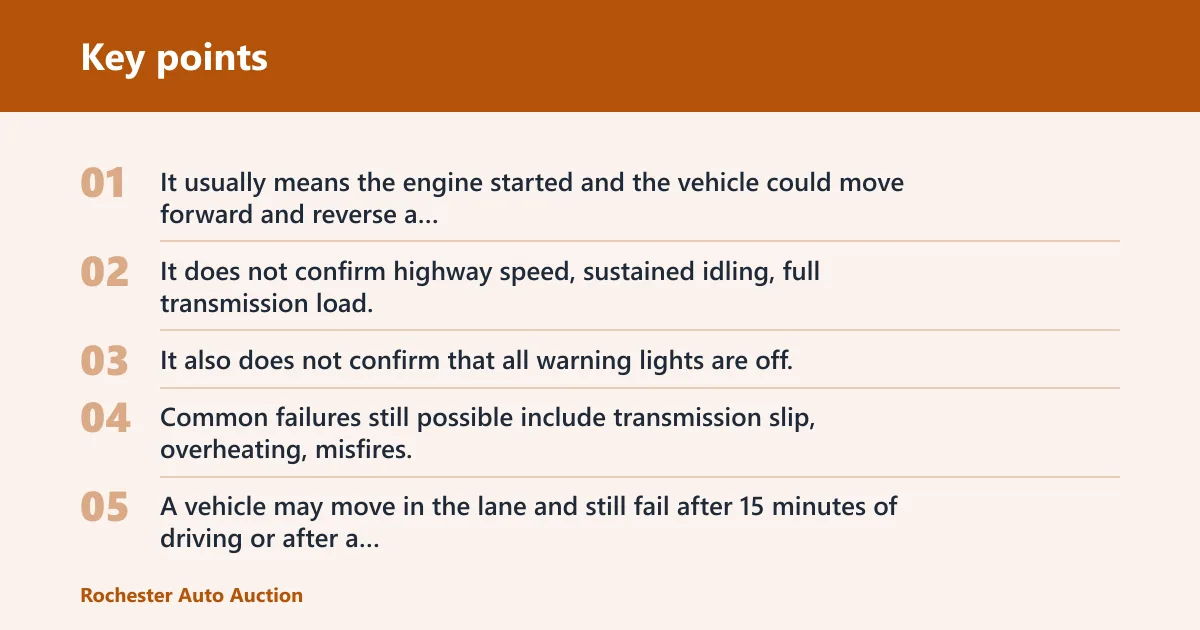
The label confirms only a limited test. It usually means the engine started and the vehicle could move forward and reverse a short distance. It does not confirm highway speed, sustained idling, full transmission load, proper charging, ABS function, or air conditioning performance. It also does not confirm that all warning lights are off.
Failures that can still hide behind the label
Common failures still possible include transmission slip, overheating, misfires, coolant loss, oil leaks, electrical shorts, sensor faults, brake pulsation, and airbag or stability-system warnings. A vehicle may move in the lane and still fail after 15 minutes of driving or after a cold soak. Short checks miss intermittent issues often enough to matter.
Suppose a crossover is marked run and drive, but the photo set shows a lit check-engine lamp and the notes mention “cooling system leak.” That combination should not be read as a minor service item. It suggests the vehicle can move, but not that it should be priced like a clean driver.
Why short inspection windows limit confidence
Auction inspections are brief. That time limit matters. A vehicle may not reach operating temperature, a transmission may not shift through all gears, and some electrical faults only appear after vibration or heat. If the report says “items not checked,” treat that as a real risk source, not a formality.
Auction report red-flag matrix

Use this matrix to turn report language into a decision. The key is not one line by itself. It is the combination of clue, severity, and what still needs proof. One severe clue can outweigh several mild notes, especially when title, water, electrical, or structural issues appear together.
| Report clue | What it may mean | Severity | What to verify next | Bid decision |
|---|---|---|---|---|
| “Run and drive” plus check-engine light | Vehicle moved, but engine or emissions fault is present | Medium | Fault codes, idle quality, coolant level, service history | Inspect further; bid only with a repair reserve |
| “Transmission slips” or “delayed engagement” | Likely internal wear or fluid-control issue | High | Shift quality, fluid condition, scan data, road test if allowed | Walk away unless repair cost is already known |
| “Frame rail repair,” “pull,” or “structural” | Possible collision damage to structure or alignment | High | Rail symmetry, tire wear, door gaps, underbody photos | Walk away for most retail buys |
| “Airbag deployed” | Collision severity was high enough to trigger restraint systems | High | Module status, seatbelt pretensioners, dash and steering wheel repairs | Walk away unless you price a full restraint repair |
| “Water line,” “odor,” or “interior moisture” | Possible flood exposure | High | Carpet backing, seat tracks, connectors, rust, residue | Walk away for retail; inspect deeply for export or parts use |
| “Title branded salvage” or “rebuilt” | Loss history, insurance total loss, or prior major damage | High | Brand type, state rules, repair quality, mileage consistency | Bid only with a lower ceiling |
| “Odometer discrepancy” or mileage gap | Reading may not match history records | High | Cluster, service records, title history, listing photos | Usually walk away |
| “Items not checked” on undercarriage or electronics | Important systems may be unverified | Medium | Undercarriage photos, scan results, seller disclosure | Bid cautiously or inspect further |
How to use mixed clues
Mixed clues need a risk score, not a single reaction. A minor bumper note plus a clean title and no warning lights may stay bid-worthy. A minor cosmetic note plus flood language, corrosion, and electrical warnings is a walk-away pattern. The cluster matters more than any one line.
A common rule of thumb is that if one safety, structural, flood, or title clue appears, treat the vehicle as high risk until proven otherwise. If two medium clues point in the same direction, such as “electrical issue” plus “items not checked,” move the car one level higher on your risk scale.
How do you spot frame damage clues?
Frame damage often shows up through structural language, alignment clues, or collision-related notes rather than a single blunt warning. If the report mentions rail repair, pull alignment, suspension shift, or uneven gaps, assume the structure may need deeper verification. Airbag deployment increases that suspicion fast.
Structural language tied to alignment and collision history
Watch for words like frame, rail, structural, unibody repair, pull, alignment correction, apron, or suspension pick-up point. These terms suggest the vehicle may have taken an impact that reached beyond panels and trim. Uneven tire wear, crooked steering wheel photos, or inconsistent hood and door gaps support that concern.
Airbag notes that raise frame-risk suspicion
Airbag deployment does not prove frame damage, but it often travels with it. A deployed bag means the crash force was serious enough to trigger restraint systems. If the report also mentions front-end or side-impact damage, steering-column work, or dash repair, structural risk climbs fast.
Why frame damage often means high-cost repair exposure
Frame or structural repair can affect wheel alignment, crash safety, tire wear, and resale value. Even when the car drives straight, hidden twist or pull can remain. That is why a vehicle with structural language should rarely be treated like a cosmetic-project buy. The bid ceiling should fall sharply.
How do you spot flood damage clues?
Flood damage often appears as a cluster of clues, such as waterline marks, odor, residue, corrosion, and electrical symptoms. Clean upholstery does not clear a vehicle. Water can reach connectors, modules, seat tracks, and undercarpet padding without leaving obvious stains in the first photos. That is why flood clues deserve high suspicion.
Waterline, odor, residue, and corrosion clues
Look for waterline marks in the door cards, trunk, engine bay, or underhood insulation. Check for silt, dried mud, mineral residue, stained seat frames, rust on fasteners, and damp carpet backing. A musty odor or strong fragrance used to mask odor is another warning sign, especially when paired with corrosion.
Electrical symptoms that often follow flooding
Flooded cars often show warning lights, dead modules, erratic windows, failing locks, seat movement problems, or intermittent starting. A battery replacement note does not clear flood risk. If multiple electrical systems act oddly, and the car also has interior residue or a title brand, flood suspicion rises fast.
Say a hatchback has clean paint, but the report notes “musty odor,” “corrosion on seat tracks,” and “radio inoperative.” That is not a cosmetic nuisance. It is a pattern that fits water exposure, even if the vehicle still starts and rolls in the lane.
Why flood risk can remain even when cosmetics look clean
Interior cleanup can hide surface evidence. Upholstery can be replaced, trim can be dyed, and carpets can be dried. Electrical and corrosion damage may remain under the floor covering or inside connectors. A clean cabin on photos is not enough if the report also mentions odor, residue, or unexplained warning lights.
Which title and mileage details matter most?
Title and mileage notes often decide the bid ceiling faster than body damage. Odometer consistency, branded title language, salvage history, rebuilt history, and reporting gaps matter because they affect resale, registration, and trust. If these notes conflict with the listing or photo set, treat the vehicle as riskier than it looks.
Odometer consistency and reporting gaps
Compare the mileage on the report with the listing, photos, service records, and title history. A gap in reporting is not proof of rollback, but it does mean the record is incomplete. A mileage jump backward, or a sudden missing period, should trigger extra verification before any bid.
Branded, salvage, and rebuilt title language
Branded titles can include salvage, rebuilt, flood, lemon, or theft-related status, depending on state. Each brand changes value and financing risk. A rebuilt title may be legal to sell, but it still implies prior major loss. Buyers should know the brand type before setting a ceiling, especially for retail inventory.
Why title notes can change the bid ceiling fast
Title notes affect more than paperwork. They affect customer trust, lender acceptance, and time on lot. A clean-condition car with a branded title may sell only to a narrower buyer pool. That means the same body damage can be acceptable on a parts unit, questionable on a retail flip, and nearly useless for a wholesale buyer chasing fast turn.
What problems are commonly missed in auction inspections?
Commonly missed problems include intermittent electrical faults, hidden underbody damage, cosmetic reconditioning, and issues that only appear after heat or vibration. A report may look tidy while a deeper problem waits in the suspension, cooling system, wheel well, or flood-prone module area. Blind spots are part of the risk, not an exception.
Blind spots that matter most
No-start vehicles limit testing. Short inspection windows limit warm-up. Undercarriage visibility may be poor or absent. That means leaks, bent brackets, torn boots, exhaust damage, bent subframes, and corrosion can stay hidden. Cosmetic repair can also disguise prior collision work in the bumper, fender edges, or paint texture.
Common first-timer mistake
A common first-timer mistake is trusting one clean line and ignoring the rest. A report that says “engine starts” plus “electrical system warning” plus “items not checked” should not be read as three small issues. It is one larger uncertainty stack, and the safer move is either deeper inspection or no bid.
Should I pay for a pre-auction inspection before bidding?
Yes, when the bid ceiling is high enough that a missed fault would hurt. A pre-auction inspection is most useful on vehicles with title brands, run-and-drive claims, warning lights, flood clues, or structural language. If the auction offers only a short lane check, the extra inspection can pay for itself fast.
Use the inspection when the report has contradictions, when the vehicle is a retail candidate, or when undercarriage and electronics matter. Skip it only when the unit is already a parts-only buy with a very low ceiling and the known risks are acceptable. Ask auction staff about what was and was not checked before bidding.
Frequently asked questions
How do you read an auction inspection report?
Read it in three passes: body, mechanical, and disclosures. Then compare those sections for contradictions. A clean grade does not cancel title problems, and a run-and-drive note does not cancel warning lights or flood clues. If two sections conflict, price the car as high risk.
What do the condition grades on an auction report mean?
The grade is a rough condition score, not a repair estimate. Higher grades usually mean fewer visible defects, while lower grades suggest more wear or damage. The grade can still miss hidden structural, electrical, or flood issues, so compare it with the notes and photos before bidding.
Which auction report items are red flags?
High-risk items include frame or structural language, airbag deployment, flood clues, odometer discrepancies, salvage or rebuilt titles, transmission slip, starting problems, coolant leaks, and warning lights. One of those may be manageable in the right buyer segment. Several together usually mean lower your bid or walk away.
What does run and drive mean on an auction inspection?
It means the vehicle started and moved under its own power during a limited check. It does not guarantee safe braking, correct shifting, stable cooling, or full electrical health. The label can still hide intermittent faults, especially when the report also mentions warning lights or incomplete checks.
How do you tell if an auction car has frame damage?
Look for structural terms such as frame, rail, pull, or alignment correction, plus collision clues like uneven gaps, tire wear, steering offset, or airbag deployment. None of those alone proves frame damage, but the combination is strong enough to treat the vehicle as high risk until verified.