How to Sell Your Car at Auction Step by Step
Sell your car at auction by choosing a venue, setting a reserve that matches the market, gathering the V5C and photo ID, approving fees, and deciding whether to relist or accept a no-sale outcome. Miss one step and you can lose money to rejected paperwork, storage charges, or a reserve that sits above real bidding. This guide covers the seller workflow step by step, including documents, reserve price, fees, and what happens if your car does not sell.
Checking private seller eligibility and paperwork
Yes, many auction houses will take private cars, but access depends on the house’s rules. Some accept private sellers, others only take trade customers who are VAT registered. For private entry, the registered owner usually needs to be the seller, and the V5C should match the ownership details.
Who can use a public auction house?
An auction house may accept private sellers or trade-only customers, and that split matters before you book. A local or online auction may have different entry rules, so confirm whether it handles consumer vehicles, trade stock, or both. Do not assume one branch follows the same policy as another.
When trade-only rules apply
Some auctions only accept trade customers who are VAT registered. If that is the case, a private seller cannot simply turn up with a car and expect it to enter the sale. Ask about seller eligibility before you pay any entry or transport cost.
Why the registered owner matters
For private auction entry, the seller usually needs to be the registered owner. The auction house will use the V5C/registration document to check ownership details. If the name, address, or vehicle details do not line up, the car may be held back until the issue is resolved.
What you need before booking
Before you book, gather the paperwork and decide whether the car is ready to be presented as it stands. Bring the V5C, a driving licence or other photo ID if the auction asks for it, the service history, and any keys you have. The auction house will inspect the vehicle, estimate likely value, and then ask you to confirm whether you want a reserve. Missing documents or unclear faults can delay listing and can also weaken bidding interest.
V5C document and ownership checks
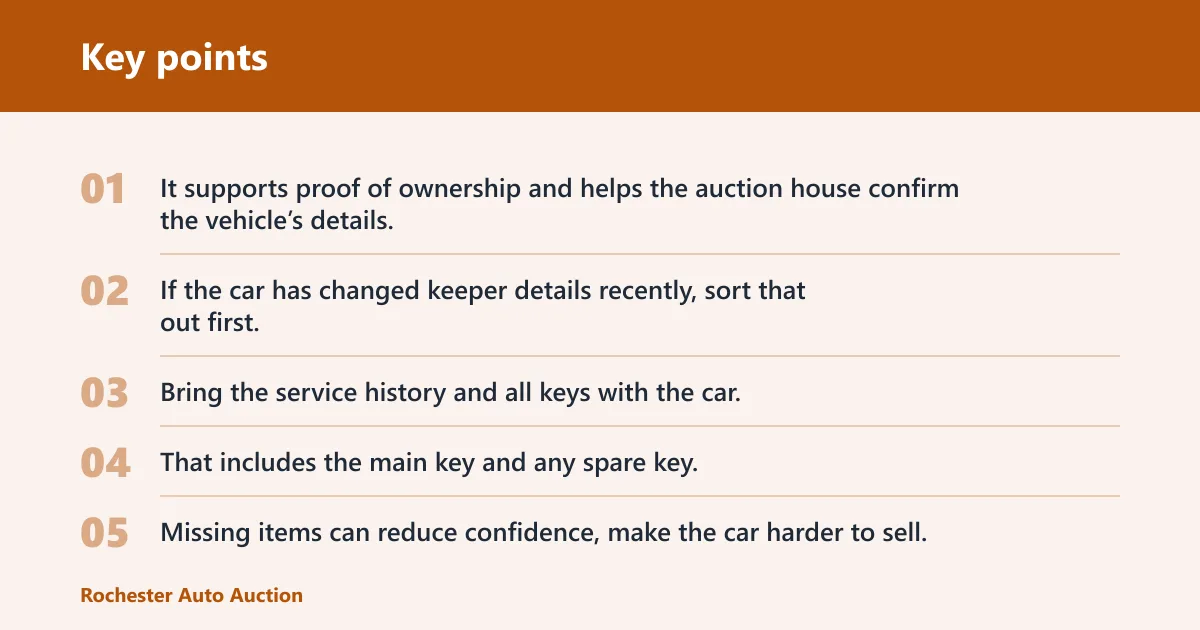
Bring the V5C document to the auction. It supports proof of ownership and helps the auction house confirm the vehicle’s details. If the car has changed keeper details recently, sort that out first, because ownership mismatches are one of the easiest reasons for delay.
Service history, keys, and spare items
Bring the service history and all keys with the car. That includes the main key and any spare key, plus remote fobs or locking wheel nut tools if you have them. Missing items can reduce confidence, make the car harder to sell, and create post-sale arguments about what was included.
Condition notes, warning lights, and known faults
List warning lights, accident damage, missing trim, and known mechanical faults before inspection. A clear declaration helps the valuation reflect the car properly and reduces disputes after the sale. If the car has a rough idle, a cracked screen, or an electrical fault, say so upfront.
Say your hatchback has a fresh service book, but the spare key is missing. That one omission can still matter because bidders may price in replacement cost and inconvenience, even if the car looks tidy. The same car with both keys often bids more cleanly than one with only a single key.
Seller auction checklist
Use this checklist to spot what the auction house needs, what you need to bring, and where sellers usually lose money. The same core items matter in most cases, but your goal can change the emphasis: quick sale, maximum price, or a problem car that needs a buyer with appetite for repair work.
| Item | Why it matters | Who provides it | Common failure points | Quick sale | Maximum price | Problem car |
|---|---|---|---|---|---|---|
| V5C document | Supports proof of ownership and vehicle details | Seller | Name mismatch, missing document, old keeper details | Always bring | Always bring | Always bring |
| Service history | Helps support condition and value | Seller | Lost stamps, incomplete records, no invoices | Bring if available | Bring if available | Bring if available |
| All keys | Signals complete handover and avoids replacement cost | Seller | Missing spare, dead battery in fob, forgotten security key | Always bring | Always bring | Always bring |
| Condition notes | Sets bidding expectations and reduces disputes | Seller | Hidden warning lights, undeclared damage, vague descriptions | Short notes | Detailed notes | Very detailed notes |
| Inspection access | Lets the auctioneer assess the car before valuation | Seller | Flat battery, blocked boot, no fuel, locked vehicle | Clear access | Full access | Full access |
| Reserve decision | Sets the minimum acceptable sale price | Seller after valuation | Reserve too high, reserve never confirmed, confusion over no-sale | Low but sensible | Carefully set | Often lower |
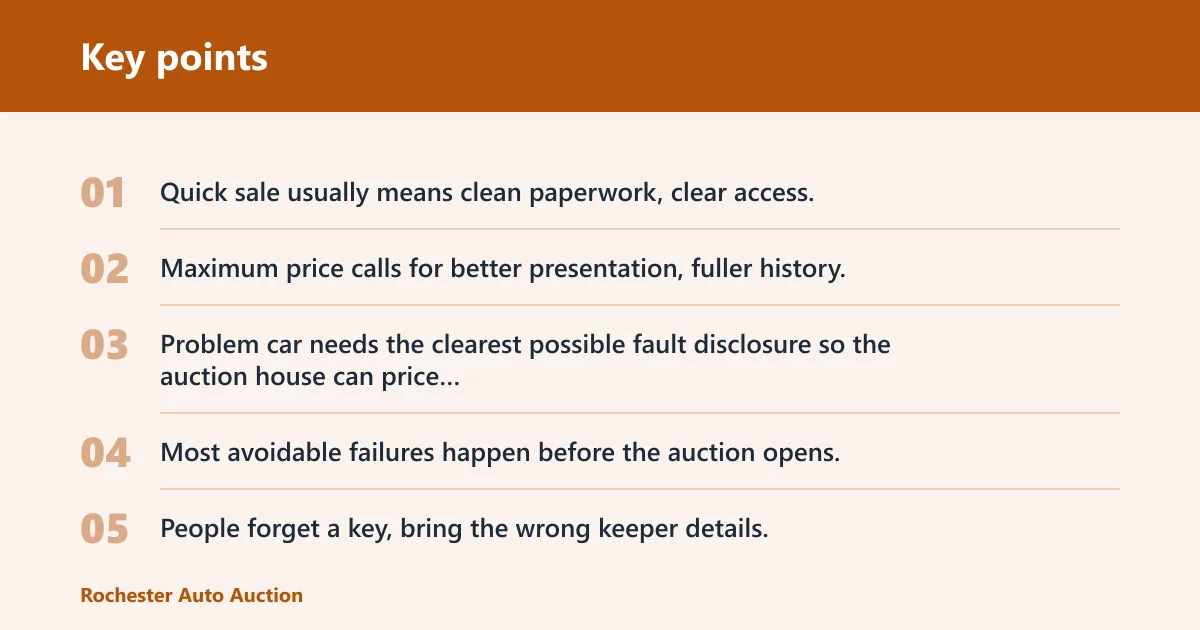
Quick sale usually means clean paperwork, clear access, and a reserve that does not chase the top of the market. Maximum price calls for better presentation, fuller history, and a reserve aligned with the car’s true condition. Problem car needs the clearest possible fault disclosure so the auction house can price it honestly.
Common failure points to avoid
Most avoidable failures happen before the auction opens. People forget a key, bring the wrong keeper details, or set a reserve that sits above the market. Any of those can delay the sale or leave the car unsold while fees continue to apply.
How the auction process works step by step

The seller process usually runs in about six stages: book the car, prepare documents, complete inspection, agree on a listing, set the reserve, and then handle the sale or no-sale after bidding ends. The exact timing depends on the auction house, local demand, and whether the sale is physical or online.
- Contact the auction house. Ask whether it accepts private sellers, what documents it needs, and whether it runs local or online sales.
- Submit basic car details. Share the registration, mileage, trim, service history, and known faults so the auction house can decide whether to take the car.
- Attend inspection and valuation. The auctioneer inspects the vehicle and gives an estimated price after inspection.
- Confirm the reserve price. Decide the minimum price you are willing to accept before the car is listed.
- Approve the listing. The auction house records the car for sale and handles the bidding process.
- Complete sale administration. If the car sells, the auction house manages paperwork, buyer payment, and handover; if it does not sell, you decide whether to relist or collect it.
Step 1: contact the auction house
Start by checking eligibility, fees, and timing. A local auction house may offer in-lane sales, while another may only list cars online. Ask how it handles private sellers, whether it needs advance booking, and whether it can inspect the vehicle on site or by appointment.
Step 2: inspection and non-binding valuation
The auction house valuation is non-binding. It is an estimate, not a promise of sale, and it is based on the inspection rather than on wishful pricing. That estimate helps you judge whether the car is suitable for auction or whether another route makes more sense.
Step 3: set your reserve price
Set your reserve after you see the valuation and compare it with your time pressure, repair costs, and local demand. A reserve price is the minimum price the seller is willing to accept. If bidding does not reach reserve, the car will not be sold, and bids below reserve are void.
Step 4: listing, bidding, and sale administration
Once listed, the auction house manages the bidding and sale administration. On a physical sale day, the car appears in the lane and bids move quickly. In an online sale, bidding may run for a set window, and handover can happen later once payment clears and collection is arranged.
Suppose a diesel estate has a bad clutch but still starts and drives. An auction house may list it as a repair car with a lower estimate, and a buyer may still bid if the fault is clear. If the seller hides the clutch issue, the sale is far more likely to unravel after collection.
How do you set a reserve price?
Set your reserve by balancing the auction estimate, the vehicle’s real condition, and the lowest price you can accept after fees. A reserve is the minimum acceptable sale price, so it should protect you without making the car impossible to sell. If you set it too high, the car may simply pass unsold.
What reserve price means
The reserve price is the line the auction must cross for the sale to complete. If the top bid stays below that line, the car remains unsold. That is why reserve management matters: it can protect value, but it can also block a sale altogether.
How reserve affects whether the car sells
Because bids below reserve are void, the reserve controls whether the winning bidder can actually buy the car. If the market is quiet or the car needs work, a high reserve may leave you with a no-sale and still leave you responsible for certain charges.
When a lower reserve can help
A lower reserve can help if you want a faster sale, the car is hard to price, or you are already competing with repair costs. It may also suit cars that need buyer confidence more than perfection. That said, do not cut the reserve so low that fees wipe out the result.
What fees could you pay?
Auction fees vary by auction house, so ask for the seller fee schedule before booking. Fees may include entry, administration, imaging, marketing, storage, and sale commission. The important point is that some charges may still apply even if the car does not sell.
Seller fees and entry fees
Ask exactly what you will pay to enter the car, list it, and complete the sale. Different houses package charges in different ways, so compare the total seller cost rather than a single headline fee. The cheapest entry fee is not always the cheapest final outcome.
Fees that may apply if the car does not sell
Do not assume a no-sale means no bill. The guide warns that fees may still apply even if the car does not sell. That can include listing or storage charges, so ask whether the car can be collected without extra cost if the reserve is missed.
What to ask for before you book
Before you commit, ask for the full seller terms, the reserve policy, what happens on a no-sale, and when payment is released after a successful bid. Also ask who pays for transport if the car cannot be driven away. Small print matters here.
Online and lane auctions for sellers
Online and physical auction lanes both sell cars, but they work differently for the seller. Online auctions may give a wider time window for bids and can simplify listing for a car that is not ready to sit on a forecourt. Physical lanes move faster on the day and may suit sellers who want a firm event date.
How online car auctions work for sellers
For online car auctions, the auction house still handles valuation, listing, bidding, and sale administration. The seller may need to provide photos, history, and condition notes in advance, then arrange handover after payment clears. Timing can be more flexible, but collection logistics matter more.
How physical auction lanes differ
In a lane sale, the car is presented at a set time and bidding happens in person. That can create fast feedback and immediate price discovery, but it also means the car has to be ready for inspection, transport, and on-the-day administration. Missed documents can slow everything down.
Which format suits a quick sale, higher price, or difficult car?
A quick sale often fits a lane or a short online window, depending on local stock and buyer demand. A higher price may come from the format that attracts the strongest buyers for that model. A difficult car usually needs the format that presents faults most clearly and allows the right buyers to see it.
How long does it take to sell a car at auction?
The full timeline can be short, but it is not instant. You still need booking, inspection, listing, and sale administration, and collection or payment can add more time. A car can often move faster than a private sale, yet setup and handover can still affect the total timeline.
Ask the auction house how long it takes from inspection to sale day, and then from sale to payment release. If the car does not hit reserve, add time for relisting or collection. That is the difference between a fast process and a fast payout.
Can I sell a car at auction if I want cash quickly?
Yes, auction can be useful when speed matters, especially if you want to avoid repeated viewings and haggling. But quick cash still depends on paperwork, valuation, reserve choice, and how fast the auction house can schedule the vehicle. A fast sale can still fail if the reserve is unrealistic.
What changes when speed is the priority
Lower friction matters most. Bring the V5C, service history, and all keys, answer inspection questions clearly, and avoid overpricing the reserve. If the car has issues, disclose them early so the auction house can place it in the right sale rather than waste time relisting it.
What documents do I need to bring to a car auction?
Bring the V5C document, service history, all keys, and any proof that supports ownership or condition. Those items help the auction house verify the car, present it accurately, and complete handover if it sells. Missing paperwork can delay the booking or weaken buyer trust.
Documents and items to pack
- V5C document
- Service history
- All keys
- Spare fobs or security keys if available
- Any ownership or repair paperwork that clarifies the vehicle’s condition
What happens if my car does not reach the reserve price?
If bidding does not reach reserve, the car will not be sold. Bids below reserve are void, so the top offer cannot complete the purchase unless you later agree to accept it. In that case, you usually decide whether to relist, reduce the reserve, or collect the car.
What happens after a no-sale
After a no-sale, ask whether the auction house can relist the car and whether that changes the fee position. Also confirm storage or collection timing. A car that sits uncollected can cost more than the missed bid, so do not leave the outcome vague.
Frequently asked questions
How do I sell my car at auction step by step?
Contact an auction house, confirm that it accepts your type of seller, book an inspection, bring the V5C, service history, and all keys, agree a reserve, then let the house manage bidding and sale administration. After the sale, settle handover or decide what to do if the reserve is missed.
Can I sell my car at auction as a private seller?
Usually yes, but only if the auction house accepts private sellers. Some houses only accept trade customers who are VAT registered. For private entry, the registered owner usually needs to be the seller, and the V5C should match the ownership details.
What fees do car auctions charge to sell a car?
Fees vary by auction house, and they may include entry, administration, marketing, storage, and commission. Ask for the seller fee schedule before you book. Also ask whether any fees still apply if the car does not sell, because a no-sale does not always mean no cost.
What should I check before booking my car into auction?
Check seller eligibility, fee terms, reserve policy, and whether the auction is local or online. Make sure the V5C details match the registered owner, gather service history, and confirm that all keys are available. If the car has faults, write them down before inspection.