What Is in a Car Auction Consignment Agreement?
An auction consignment agreement usually covers commission, reserve price, title status, seller fees, payment timing, arbitration, and liability. The clauses that matter most are the ones that change who bears loss and when you get paid. Weak terms can cut your payout, delay title transfer, or leave you paying storage and dispute fees after the vehicle sells. This guide breaks down the seller-critical clauses so you can spot risk before you sign.
What a consignment agreement does
A car auction consignment agreement is the contract that lets the auction house sell your vehicle on your behalf. The consignor is the seller who delivers the car and keeps ownership until sale unless the agreement says otherwise. That written contract should spell out commission, reserve, settlement timing, and what happens if the car does not sell.
Why the written terms matter before drop-off
Do not treat the agreement as an intake sheet or receipt. It is the document that protects the auction house if a dispute happens, and it should also protect you by fixing the sale terms in writing. At minimum, it should cover commission split and payment timeline.
If the contract leaves pricing, title transfer, or fee add-ons open-ended, the auction house can later say its standard terms control. That is where sellers get surprised by storage charges, reserve changes, or delayed payment.
Who signs and who owns the car?
The consignor signs the agreement and must have legal authority to sell the vehicle. The auction house acts as the selling agent, not the owner, unless the contract clearly changes that. Title and ownership normally stay with the consignor until the vehicle sells and the contract’s transfer steps are completed.
Consignor role and legal authority to sell
Before you sign, confirm that the name on the title matches the seller or that you have authority to act for the titled owner. An estate executor, dealer, fleet manager, or trustee may need extra paperwork. The auction can ask for proof that you can transfer the vehicle without a later title defect.
Suppose the title is still in a deceased owner’s name. The auction may require letters testamentary or another legal document before it accepts the car, because the consignor needs authority to sign away ownership.
Auction house role as selling agent
The auction house usually controls cataloging, sale format, and settlement procedures. Its role is to market the vehicle, present it to buyers, collect funds, and send payment after the sale clears. The agreement should say which terms the auction can set on its own and which ones need your approval.
When title and ownership transfer
Title transfer should be stated clearly. Look for the exact event that ends your ownership: hammer fall, cleared funds, title delivery, or buyer settlement. If the language is vague, you may still be the owner on paper after the sale, which can matter for disputes, tax reporting, and risk allocation.
Fees, commission, and reserve terms
Check every line that affects the seller’s net proceeds. Commission may be a percentage or flat fee, and some auctions charge it only if the car sells, while others calculate it on hammer price. Automobilia Auction says vehicle consignments may carry 6% no reserve or 10% with reserve fees. Classic Car Auctions says a 6% auction house commission is added to purchases.
Commission structure and seller fees
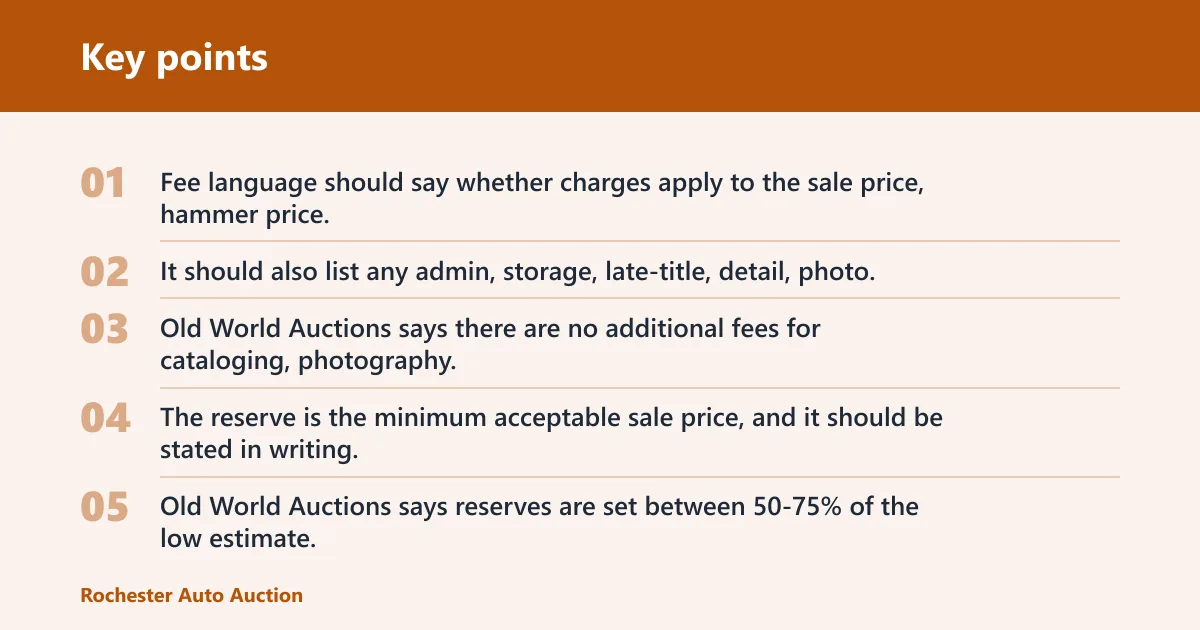
Fee language should say whether charges apply to the sale price, hammer price, or some other base. It should also list any admin, storage, late-title, detail, photo, or reconditioning charges. Old World Auctions says there are no additional fees for cataloging, photography, marketing, or storage, which shows how much these add-ons can vary by auction.
Reserve price language to verify
The reserve is the minimum acceptable sale price, and it should be stated in writing. The same source says reserves are set between 50-75% of the low estimate. If the contract references a low estimate, confirm whether the reserve follows that estimate automatically or whether the auction can set it lower or higher by itself.
Reserve language should also say who can lower it, when that change can happen, and whether you must approve the adjustment in writing. A one-sided clause that lets the auction cut the reserve without notice can change your payout after you have already delivered the car.
Estimate and reserve changes in writing
Catalog estimates are not guarantees. They are marketing numbers, and the agreement should not let them replace the actual reserve unless you agree to that in writing. If the auction wants authority to revise the estimate, reserve, or seller fee after intake, ask for a written notice requirement before publication.
How insurance and custody coverage work

The agreement should say who covers loss, theft, or damage while the vehicle is in the auction’s custody. It should also identify when coverage starts and ends. Old World Auctions says accepted consignment items are covered under its insurance policy after receipt, which is the kind of trigger date you want to see in writing.
Who covers loss, theft, or damage
Read the liability clause closely. Some auctions insure the vehicle only while it is physically on their property. Others exclude cosmetic damage, mechanical failure, or wear from moving and loading. The contract should explain whether the auction’s coverage applies to fire, theft, vandalism, transit damage, or acts of employees and bidders.
Coverage start and end points
Coverage start and end points matter because custody changes can happen fast. The agreement should say whether insurance begins on receipt, after inspection, or after catalog approval. It should also say when coverage ends: sale, pickup, return to the seller, or delivery to the buyer.
Picture a car delivered on Monday and moved to an off-site photo yard on Wednesday. If the agreement does not cover off-site movement, a loss during transport may fall into a gray area that is expensive to sort out later.
What limits or exclusions to read
Watch for exclusions tied to pre-existing damage, keys, tires, glass, odometer issues, or aftermarket parts. Also check whether the auction’s liability is capped at the reserve, the hammer price, or some other amount. If the agreement limits recovery too tightly, an insurance clause can leave you with most of the risk.
What happens if the car does not sell?
The unsold-vehicle clause should tell you whether the auction will relist the car, return it, or keep it available for a post-auction sale. It should also say who pays return shipping and what happens to storage or handling charges if the vehicle does not meet reserve or fails to attract a buyer.
Relist, return, or post-auction sale options
Some auctions relist unsold vehicles in a later sale. Others release the car back to the consignor immediately. A post-auction offer may still be possible, but the agreement should say whether you can accept it directly or whether the auction keeps selling authority until a later cutoff.
Who pays return shipping
The return-shipping clause should name the payer, the carrier, and the pickup window. If the agreement is silent, you may end up paying to retrieve a car that never sold. Ask whether the auction arranges transport, bills it to you, or deducts it from any later proceeds.
- Check whether the vehicle must be relisted before return.
- Confirm who pays for towing, loading, or carrier pickup.
- Read the deadline for claiming the car after a no-sale result.
- Ask whether storage charges resume once the sale ends.
What the agreement says about non-sale
A common first-timer mistake is assuming “no sale” means no cost. The contract may still allow storage, imaging, or withdrawal fees. Make sure the non-sale clause says whether the car can be sold later, withdrawn, or returned, and whether the auction can keep fees from any later proceeds.
Settlement, taxes, and payment timing
Settlement terms tell you when the money leaves the auction and reaches you. The same source says consignor payments are sent exactly 30 days after the close of each auction. The same source says consignors are paid within 14 business days after cleared funds. Those examples show why the payout window must be written clearly.
When the seller gets paid
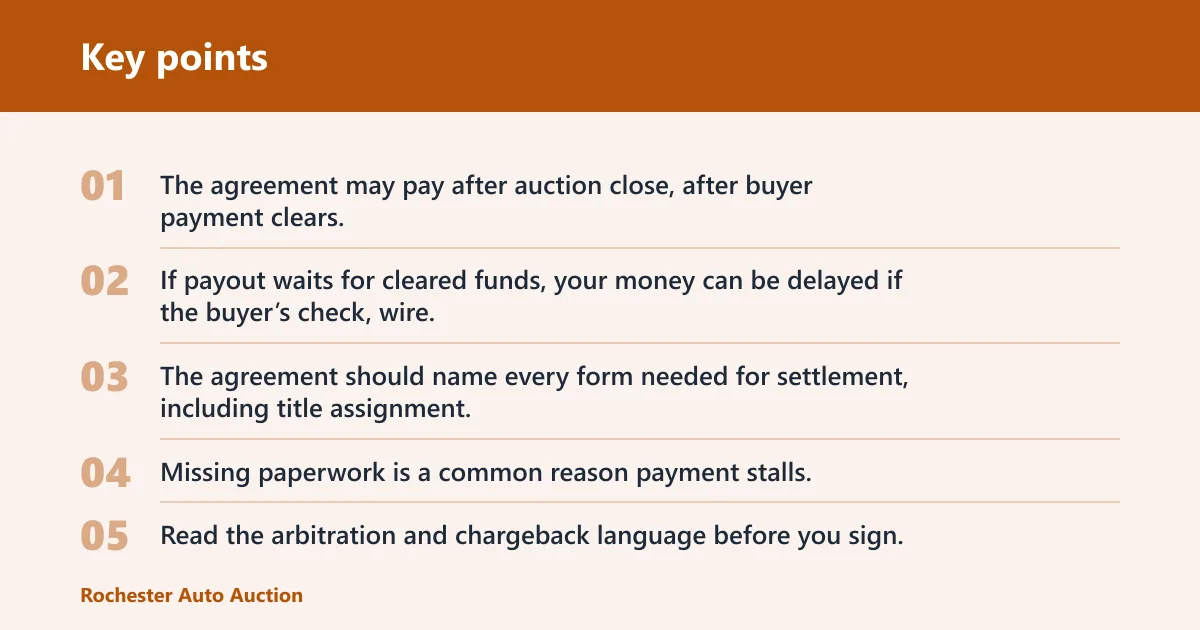
Look for the exact payment trigger. The agreement may pay after auction close, after buyer payment clears, or after the title and paperwork are complete. If payout waits for cleared funds, your money can be delayed if the buyer’s check, wire, or financing has not settled.
W-9 or W-8 and settlement paperwork
Some auctions require a W-9 for U.S. sellers or a W-8 for non-U.S. sellers before payout. The agreement should name every form needed for settlement, including title assignment, odometer statement, power of attorney if used, and any invoice or release form. Missing paperwork is a common reason payment stalls.
Disputes, title defects, and post-sale issues
Read the arbitration and chargeback language before you sign. The contract should say how the auction handles odometer disclosure errors, title defects, buyer nonpayment, returned-sale disputes, and any later claim that the car was misdescribed. If the agreement is vague, a post-sale problem can circle back to the seller.
| Clause | What it means | Why it matters | What to verify | Red-flag example |
|---|---|---|---|---|
| Title | States who owns the car until sale and how title transfers. | Sets when ownership risk changes hands. | Look for the exact transfer event and required title documents. | “Title transfers at our discretion after sale.” |
| Reserve | Sets the minimum acceptable sale price. | Controls whether the car can sell below your floor. | Confirm the reserve amount and who can change it. | “Reserve may be adjusted without notice.” |
| Commission | States the seller’s fee or auction commission. | Changes your net payout. | Check percentage, flat fee, and whether it applies on hammer price or sale price. | “Additional service charges may apply.” |
| Storage | Charges for holding the vehicle before or after sale. | Can reduce proceeds or add a bill after no-sale. | Ask when storage starts, ends, and when billing begins. | “Storage billed per auction policy.” |
| Insurance | Explains custody coverage for loss, theft, or damage. | Shows who carries risk while the car is on site. | Verify coverage start, end, exclusions, and claim process. | “Owner remains responsible for all loss.” |
| Reserve changes | Describes how the reserve can be revised. | Can change sale odds and payout without warning. | Require written approval for any change. | “We may lower reserve to move inventory.” |
| Marketing approval | Controls photos, catalog text, and estimates. | Affects how the car is presented to buyers. | Review the description before publication. | “Auction may edit description as needed.” |
| Unsold vehicle handling | Explains relist, return, or post-auction sale options. | Determines whether the car stays in auction control. | Check who decides next steps after a no-sale result. | “Seller must retrieve vehicle at own expense.” |
| Payment timing | States when settlement is sent. | Sets cash flow and delay risk. | Confirm business days, cleared-funds rule, and payout window. | “Payment issued when convenient.” |
| Taxes and forms | Lists W-9, W-8, title, and settlement forms. | Missing paperwork can stop payment. | Get the full list before drop-off. | “Forms may be requested later.” |
| Dispute handling | Sets arbitration, chargeback, and claim rules. | Controls what happens after a buyer complaint. | Read who pays if a title or odometer issue surfaces. | “Auction may reverse sale if buyer complains.” |
| Return shipping | Explains who pays to move an unsold car back. | Can be a material added cost. | Identify the carrier, timing, and who pays. | “Return shipping billed at seller expense.” |
Frequently asked questions
What is a consignment agreement for a car auction?
It is the contract that allows the auction house to sell your car on your behalf. The agreement should spell out commission, reserve, title status, payment timing, and liability. It is not the same thing as a simple intake form or a catalog submission.
What information is usually in an auto consignment contract?
Most contracts list the seller, the vehicle, title status, reserve price, commission, storage terms, insurance responsibility, payout timing, and unsold-vehicle handling. They may also cover catalog text, photo use, tax forms, and dispute rules if the sale later breaks down.
Who owns the car while it is on consignment?
The consignor usually keeps ownership until the car sells, unless the agreement says something different. That is why title language matters so much. The auction house is generally the selling agent, not the owner, during the consignment period.
What fees and commissions are listed in the agreement?
The contract may list a seller’s commission, flat admin fees, storage, photo or catalog charges, and any post-sale handling costs. Some auctions charge a percentage only if the car sells, while others use a fee tied to hammer price. Every charge should be written down.
How are reserve price and minimum sale price handled?
The reserve is the minimum price the seller will accept, and it should be stated clearly in writing. Some auctions tie reserve to the low estimate, while others let the seller set a fixed floor. Check who can change it and whether written approval is required.
When does the seller get paid after the auction?
Payment timing varies by auction and by whether funds have cleared. Some contracts promise payment within business days, while others use a fixed 30-day window after the auction closes. The agreement should say what happens if buyer funds have not cleared yet.
How do I know the auction house can legally sell my car?
Ask for the clause that shows legal authority to sell and the documents needed to support it. The auction may require a signed consignment agreement, title, proof of identity, and, for estates or companies, extra authority documents. If the paperwork is incomplete, the sale can be delayed or challenged later.