How Much Are Buyer Fees at Dealer-Only Auto Auctions?
Buyer fees at dealer-only auto auctions are usually a percentage-based buyer’s fee tied to the hammer price, plus fixed charges such as gate, title, and online fees; the total commonly lands in the low hundreds and rises with vehicle price. Miss one line item, and your true cost can be hundreds higher than the bid you thought you won. This guide breaks out the visible fee, the easy-to-miss fee, and the penalty charges that appear after the sale.
Buyer fees explained

The buyer fee is the auction’s charge for winning the vehicle, and it is not the whole bill. On dealer-only auto auctions, that charge may be fixed, percentage-based, or tiered by price band. Some platforms show an estimate before you bid; others do not, so you need the fee schedule before you set your ceiling.
What the buyer fee covers
Dealer-only auctions are wholesale buying channels. The fee can cover platform access, auction handling, listing systems, and back-office processing. On some platforms, the number you see as a buyer fee is only one part of the transaction, because seller auction fees or administrative fees may also be built into the flow.
Fixed fee versus percentage fee
A fixed fee stays the same within a price band. A percentage fee rises with the winning bid. A tiered fee does both: it stays fixed until the bid crosses a band, then jumps to a higher amount. That is why the same auction can feel inexpensive on one car and expensive on the next.
Suppose a dealer wins a low-cost sedan and then a higher-priced SUV on the same platform. The sedan may trigger the lower buyer fee band, while the SUV moves into the higher one. The winning bid changed only once, but the fee changed with it.
Why the fee changes by platform and vehicle price
Platforms set their own pricing rules, and dealer-only auction fees differ from public-auction fees. The vehicle’s final bid price, origin, and the platform’s own policy can all affect the bill. For European platforms, tax treatment can also change the total, especially when VAT rules apply.
Dealer auction fee stack
Dealer-only auctions commonly use more than one charge. The buyer fee is only the first line. You may also see documentation fees, commission or administrative fees, seller-side auction fees, and payment-processing charges. Treat each one separately so you do not double-count or miss a cost.
Buyer fee
This is the main fee tied to the bid or price band. AuctionExport charges $195 for cars priced at $2,999.99 or less, and $295 for cars priced at $3,000 and more. eCarsTrade says auction fees can range from about €200 to €800 for cars priced between €10,000 and €20,000.
Documentation fee
Documentation fees are separate from buyer fees. They may cover title handling, mailing, or paperwork processing. AuctionExport charges a separate $95 documentation fee. That fee still applies even if the buyer fee itself looks straightforward.
Commission or administrative fee
Some platforms use commission fee and administrative fee as interchangeable terms. These charges can depend on bid amount and vehicle origin, and they may be tiered by price band. eCarsTrade shows fees by bid band, starting at €200 for cars from Belgium up to €5,000, and rising to €400 for bids over €20,000 from another country.
Seller-side and platform-side charges
Some dealer-only auctions also pass along seller auction fees. AuctionExport says the selling auction can add 2% with a minimum of $50. That is a separate charge from the platform’s own buyer fee, so the winning bidder needs to look for both.
Do dealer auction fees vary by vehicle price?
Yes. Dealer auction fees often change by vehicle price, and the pattern can be fixed bands or percentage bands. Lower-priced units may sit in one fee tier, while higher-priced vehicles move into another. That is why a single fee quote is not enough for planning.
Low-price vehicle fee patterns
For lower-priced vehicles, many platforms use a lower flat buyer fee. AuctionExport’s $195 fee at $2,999.99 or less is a clear example of a low-price band. In this range, the fee can look large relative to the car itself, so it can change the deal fast.
Mid-price vehicle fee patterns
Mid-price vehicles often sit in the middle of a tiered schedule. The spread shows why two similar vehicles can carry different all-in costs if they fall on opposite sides of a band.
High-price vehicle fee patterns
Higher-priced vehicles can trigger a larger commission or fee band. eCarsTrade says commission rises to €400 for bids over €20,000 from another country. In a percentage-based system, the fee may also keep climbing as the hammer price climbs.
What extra charges can hit after the sale?

Late payment, storage, cancellation, and payment-processing charges can arrive after the winning bid. These are the fees that hurt when the purchase is not closed on time or is backed out of. They are not hypothetical in the abstract; they are part of the real cost if deadlines are missed.
Late payment fee
A late payment fee can apply after a short payment window, often three business days. The same source gives buyers 3 business days to pay in full, then charges 0.125% per day if payment is late. The selling auction can add 2% with a minimum of $50, so the penalty can come from both sides of the transaction.
Storage fee
Storage fees can start if payment is not received on time, and they are often billed daily. The rate depends on the auction location and policy. A daily fee matters because even a short delay can turn into a larger invoice once a vehicle is held past the deadline.
Cancellation fee
Cancellation fees may apply if the purchase is backed out of. The same source says cancellation can cost a minimum of $600 or 10%. Some auctions may charge $1,000 or 15% for cancellation. Those numbers make it clear that canceling is often far more expensive than paying on time.
Payment-processing or mailing costs
Other charges can sit around the edges of the deal. The same source says debit or credit card deposits over $2,500 incur 3.8%. Mailing and title handling may also be part of the documentation charge, so you should confirm whether a quoted fee includes those tasks or leaves them out.
Buyer fee worksheet
Use this plain-text dealer auction cost worksheet before you bid. It separates the winning bid from the fee you see, the fee you may forget, and the penalties you only pay if something goes wrong.
| Line item | Low-price vehicle | Mid-price vehicle | High-price vehicle |
|---|---|---|---|
| Winning bid | $2,500 | $12,500 | $22,500 |
| Buyer fee | $195 | Use platform schedule | Use platform schedule |
| Documentation fee | $95 | $95 | $95 |
| Late-payment risk fee | 0.125% per day after day 3 | 0.125% per day after day 3 | 0.125% per day after day 3 |
| Storage risk fee | Daily fee if payment is late | Daily fee if payment is late | Daily fee if payment is late |
| Cancellation risk fee | Minimum $600 or 10% | Minimum $600 or 10% | Minimum $600 or 10% |
| All-in estimate formula | Bid + buyer fee + documentation fee | Bid + buyer fee + documentation fee | Bid + buyer fee + documentation fee |
Formula: All-in estimate = winning bid + buyer fee + documentation fee + any seller-side fee + any platform fee + any processing fee + any tax that applies. Add late-payment, storage, or cancellation charges only if the scenario triggers them.
A common first-timer mistake is to stop at the hammer price and the buyer fee. A $12,500 bid with a mid-band fee and the $95 documentation charge is already above the bid before any transport, registration, or tax is added. The vehicle did not get more expensive after the sale; the full cost was simply not counted at the start.
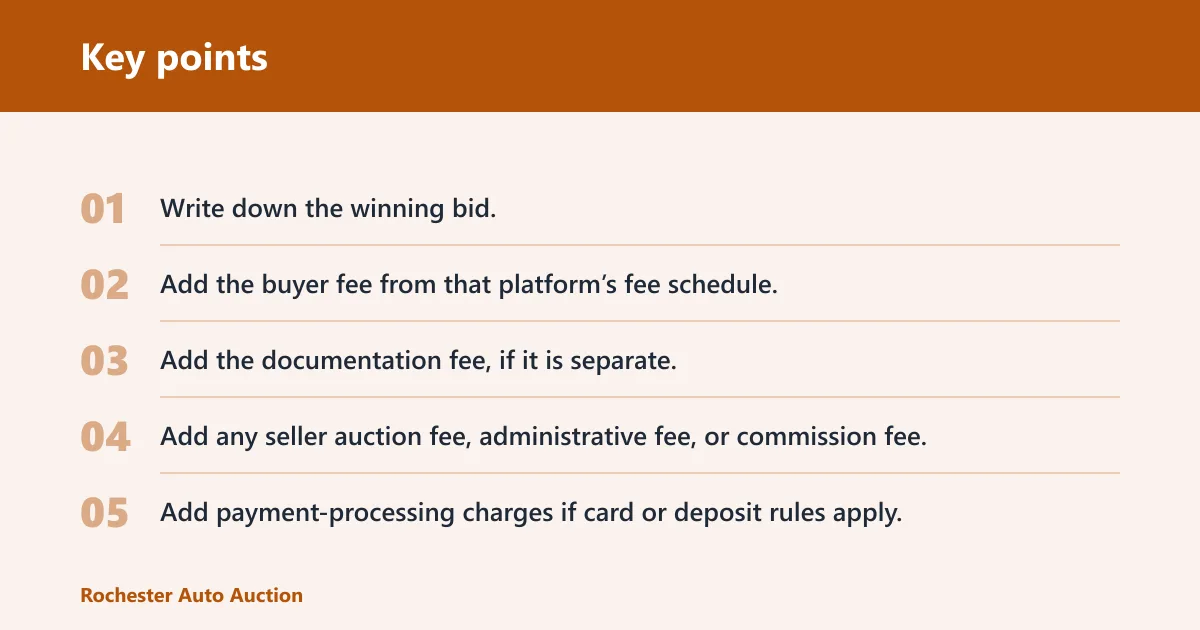
- Write down the winning bid.
- Add the buyer fee from that platform’s fee schedule.
- Add the documentation fee, if it is separate.
- Add any seller auction fee, administrative fee, or commission fee.
- Add payment-processing charges if card or deposit rules apply.
- Add VAT or other tax only if the platform says it applies.
- Check the deadline for full payment.
- Reserve room for late-payment or storage fees if funds may miss the cutoff.
- Check cancellation terms before you bid.
Can you see fees before you bid?
Sometimes yes, sometimes no. Some platforms show estimated fees before bidding, and some list them on the vehicle page or in the bidding screen. Others require you to read the fee schedule or ask the sales agent. Treat a visible estimate as useful, but not final, until you confirm the exact vehicle and location terms.
Where fee estimates appear on some platforms
Fee estimates may appear beside the current bid, in the vehicle detail page, or in a checkout-style summary. On some systems, the estimate updates as the bid amount changes. That is helpful, but it does not replace the posted fee policy.
What to confirm with the auction or sales agent
Confirm the buyer fee, documentation fee, seller-side fee, payment deadline, storage policy, and cancellation terms. Ask whether the quote includes title handling, mailing, or processing costs. If the auction is outside your country, ask how VAT is treated before you bid.
When to treat a fee estimate as provisional
Treat any estimate as provisional if the platform says fees vary by vehicle origin, sale channel, or final price band. Also treat it as provisional if the auction can add its own fee on top of the platform’s fee. The estimate is a planning tool, not a promise.
VAT and other tax checks
VAT can change the final purchase cost on European platforms, but it does not apply the same way everywhere. The treatment depends on whether the vehicle is sold under a taxable sale or a margin scheme. That status must be checked before bidding, because tax can move the true total by a meaningful amount.
When VAT can affect total cost
If the listing is taxable, VAT can be added to the purchase price or to part of the invoice. If the sale is under a margin scheme, the tax treatment is different. The listing should state the rule, and if it does not, ask before placing a bid.
Margin scheme versus taxable sale treatment
A margin scheme can limit how VAT is applied, while a taxable sale can change the invoice total more directly. Do not assume the same treatment from one vehicle to the next. The tax status of the car matters as much as the fee schedule.
Why tax status matters before bidding
If you are bidding across borders, tax can alter the all-in cost more than a small fee band change. That is why dealer-only auction buyers should check the tax line before setting a maximum bid. The hammer price tells only part of the story.
Frequently asked questions
How much are buyer fees at dealer-only auto auctions?
Buyer fees are often in the low hundreds, though the amount can vary by platform, the vehicle’s bid price, and the fee band.
Are dealer auction fees fixed or based on the bid price?
They can be either. Some auctions use a flat fee within a price band, while others use a percentage of the winning bid. Many dealer-only platforms use tiered pricing, which means the fee changes when the car crosses a price threshold.
What extra charges can come after the buyer fee?
Late payment fees, storage fees, cancellation fees, documentation fees, and payment-processing charges can all appear after the buyer fee. Some auctions also add seller-side fees. If you bid without checking those items, the final bill can be much higher than expected.
Do dealer-only auctions charge documentation fees too?
Yes, many do. Documentation fees are usually separate from the buyer fee and may cover title handling, mailing, or paperwork processing. The same source lists a separate $95 documentation fee, which shows why the buyer fee alone is not enough for cost planning.
How do I estimate the total cost before I bid?
Add the winning bid, the buyer fee, the documentation fee, and any seller-side or administrative fees the platform lists. Then check whether tax, processing charges, or transport will apply. If the payment deadline is short, include the risk of late-payment or storage charges as well.
Are late payment or storage fees possible at dealer auctions?
Yes. Some platforms give only a short payment window, and AuctionExport gives buyers 3 business days to pay in full. If payment is late, AuctionExport charges 0.125% per day, and the selling auction can add 2% with a minimum of $50. Storage charges may also begin if payment is delayed.
Can I see the buyer fee before I place a bid?
Sometimes. Some platforms show estimated fees before bidding, while others require you to check the fee schedule or ask the sales agent. Even when an estimate is visible, confirm the exact fee for that vehicle, since price band, origin, and auction policy can change the total.
How much more than the winning bid will I actually pay?
Often several hundred dollars more, and sometimes more if the car sits in a higher fee band. The amount depends on the buyer fee, documentation fee, and any seller-side or processing charges. If payment is late or the deal is canceled, the total can rise sharply.