Which Car Auction Fees Are Negotiable and Which Are Fixed?
Most car auction fees are fixed, but buyer premiums, arbitration terms, and some dealer or fleet charges can be reduced when volume, status, or lot value gives you room to ask. Miss this split and you can overpay by hundreds on a single unit. This guide shows which fees are fixed, which are conditionally flexible, and what to ask before you bid.
Auction fee matrix

Start with the hammer price, then add the buyer premium, taxes, title, transport, and any storage or payment charges. Auction houses publish fee schedules in their terms, and the conditions of sale control what can change. Some fees are flat-dollar charges. Others are percentage-based. Seller fees can differ from buyer fees.
| Fee type | Buyer or seller side | Fixed, variable, or conditional | Typically negotiable? | Who can sometimes get a concession? | Exact question to ask the auction house |
|---|---|---|---|---|---|
| Buyer premium | Buyer | Percentage-based, sometimes with a minimum and a cap | No for most retail buyers; sometimes conditional | Dealer, fleet, repeat-volume, or high-value account | “Does my account qualify for a lower buyer premium, a fee credit, or a channel-specific rate?” |
| Consignment fee | Seller | Usually percentage-based, sometimes with a minimum | Yes, sometimes | Seller of a higher-value unit or a large-volume consignor | “Can you reduce the consignment fee on this lot based on value or volume?” |
| Administrative fee | Buyer or seller, depending on event | Usually fixed | Rarely | Special accounts or promotional events, if policy allows | “Is the administrative fee fixed in the terms, or can it be waived for my account?” |
| Title and documentation fee | Buyer or seller, depending on auction policy | Fixed or standardized | Usually no | Very limited cases, often by policy exception | “Is the title and documentation fee a set charge, and is any exception available?” |
| Storage fee after pickup deadline | Buyer | Daily charge after a deadline | No, once incurred | Only before the deadline if the auction grants an extension | “What is the pickup deadline, and can that deadline be extended before storage starts?” |
| Payment processing fee | Buyer or seller, depending on payment method | Policy-based or fixed surcharge | Usually no | Buyer who switches to wire transfer or another allowed method | “Which payment methods avoid the processing fee?” |
| Minimum fee | Buyer | Policy floor under a percentage schedule | No | No standard concession; it is part of the schedule | “What minimum fee applies if the percentage calculation falls below the floor?” |
| Fee cap | Buyer | Policy ceiling under a percentage schedule | No, but it may already limit cost | High-value buyers benefit automatically if the cap applies | “Is there a cap on the buyer fee for this channel or event?” |
| Registration fee | Buyer | Fixed or policy-based | Sometimes | Dealer accounts, repeat bidders, or promotions that credit the fee | “Is the registration fee refundable, credited, or waived for my account type?” |
That matrix is the quickest way to separate what you can ask about from what is set by policy. Minimum fees and caps matter most on low-priced and high-priced cars, respectively. A small unit can trigger a floor that makes the percentage math irrelevant. A high-priced unit can hit a ceiling and stop the fee from climbing further.
Say a $1,200 car carries a buyer premium schedule with a floor. The percentage calculation may point lower, but the minimum fee still applies. That is not a negotiation point. It is a pricing rule you need in your all-in budget before you bid.
Which fees are negotiable?
The fees with the best chance of movement are seller-side consignment charges, some registration charges, and buyer-premium exceptions for accounts with real room to ask. That room usually comes from repeat volume, fleet status, or a vehicle value high enough to matter to the auction house. Retail one-time buyers usually have less room.
Consignment fees on higher-value or repeat-volume vehicles
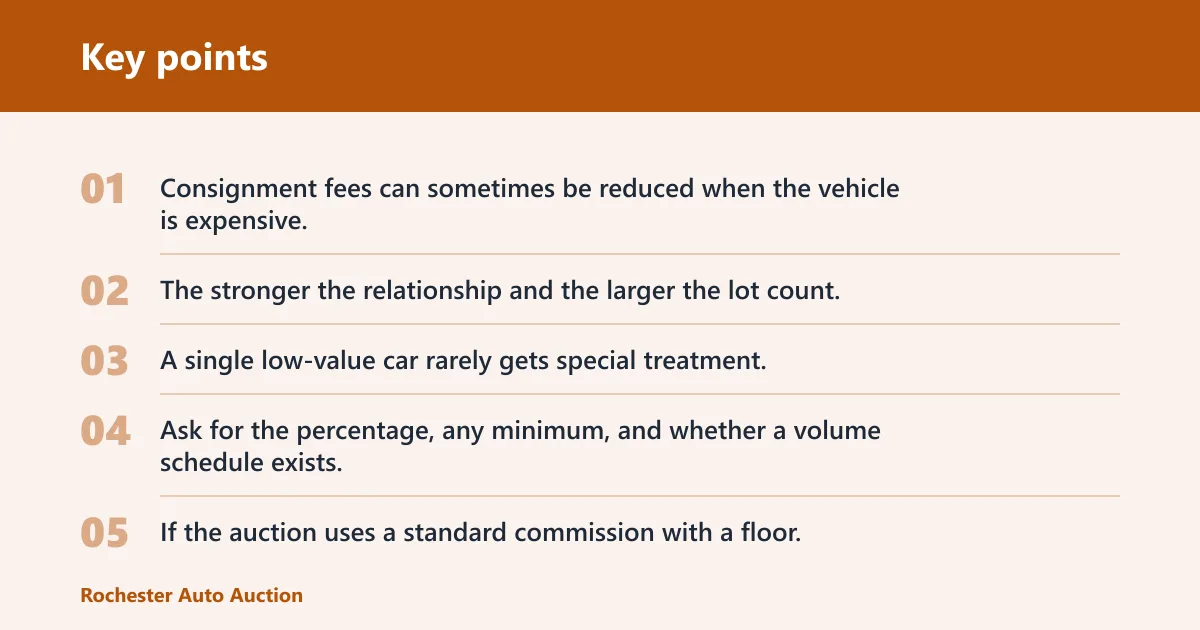
Consignment fees can sometimes be reduced when the vehicle is expensive, the seller is placing several units, or the auction wants to secure ongoing business. The stronger the relationship and the larger the lot count, the more likely a concession becomes. A single low-value car rarely gets special treatment.
Ask for the percentage, any minimum, and whether a volume schedule exists. If the auction uses a standard commission with a floor, the floor may still hold even if the percentage drops. That is why the exact terms matter more than a verbal “we can work with you.”
Buyer premium exceptions for fleet, dealer, or high-volume accounts
Buyer premiums are usually not negotiable for buyers in standard retail settings. The exception is a channel or account program that changes the premium by bidder status, event type, or bidding method. Mecum charges 10% for in-person bidders on collector cars and motorcycles and 12% for telephone and internet bidders on the same category, with a minimum premium of $1,000 on vehicles.
Bring a Trailer charges buyers 5% of the winning bid, has a $250 minimum buyer fee, and caps the buyer fee at $7,500. Cars & Bids also charges 5% with a $250 minimum and a $7,500 maximum. Hagerty Marketplace charges a 7% bidder’s premium with a $500 minimum. Those published structures show that the fee can vary by channel, but they do not mean a retail buyer can haggle line by line.
Registration fees that may be credited or waived
Some auctions charge a registration fee to get bidder access. In a few cases, that fee is credited against a purchase, refunded, or waived for dealer or repeat accounts. It is one of the few front-end charges that may change before you register, especially if the house wants to keep an active bidder in its system.
Ask whether the registration fee is a hard charge or a credit toward purchase. Those are not the same. A refundable or credited fee affects cash flow and budget planning very differently from a fee that disappears only if the account meets a policy threshold.
Which fees are fixed?

Administrative fees, title and documentation fees, storage after the pickup deadline, and most payment processing charges are usually fixed or policy-based. Once the auction publishes those charges in the terms and conditions, they are not line-by-line negotiation items. The better move is to identify them early and price them into the bid limit.
Administrative fees and processing charges
Administrative fees are flat processing charges. They often cover the auction’s internal handling and are usually disclosed in the terms and conditions. eCarsTrade says auction fees can be fixed or percentage-based, and it lists administrative and commission fees from €200 for cars from Belgium. That kind of disclosure tells you the fee is set by policy, not by auction-floor bargaining.
Payment processing charges also tend to follow policy. If a card surcharge applies, the practical way to lower it is often to use a permitted method such as wire transfer. Do not treat that as negotiation. It is a payment choice.
Title and documentation fees
Title and documentation fees cover paperwork processing and are generally fixed or standardized. They can vary by state or auction house, but they usually do not move because the buyer asked. If the event has a set title-handling charge, read it as a published cost, not a flexible one.
Do not assume title handling is bundled with the buyer premium. It may be listed separately. That separation matters because the premium tracks the hammer price, while title and documentation charges usually do not.
Storage fees after the pickup deadline
Storage fees start after the pickup deadline and are charged daily. Once the removal window passes, the fee is usually non-negotiable. The Autowalk guide gives Copart an example buyer premium of 20% as a Guest member, and says storage fees can begin after 3 days at $20 per day. That shows how quickly delay can add cost after the sale.
Picture a car bought on Friday with a pickup deadline that passes on Monday. If the unit sits until Wednesday, the storage line starts growing whether the buyer likes it or not. The only practical negotiation is before the deadline, when you ask for an extension.
Minimum fees and fee caps set by policy
Minimum fees and fee caps are often part of the house’s pricing formula. They are not negotiated line by line for ordinary buyers. A minimum protects the auction on low-dollar sales. A cap limits the charge on expensive ones. Both are policy rules, not custom discounts.
That said, the cap can work in the buyer’s favor on a high-value car. For example, a premium with a ceiling may stop rising after a certain amount even if the hammer price keeps climbing. That is a built-in benefit, not a concession granted after a request.
Can sellers negotiate auction fees?
Yes, sellers can sometimes negotiate, but mostly on consignment terms rather than on buyer charges. The strongest cases involve high-value inventory, repeat volume, or a seller that can send multiple lots. A single-unit seller has less room. The agreement should state the commission, any minimum, and any added charges before the car is booked.
When consignment terms have room for reduction
Consignment terms may move when the auction wants the vehicle or the relationship. High-value units are the most likely to draw a better rate because the commission base is larger. Large consignors can also use volume as room to ask, especially if they send regular inventory through the same lane or platform.
Ask for the full seller schedule, not only the headline commission. A lower percentage can still be offset by a higher minimum or by extra charges for imaging, listing, or transport. The only way to compare offers is to see the full fee stack.
How lot value and volume affect seller-side concessions
Lot value changes how much margin there is to negotiate. A high-dollar car can absorb a smaller commission rate, so the house may have room to adjust. Volume matters because repeat sellers are easier to retain than one-off consignors. That is where concessions tend to appear.
Suppose a dealer sends one rare SUV and five average trade-ins in the same month. The auction may hold the standard rate on the single unit but offer a better seller schedule on the batch. The concession follows the business relationship, not the fact that one car happened to sell well.
What to confirm in the seller agreement
Before signing, confirm the commission, the minimum fee, any listing or reconditioning charges, reserve handling, and who pays title transfer costs. Also confirm whether the fee applies per unit or per account. If the agreement is vague, ask for the exact line items in writing before the lot enters the sale.
The same rule applies to arbitration terms. If there is any possibility of fee relief after a dispute or a missed representation, that condition should be written into the seller agreement, not left to memory.
How online auction fees differ
Online auctions often separate fees by bidding channel, payment method, and account type. That is where the buyer premium can change. A platform may charge one rate for in-person bidding and another for internet or phone bids. Some houses also use different minimums and caps online than they do in lane.
Channel-specific buyer premiums
Online bidding can carry a higher buyer premium than in-person bidding. Mecum’s published example shows 10% for in-person bidders and 12% for telephone and internet bidders on collector cars and motorcycles. That channel difference is one reason you should check the event’s conditions before you place a bid, not after.
Do not assume an online discount exists. Some platforms do the opposite and charge more for remote bidding because the service and settlement steps differ. The schedule is event-specific.
Payment method surcharges
Payment method surcharges are usually policy-based, not negotiable. A card fee may apply because of processor costs, while wire transfer may avoid the surcharge. The practical question is not whether the auction will bargain on the fee. It is which payment method the auction accepts without the added charge.
Where caps and minimums matter most
Minimums matter most on inexpensive units, where a percentage premium can fall below the floor. Caps matter most on expensive units, where the percentage would otherwise keep climbing. Those figures show why the same fee can behave very differently at low and high values.
eCarsTrade lists administrative and commission fees from €200 and gives a €350 commission on a €10,300 bid example. That is the kind of structure where a buyer should calculate the fee before bidding, because the final invoice can move quickly once the schedule is applied.
What to ask before bidding
Before you bid, ask for the current conditions of sale, the fee schedule, and an estimated total out-the-door cost. Then ask which fees can be waived, credited, or reduced for your account type. The goal is simple: know the real cost before the bidding ends, not after the invoice arrives.
- Ask for the current conditions of sale for that exact event.
- Ask whether the buyer premium changes by channel, account type, or lot value.
- Ask which fees are fixed, which are percentage-based, and which may be credited.
- Ask whether any minimum fees or caps apply to the unit you want.
- Ask whether registration, admin, title, or payment fees can be waived or avoided.
- Ask for an all-in estimate that includes taxes, transport, and storage risk.
A practical script helps. Say: “Before bidding, please confirm the buyer premium, any minimum or cap, the registration charge, the title and documentation fee, the payment method fee, and the pickup deadline.” If my account qualifies for any dealer, fleet, or repeat-buyer concession, please show the revised total in writing.”
That script does two things. It forces the auction to name the fee bucket. It also flushes out any concession that exists only for certain bidder classes. If the answer stays vague, assume the published schedule controls.
Frequently asked questions
Which car auction fees can I negotiate before I register?
Before registration, the most realistic items are the registration fee itself, some seller-side consignment terms if you are consigning a vehicle, and any account-based buyer-premium concession for dealers or fleet buyers. Ask whether the house can credit or waive the fee, and get the answer in writing before you place a bid.
Are buyer premiums ever negotiable at auto auctions?
Usually not for retail buyers. Buyer premiums are commonly set by event terms, and published schedules can differ by bidding channel, as shown by Mecum’s 10% in-person rate and 12% telephone and internet rate. The exception is an account program or volume relationship that the auction house has already approved.
Can seller fees or consignment fees be reduced at auction?
Yes, sometimes. Seller-side reductions are most realistic on high-value cars, multiple-unit consignments, or repeat business. Ask for the commission rate, any minimum, and any extra listing or handling charges. A lower percentage is only useful if the minimum and add-on fees do not erase the savings.
Which auction charges are fixed and non-negotiable?
Administrative fees, title and documentation fees, storage after the pickup deadline, and most payment processing charges are typically fixed or policy-based. Minimum fees and caps are also usually set by the house. If the conditions of sale list the charge, treat it as a rule unless the auction explicitly says otherwise.
Can I negotiate storage, title, or document fees at auction?
Usually no, especially after storage has already started. Storage becomes a daily charge once the pickup deadline passes, and title or document fees are generally standardized. The only workable move is to ask before the deadline whether you can get an extension, a pickup exception, or a credited paperwork charge.
Do online auction fees give any room for negotiation?
Sometimes, but the room is narrow and usually tied to account type rather than the single vehicle. Online platforms may use different buyer premiums, minimums, or caps by channel, and some dealer or fleet accounts get special terms. Read the event’s conditions of sale before bidding and do not assume a web discount exists.