How Do Seller Fees Work at Online Car Auctions?
Seller fees at online car auctions cut your payout step by step: listing or relist fees, then commission or platform and gate fees, then condition, arbitration, title, transport, and admin charges before net proceeds are paid. Miss one line and your estimate misses too. This guide breaks the payout waterfall from listing to final disbursement so you can estimate what you keep.
What seller fees include and when they are charged
Seller fees are the charges an auction takes for listing, processing, selling, and closing out a vehicle. Some come out of the hammer price before payout, while others are billed separately or appear only after a change such as a title correction, storage delay, or relist.
What the seller fee covers
A seller fee can cover platform access, listing setup, inspection or condition reporting, sale administration, payment processing, title handling, and post-sale paperwork. Some auctions use one flat fee. Others combine a flat charge with a percentage of the sale price, so the same vehicle can produce different net proceeds across platforms.
When the fee is charged
Some fees hit at listing, some at sale, and some at settlement. A listing fee may be due when the vehicle goes live. A commission or platform fee is usually taken only if the vehicle sells. Storage, transport, title corrections, and relisting often appear later, after a specific trigger.
What changes by platform and vehicle type
Seller fees vary by auction platform, seller type, vehicle type, and sales channel. Private sellers often see a different fee schedule than dealers or consignment inventory. Commercial units, salvage vehicles, inoperable vehicles, and specialty vehicles can carry extra inspection, handling, or transport charges.
How seller proceeds are calculated
Seller proceeds start with the gross hammer price, then the auction subtracts fees and approved adjustments to reach net payout. If the auction pays after a holdback period, the final check or transfer may be lower than the first settlement estimate because title issues, transport charges, or arbitration can still post.
Gross hammer price, deductions, and net payout
The basic formula is simple: gross sale price minus seller fees and other deductions equals net payout. For example, a $12,000 hammer price with a $300 base seller fee and $175 in title and transport charges leaves $11,525 before any holdback or post-sale adjustment. That is the number the seller should model.
Suppose a sedan sells for $8,500. If the base seller fee is about $250, the title fee is $75, and the auction adds about $150 for transport arranged after sale, the net payout is about $8,025 before any reserve-related or post-sale adjustments.
Timing of payout
Online auction settlement can happen quickly, but not instantly. Many platforms wait until payment clears, title status is confirmed, and any required release conditions are met. If the listing has a holdback, the seller may receive one amount first and a final balance later, after all charges post.
Do seller fees come out of your proceeds?
Often, yes. The most common setup is to deduct seller fees from sale proceeds before the seller receives payment, but some charges are billed separately or collected upfront. The key question is not only whether a fee exists, but when the auction applies it and whether it can still be added after sale.
Deducted from sale proceeds
Commission, platform, admin, title, and arbitration charges are often withheld from the seller’s payout. This keeps the settlement clean, but it also means the hammer price is not the amount the seller receives. Read the schedule line by line, because “net to seller” can mean different things across platforms.
Billed separately
Some auctions invoice listing, transport, storage, or document correction fees separately. That matters because the seller may owe money even if the sale proceeds are modest. It also matters for cash flow: a separate invoice can arrive before payout, after payout, or after a failed sale.
Holdbacks and final adjustments
A holdback is money the auction keeps back until title work, condition review, or payment clearing is complete. Final adjustments can reduce the payout later if a missing document turns up, a transport dispute is resolved, or the condition report leads to a charge for misrepresentation.
What happens if your car does not sell?
If the vehicle does not sell, the seller may still owe some costs. Whether you pay depends on the platform, the listing terms, and why the unit failed to sell. A reserve-not-met result, a withdrawn listing, or an expired listing can each produce a different fee outcome and different retry costs.
No-sale cost exposure
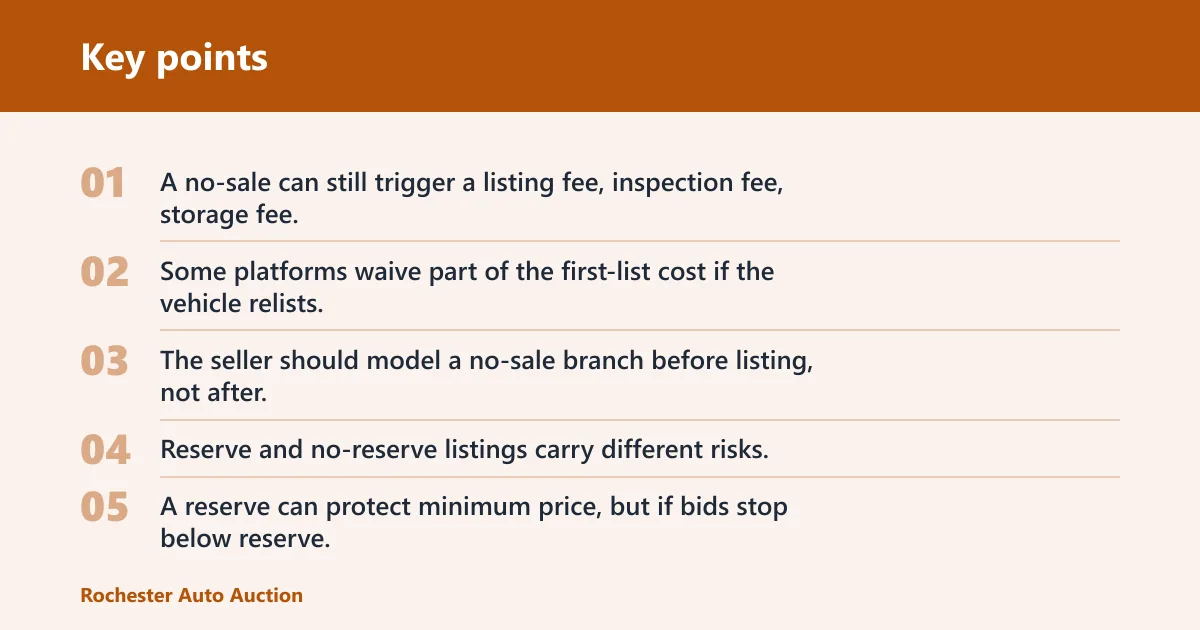
A no-sale can still trigger a listing fee, inspection fee, storage fee, or transport charge if the vehicle was already moved or listed. Some platforms waive part of the first-list cost if the vehicle relists, while others charge again. The seller should model a no-sale branch before listing, not after.
Reserve-not-met outcomes
Reserve and no-reserve listings carry different risks. A reserve can protect minimum price, but if bids stop below reserve, the vehicle may not sell and the seller may still owe listing, storage, or relist charges. A no-reserve listing can sell more easily, but it gives up price protection.
Picture a pickup listed with about a $9,000 reserve and a bid of about $8,700. The auction may count that as reserve not met, which leaves the seller with no payout and possible relisting or storage exposure if the unit stays on site or in the platform system for another round.
Relisting and retry fees
Relisting fees apply after a no-sale or after a failed reserve outcome, depending on platform rules. They are not the same as the first-list fee. A platform may charge less for the second listing, may bundle relisting with storage, or may waive part of it if the seller lowers reserve and relists quickly.
Which extra fees can reduce payout?
Extra fees often matter more than the base commission because they arrive after the seller has already priced the vehicle. The main ones are listing, storage, transport, and title handling. Each one ties to a specific event, and each one can move the final payout lower if the seller does not prepare the paperwork and logistics early.
Listing fee
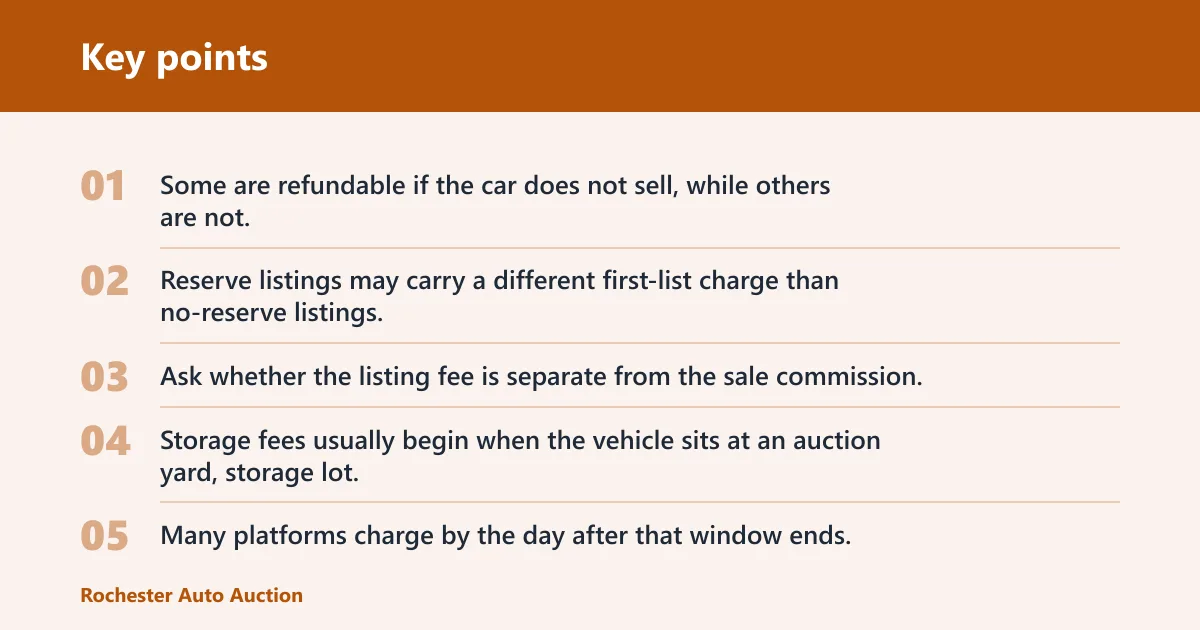
A listing fee may be upfront or post-sale. Some are refundable if the car does not sell, while others are not. Reserve listings may carry a different first-list charge than no-reserve listings, and relisting often gets its own fee schedule. Ask whether the listing fee is separate from the sale commission.
Storage fee
Storage fees usually begin when the vehicle sits at an auction yard, storage lot, or receiving location beyond the free window. Many platforms charge by the day after that window ends. The seller pays unless the auction explicitly absorbs the cost, so pickup timing can directly change net proceeds.
Transport fee
Transport fees depend on who arranges pickup, who pays for delivery, and whether the vehicle is drivable. If the auction coordinates towing or shipping, the cost may come out of proceeds. If the seller must drop off the vehicle, the seller bears that cost before the car is even listed.
Title handling fee
Title handling fees cover document intake, transfer processing, lien release handling, and final release conditions. The auction may hold payout until the title matches the seller record, the lien is cleared, and any required signatures are complete. Missing or inconsistent title data can delay payment and add correction charges.
Condition report
A condition report documents the vehicle’s stated condition before sale. It matters because misrepresentation can lead to post-sale arbitration, reduced proceeds, or added charges if the buyer disputes major differences between the listing and the vehicle delivered. A clear report lowers the risk of after-the-fact deductions.
Reserve price, no-reserve, and fee risk
Reserve price changes both sale probability and fee exposure. A reserve can keep a vehicle from selling below a minimum, but it also raises the chance of a no-sale branch with possible relist or storage costs. No-reserve listings usually improve sale odds, yet they can lower the final hammer price.
Reserve versus no-reserve listings
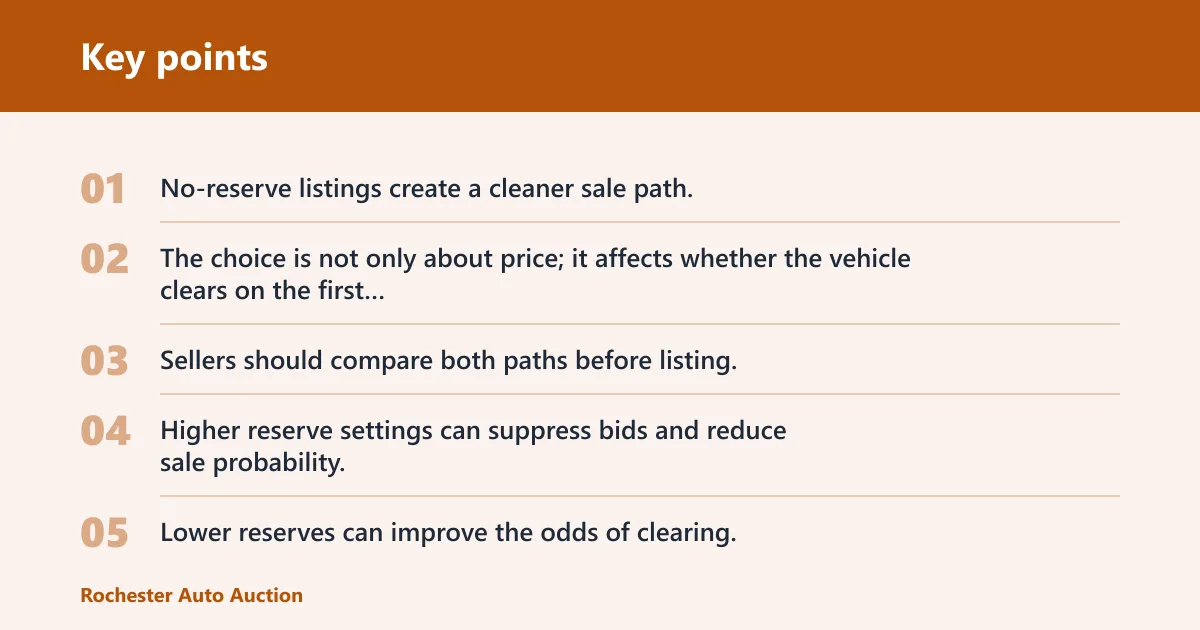
Reserve listings create a floor. No-reserve listings create a cleaner sale path. The choice is not only about price; it affects whether the vehicle clears on the first try and whether the seller faces additional fees if it does not. Sellers should compare both paths before listing.
Effect on sale probability
Higher reserve settings can suppress bids and reduce sale probability. Lower reserves can improve the odds of clearing, but they also narrow the seller’s protection if bidding is weak. The right setting depends on market demand, vehicle condition, and how much fee risk the seller is willing to carry.
Effect on seller fee exposure
If the car does not meet reserve, the seller may still owe the first-list fee, storage, and any transport already arranged. If the auction allows a quick relist, the second round may add a relist fee, but it can also reduce the chance of paying repeated storage costs while the vehicle sits unsold.
Seller fee waterfall worksheet
This worksheet shows the payout waterfall from gross sale price to net payout, plus a no-sale branch and a reserve-not-met branch. Use the same fee lines for each scenario so you can compare best case, weak sale, and no-sale exposure before you list the vehicle.
| Scenario | Gross sale price | Base seller fee | Optional deductions | Net payout |
|---|---|---|---|---|
| Best case sale | $12,000 | $300 | $75 title + $150 transport = $225 | $11,475 |
| Reserve not met | $8,700 bid | $300 | $0 payout, possible $100 relist + $50 storage | -$150 exposure |
| No sale | $0 | $150 listing fee | $60 storage + $120 transport return = $180 | -$330 exposure |
The table shows the difference between a sale and a failed listing. A sold vehicle can still carry deductions, but a no-sale can create pure cost exposure because no hammer price exists to absorb the charges.
What sellers should confirm before listing
Before you list, confirm the fee schedule, title rules, pickup terms, and settlement timing in writing. That prevents surprise deductions and makes the net estimate far more reliable. Private sellers and dealers should also verify whether the platform treats them differently on relist, storage, or transport.
- Get the exact seller fee schedule for your platform and vehicle type.
- Check whether the listing fee is upfront, post-sale, refundable, or nonrefundable.
- Confirm whether title handling, storage, transport, and relist charges are separate.
- Verify who arranges pickup, who pays transport, and when storage starts.
- Ask when payout is released and whether any holdback can reduce it later.
- Make sure the title, lien release, and condition report are complete before listing.
What information you need upfront
Collect the title status, lien status, pickup availability, odometer reading, keys, and any disclosure items before the listing goes live. Missing details can lead to delayed payout, added document fees, or a condition dispute after sale. That is the easiest way to avoid surprise deductions.
A common first-timer mistake is listing a vehicle without checking the pickup window. If the car sits five extra days and storage begins on day three, the final payout can shrink fast even when the sale itself looks strong.
Frequently asked questions
How do online car auctions work?
You list the vehicle, the platform collects vehicle details and photos or a condition report, buyers bid online, and the highest qualifying bid wins if it meets any reserve. After that, the auction settles payment, deducts applicable fees, and releases the seller’s net proceeds once title and release conditions are satisfied.
How much are car auction fees?
There is no single number. Seller fees can be flat, percentage-based, or a mix of both, and extra charges may apply for title work, storage, transport, or relisting. The only reliable answer is the platform’s fee schedule for your seller type and vehicle type before you list.
How do auction fees work?
Auction fees are charged to cover listing, processing, and sale administration, but the timing differs. Some are taken from sale proceeds, some are billed separately, and some appear only if a vehicle does not sell or must be relisted. The seller should map each fee to the exact stage it can appear.
Do seller fees come out of your auction proceeds?
Often they do, especially for commission, platform, title, and admin charges. However, some costs are billed separately or can be deducted later through a holdback or final adjustment. Read the settlement terms carefully so you know whether the gross hammer price is close to the amount you actually receive.
What extra seller fees can be added after your car sells?
Common post-sale charges include title corrections, storage after the free window, transport, arbitration tied to condition disputes, and document handling. These additions usually depend on what happens after the sale closes, not just on the winning bid, which is why the final payout can differ from the first estimate.
Are seller fees negotiable at auto auctions?
Sometimes, but only if the platform or auction says they are. Negotiation is more common with dealer accounts, repeat volume, or special inventory, and even then some charges stay fixed. Do not assume a listed fee can be changed; ask for the exact terms in writing before you commit.