Do You Need a Dealer License for Dealer-Only Auto Auctions?
Usually, dealer-only auto auctions require a valid dealer license, though some houses may accept other credentials such as a wholesaler, broker, repossession, or export credential if state law and auction policy allow it. Showing up with the wrong document can mean denied entry, canceled bids, or penalties for buying outside your licensed authority. This guide separates state rules, auction-house rules, and license types, then lists the checks you should make before you bid.
Dealer-only auctions: the rule
Dealer-only auto auctions are restricted-entry sales. Access is screened before bidding or buying, and that screening often starts with a dealer license number, business name, and expiration date. State law sets the outer limits, but the auction house can add its own approval steps.
A dealer license is state-issued and must be active and verifiable. In many states, it may be a wholesale license, a retail license, or a separate broker category. The exact class matters because one license may allow resale buying while another also allows retail sales to the public.
Where state law fits
State dealership license rules vary by state. Some states require a lot, a bond, insurance, or a registered business entity before they issue a license. Others split dealers into wholesale-only, retail, or broker categories and give each category different buying authority.
That matters because auction access is never based on the license label alone. A license can be valid in the state database and still fail an auction review if the house only accepts certain dealer types or requires an account tied to a specific business structure.
Do you need a dealer license?
Usually, yes. If an auction is dealer-only, a dealer license is typically the normal entry document, and it should be active at the time of approval. In some cases, another credential such as a wholesale, broker, repossession, or export authorization can work, but only if both state law and the auction’s rules allow it.
When the answer is yes
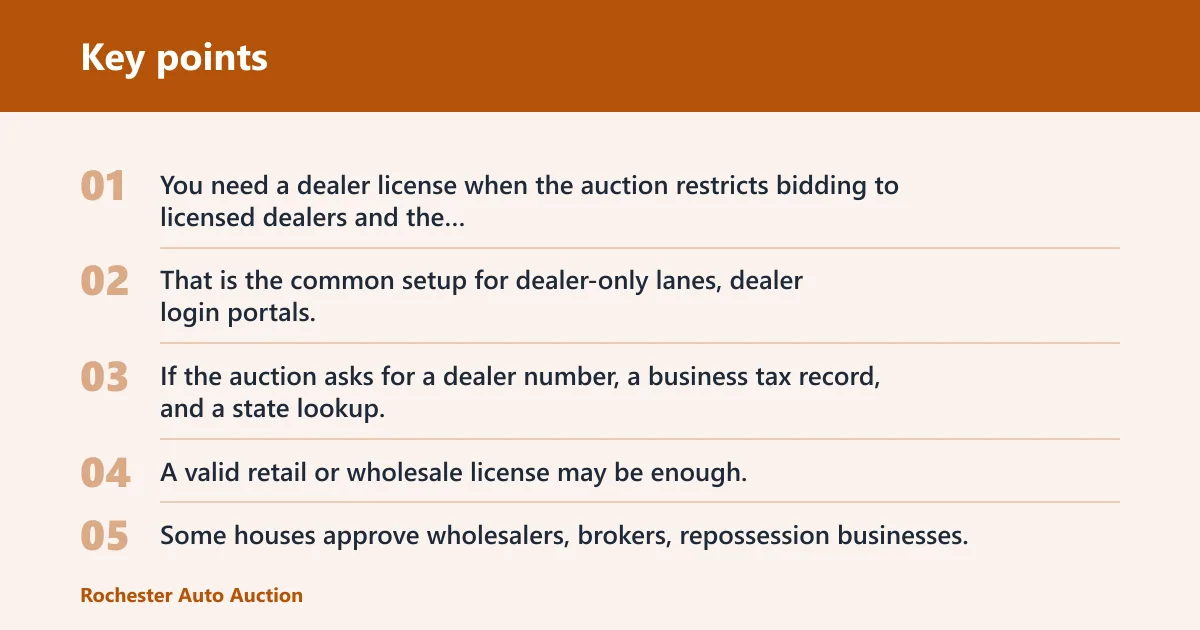
You need a dealer license when the auction restricts bidding to licensed dealers and the house uses license screening as its gatekeeping step. That is the common setup for dealer-only lanes, dealer login portals, and in-person buyer registration desks that require proof before you can bid.
If the auction asks for a dealer number, a business tax record, and a state lookup, a public buyer without that license usually cannot proceed. A valid retail or wholesale license may be enough, but only if the auction accepts that class.
When another credential may work
Some houses approve wholesalers, brokers, repossession businesses, or export buyers under separate rules. That approval is not automatic, and it is not the same as a standard dealer account. The house may want a different application, extra insurance, or a signed agreement that limits how vehicles can be purchased.
Say your state issues a wholesale-only dealer license and the auction accepts wholesale accounts. You may get in with that credential, but only after the house confirms the business name, the active status, and the type of buying authority attached to that license.
Why auction policy still matters
Auction-house rules can be stricter than state law. A state may allow a licensed wholesaler to buy for resale, but a particular auction may still require a retail dealer account, an approved company profile, or prior sales history before it opens the lane to that bidder.
That is why approvals fail even when the paperwork looks complete. The house is not only checking whether the license exists; it is checking whether the license class matches its own registration rules.
Which license type counts?
Wholesale dealer licenses and retail dealer licenses are different, and either may qualify depending on the state and the auction’s policy. The right answer depends on what the state authorizes and what the auction accepts, not on a general rule that one dealer license always covers every auction.
Wholesale dealer license
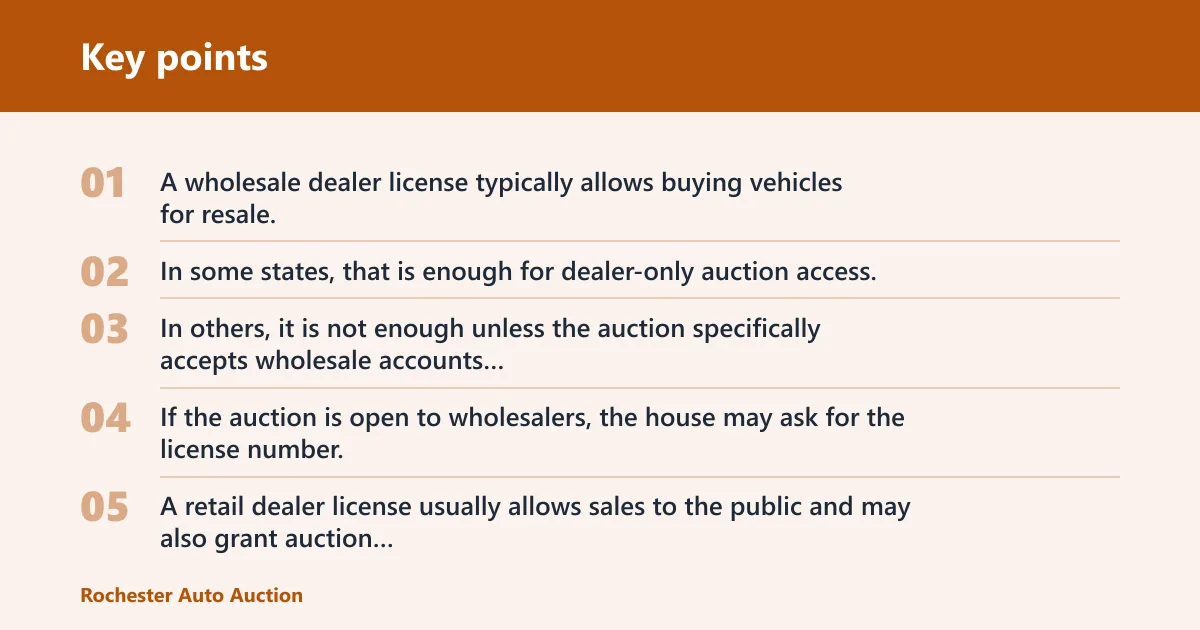
A wholesale dealer license typically allows buying vehicles for resale. In some states, that is enough for dealer-only auction access. In others, it is not enough unless the auction specifically accepts wholesale accounts or the business also meets a separate registration standard.
Do wholesale dealers get auction access? Often, yes, but not always. If the auction is open to wholesalers, the house may ask for the license number, business name, and proof that the license is active in the state database.
Retail dealer license
A retail dealer license usually allows sales to the public and may also grant auction access. Many auctions accept retail dealers because the license already shows state-issued authority to buy and resell inventory, but the house can still ask for extra documents before activating the account.
The key point is that retail and wholesale are not interchangeable. A wholesale-only credential may be rejected by a house that limits access to retail dealers, and a retail license may still need separate approval if the auction reserves some lanes for specific buyer types.
Out-of-state dealer license
Out-of-state dealer licenses may be accepted or rejected depending on the auction and the state rules. Some auctions accept them for online bidding or temporary registration, while others require an in-state license because their house policy tracks local dealer law or tax handling.
Picture a licensed dealer from another state applying to a nearby auction. The auction may confirm the license through the home state database, then deny access if its own policy requires a local dealer number or a matching business registration in the auction state.
Can a private buyer enter?
Usually no. Private buyers generally cannot attend dealer-only auto auctions unless the auction offers a separate approved channel, such as a public sale, an employee program, or another preapproved exception. A private person should not assume general admission means bidding rights.
Private buyer access limits
Private buyers are usually blocked because dealer-only auctions are built around licensed trade accounts. The house expects a credential it can verify, and a personal ID alone usually does not meet that standard. Without that credential, registration may stop before bidding starts.
That holds for in-person and online access. If the auction labels a sale as dealer-only, the private buyer should read the registration rules first, because a public viewing day does not mean public bidding access.
Approved exceptions
Some auctions create limited exceptions for businesses that are not dealers but still participate in vehicle transactions, such as repossession firms, export agents, or fleet operators. Those exceptions are narrow. They normally require direct approval, document upload, and a house account tied to the business name.
A common first-timer mistake is assuming a general business tax certificate replaces dealer approval. It usually does not. The auction still wants proof that the applicant fits one of its allowed buyer categories.
Online auction access
Dealer-only online auctions usually use the same gatekeeping rules as in-person sales. The house can require a license upload, a state lookup, and a verified business account before login access is activated. If the account is not approved, online bidding is blocked even if the site is public-facing.
Do you need a dealer license for online dealer-only auctions? In most cases, yes, unless the auction accepts another verified credential. The format changes; the access rules usually do not.
Dealer auction decision table
This table helps you sort out likely access before you apply. The final answer still depends on the state database, the auction’s registration rules, and whether your documents match the business name on file.
| Applicant type | Likely access | Required proof | Common rejection reason |
|---|---|---|---|
| Private buyer | Usually no | Separate public-sale approval, if offered | No dealer credential or approved exception |
| Wholesale dealer | Often yes, if accepted by the house | Active wholesale license, business name match, state lookup | House accepts retail only or wholesale authority is limited |
| Retail dealer | Often yes, if the auction accepts retail accounts | Active retail license, business documents, expiration check | Account type does not match house policy |
| Out-of-state dealer | Sometimes | Home-state license, state database confirmation, business registration | Local-only policy or cross-state credential not accepted |
| Expired license | No | Renewed active license, updated database record | Inactive status or lapsed expiration date |
| Business-only applicant | Usually no | Dealer license or a separate approved buyer category | Business license is not a dealer license |
How auctions verify licenses
Auction credential verification usually includes four checks: the license number, the business name match, the expiration date, and a state database lookup. If any one of those does not line up, approval can stall or fail.
License number check
The auction first checks whether the license number is valid and tied to the applicant. That number should match the state record and the buyer account. A missing digit, copied number, or old account record can stop the process before a bid is allowed.
Business name match
The business name on the license should match the name on the auction account and supporting documents. A DBA, a shortened company name, or a parent company name can create a mismatch if the auction cannot tie the records together quickly.
Expiration date check
Expired or inactive credentials can block access immediately. Even if the license was valid last month, it will not pass review once the expiration date has passed or the state database shows a lapse, suspension, or probation status.
State database lookup
Many auctions use a dealer license lookup to confirm active status. That lookup is often done through a state agency database, and some houses will not finish approval until the online record matches the paper or uploaded document. If the state site has not updated yet, the account may sit pending.
Why approvals get denied

Approvals usually fail for predictable reasons: the license is expired or inactive, the business documents are missing, the name does not match, or the state rule does not fit the auction’s policy. None of those problems is fixed by arguing at the registration desk.
Expired or inactive license
If the license has expired, the auction has a clear reason to deny access. Most houses will not risk allowing a bidder to operate on lapsed authority, even if the applicant says renewal is already in progress.
Missing business documents
Auctions often ask for more than a license number. They may want a business license, tax certificate, entity registration, insurance, bond proof, or a resale certificate, depending on the state and house rules. If one document is missing, the account may stay on hold.
Name mismatch
Mismatched business names are a common rejection reason. The license may be under one legal entity while the auction account is under another. Without a clear paper trail, the house may refuse to approve the buyer until the names are corrected.
State rule conflict
Sometimes the problem is not the paperwork but the law. A state may allow a wholesale dealer license, but the auction may require a retail dealer license for a specific lane or sale type. In that case, the account is denied because the credential does not fit the house rule.
Suppose an out-of-state dealer applies with a valid license and a clean state lookup. If the auction’s policy requires an in-state business entity, the application can still be rejected even though the dealer license itself is active.
Frequently asked questions
Do you need a dealer license for dealer-only auto auctions?
Usually yes. Dealer-only auctions normally require an active dealer license or another credential the house accepts. The exact answer depends on state law and auction policy, so a valid license alone is not enough if the auction limits access to certain dealer classes.
Can a private buyer attend dealer-only auto auctions?
Usually not. Private buyers generally cannot enter dealer-only auctions unless the house offers a separate public-sale channel or a narrow approved exception. Even then, the buyer may need preapproval, business paperwork, or another credential before bidding is allowed.
What kind of dealer license do you need to buy at auction?
It depends on the state and the auction. A wholesale dealer license may be enough at one house, while another requires a retail dealer license or a different buyer category. The house will usually check the license class, business name, expiration date, and state record.
Do wholesale dealers get auction access?
Often yes, but not always. Wholesale dealers are commonly allowed at dealer-only auctions that accept wholesale buyers, yet some houses limit access to retail dealers or specific approved businesses. The buyer should confirm the house’s policy before creating an account.
How do auction houses verify dealer license status?
They usually check the license number, the business name, the expiration date, and the state database. Some houses also ask for entity registration, insurance, bond information, or resale paperwork. If any item does not match, approval can be delayed or denied.
What happens if your dealer license expires before an auction?
Access is usually blocked. An expired or inactive license can stop bidding, freeze an existing account, or cancel approval until the license is renewed and the state record shows active status. The auction will usually not accept a lapsed credential as proof.