What Seller Fees Does Copart Charge?
Copart seller fees are not a single fixed number. Your net payout can shrink from Copart-controlled charges such as seller fees, storage, gate or pickup fees, and condition-related deductions, while outside costs like towing, title work, and repairs can reduce it further. Miss those deductions and you can mistake the sale price for your payout, then lose money to fees you did not plan for. This guide breaks down which costs come from Copart, which usually come from elsewhere, and how they change the money you actually receive.
Copart seller fees explained
Copart seller costs fall into two buckets. Some are built into the auction process and can cut proceeds directly. Others are outside costs tied to the vehicle, the title, the buyer, or the yard, so you should treat them as possible net reductions rather than automatic charges.
What counts as a seller-side deduction
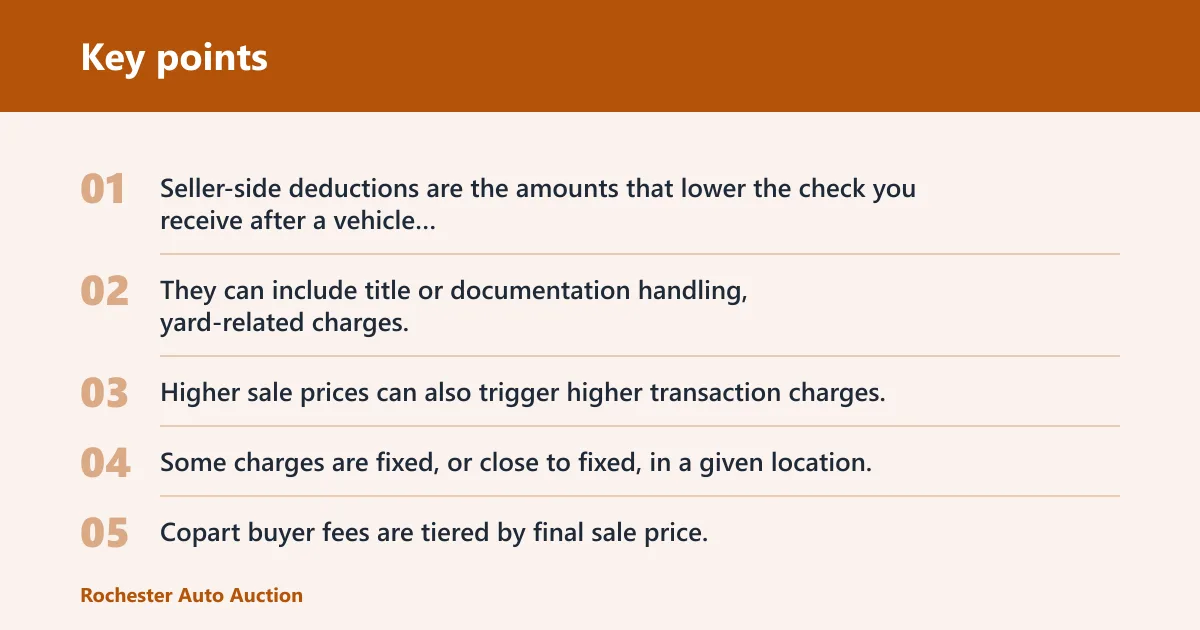
Seller-side deductions are the amounts that lower the check you receive after a vehicle sells. They can include title or documentation handling, yard-related charges, and fees tied to a failed payment or delayed pickup. Higher sale prices can also trigger higher transaction charges, so the sale amount itself matters.
Fixed charges versus price-based charges
Some charges are fixed, or close to fixed, in a given location. Others rise with sale price. Copart buyer fees are tiered by final sale price, and the example buyer fee starts at $35 for $0-$99 and reaches $285 for $2,000-$4,000. That tiering matters because the winning bid is only the starting point.
Which costs are conditional, not automatic?
Not every charge applies to every sale. Title status, pickup timing, sale location, payment timing, and buyer access can all change the final amount. A vehicle that clears quickly with clean paperwork has fewer deductions than one that sits, relists, or needs extra paperwork handling.
Say your sedan sells at a low bid but the buyer needs a broker and misses the pickup window. The seller does not pay every charge on the invoice, but the sale can still leave a smaller net because storage, relist risk, and paperwork-related deductions may stack up around the transaction.
What fees does Copart charge?
Copart charges a mix of sale-related and transaction-related fees, and some only apply when title status, payment timing, or location triggers them. Common seller-exposure categories include title and documentation costs, gate or yard processing charges, storage fees, late payment fees, and relist fees if payment fails.
Copart seller fees that may apply
The fees most sellers need to watch are the ones that can reduce proceeds after the sale: documentation handling, gate or yard processing, storage, late payment penalties, and relist charges. These are not universal in every transaction, but they are common enough that sellers should budget for them before listing.
Title and documentation costs
Documentation fees can range from $50 to $100. That cost is tied to paperwork handling, which is why title status matters. Clean title processing is usually simpler than salvage or incomplete paperwork, and the paperwork burden can affect both timing and the final payout.
Storage, late payment, and relist risk
Storage fees are described as $5 to $20 per day, late payment fees as $50 to $100, and a relist fee as 10% of sale price with a $600 minimum. Those charges matter most when a buyer does not pay on time or cannot remove the vehicle within the pickup window.
- Identify the sale price and whether it falls into a higher fee tier.
- Check whether title or documentation handling will apply.
- Confirm the pickup deadline and possible storage exposure.
- Ask whether a relist penalty could apply if payment fails.
- Separate Copart-controlled deductions from broker, tax, and transport costs.
How much are Copart auction fees?
Copart auction fees vary by sale price, buyer type, and whether the bid is online. The buyer fee is tiered by final sale price, the internet bid fee applies to online bidding, and the gate fee can be fixed in some cases. These charges add to the transaction amount, not just the winning bid.
Buyer fee tiers and sale price basis
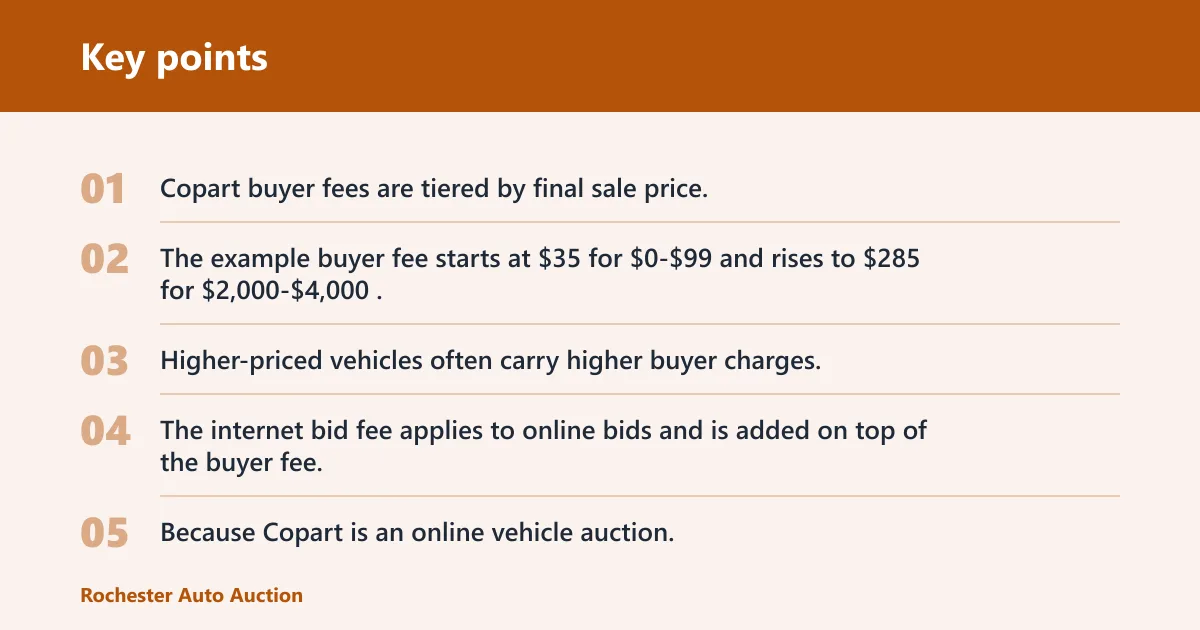
Copart buyer fees are tiered by final sale price, and the fee is based on the final sale amount rather than a seller’s estimate. The example buyer fee starts at $35 for $0-$99 and rises to $285 for $2,000-$4,000. Higher-priced vehicles often carry higher buyer charges.
Internet bid fee on online bids
The internet bid fee applies to online bids and is added on top of the buyer fee. Because Copart is an online vehicle auction, many transactions include this extra charge when the buyer bids through the platform rather than in a physical lane.
Gate fee and location-based variation
The example gate fee is $79 per vehicle. Auction fees depend on the vehicle location, not the member’s residency, so the same buyer can face different charges across yards. In practice, that means the location of the vehicle matters more than where the buyer lives.
How those fees affect seller net
Even if the seller does not directly write the buyer-fee check, those charges affect the final transaction amount and can change how quickly a buyer pays. Faster payment and cleaner pickup reduce the risk of storage or relist exposure, which is why fee tiers matter to sellers too.
Does Copart charge sales tax?
Copart transactions can include sales tax, but the rate is not national and not fixed. Sales tax is typically 6% to 10%, and the actual amount depends on jurisdiction. That means tax can change the buyer’s total due and, indirectly, the seller’s chance of a smooth close.
When sales tax can appear on a transaction
Sales tax can appear when the transaction is taxable under local rules. It is not a flat national amount. The vehicle location, buyer status, and state or local law determine whether tax is due and how much is collected.
Why the rate depends on jurisdiction
The rate depends on the jurisdiction tied to the sale, not a single Copart-wide percentage. A yard in one state can have a different tax outcome than a yard in another state. That is why the same winning bid can produce a different total amount due.
How tax affects net proceeds versus buyer cost
Sales tax usually increases the buyer’s out-of-pocket total rather than acting as a seller fee line by itself. Still, a higher tax burden can affect how quickly a buyer completes payment, and payment speed affects the seller’s exposure to storage, late payment, and relist charges.
Seller fee worksheet
This worksheet separates Copart-controlled deductions from outside costs so you can estimate net proceeds before the sale closes. Use it as a planning tool, not a final invoice. Exact charges depend on sale price, location, title status, buyer type, tax rules, and whether payment or pickup happens on time.
Worksheet columns and how to use them
| Gross sale price | Copart deductions | Conditional charges | Outside costs | Estimated net proceeds |
|---|---|---|---|---|
| $800 | $79 gate fee + $50 documentation fee = $129 | No storage, no late payment, no relist | $0 broker, $0 tax, $0 transport | $671 |
| $3,000 | $79 gate fee + $100 documentation fee = $179 | $75 storage risk if pickup slips a few days | $300 broker + tax if due + transport | $2,446 before outside tax and transport |
| $8,500 | $79 gate fee + $100 documentation fee = $179 | $100 late payment risk or $850 relist risk if payment fails | $250 broker + tax if due + transport | $8,071 before outside tax and transport |
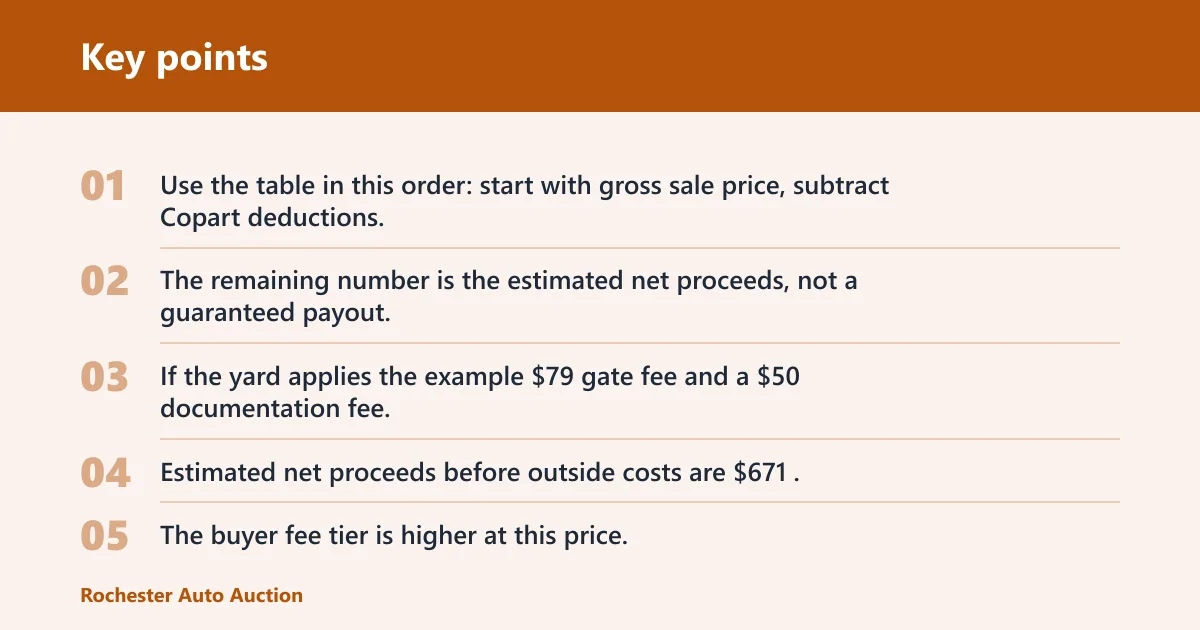
Use the table in this order: start with gross sale price, subtract Copart deductions, then subtract any conditional charges that may actually occur, then subtract outside costs such as broker fees, tax, and transport. The remaining number is the estimated net proceeds, not a guaranteed payout.
Low-price sale example
Suppose a vehicle sells for $800. If the yard applies the example $79 gate fee and a $50 documentation fee, Copart-controlled deductions total $129. Estimated net proceeds before outside costs are $671. Add transport or tax if those apply.
Mid-price sale example
Suppose a vehicle sells for $3,000. The buyer fee tier is higher at this price, and a broker may charge $200 to $400 per vehicle. Using the table’s midpoint outside-cost example, the seller should expect the net to drop further if payment is slow or pickup creates storage fees.
High-price sale example
Suppose a vehicle sells for $8,500. At that level, a payment failure is expensive because the relist fee is described as 10% of sale price with a $600 minimum. A delayed close can also trigger storage and late payment penalties, which is why high-value sales need closer follow-up.
A common first-timer mistake is to compare the winning bid to the amount that arrives in the account. Those are not the same number. The bid is gross sale price; the payout is the gross amount minus Copart deductions, plus or minus outside costs depending on who pays them.
How much does a Copart broker cost?
A broker is a third-party cost, not a Copart seller fee, but it can still affect the seller’s expected net because it changes how much the buyer must spend to complete the purchase. Broker fees are described as $200 to $400 per vehicle, and one published example lists a $100 broker fee per vehicle.
When a broker fee enters the deal
A broker fee enters when the buyer does not have direct access or needs an intermediary to bid and complete the purchase. That cost is per vehicle, so a buyer who uses a broker on more than one unit pays it each time. Sellers should account for the possibility that higher buyer costs slow payment.
Per-vehicle third-party charges
Broker charges sit outside Copart-controlled deductions. Other third-party or outside charges can include a $20 mailing fee per vehicle and a $15 environmental fee per vehicle in some published fee summaries. Those costs do not belong in a Copart seller-fee line, but they still reduce the buyer’s total tolerance.
How broker cost changes the seller’s expected net
Broker cost can change expected net by affecting buyer demand, closing speed, and the chance of a clean payment. If the buyer faces a larger all-in cost, the seller should watch for slower payment and the related risk of storage, late payment, or relist fees.
Frequently asked questions
How much are Copart auction fees?: copart auction fees are not?
Copart auction fees are not one flat number. Buyer fees are tiered by final sale price, the internet bid fee applies on online bids, and the gate fee can be fixed at a location. Higher sale prices usually carry higher buyer fees, so the final price matters more than the opening bid.
Does Copart charge sales tax?: copart transactions can include sales?
Copart transactions can include sales tax, but the rate depends on jurisdiction and is typically 6% to 10%. It is not a national flat amount. Tax usually changes the buyer’s total due, which can indirectly affect how quickly the seller gets paid and whether storage fees begin.