What Is Auction Arbitration at a Car Auction?
Auction arbitration at a car auction is the post-sale process for reviewing a vehicle-condition dispute. Claims usually must be filed before the posted deadline, or they are ineligible. Miss the clock or the required proof, and you may be stuck with the car, the repair bill, or both. This guide explains what arbitration covers, how eligibility is decided, and which checkout steps protect your claim.
What is auction arbitration?
Auction arbitration is a post-sale review process for disputes about the vehicle’s condition. It applies when buyer and seller disagree after the sale closes, and the auction house uses its policy to decide whether the claim can move forward and what resolution fits the facts.
That means the issue has to fit the auction’s condition rules. A missing disclosure, a major mechanical defect, or a conflict with the condition report can qualify. Normal wear, expected age-related flaws, or items excluded by policy often do not.
How it differs from a lawsuit
A lawsuit is a legal action in court. Auction arbitration is a policy-based dispute review inside the auction system. The difference matters because the auction’s deadline, checkout rules, and evidence standards can decide eligibility before anyone reaches the merits of the complaint.
In automotive terms, arbitration asks whether the sale violated the auction’s condition policy. A court asks broader legal questions. For most buyers, the first hurdle is not winning the argument. It is getting the claim accepted on time and with enough support.
Why auctions use it
Auctions use arbitration to sort buyer-seller disagreements after the sale closes. It gives both sides a set process, limits open-ended disputes, and creates a consistent way to review condition concerns. Reconcash describes it as a post-sale dispute mechanism for completed transactions.
Which vehicle issues qualify?
Only certain vehicle-condition disputes belong in arbitration. The strongest claims usually involve a mismatch between what was disclosed and what the buyer received, or a defect that policy treats as material. Cosmetic wear, age, and expected condition often fall outside the claim path unless the policy says otherwise.
Mechanical defects and disclosure conflicts
Undisclosed mechanical defects are a common trigger. So are mileage misrepresentation and condition-report conflicts. If the report says one thing and the vehicle shows another, the report, the timing, and the supporting documents become central to the review.
Suppose a condition report lists a clean-running engine, but the buyer discovers a coolant leak and diagnostic codes the next day. That may be a viable arbitration issue if the leak is material, the filing is timely, and the policy covers that type of defect.
Cosmetic wear and excluded items
Cosmetic blemishes alone are usually weaker claims. Scratches, chips, faded trim, or tires worn in line with age may be treated as normal use, not a dispute-worthy defect. A claim based only on expected wear can be rejected even if the buyer is disappointed.
That is why the condition report matters. It can support the buyer when it omits damage or weaken the claim when the issue was already disclosed.
How the arbitration clock starts
The filing clock is the part many buyers miss. Auction policies usually count from a purchase-related date, but the exact start point can change with pickup timing or transportation. Some systems also require checkout to be finished before the claim can even be filed.
Standard purchase timeline
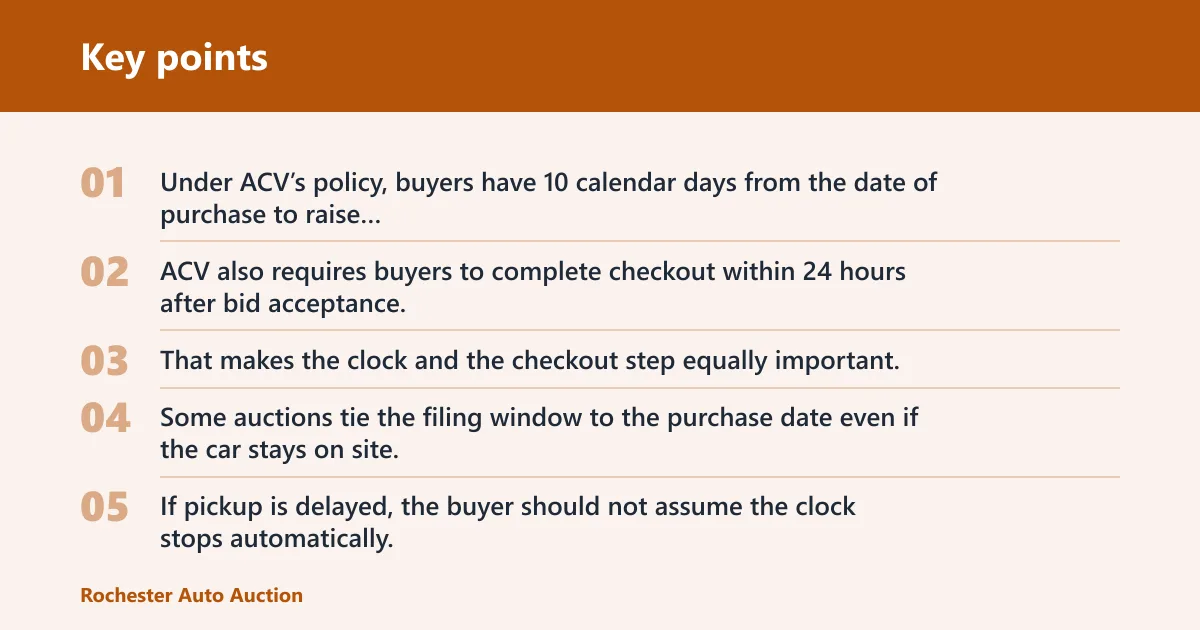
Under ACV’s policy, buyers have 10 calendar days from the date of purchase to raise concerns, and the date of purchase counts as day one. ACV also requires buyers to complete checkout within 24 hours after bid acceptance. That makes the clock and the checkout step equally important.
Delayed pickup timeline
Some auctions tie the filing window to the purchase date even if the car stays on site. Others may adjust the deadline by policy. If pickup is delayed, the buyer should not assume the clock stops automatically. The posted rule controls.
Auction-arranged transportation timeline
Transportation can change the clock. ACV adds a short post-delivery window when transportation is selected, and it offers an extended arbitration period of about 10 additional calendar days. That is a policy example, not a universal rule. Other auctions may shorten, extend, or alter the window.
Suppose a buyer wins a sedan on Monday, chooses auction-arranged transport, and receives it the following week. Under a policy like ACV’s, the delivery date matters because the post-delivery window can apply. The buyer still has to follow the platform’s process and meet the condition-based filing rule.
| Scenario | Clock start | What to watch |
|---|---|---|
| Standard purchase | Date of purchase counts as day one | File inside the posted purchase window and finish any required checkout steps |
| Delayed pickup | Usually still tied to the purchase date unless policy says otherwise | Do not assume storage time pauses the deadline |
| Auction-arranged transportation | May start a post-delivery window under the auction’s policy | Keep delivery proof and inspect promptly on arrival |
What happens after you file?
After filing, the auction reviews the claim against its policy, the condition report, and the evidence you submit. The seller usually gets a chance to respond. The auction may ask for more documents, an inspection, or proof that the issue existed within the allowed window.
Claim intake and review
The first step is claim submission. The same source lists claim submission as the first step, and ACV says buyers must contact the arbitration team through the platform. If the claim is late, incomplete, or outside condition policy, review may stop before the merits are reached.
Seller response and inspection
The seller can respond to the dispute review and may accept a resolution outcome. The auction may compare the complaint with the condition report, photos, repair orders, mechanic notes, and transport records. In some cases, that review is enough. In others, the auction may ask for a closer inspection.
Final decision
The outcome is policy-based. It can be a refund, an adjustment, or rejection of the claim. The same source lists those outcomes directly. The key point is that evidence and policy drive the result, not the buyer’s frustration level or the size of the repair estimate alone.
Arbitration eligibility table
This checklist shows how issue type, proof, timing, and policy usually work together. A claim can fail on eligibility before anyone debates the repair itself.
| Issue type | Proof needed | Filing deadline trigger | Common exclusion | Likely outcome |
|---|---|---|---|---|
| Undisclosed mechanical defect | Condition report, photos, repair order, mechanic notes | Date of purchase or delivery date if the policy says so | Wear item, pre-disclosed fault, late filing | Refund, adjustment, or rejection |
| Mileage misrepresentation | Odometer records, sale documents, photos, title or disclosure records | Date of purchase | Buyer already knew the mileage issue, policy excludes it | Adjustment or rejection |
| Condition-report mismatch | Listing copy, condition report, dated photos, inspection notes | Date of purchase | Minor cosmetic difference within normal wear | Adjustment or rejection |
| Transport-related damage | Delivery record, unloading photos, carrier notes, timing proof | Post-delivery window if policy allows it | No delivery documentation, damage not tied to transport | Refund, adjustment, or rejection |
| Pure cosmetic wear | Photos only, if policy even allows review | Usually still the purchase date | Expected age, normal wear, excluded cosmetic issue | Often rejected |
What proof should you gather first?
Start with the condition report and sale documents. Those are the reference points for what was promised, what was disclosed, and what the policy will compare against. If they do not support the claim, later evidence may not be enough.
- Save the condition report, invoice, and purchase confirmation.
- Take dated photos and video of the issue from several angles.
- Get a written mechanic evaluation or repair estimate.
- Keep transport records if the issue appeared after delivery.
- Record the filing date and checkout confirmation.
Repair orders and mechanic notes help most when they identify the defect clearly and tie it to the relevant time period. Timing proof matters too. If the policy gives 10 calendar days from the date of purchase, a report dated after that window may not save the claim.
A common first-timer mistake is gathering only a repair quote. A quote shows cost, but it does not always prove condition, timing, or disclosure conflict. The auction still needs to compare the claim with the policy and the vehicle record.
How policies and guidelines fit together
Industry guidance and auction policy work together, but the local rule is what usually controls the claim. ACV says its arbitration follows the NAAA Policy unless modified. That means NAAA Arbitration Guidelines can matter, but the auction’s posted policy can add different deadlines or checkout rules.
NAAA arbitration Guidelines
NAAA Arbitration Guidelines are commonly referenced as an industry framework. When an auction follows them, they can shape deadlines, eligible issues, and the way disputes are handled. If an auction modifies the framework, the posted auction rule takes priority for that sale.
Example: ACV timing and checkout rules
ACV is a clear example of how policy details affect eligibility. It requires checkout within 24 hours after bid acceptance, gives buyers 10 calendar days from the date of purchase to raise concerns, counts the date of purchase as day one, and adds a 4-day post-delivery window when transportation is selected.
That combination shows why timing and status matter. A buyer who files late, skips checkout, or submits a non-condition complaint may never reach the merits of the dispute.
Frequently asked questions
What does arbitration mean in car sales?
In car sales, arbitration means a post-sale dispute review for condition concerns. It is used when the buyer and seller disagree about what was disclosed, what was delivered, or how a vehicle should be classified under the auction’s policy. It is time-limited and evidence-driven.
What is arbitration for cars?
Arbitration for cars is the auction or dealer dispute process that checks whether a sale should be adjusted because of a qualifying defect or disclosure issue. It usually applies after the transaction closes and depends on the vehicle record, the deadline, and the claim evidence.
What is arbitration in automotive?
In automotive settings, arbitration is a structured review of a vehicle-condition dispute. It is used for issues like undisclosed mechanical defects, mileage misrepresentation, or a mismatch with the condition report. It is not a general complaint channel for any dissatisfaction with the car.
Is arbitration a legal action?
Not in the usual auction sense. Auction arbitration is a policy-based review inside the sale system, not a courtroom filing. It can affect whether the buyer gets a refund, an adjustment, or a rejection, but it follows auction rules rather than ordinary court procedure.
How long do you have to file auction arbitration after purchase?
It depends on the auction. The same source gives buyers 10 calendar days from the date of purchase, with the date of purchase counted as day one, and it requires checkout within 24 hours after bid acceptance. Other auctions may use different timing, especially when transport is involved.
What happens after you file an auction arbitration claim?
The auction reviews the claim, checks the condition report and supporting proof, and usually gives the seller a chance to respond. It may also request more documents or an inspection. The final result can be a refund, an adjustment, or a denial under policy.