Reserve Price at a Car Auction: How It Works
A practical starting point is about 90-95% of realistic market value after fees. If bidding stops below it, the car does not sell, and a practical starting point is about 90-95% of realistic market value after fees. Set it too high and bidding slows. Set it too low and you may leave money on the table or still owe auction costs on a no-sale. This guide explains how reserve pricing works, when buyers see it, and how to set one that protects you without choking momentum.
What is a reserve price at a car auction?
A reserve price at a car auction is the seller’s minimum acceptable sale amount, fixed before bidding opens and usually hidden from bidders. It protects against a sale at an unacceptable number, but it does not create demand, fix weak condition, or make bidders chase a car priced above the market.
The seller’s floor, set before bidding starts
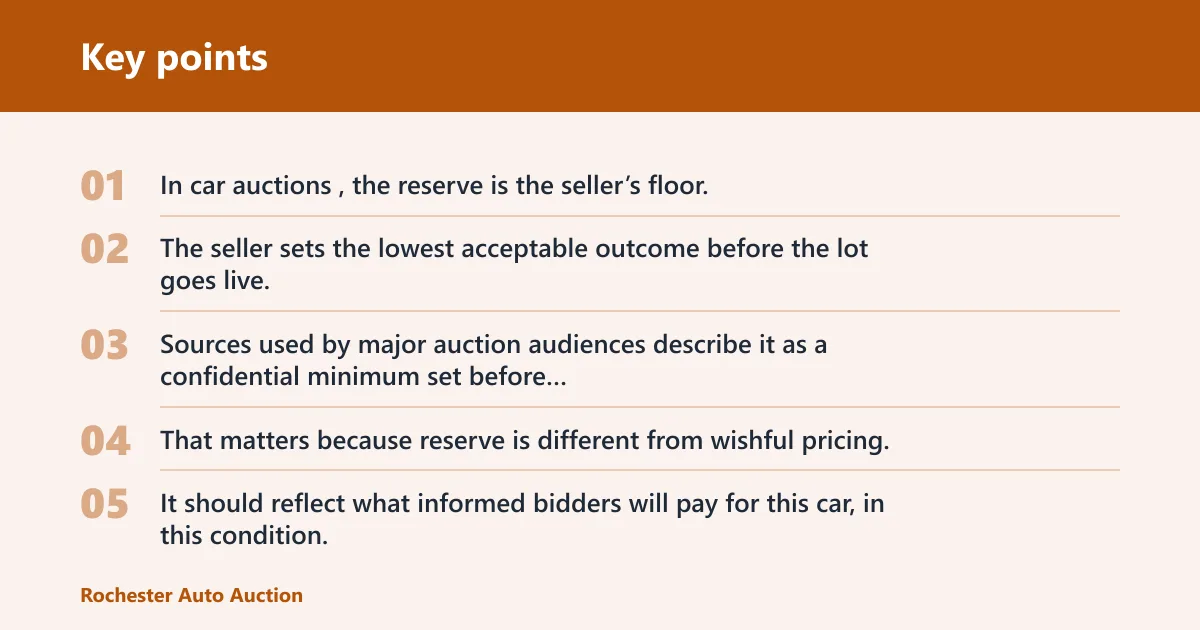
In car auctions, the reserve is the seller’s floor. The seller sets the lowest acceptable outcome before the lot goes live, and that number determines whether the car can actually change hands. Reserve is commonly confidential. Sources used by major auction audiences describe it as a confidential minimum set before the auction begins, and they also note that the seller is not obliged to accept a deal below it.
That matters because reserve is different from wishful pricing. It should reflect what informed bidders will pay for this car, in this condition, on this platform, at this time.
What reserve protects, and what it cannot do
Reserve protects a seller from an obviously weak result. It helps most when the vehicle has uneven demand, unusual options, fresh reconditioning, or condition details that bidders may read incorrectly in a short bidding window.
It cannot save a stale listing, poor photos, missing disclosures, bad timing, or a reserve set far above comparable sales. Octane states that reserves are set together with the seller based on market knowledge, and it also warns that a reserve set too high can leave the car unsold. That is the tradeoff: more seller protection usually means a higher chance that bidding momentum fades before the floor is reached.
How does a reserve price work during bidding?
A reserve price works by separating bidder activity from the seller’s minimum. The auction can open below reserve to pull in early bids, then move toward the hidden threshold as competition builds. If the high bid reaches reserve, the sale can proceed. If it does not by the close, the car usually remains unsold.
Starting bid and reserve do different jobs
The starting bid is the first amount shown when the lot opens. It can sit well below reserve. Its job is to get people bidding, create motion, and reduce the hesitation that comes with an empty bid history.
The reserve does the opposite job. It sets the lowest number the seller will accept. Treating those numbers as interchangeable is a common mistake. A low starting bid can attract activity even when the seller’s true minimum is much higher.
Picture a clean 2021 midsize SUV with average miles and solid service records. The seller may open bidding at a number meant to draw attention, while the reserve sits closer to recent sale comps. Early bids create interest. The reserve decides whether that interest becomes a deal.
What “reserve met” and “reserve not met” mean
Once bidding reaches the threshold, the auction may mark the lot as “reserve met,” “on the market,” or use a similar signal. Platform rules vary, but the meaning is the same: the bid level is now high enough that a sale can proceed if the high bid still stands at the close.
If the top bid is still below the seller’s hidden minimum when bidding ends, the lot is “reserve not met.” RideSafely describes reserve auctions as having a hidden threshold that must be met before sale. Savings Grove likewise notes that items remain unsold if bids do not meet reserve.
What happens at auction close
The close is where reserve status becomes an outcome. If the highest bid is at or above reserve when the auction closes, the car can sell. If the high bid is short, the car does not automatically transfer.
That timing point matters. The reserve is not settled by the best bid seen an hour earlier, it is settled by the highest valid bid at the end. If bids do not reach reserve when the auction closes, the car will not be sold. That is the basic rule across reserve auctions, though some platforms allow post-sale contact or seller review after the close.
Why do sellers use a reserve price?
Where reserve helps most
Sellers use reserve to avoid a result that ignores actual condition, recent repairs, rarity, or thin bidding on a specific day. It has more value when pricing is noisy: enthusiast cars with wide condition spreads, damaged units with uncertain repair economics, older trucks with option-driven demand, and specialty inventory that may have only a few serious buyers.
Reserve can also help when a seller has strong documentation. Fresh tires, paint-meter readings, title clarity, service records, and clear damage disclosure can support a firmer floor because bidders have less uncertainty to price in.
Where reserve can work against the seller
The higher reserve sits versus real market comps, the more protection it gives the seller and the more momentum it can kill. Bidders do not like chasing a car that feels out of reach. If they suspect the seller is far away from market, some stop increasing bids early.
That is why no-reserve formats often create more bidding energy. A no-reserve auction often attracts more bidders and creates more dynamic energy. Another states that in a no-reserve auction, the highest bidder wins regardless of final price. Those traits can lift confidence, but they also shift more risk to the seller.
How should you set a reserve price?
Set reserve from recent comparable sales, then adjust for your car’s exact condition, disclosure quality, and the liquidity of that vehicle segment. A reserve close to real market keeps bidders engaged, while a reserve based on asking prices, payoff balance, or emotion often misses the market and leaves the lot unsold.
Start with sold comps, not asking prices
Use recent completed sales for the same generation, trim, powertrain, drivetrain, mileage band, title status, and major options. Asking prices tell you what sellers want. Sold prices tell you what buyers actually paid.
Then narrow for context. A commuter sedan with ordinary miles has deeper market data than a manual sports coupe with one-year-only options. Wider comp ranges call for a more conservative reserve because valuation error is larger.
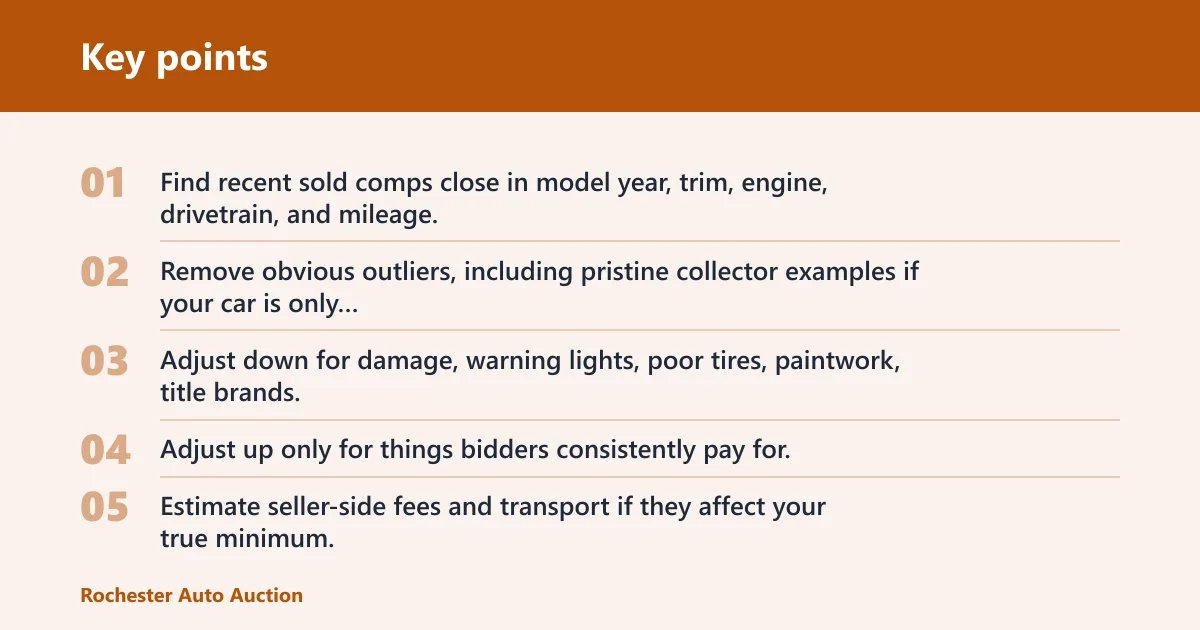
- Find recent sold comps close in model year, trim, engine, drivetrain, and mileage.
- Remove obvious outliers, including pristine collector examples if your car is only average.
- Adjust down for damage, warning lights, poor tires, paintwork, title brands, missing keys, or overdue maintenance.
- Adjust up only for things bidders consistently pay for, such as highly desirable factory equipment or exceptional documentation.
- Estimate seller-side fees and transport if they affect your true minimum.
- Set the reserve near the low end of your adjusted fair-value range if liquidity is strong, or near the middle if the car is thinly traded but honestly represented.
Adjust for mileage, damage, wear, and disclosure quality
Condition changes the floor faster than many sellers expect. High mileage is not automatically fatal, but it narrows the bidder pool. Cosmetic wear may be manageable on a work truck and much more damaging on an enthusiast car. Mechanical faults matter most when repair cost and downtime are uncertain.
Disclosure quality also changes price. A car with sharp photos, cold-start video, underbody images, service invoices, tire dates, and paintwork notes can support a stronger reserve than a similar car with vague captions and missing history. Bidders discount uncertainty.
Suppose two 2018 half-ton pickups have similar miles. One has a clean frame, matching tires, no warning lights, and dated service records. The other has a rust-stained hitch area, mixed tires, and a transmission shudder mentioned only in the comments. The second truck needs a meaningfully lower reserve even if guide values look similar.
Factor in market liquidity by vehicle segment
Liquidity is the speed and depth of demand for a specific type of vehicle. Common late-model commuter cars and popular trucks usually have more bidders and tighter comp ranges. Niche convertibles, modified performance cars, branded-title units, and heavy commercial equipment often have fewer natural bidders.
More liquidity supports a reserve closer to market because multiple bidders may still converge on fair value. Less liquidity calls for extra caution. A hidden reserve far above the likely top bid can end the auction before the serious buyer decides to stretch.
Use a practical reserve band
A common rule of thumb is to set reserve at about 90-95% of realistic market value after fees when the goal is seller protection without making the sale harder. That is a starting band, not a fixed law. The tighter and healthier the market for your exact vehicle, the closer the reserve can sit to the top of a defensible fair-value range.
Bank auction guidance sometimes uses a lower frame, with reserve typically 80-90% of assessed market value. That is a different setting, though it still shows the same principle: the reserve is usually below an ideal headline value because bidders need room to move toward a successful close.
Reserve pricing decision table
Reserve-setting ranges by vehicle type
| Vehicle type | Condition | Market liquidity | Suggested reserve band | Recommended auction format |
|---|---|---|---|---|
| Late-model commuter sedan | Clean title, average miles, normal wear, no active faults | High | 90-93% of realistic market value after fees | Reserve auction with low starting bid |
| Late-model half-ton pickup | Clean, documented service, strong tire and brake life | High | 92-95% of realistic market value after fees | Reserve auction; no-reserve can work if comps are deep |
| Enthusiast coupe or manual sports car | Clean but option-sensitive, modifications disclosed | Medium | 88-92% of realistic market value after fees | Reserve auction on an enthusiast-focused platform |
| Older luxury SUV | Higher miles, some cosmetic wear, complete records | Medium | 88-91% of realistic market value after fees | Reserve auction with detailed disclosures |
| Damaged insurance unit | Collision damage or branded title, repair path uncertain | Medium to low | 85-90% of realistic as-is market value after fees | Reserve auction if damage is well documented; otherwise specialist sale |
| Slow-moving specialty vehicle | Niche use, narrow buyer pool, condition heavily matters | Low | 85-90% of realistic market value after fees | Reserve auction with longer exposure or negotiated sale channel |
| Very common economy hatchback | Average condition, easy-to-price unit | High | 90-92% of realistic market value after fees | No-reserve can be effective if seller accepts more price risk |
How to use the table
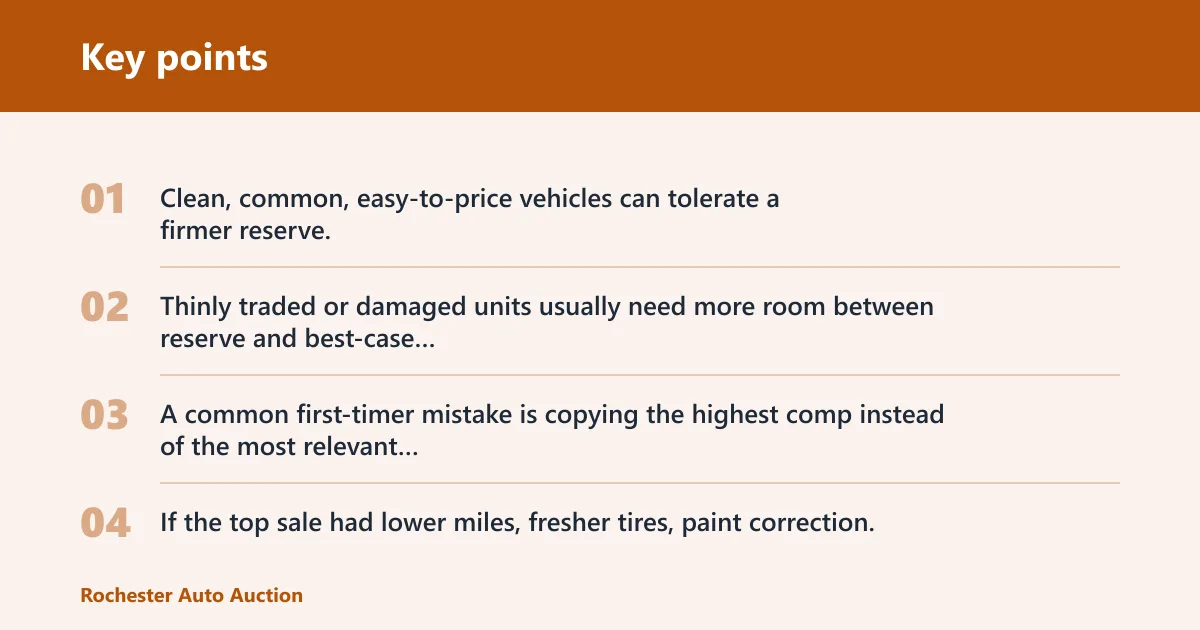
The band narrows as certainty rises. Clean, common, easy-to-price vehicles can tolerate a firmer reserve. Thinly traded or damaged units usually need more room between reserve and best-case retail expectations.
A common first-timer mistake is copying the highest comp instead of the most relevant comp. If the top sale had lower miles, fresher tires, paint correction, and a clean pre-sale inspection, using that figure as the reserve for an average example usually leads to a no-sale.
Post-auction action matrix
| Outcome | What it means | Best next step | Reserve move | Format move |
|---|---|---|---|---|
| Reserve met | High bid reached the seller floor before close | Proceed with sale under platform rules | No change needed | Keep same format for similar future units |
| Near miss | High bid ended slightly below reserve, with active late bidding | Review post-sale negotiation if allowed; compare gap to fees and relist risk | Consider lowering modestly to the final bid range | Same platform can still work if listing quality was strong |
| Large miss | High bid ended well below reserve, little urgency near close | Recheck comps, fix condition disclosures, reconsider timing | Lower materially or reset from fresh market data | Consider no-reserve or a different venue only after repricing |
Reserve vs no-reserve: which format fits your car?
A reserve auction fits a car that has pricing uncertainty, meaningful condition differences, or a seller who cannot accept an outlier low result. A no-reserve auction fits a car with strong bidder depth and clean disclosure, where higher buyer confidence may create stronger competition despite greater seller risk.
When reserve is the better fit
Reserve makes more sense when the downside of a weak sale is large. That includes unusual classics, modified vehicles, newly repaired units, and cars with sparse comps. It also helps when the seller has done expensive reconditioning that the average bidder may not fully value at first glance.
When no-reserve can be the stronger play
No-reserve works best when the market is broad and the listing is easy to trust. High-demand pickups, ordinary late-model commuter cars, and popular enthusiast models with good presentation can do well because bidders know the car will sell if they are the highest bidder.
That certainty changes behavior. Buyers often bid earlier and with more confidence when there is no hidden floor blocking the sale. No-reserve auctions often attract more bidders and create more dynamic energy. That can help final price, but it is never a guarantee.
The format changes buyer psychology
Hidden reserve can protect the seller, but it can also make bidders cautious if they feel the target is unknown and possibly unrealistic. Visible “reserve not met” status tells them they are still below the floor. Visible “on the market” status tells them every additional bid can truly win the car.
Neither format is always better. The right choice depends on whether seller downside risk or bidder confidence is the bigger issue for that specific vehicle.
Can buyers see the reserve, and can sellers change it?
Usually buyers cannot see the actual reserve before the auction ends, though some platforms show status signals such as “reserve not met” or “on the market.” Whether a seller can change the reserve during live bidding depends on platform and auctioneer rules, and many systems restrict changes once bidding is active.
Hidden reserve versus visible status signals
Several auction sources state that reserve is undisclosed to bidders during the auction. The same source says bidders do not know the reserve during the auction. RideSafely also describes reserve auctions as having a hidden threshold, and WallStreetMojo states that the reserve price is undisclosed to the bidder during the auction.
Still, a hidden number does not always mean hidden status. Some platforms tell bidders when reserve has been met. Others only show whether the current bid is still short. Those signals shape strategy. If buyers see “reserve met,” they know the car can actually sell at the close.
Can the seller change reserve mid-auction?
This is a rules question, not a universal auction rule. Some venues lock the reserve before bidding begins. Others may allow a reduction, but not an increase, once bidding is live. A live auctioneer may also need seller approval in real time if the reserve is being reconsidered.
If reserve changes are allowed, lowering it can revive a near-stalled auction. Raising it after bidding starts is often restricted because it damages bidder trust. Check platform policy before listing, not when the countdown is already running.
What happens if the car does not meet reserve?
If a car does not meet reserve at the close, it is usually unsold. The seller may then approve a post-auction deal, lower the reserve, relist the car, or switch formats. The right move depends on how close the top bid was, how strong bidding looked, and whether the reserve itself was the real problem.
The basic outcome: unsold at the close
If the highest bid is under reserve when the auction closes, the sale does not automatically happen. Sources aimed at auction users say plainly that if bids do not reach reserve by the close, the item remains unsold.
Near miss versus large miss
A near miss means the top bid finished close enough that a deal may still be possible if the seller can live with the number. A large miss usually means the market rejected the pricing, the listing, or both.
Say your reserve is set at the top of the comp range on a 92,000-mile sport sedan, and bidding closes just short after a busy final hour. That is a negotiation case. If the car closes far below reserve with few late bids, the issue is more likely reserve strategy, car presentation, or buyer demand.
How to avoid the unsold-lot cycle
Repeated relisting with the same over-market reserve often weakens the result. Bidders notice stale inventory. The next audience may assume there is a hidden problem or a seller who will not meet the market.
After a failed sale, review three things in order: comp quality, condition drag, and format. If the comps were stale, reset them. If the car needed clearer defect disclosure, fix the listing. If the reserve was simply too aggressive, bring it down before trying again.
Mistakes that cause reserve auctions to fail
Using stale or mismatched comps
Old sales, wrong trims, auction results from cleaner cars, and retail asking prices all push reserve upward without support. Match the comp to the actual vehicle, not the seller’s preferred outcome.
Ignoring condition and reconditioning costs
Reserve should reflect what the next owner must spend. Tires at the wear bars, cracked windshields, overdue brakes, bodywork, rust repair, or unresolved warning lights all push the realistic floor lower.
Pricing from debt or emotion
Loan payoff, sentimental value, and original purchase price do not set auction value. Bidders price the car they see, against the alternatives they can buy this week. Reserve should follow that market behavior, not the seller’s history with the vehicle.
Frequently asked questions
What is a reserve price at auction?
A reserve price at auction is the seller’s confidential minimum acceptable sale amount, usually set before bidding begins. If bidding ends below that threshold, the seller is generally not required to complete the sale, and the lot may remain unsold or move into post-auction negotiation if rules allow.
How do you calculate reserve price for auction?
Start with recent sold comps for the same vehicle, then adjust for mileage, title status, damage, wear, options, and disclosure quality. A practical car-auction starting band is about 90-95% of realistic market value after fees, then lower or tighten that band based on liquidity and condition risk.
What is the difference between reserve price and starting bid?
The starting bid is the opening number shown at the start of the sale to draw bidder activity. The reserve price is the hidden seller floor that must be reached for the sale to proceed. The starting bid can sit below reserve, and the two numbers serve different purposes throughout the auction.
Can a buyer see the reserve price before the auction ends?
Usually no. Many platforms keep the actual reserve hidden from bidders during the auction, though they may display status cues such as “reserve not met” or “on the market.” Those signals tell buyers where the sale stands without revealing the seller’s exact minimum.
Can a car be sold below reserve price at auction?
A car can sell below reserve only if the seller explicitly agrees, the reserve is lowered under platform rules, or a post-auction negotiation produces a deal the seller accepts. A below-reserve high bid does not automatically become a sale just because it was the top bid.
Should I sell my car at auction with a reserve or no reserve?
Choose reserve if your car has pricing uncertainty, condition sensitivity, or a downside you cannot accept. Choose no-reserve when bidder depth is strong, the car is easy to evaluate, and buyer confidence is likely to create active competition. The decision turns on risk tolerance and market liquidity, not preference alone.