What Buyer Fees Does Bring a Trailer Charge?
Bring a Trailer charges buyers 5% of the winning bid on standard listings, with a $250 minimum and a $7,500 cap. Certain categories are charged about 10%, with a cap of around $4,000. Add the buyer fee to the hammer price, then leave room for tax, transport, and registration.
The key number is the winning bid, not your opening bid or watchlist estimate. BaT says the buyer fee is disclosed before bidding, so check the listing page before you commit. That matters because the cap changes the effective fee rate on higher-priced vehicles.
Standard 5% buyer fee and its minimum and maximum caps
Standard listings at 5%
For standard vehicle listings, the math starts with 5% of the winning bid. If 5% comes out below $250, the fee jumps to the $250 minimum. If 5% rises above $7,500, the fee stops there.
Where the fee appears before you bid
BaT’s guide says the buyer fee is clearly disclosed before bidding. Use that number before you set a ceiling. If the listing is in a 10% category, the fee will not match the standard-car calculation.
Buyer fee calculator
The table below shows how to turn a target out-the-door budget into a safe maximum bid. The examples separate standard listings from 10% categories, and they show where the minimum fee or cap changes the math. Tax and shipping columns are placeholders for your own estimate.
| Listing type | Winning bid | Buyer fee | Subtotal | Estimated tax | Shipping estimate | Maximum bid for target budget |
|---|---|---|---|---|---|---|
| Standard listing | $1,450 | $250 minimum | $1,700 | $100 | $200 | $1,450 for a $2,000 budget |
| Standard listing | $10,000 | $500 | $10,500 | $700 | $800 | $10,000 for a $12,000 budget |
| Standard listing | $128,571 | $6,428.55 | $134,999.55 | $5,000 | $5,000 | $128,571 for a $144,999.55 budget |
| Standard listing | $150,000 | $7,500 cap | $157,500 | $10,000 | $10,000 | $150,000 for a $177,500 budget |
| 10% category | $5,000 | $500 | $5,500 | $350 | $150 | $5,000 for a $6,000 budget |
| 10% category | $86,000 | $4,000 cap | $90,000 | $6,000 | $4,000 | $86,000 for a $100,000 budget |
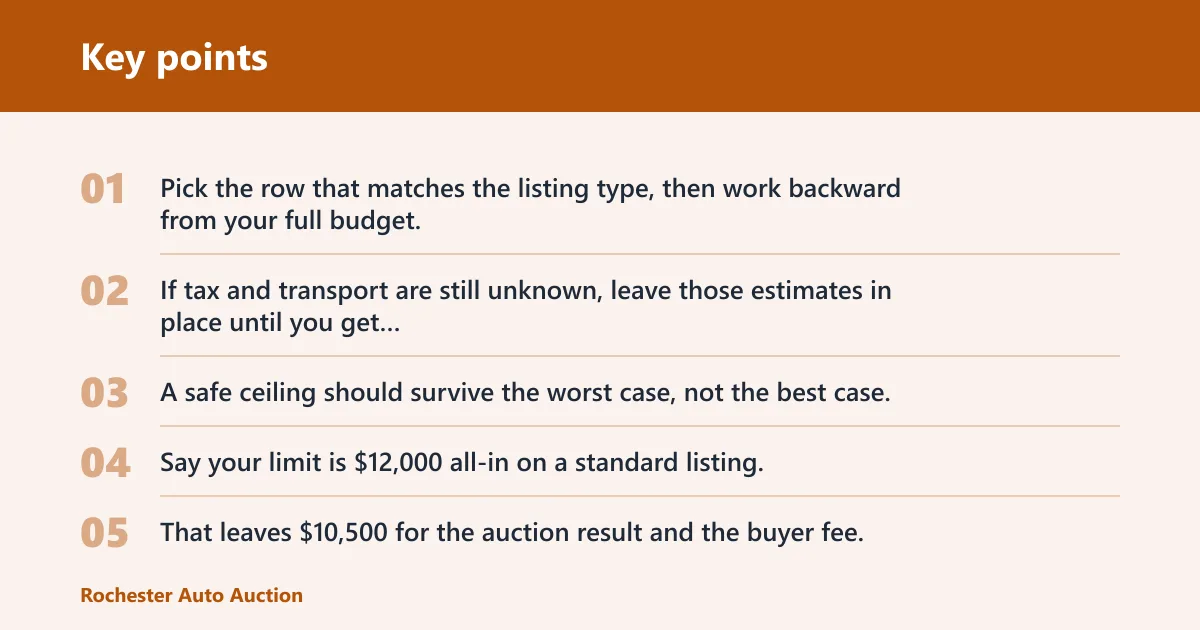
Pick the row that matches the listing type, then work backward from your full budget. If tax and transport are still unknown, leave those estimates in place until you get local quotes. A safe ceiling should survive the worst case, not the best case.
Say your limit is $12,000 all-in on a standard listing, and you expect about $700 in tax plus $800 in transport. That leaves $10,500 for the auction result and the buyer fee. At 5%, a $10,000 winning bid stays within budget; a $10,500 bid would push you over.
How the buyer fee is calculated
BaT calculates the buyer fee from the winning bid, also called the hammer price. The fee is not based on your maximum bid setting unless you actually win at that number. The minimum and cap are the parts that change the math at the low and high ends.
The winning bid is the base
If you win at $18,000 on a standard listing, the buyer fee is 5% of $18,000, or $900. Your subtotal becomes $18,900 before tax and transport. That is the number to compare against your budget, not the headline hammer price alone.
The minimum fee matters on low bids
At low price points, the percentage can fall below the minimum. A $2,000 winning bid on a standard listing would make 5% about $100, but the fee is higher instead. That makes the effective fee rate much higher on cheaper cars.
The cap matters more on high bids
Once the cap is reached, the effective percentage drops as the bid rises. On a standard listing, the fee tops out at $7,500. On a 10% category, it tops out at $4,000. That is why high-value lots need cap math, not just a quick percentage estimate.
Picture a $200,000 standard car. Five percent would be $10,000, but the cap holds the buyer fee at $7,500. The fee still looks large, but the cap lowers the effective rate below the nominal 5% on that sale.
Which listings pay 10%?
The same source says select categories use a 10% buyer fee instead of 5%, with a $4,000 cap. BaT’s guide says motorcycles, parts, and a few other categories use the 10% tier. That makes category verification just as important as the bid amount.
Motorcycles, minibikes, and scooters
These listings can fall under the 10% buyer-fee tier. Do not assume a motorcycle follows the same math as a car listing. Check the fee on the auction page before you bid.
Parts and automobilia
Parts and automobilia are also part of the 10% group. The same applies to smaller items with lower hammer prices, where the percentage may matter more than the cap.
Wheels, ATVs, go-karts, and tractors
BaT also places wheels, ATVs, go-karts, and tractors in the 10% tier. That list matters because buyers often assume only full vehicles get a special fee structure. They do not.
What changes your out-the-door total
The buyer fee is only one piece of the final bill. Taxes, registration, title transfer, and transport are separate costs and vary by state, distance, and vehicle details. Do not treat the buyer fee as an all-in estimate.
Sales tax and registration
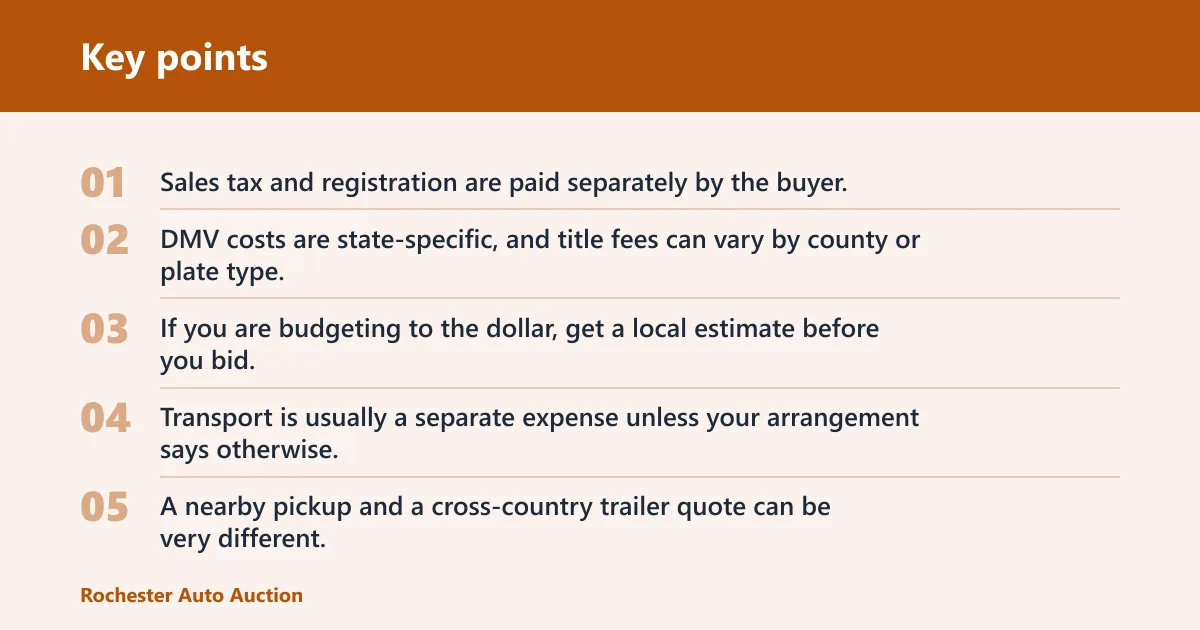
Sales tax and registration are paid separately by the buyer. DMV costs are state-specific, and title fees can vary by county or plate type. If you are budgeting to the dollar, get a local estimate before you bid.
Shipping or transport
Transport is usually a separate expense unless your arrangement says otherwise. A nearby pickup and a cross-country trailer quote can be very different. Put a real shipping number into the calculator before you decide on a ceiling.
Local DMV and title costs
Paperwork costs can surprise first-time buyers. Title transfer, tags, inspection, and registration rules differ by state. Those costs do not change the buyer fee, but they do change what you can safely bid.
A common mistake is to assume the winning bid is the only amount owed, even though buyer fees are added on top. If the winning bid is $25,000 and the buyer fee is $1,250, the real subtotal is already $26,250 before tax and transport are added.
Bring a trailer Verified Checkout
BaT may offer Verified Checkout on eligible U.S. listings. When available, it can handle title, payment, and shipping online. It can make the closing steps simpler, but it does not change the fee math tied to the winning bid.
What it handles
Verified Checkout is meant to centralize the transaction after the auction. That can reduce back-and-forth on payment and shipping coordination. It is still a listing-specific option, not a blanket promise on every BaT sale.
What it does not replace
Verified Checkout does not erase taxes, registration, or transport. It also does not replace your need to confirm category, title status, and the buyer fee before bidding. Buyers should verify category, fee, tax, shipping, inspection, title status, and checkout before they bid.
Frequently asked questions
What does Bring a Trailer charge buyers?
Bring a Trailer charges buyers a fee based on the winning bid. Select categories use 10% with a $4,000 cap. The fee is added to the sale price before tax and transport.
What percentage does Bring a Trailer charge?
BaT charges 5% on standard listings and 10% in select categories. The percentage is only part of the story because the minimum fee and cap can change the real cost on very low or very high bids. Check the listing’s fee disclosure before bidding.
How much does Bring a Trailer charge?
How much BaT charges depends on the listing category and the winning bid. On 10% categories, the fee is 10% with a $4,000 cap.
Is there a minimum buyer fee on BaT?
Yes. Standard BaT listings have a $250 minimum buyer fee. That means small wins can carry a higher effective fee rate than the headline 5% suggests. The minimum matters most on lower-priced lots and reserve-free bargains.
Does Bring a Trailer charge different fees for motorcycles or parts?
Yes. The same source says motorcycles, parts, and a few other categories use the 10% tier, with a $4,000 cap. That is different from the standard 5% buyer fee on cars and similar listings, so category checks matter before every bid.
Is the BaT buyer fee included in Verified Checkout?
BaT may offer Verified Checkout on eligible U.S. listings, and some third-party guides describe it as included in the 5% buyer fee. Even so, you should treat each listing as its own case and confirm the fee display before bidding.
What other costs come after the buyer fee on Bring a Trailer?
Taxes, registration, title transfer, inspection, and shipping can all come after the buyer fee. Those costs are separate and vary by location and vehicle. If you want a safe maximum bid, put realistic numbers for those items into your budget first.
How do I estimate my total out-the-door cost on BaT?
Start with the buyer fee formula for the correct category, then add expected tax, shipping, and DMV costs. For a standard listing, use 5% unless the minimum or cap applies. For 10% categories, use the higher rate and the $4,000 cap.
Are taxes and registration included in Bring a Trailer buyer fees?
No. Taxes and registration are paid separately by the buyer. BaT’s buyer fee covers the auction-side charge only, not state DMV costs or transport. Your out-the-door total will usually be higher than the hammer price plus fee.
What happens to the buyer fee if I win a BaT auction?
If you win, the buyer fee is added to the winning bid. That total becomes the starting point for your tax and transport estimates. The fee is not optional, and it does not disappear after the auction ends.