Can You Get Buyer Fees Refunded If the Sale Is Canceled?
Sometimes yes, but only some buyer fees are refundable, and the refund usually depends on why the sale was canceled and which charges the auction terms label refundable. Miss the fee rules, and you can lose a buyer premium, gate fee, or payment-processing fee even when the vehicle never changes hands. This guide breaks down seller cancellation, buyer cancellation, and payment failure so you know which auction charges are most likely refundable and who has to request the refund.
Buyer fee refund matrix
The fastest way to read a canceled-sale refund is to separate the trigger from the charge. In many auction systems, the buyer fee is tied to a completed sale, while some other charges are refundable only if the platform or seller initiates the unwind. The matrix below shows the usual outcome by scenario.
| Cancellation scenario | Buyer fee outcome | Other fee outcomes | Who must act next |
|---|---|---|---|
| Seller cancels after reserve not met | Usually refundable if no completed sale was created or the terms call for reversal | Processing fees may be retained; deposit handling depends on policy | Seller or auction support initiates the reversal, then buyer checks for the credit |
| Buyer fails to pay on time | Usually not refunded if the auction terms treat the buyer fee as earned when the bid is won | Card processing fees and penalties are often kept; deposits may be forfeited | Buyer must contact support quickly if the payment failed in error |
| Title problem discovered after sale | Often refundable if the auction unwinds the sale | Title, registration, and tax charges may be reversed only if they were not sent to a third party | Auction staff usually need to approve the unwind and issue the refund |
| Arbitration reversal | Usually refundable when the arbitration outcome cancels the deal | Fees tied to completed payment can be refunded or kept depending on the policy and payment method | Buyer and seller follow the arbitration decision; auction accounting finalizes the refund |
| Transport not booked | Usually not refundable by itself, because transport is separate from the sale | Transport charges may be refundable only under the carrier’s own terms | Buyer must contact the transport provider, not assume the auction will reverse it |
| Duplicate charge | Not a sale-cancellation issue; the duplicate should be reversed | Extra card processing or duplicate authorization should be corrected if the charge actually posted twice | Buyer should contact the auction and the card issuer if needed |
| Auction cancels before payment completes | Usually refundable or never finalized, because the sale did not clear | Any captured payment should be returned; pending authorizations may drop off later | Auction or payment processor must release the hold or refund the charge |
| Buyer cancels after winning | Often not refundable, unless the terms allow a cancellation reversal or the auction agrees to unwind | Deposits, processing fees, and surcharges are commonly kept | Buyer must request a review; approval is policy-dependent |
Seller cancels after reserve not met
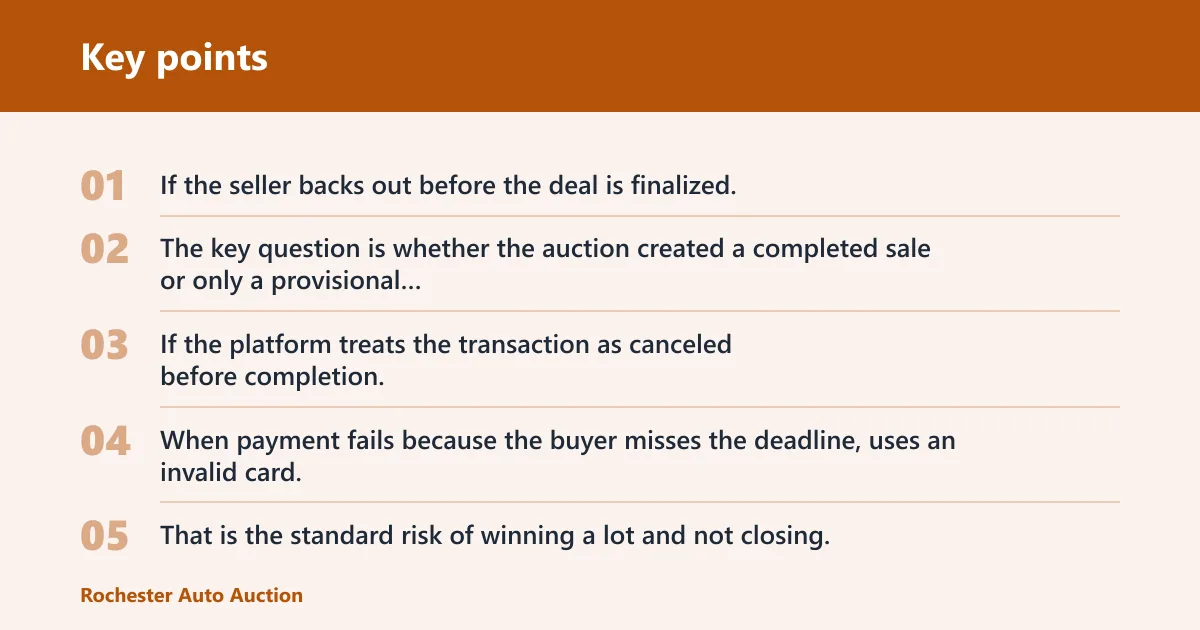
If the seller backs out before the deal is finalized, the buyer fee is more likely to come back than in a buyer-initiated cancellation. The key question is whether the auction created a completed sale or only a provisional win. If the platform treats the transaction as canceled before completion, the buyer usually has a better refund position.
Buyer fails to pay
When payment fails because the buyer misses the deadline, uses an invalid card, or does not complete checkout, the buyer fee is often treated as earned and kept. That is the standard risk of winning a lot and not closing. Review the terms before paying, because some auctions treat processing costs and deposits as separate, non-refundable charges.
Title problem discovered after sale
A title defect can affect the refund result because the sale may be unwound after the auction discovers it cannot deliver what was sold. In that case, the buyer fee may be refunded, but only if the auction’s unwind process covers it. Title, registration, and tax items may be handled differently if they were already sent to a government office or third-party processor.
Say your bid wins a car on Monday, but the title review on Tuesday finds a lien issue. If the auction cancels the deal before the title transfer is completed, the buyer fee is more likely to be returned than if the buyer had already accepted delivery and finished registration steps.
Arbitration reversal
An arbitration win for the buyer can trigger a post-sale unwind. In that case, the buyer fee may be refundable, but the auction will follow its own arbitration outcome and accounting rules. The refund can include the base sale charge while still excluding separate service or processing charges if the policy says so.
Can buyer fees be refunded?

Yes, but only in some cancellation paths. The biggest divider is whether the sale was completed or canceled before final settlement. If the auction’s policy says the buyer fee is refundable on a seller-driven cancellation, the refund may cover the fee itself, while service and card-processing charges can still be retained.
Completed sale versus canceled sale
A buyer fee tied to a completed sale is harder to recover than a fee tied to a canceled or unwound sale. If the auction processed the win, accepted payment, and logged a completed transaction, the fee is more likely to be treated as earned. If the event, deal, or title transfer was canceled, the outcome is more likely to favor a refund.
Policy terms shown before payment
Refund terms matter most before you pay. The policy shown at checkout or in the buyer agreement controls whether a fee is refundable, whether the seller or host must approve the reversal, and whether the refund is automatic or manual. Some refunds are only available within two business days after payment, so the timing in the terms matters.
A common first-timer mistake is assuming that if a condo purchase falls through after the inspection, the buyer’s fee and appraisal costs are automatically refunded. That is not how many auction systems work. The buyer fee may be refundable, while card fees, surcharges, or prior service charges stay on the account unless the policy says otherwise.
Automatic refund versus manual request
Some cancellations trigger automatic refunds, especially when the auction or host cancels the sale. In other systems, the seller or host, not the buyer, issues the refund. If the money does not appear, the buyer should contact support with the invoice number, the lot number, and the payment method used.
What gets refunded besides the buyer fee?
Other charges are often handled separately from the buyer fee. A host refund may return the ticket price, but service fees are not refunded in that system. If the auction follows a similar structure, the base fee may come back while service charges, processing fees, and some surcharges remain excluded.
Service fee and processing fee
Service fees and card processing fees are the most common items to check next. Some refunds exclude credit card fees and certain surcharges outright. In other systems, a host-initiated refund returns everything paid back, fees included. That difference is why you should read the exact refund language before paying.
Taxes, title, and registration
Tax and registration charges are often the most complicated part of a canceled sale. Some taxes can be refunded, some cannot, and some are only reversed if the auction has not already filed the paperwork. In the UK vehicle-tax example, refunds are only for full months remaining, so prorated handling depends on the authority’s rule, not the buyer’s preference.
Deposits and surcharges
Deposits are usually governed by the auction terms, and surcharges are often excluded. The safest assumption is that a deposit may be retained if the buyer cancels or misses payment, while a seller-driven cancellation has a better chance of reversal. If the fee schedule says a surcharge is non-refundable, do not expect that item to come back automatically.
Who must act next?
The next step depends on who caused the cancellation and how the payment was recorded. If the auction or seller canceled the sale, staff may need to issue the refund without a buyer request. If the buyer’s card failed, the buyer usually needs to contact support and confirm whether the charge was captured, reversed, or only authorized.
- Check the sale status and invoice line by line.
- Separate the buyer fee from processing, tax, title, registration, and any surcharge.
- Read the policy for automatic refunds, manual requests, and any time window for asking.
- Contact the auction if the refund was promised but not posted.
- Contact the card issuer only if the charge posted incorrectly or the refund does not arrive after the normal bank window.
When to contact support
If the refund has not landed, do not guess at the delay. Refunds can take 5 to 10 business days to reach the buyer’s card, and banks may post them later than the auction’s accounting system. If the platform says the refund was issued and nothing appears after that normal window, contact support with proof of payment and the canceled-sale notice.
Can a canceled sale still leave some charges behind?
Yes. A canceled sale can still leave card fees, surcharges, or transport charges behind if those items are handled under separate terms. Payment method matters too. Some refunds are easy to reverse on the same card used for payment, while other charges may be excluded or tied to a third-party biller. Duplicate charges should be corrected separately from cancellation refunds.
Payment-method differences
Card refunds usually go back to the same card, but the timing depends on the bank and processor. If the original payment was an authorization only, it may disappear instead of posting as a refund. If it posted as a charge, the reversal may show later than the auction’s internal status update.
Duplicate charge correction
A duplicate charge should not be treated as a normal canceled-sale refund. It is a posting error or repeated authorization that needs correction. Send support the invoice number, the exact amount, and the date, then ask whether the duplicate is only pending or actually posted twice.
Refund timing by bank
Refund speed depends on the payment method and the bank, not just the auction. The auction may mark the refund complete quickly, but the card issuer can take longer to post it. If the refund was supposed to be automatic and still has not appeared, ask support for the refund date and the transaction reference.
Which auction scenarios change the refund outcome?

The outcome changes most when the sale is canceled before payment, canceled after payment, or unwound after delivery. Buyer cancellation is usually the weakest refund case. Seller cancellation, auction cancellation, or an arbitration reversal gives the buyer a better chance of recovering the buyer fee, especially when the policy says the fee follows the sale itself.
Auction cancels before payment
If the auction cancels before payment clears, the buyer should expect the cleanest refund path. In some systems, the refund is automatic. In others, the seller or host must issue it. If payment only sat as a pending authorization, the hold may simply drop off instead of appearing as a refund.
Buyer cancels after winning
Buyer-initiated cancellation is often the least favorable refund case. The buyer fee may be treated as earned once the bid wins, even if the buyer never takes delivery. That is why the policy shown before payment matters. Some auctions allow a reversal only by exception, and some do not allow it at all.
Transport not booked
Not booking transport does not usually change the sale refund by itself. It may leave a separate transport fee unpaid or nonrefundable under the carrier’s terms, but it does not automatically turn the buyer fee into a refundable item. Keep the transport invoice separate from the auction invoice.
Post-sale unwind after arbitration
When arbitration reverses the deal, the auction may unwind the sale and return charges tied to the unwound transaction. That can include the buyer fee, but not always the same way for service fees, processing fees, or taxes already sent out. The deciding document is the arbitration result and the refund policy attached to it.
Frequently asked questions
Can I get my buyer fee back if the auction sale is canceled?
Sometimes yes. The strongest refund cases are seller cancellation, auction cancellation before payment clears, or a post-sale unwind approved by the auction. Buyer cancellation is much less likely to produce a refund. The policy shown before payment controls the result, so check the fee terms before paying.
Are buyer fees refunded when the seller backs out after I win?
Often yes, but only if the auction treats the sale as canceled or reversed rather than completed. If the seller withdraws before final settlement, the buyer fee is more likely to be refundable than in a buyer-default case. The auction or seller usually has to start the reversal.
Do auction fees get refunded if payment fails or the deal falls through?
Not always. If payment fails because the buyer did not complete checkout, the buyer fee may be kept, and processing fees or deposits may also stay on the account. If the failure was on the auction side or the sale was canceled before completion, the refund case is stronger.
Which fees are refundable on a canceled auction sale?
The buyer fee is the first item to check, followed by service fees, processing fees, deposits, taxes, title charges, and registration charges. Some charges are refundable only if they were not forwarded to a third party. Others are explicitly non-refundable, including credit card fees and certain surcharges.
Does the auction refund buyer fees automatically or do I need to ask?
It depends on the policy and the canceling party. Some cancellations trigger automatic refunds, while other systems require the seller or host to issue the refund. If the money does not show up, contact support with the invoice and payment details rather than assuming the refund was denied.
How long does a buyer fee refund take after a canceled sale?
Refund timing depends on the payment method and the bank. A card refund can take 5 to 10 business days to reach the buyer’s card. If the refund was said to be issued but has not appeared after that normal window, contact support and ask for the transaction reference.