Wholesale vs Retail Dealer License: Which One Do You Need?
Choose a wholesale dealer license if you plan to buy and resell cars to other dealers. Choose a retail dealer license if you plan to sell to the public; in some states, you may need both licenses if you do both types of sales. Pick the wrong one and you can face denied applications, fines, or a business model that cannot legally close sales. This guide compares auction access, sales limits, facility rules, fees, and common state requirements so you can match the license to your operation.
How to Choose Based on Your Sales Channel
The right license starts with your sales channel. If your goal is B2B inventory movement, wholesale is usually the fit; if your goal is consumer sales, retail is the fit. State law decides the final answer, so your next step is to match your business model to the license rules in your state.
The core trade-off in one sentence
Wholesale licenses are built for dealer-to-dealer transactions, while retail licenses are built for public sales and usually bring more facility and consumer-protection requirements. Both can support inventory buying, but they do not authorize the same kind of sale.
Quick decision rule before you apply
If you plan to advertise to consumers, accept trade-ins, or hand a signed retail deal to a private buyer, start with retail. If you plan to source inventory and move units only to other licensed dealers, start with wholesale. If you expect both, check whether your state requires separate licenses or a higher-level retail setup.
What is a wholesale auto dealer license?
A wholesale auto dealer license is typically for buying and selling vehicles only to other licensed dealers in most states. Wholesale dealers usually cannot sell vehicles directly to the general public, and the license often comes with fewer facility requirements than a retail license.
Who you can usually sell to
In most states, wholesale transactions stay inside the dealer network. That makes the license a fit for a B2B inventory-sourcing model, where you buy at one price point and move units through dealer channels rather than consumer advertising.
Typical facility and lot requirements
Wholesale businesses generally don’t need retail sales staff, and wholesale dealers often do not need a showroom. Some states still require a business address, records access, or zoning approval, but the physical setup is usually lighter than a public retail lot.
How dealer-only auctions fit this model
Dealer-only auto auctions are a major source of inventory for wholesale dealers. Access is not automatic, though; each auction and each state can set its own entry rules, and some lanes or sale types may be limited to licensed dealers with the right credentials.
What is a retail auto dealer license?
A retail auto dealer license allows direct sales to the public. Retail dealers can typically buy vehicles from auctions and private sellers, and they may be able to accept trade-ins, which can make the license a better fit for consumer-facing inventory turnover.
Who you can usually sell to
The retail license is built for consumer transactions. That means advertising to the public, drafting retail buyer paperwork, and handling sales tax and title steps that apply to end users rather than dealer partners.
Auction access, private sellers, and trade-ins
Retail dealers can typically buy vehicles from auctions and can often buy vehicles from private sellers. They often can accept trade-ins, which adds a useful source of inventory and gives the customer a way to reduce the cash due at signing.
Why retail rules often bring more facility obligations
Retail operations usually face more facility rules because the state is regulating public access, signage, customer-facing business hours, records, and inspection points. A showroom or a defined retail lot is commonly part of that setup, though the details vary by jurisdiction.
Wholesale dealer vs. retail dealer: side-by-side comparison

The biggest difference is simple: wholesale is usually for dealer-to-dealer sales, while retail is for public sales. The secondary differences matter just as much in practice because they affect your lot, your insurance, your bond, your advertising, and whether you can close the deal you just negotiated.
| Decision factor | Wholesale | Retail dealer license | Winner |
|---|---|---|---|
| Buyer type | Usually other licensed dealers | Direct sales to the public | Retail dealer license for consumer access |
| Facility requirement | Often fewer facility requirements | May require showroom, lot, or retail-ready space | Wholesale |
| Auction access | Often used for dealer-only auctions | Can typically buy from auctions too | Tie |
| Trade-in ability | Usually limited or not central | Often can accept trade-ins | Retail dealer license |
| Consumer compliance load | Usually lower | Usually higher | Wholesale |
Buyer type
Wholesale wins here because it is built for dealer-to-dealer movement. Retail wins if you need a legal path to the public, since retail dealers can sell vehicles directly to the public.
Facility, showroom, and lot expectations
Wholesale is usually lighter on physical setup. Retail often has the stricter facility ask because states may expect customer access, records availability, and a defined sales operation.
Insurance, bond, and tax registration differences
A dealer bond is often required for both license types, and bond amounts vary by state and license type. Garage liability insurance is commonly part of dealer licensing insurance requirements, open lot insurance is often required where a physical lot is required, and a wholesale license may also reduce sales tax on bulk purchases or require a sales tax ID / seller’s permit in some states.
Common compliance risks by license type
Wholesale risk often centers on selling to the wrong buyer, missing tax registration, or using auction access outside the stated license scope. Retail risk often centers on advertising, title handling, consumer disclosures, trade-in paperwork, and operating without the facility your state expects.
Which license do you need for your business model?
Choose the license that matches how the car will leave your inventory. If the buyer is another dealer, wholesale may be enough. If the buyer is a consumer, retail is the safer starting point. If you plan both, your state may require both licenses or one retail setup that satisfies consumer-facing rules.
If you only want to flip a few cars occasionally
Occasional flipping does not automatically mean wholesale. If you will sell those cars to the public, retail is the relevant license; if you will move them only to dealers, wholesale may fit. Even a small number of sales in a year can still trigger full dealer rules in some states.
If you plan to buy at auction and resell to dealers
Wholesale is the natural fit for a B2B sourcing model. Dealer-only auctions are a major inventory source for that model, but access depends on auction policy and state licensing, so the auction door is not open just because you hold a license.
If you want to sell to the public and take trade-ins
Retail is usually required if you plan to sell to consumers and accept trade-ins. That combination changes title flow, tax handling, and advertising, because you are operating a consumer retail business rather than a dealer-only transfer channel.
If you want to operate from a home office or without a lot
Wholesale is often the easier path because it usually has fewer facility requirements and does not generally need a showroom. Even then, your state may still require zoning approval, a business location, records access, or an office that meets licensing standards.
Choose wholesale auto dealer license if… / Choose retail auto dealer license if…
Wholesale fits dealer-to-dealer inventory flow. Retail fits consumer-facing sales. If your business model straddles both, the state may force you into one license type, both licenses, or a retail setup that covers the larger compliance load.
Choose wholesale auto dealer license if…
- You will buy and sell mainly to other licensed dealers.
- You want to keep facility requirements lighter.
- You do not need retail sales staff or a showroom.
- You want a B2B inventory-sourcing model with dealer-only auction access where allowed.
Choose retail auto dealer license if…
- You will sell directly to the public.
- You want to accept trade-ins.
- You plan to advertise consumer inventory.
- You need the ability to buy from auctions and private sellers for retail turnover.
When a mixed model can create problems
Suppose you buy three cars at auction, then try to sell two to the public and one to a dealer under a wholesale-only license. That creates a licensing mismatch. The fix is not improvising around the paperwork; it is matching the license to the actual sales path before you buy inventory.
Decision matrix: match your model to the license
Use this matrix to compare the most common dealership models. The right answer is the one that matches your buyer type, facility setup, and compliance burden in your state.
| Business model | License type | Required facility | Buyer type | Auction access | Trade-in ability | Common compliance risks | Choose this if… |
|---|---|---|---|---|---|---|---|
| B2B wholesaling from a small office | Wholesale auto dealer license | Often a lighter office setup; usually no showroom | Other licensed dealers | Often dealer-only auctions, subject to auction rules | Usually not a core feature | Wrong-buyer sales, tax registration, title assignment errors | You want to move inventory dealer to dealer with lower overhead |
| Consumer retail lot | Retail auto dealer license | Retail lot and often showroom expectations | Public buyers | Typically yes, if auction and state rules allow | Often yes | Advertising, disclosures, consumer paperwork, title handling | You want to sell directly to the public and take trade-ins |
| Occasional flipper with a few units | Depends on final buyer type | Home office may work in some states; others require a lot | Public or dealers, depending on license | Possible with the right license and auction approval | Only if retail rules allow it | Operating outside license scope, missed state filings, ad violations | You want to keep volume low and stay inside one legal sales channel |
| Consignment and mixed inventory | Often retail, sometimes both | Usually retail-oriented facility or state-approved location | Public, and sometimes dealer buyers | Usually yes for sourcing inventory | Often yes | Consignment paperwork, ownership transfer delays, bond exposure | You will handle consumer sales plus inventory from third parties |
How to use the matrix with your state licensing agency
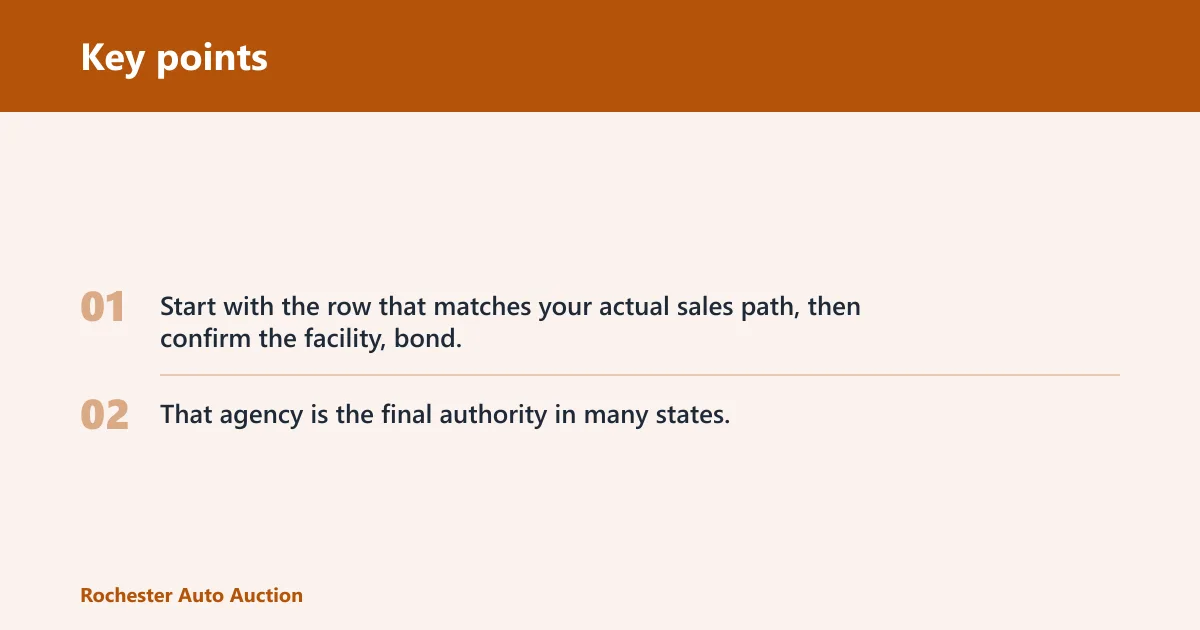
Start with the row that matches your actual sales path, then confirm the facility, bond, and tax rules with the state motor vehicle licensing agency. That agency is the final authority in many states, and its forms often reveal whether your model needs wholesale, retail, or both.
What state rules change the answer?
State law changes the answer because dealer licensing laws vary significantly by state. The agency that issues dealer licenses in your state can require different documents, facility standards, insurance, title steps, and tax registrations, so a license that works in one state may not work the same way in another.
State motor vehicle licensing agency requirements
Your state motor vehicle licensing agency may define who qualifies, where the business can operate, what signage is required, and what documents support the application. That is why the same business model can land in different licensing buckets across state lines.
Surety bond, garage liability, and open lot insurance
A motor vehicle dealer surety bond is often required for both license types, and the amount varies by state and license type. Garage liability insurance is commonly part of the insurance package, and open lot insurance often becomes relevant when a physical lot is required.
Sales tax ID / seller’s permit rules for wholesale operations
Wholesale businesses may need a sales tax ID or seller’s permit, and some states may use different names or filing steps for that registration. A wholesale license can reduce sales tax on bulk purchases in some jurisdictions, but only if the state’s tax rules and resale paperwork are followed correctly.
Why title, advertising, and facility rules vary by state
Title handling rules differ because states decide how transfer paperwork, odometer statements, disclosures, and resale records must be completed. Advertising and facility rules vary for the same reason, and some states are strict about whether a home office, lot, or showroom qualifies at all.
Frequently asked questions
What is the difference between a wholesale and retail dealer license?
A wholesale dealer license usually limits sales to other licensed dealers in most states, while a retail dealer license allows direct sales to the public. Wholesale is typically lighter on facility needs, and retail usually carries more consumer-facing rules, paperwork, and advertising obligations.
Can a wholesale dealer sell to the public?
Usually no. Wholesale dealers usually cannot sell vehicles directly to the general public, and trying to do so can trigger licensing problems, rejected title work, or penalties. If public sales are part of the plan, retail licensing is the safer starting point.
Do wholesale dealers need a showroom or lot?
Often no. Wholesale dealers often do not need a showroom, and wholesale businesses generally don’t need retail sales staff. Some states still require an office, records access, or zoning approval, so the facility answer still depends on local law.
Can a retail dealer buy from dealer-only auctions?
Retail dealers can typically buy vehicles from auctions, but dealer-only access is not automatic at every auction. The auction operator may require proof of license, membership, floor plan status, or separate registration, and state rules can also affect access.
Which license is better if I only want to flip cars occasionally?
That depends on who will buy the cars. If you plan to sell to the public, retail is the relevant license; if you only plan to sell to other dealers, wholesale may be enough. A low volume does not remove licensing rules in states that regulate every sale.
What bond or insurance is required for each license type?
A dealer bond is often required for both license types, and bond amounts vary by state and license type. Garage liability insurance is commonly part of the insurance requirement, and open lot insurance may be required when a physical lot is part of the licensing setup.