Can You Check VIN or License Plate for an Auction Car?
Yes, use the VIN first. Use the plate only as a cross-check when the auction listing or seller record allows it. The VIN is the more reliable lookup key for history reports and title checks. Skip that step and you can bid on a car with salvage, flood, odometer, or lien issues you could have found before the sale. This guide shows what a VIN or plate search can reveal, what it cannot prove, and how to verify an auction car before you bid.
Can you check VIN or license plate for an auction car?
You can sometimes check auction history by VIN or license plate, but the result depends on the data source and the region. VIN is the primary identifier. Plate searches can help when the VIN is missing from a listing, but they are often less reliable and may return incomplete or no matches.
Why the VIN is the stronger search key
A VIN is the best field for matching title status, damage notes, mileage, prior listings, and auction history. Auction records can be checked by VIN or license plate, and a VIN-based search is more stable because plates can change, transfer, or get reassigned. For auction work, the VIN should anchor the file.
When a license plate lookup can help
A plate lookup can help when the seller did not publish the VIN or the vehicle is still in a yard photo set with only a visible plate. It may return auction records when the VIN is unavailable. That said, plate coverage varies by source and region, so a blank result does not settle anything.
Why coverage differs by auction data source
Coverage is tied to major auction networks and other sources. The lookup is positioned as free for Copart and IAAI history, and some records also draw from other networks such as Manheim. That mix matters because one source may hold a listing that another source does not index.
What an auction lookup can reveal before you bid
An auction lookup can give you a fast view of prior sale data, but it is a verification tool, not a final verdict. Auction records may include the auction date, final bid and valuation context, odometer reading, damage description, title status, condition notes, airbag status, archived listing photos, sale location, and seller information when available.
Title status and title brands
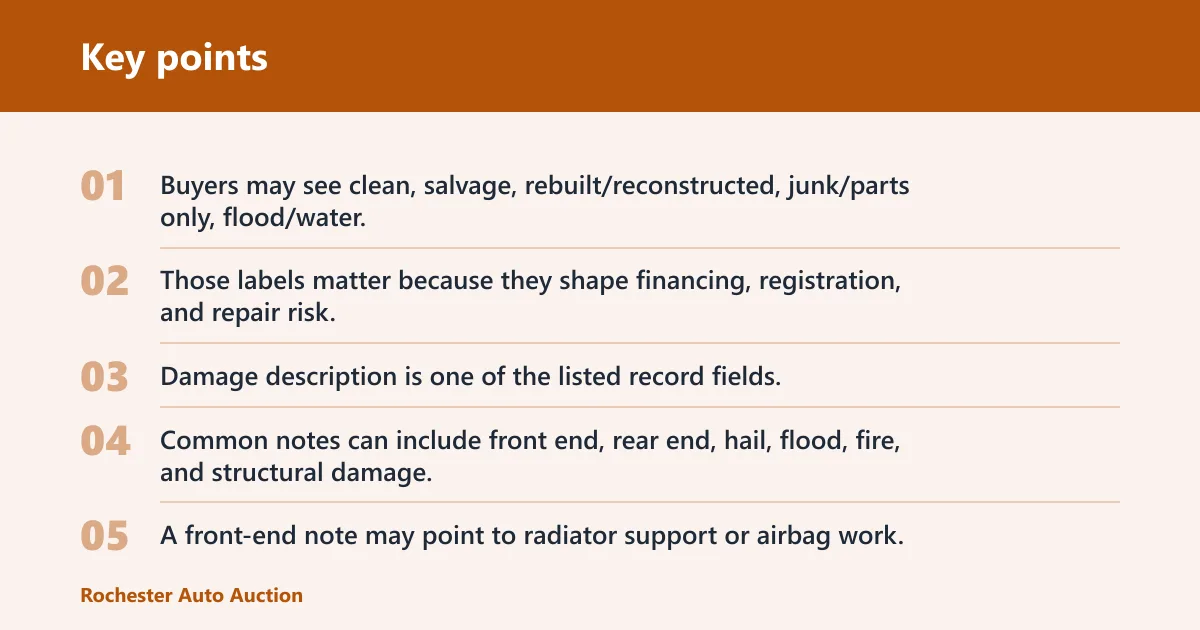
Title status can appear in auction records. Buyers may see clean, salvage, rebuilt/reconstructed, junk/parts only, flood/water, or other title brands. Those labels matter because they shape financing, registration, and repair risk, but they do not tell the whole story by themselves.
Damage descriptions and repair clues
Damage description is one of the listed record fields. Common notes can include front end, rear end, hail, flood, fire, and structural damage. A front-end note may point to radiator support or airbag work. A flood note deserves a deeper interior and electrical check, even if the body looks straight.
Mileage, seller type, and auction location
Odometer reading can be part of auction records. Seller information may be included when available, and seller type can hint at the vehicle’s history, such as insurance, bank, rental/fleet, or dealer. Auction location also matters because certain regions see more flood, hail, or total-loss patterns.
Archived auction photos
Archived listing photos may be included. Those images are useful because they can show structural damage, flood lines, fire heat marks, deployed airbags, or missing body panels. Photos are not always available, but when they are, they often answer questions that a text field cannot.
| Lookup result | What it can suggest | Next check before bidding |
|---|---|---|
| Salvage title brand | Prior total-loss status or major insurance loss | Review repair receipts, title paperwork, and structural photos |
| Front end damage note | Possible impact to cooling, sensors, airbags, and frame | Compare photos to the current front structure and scan for hidden repairs |
| 150,000-mile odometer entry | Usage level and possible wear pattern | Compare the odometer to the current cluster and service records |
| Airbags listed as deployed | Safety restraint repair is likely required | Inspect the dash, seats, belts, and SRS lights before you bid |
| Flood/water damage note | Potential wiring, corrosion, and mold risk | Check carpet, connectors, odor, and under-seat corrosion in person |
What a VIN or plate lookup cannot prove
A lookup can point you in the right direction, but it cannot prove the car is safe, roadworthy, or free of hidden damage. Clean title does not mean clean history. No records may mean no matched listing, not no history. That distinction matters before you commit bid money.
Why clean title does not mean clean history
A clean-title car can still have auction damage history. It may have sold through a loss channel before being retitled, repaired, or moved to a different market. The title brand and the auction history are related, but they are not the same signal.
What no records may mean
If a search returns nothing, treat it as incomplete data until proven otherwise. The vehicle may not have a matched listing, the source may not cover that network, or the plate may have changed. Missing records should slow the process, not clear the car.
What lookup data may miss
Some edge cases sit outside a normal search path: swapped VIN plates, cloned plates, re-titled vehicles, and incomplete listing data. A plate can be cloned, a VIN plate can be swapped, and a re-titled car can move through the market with a different paper trail. That is why history checks and physical verification both matter.
How to use auction records as a buyer verification workflow
Use auction records as a sequence, not a one-step answer. Start with identity, then title brand, then damage, then condition evidence, then decide whether to bid, inspect in person, or walk away. That order helps separate a useful lead from a risky guess.
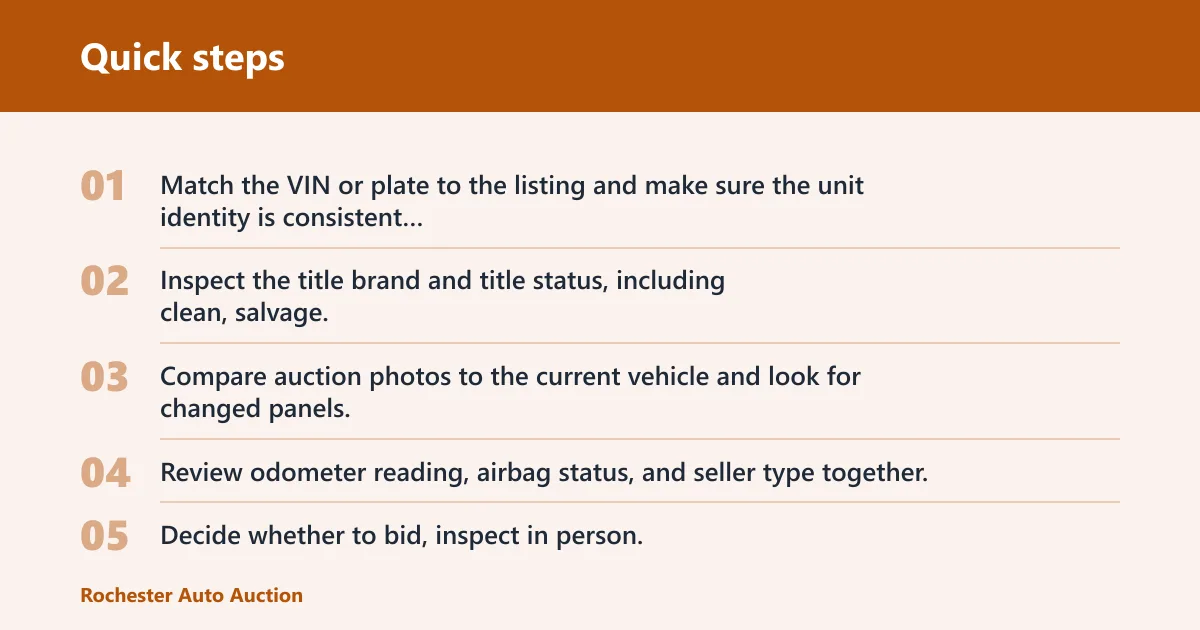
- Match the VIN or plate to the listing and make sure the unit identity is consistent across the record, the photos, and the seller paperwork.
- Inspect the title brand and title status, including clean, salvage, rebuilt/reconstructed, junk/parts only, flood/water, or other brands.
- Compare auction photos to the current vehicle and look for changed panels, repaired structure, missing trim, or fresh paint over damaged areas.
- Review odometer reading, airbag status, and seller type together, because those fields often explain repair cost and risk better than a single note.
- Decide whether to bid, inspect in person, or walk away based on the gaps that remain after the lookup.
Say your search returns a 2019 sedan with rear end damage, a rebuilt title, and photos showing trunk-floor deformation. That is not an automatic no, but it is a cue to inspect alignment, weld quality, taillight mounts, and the rear crash structure before bidding.
Suppose a compact SUV shows clean title, 72,000 miles, and no auction photos, but the plate search returns no match while the VIN is one digit off from the dashboard plate. That is a stop sign. Verify the VIN plate, the door sticker, and the title before you go further.
What to do if the vehicle has no auction records
If the vehicle has no auction records, first check for title and VIN inconsistencies. Then use a broader history search before bidding. Missing data is not proof of a clean past, and it is not a reason to bid faster. It is a reason to slow down and verify.
Check for title and VIN inconsistencies
Compare the VIN on the dash, door jamb, title, and any available auction paperwork. If one field does not line up, stop and resolve it before proceeding. A mismatch can point to a clerical error, a swapped component, or a deeper identity problem.
Use a broader history search before bidding
Because coverage varies, a record may exist outside the first source you checked. Auction records can come from Copart, IAAI, Manheim, and other sources, but no single lookup covers every sale in every region. The goal is to widen the search, not to accept the first blank result.
Treat missing data as a reason to slow down
Missing records can be normal on older, lower-volume, or regionally limited units. They can also mean the vehicle was sold under a different identifier. Either way, keep the burden on verification. If the seller cannot explain the gap, the safest move may be to walk away.
Auction-specific red flags to watch for
Auction history is most useful when it points you toward the right physical checks. Flood, fire, structural issues, airbag deployment, odometer inconsistency, and repeated listings all deserve attention. Auction location can also matter when it matches regional loss patterns.
Flood, fire, and structural clues in photos
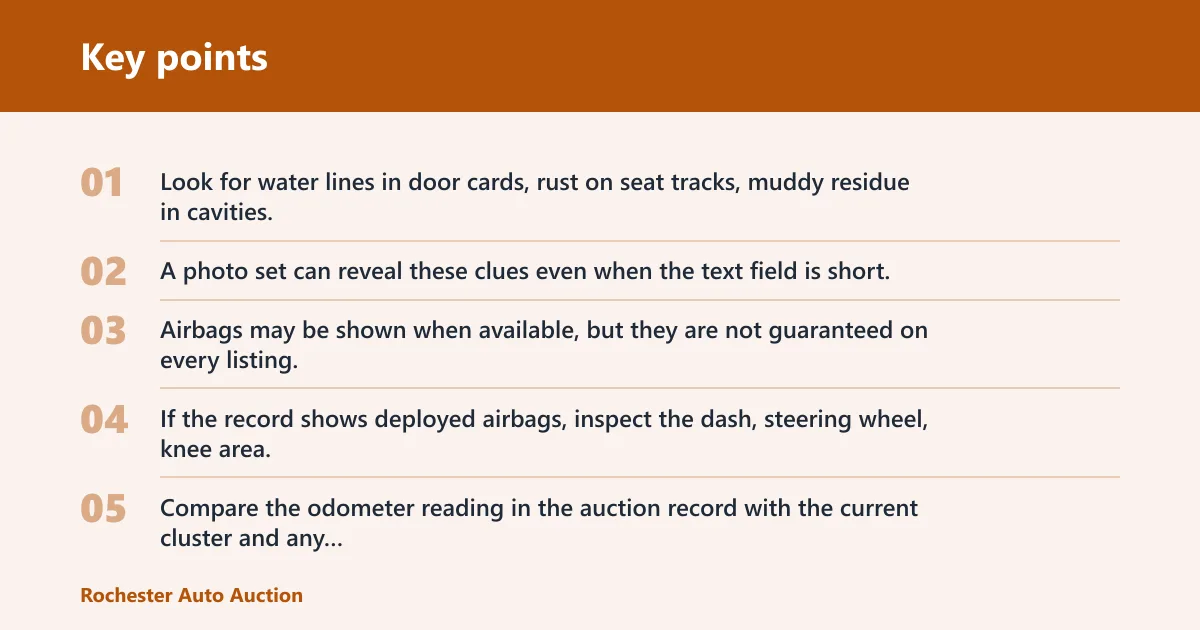
Look for water lines in door cards, rust on seat tracks, muddy residue in cavities, melted harness insulation, soot on trim, and buckled rails or apron panels. A photo set can reveal these clues even when the text field is short.
Airbag deployment and interior damage
Airbags may be shown when available, but they are not guaranteed on every listing. If the record shows deployed airbags, inspect the dash, steering wheel, knee area, side curtains, seat belts, and SRS warning system. Missing airbags can change repair cost fast.
Odometer inconsistencies and repeated listings
Compare the odometer reading in the auction record with the current cluster and any service paperwork. A large gap can be normal on a long-lived vehicle, but a mismatch between history and present mileage needs a better explanation. Repeated listings can also hint at unresolved damage or title friction.
Auction location patterns that may matter
A sale location can point to regional hail, flood, or total-loss exposure. That does not prove the cause, but it helps you frame the risk. A water-marked interior from a coastal yard deserves a different review than a dry car from a hail-heavy region.
Can a clean-title car still have auction damage history?
Yes. A clean title and auction damage history can exist on the same vehicle, because title branding and auction history are different signals. The title tells you the current status in the paperwork chain. The auction record may show what happened before that status was assigned or changed.
Why title branding and auction damage are different signals
A vehicle can move through repairs, retitling, or ownership transfers and still keep prior auction records tied to its VIN. That record may show damage, mileage, photos, and location long before the present title label. Do not read a clean title as a clean bill of health.
What to verify before assuming the car is low risk
Check the title brand, compare auction photos to the current body, and review odometer and airbag fields together. If the current car looks far better than the old photos, confirm the repair quality. If the current car looks worse, something may have changed without a clear paper trail.
Frequently asked questions
Can I look up auction history by license plate instead of VIN?
Sometimes, yes. A plate lookup can return auction records when the VIN is unavailable, but it is less reliable and may miss matches. Plates change, transfer, or get reassigned, so use the plate as a cross-check, not the main identifier.
What can a VIN lookup tell me on an auction vehicle?
A VIN lookup can surface auction date, damage description, title status, odometer reading, condition notes, airbag status, archived photos, sale location, seller information, and valuation context when available. It helps you screen risk before bidding, but it does not replace a hands-on inspection.
Do auction records show title brands like salvage or rebuilt?
Yes. Title status can appear in auction records, and buyers may see clean, salvage, rebuilt/reconstructed, junk/parts only, flood/water, or other brands. Those labels matter, but they should be read alongside damage notes, photos, mileage, and the current vehicle condition.
What auction photos or damage notes should I look for before bidding?
Look for flood lines, soot, airbag deployment, bent rails, missing panels, cracked lamps, and uneven body gaps. Damage notes such as front end, rear end, hail, flood, fire, structural, or airbag-related damage help you judge repair cost and hidden risk before you commit.
Does a VIN check show airbags, odometer, and prior damage?
Often, yes. Auction records can include odometer reading, damage description, and airbag status when available. But those fields are not guaranteed on every listing, and missing data should not be read as proof that nothing happened. Verify what the record does and does not say.