
How much are buyer fees at public car auctions?
Buyer fees at public car auctions can range from a flat fee of around $100 to a few hundred dollars, or about 5% to 10% of the winning bid, depending on the auction house. Ignore them and your “cheap” car can cost far more than you planned. This guide shows how buyer fees work and how to estimate your out-the-door auction total before you bid.
How much are buyer fees at public car auctions?
Buyer fees are charged by the auction house and added to the winning bid, so the number you hear in the room is rarely the final amount you pay. Some public auctions use a flat fee. Others use a percentage-based fee that rises with the hammer price. The final charge depends on venue rules and sale type.
What a buyer fee is
A buyer fee is the auction house’s charge for buying through the sale. It is separate from the hammer price, which is the amount your bid wins at. If the hammer price is around $4,000 and the buyer fee is about $300, your starting total is already about $4,300 before tax, title, or other charges.
Flat fee versus percentage-based fee
A flat fee is easier to plan for because it does not move with the vehicle price. A percentage-based fee changes with the winning bid, so a higher hammer price raises the fee automatically. Public auctions may use either model, and some add tiered fees that change by price band or sale channel.
📊 Carwow says to bring the V5C document to the auction. Source: CO.
What fees do public car auctions charge buyers?

Public car auctions often charge more than one fee. Buyer fee is the main line item, but buyers may also pay doc or admin fees, payment processing charges, taxes, title and registration costs, and post-sale charges such as storage or collection delays. The full bill matters more than any single fee line.
Buyer fee
This is the charge added to the winning bid. It is usually set by the auction house, and it may be fixed or percentage-based. Treat it as part of the purchase price when you budget, because it is not optional once you win.
Doc or admin fee
Some auctions add a documentation or administration charge for processing the sale, filing paperwork, or handling the transfer. That charge can be separate from the buyer fee. Ask whether the listed fee covers only the sale, or also title work and basic paperwork.
Payment processing, tax, title, and registration
Card processing or wire-transfer fees can apply if the auction house accepts certain payment methods. Sales tax may apply to the car price, the buyer fee, or both, depending on local rules. Title and registration costs are often separate government fees, not auction fees, but they still affect your total.
Post-sale charges
Storage, late collection, loading help, or transport booking can create extra costs after the sale. If you do not collect the car on time, storage can become a real line item. Ask for the pickup deadline before you bid, especially if you cannot move the car immediately.
| Line item | Example amount | What it covers |
|---|---|---|
| Hammer price | $4,000 | Your winning bid before fees |
| Buyer fee | $300 | Auction house charge |
| Doc/admin fee | $75 | Sale processing and paperwork |
| Sales tax | $320 | Assuming 8% on $4,000; local rules vary on what is taxable |
| Title and registration | $180 | Government transfer and road-use paperwork |
| Payment processing | $40 | Card or transfer handling fee |
| Post-sale charges | $0 to $100 | Storage, late pickup, or collection handling |
| Total estimated cost | $4,915 to $5,015 | Before transport to your home |
Why do auction fees vary from one auction house to another?

Auction fees vary because each auction house sets its own fee structure, payment rules, and sale terms. Some venues are open to private buyers. Others are trade-only or VAT registered only. Sale type also matters, because live room bidding, online bidding, and dealer-focused sales can carry different charges.
Venue policy and sale type
Carwow says auction fees can vary by auction house, and that some auctions only work with trade customers who are VAT registered. That means a fee schedule from one public sale should never be treated as universal. The auction house decides how it charges for access, administration, and payment handling.
Public buyer rules versus trade-only rules
Some public car auctions are open to private buyers, while others are limited to trade customers. That difference changes the rules you face and may change the fee schedule too. Always check whether the sale accepts public bidders, because trade-only entry can bring different paperwork and pricing terms.
Online bids, in-person bids, and VAT-registered sales
Fees can also change depending on whether you bid in the room, bid online, or buy through a VAT-registered channel. Online platforms sometimes add platform charges, while in-room sales may rely on a simpler buyer fee. Ask for the full fee list before you register, not after you win.
Do auction fees change based on how the car is sold?
Yes. The sale channel can change the fee structure, and so can reserve-price rules or cancellation terms. A live room sale may use one buyer fee, an online listing another, and a reserve-backed entry another still. Fees may also apply even if the car does not sell.
Live room sale versus online sale
Live sales often have a visible hammer price and a published buyer fee. Online sales can add platform or bid-handling charges that are not obvious at first glance. If a car appears in both channels, compare the full buyer cost, not just the bid amount or headline price.
Reserve-price listings
Carwow says a reserve price is the minimum price you are willing to accept. If bidding does not reach the reserve, the car will not be sold. Carwow also says any bids are void if the reserve is not met. That can matter for both buyers and sellers.
Fees that apply even if the car does not sell
Carwow warns that fees may still need to be paid even if reserve is not met. That is why you should ask whether admin, listing, or inspection charges apply if the sale falls through. A car that does not sell is not the same as a no-cost event.
What extra costs can you still owe after the hammer falls?
After the hammer falls, your bill can still grow. Sales tax, title and registration, payment processing, transport, and storage are common extras. If you budget only for the winning bid and buyer fee, you risk being short on the day you pay.
Sales tax where applicable
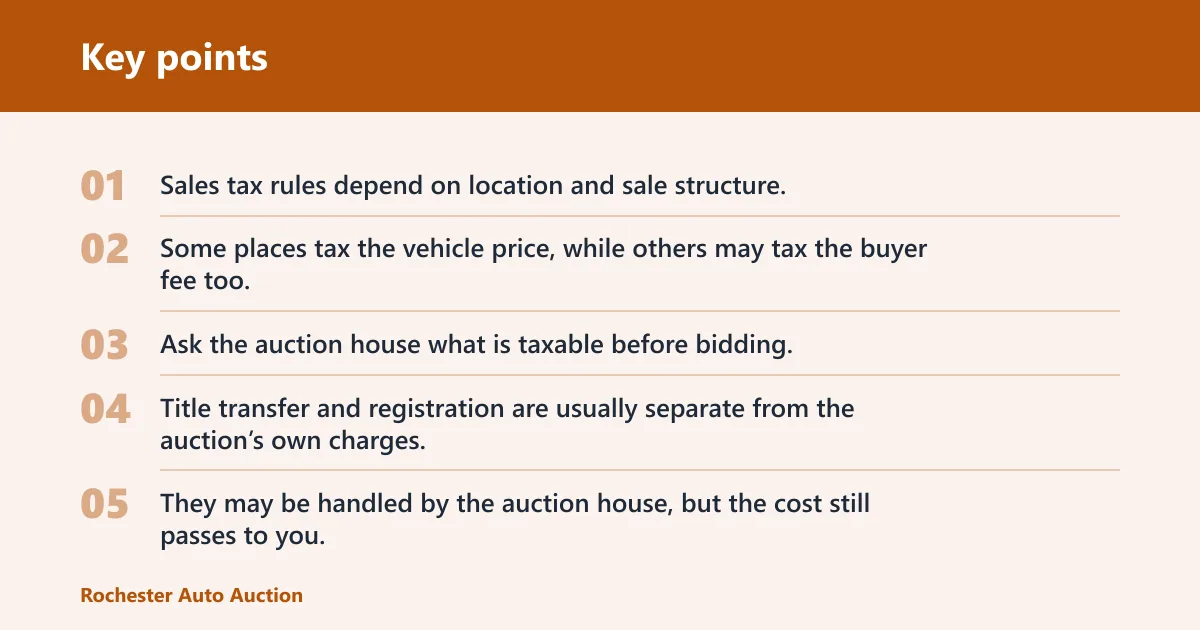
Sales tax rules depend on location and sale structure. Some places tax the vehicle price, while others may tax the buyer fee too. Ask the auction house what is taxable before bidding, because tax can change the real cost more than a small buyer fee does.
Title and registration
Title transfer and registration are usually separate from the auction’s own charges. They may be handled by the auction house, but the cost still passes to you. This is one reason “cheap at the block” does not always mean cheap on the road.
Payment method charges
Some auction houses charge for card processing or insist on bank transfer, cashier’s check, or another specific payment method. A fee can also appear if the method you choose costs the auction house more to handle. Confirm accepted methods before bidding so payment does not become a delay.
Collection, transport, or storage
If you cannot take the car immediately, add towing, transport booking, or storage to the total. Picture a small hatchback bought for commuting, then left three extra days because the buyer did not bring a trailer. The storage fee can erase the savings fast.
What paperwork should the car come with?
The car should come with the right paperwork and handover items, because missing documents can slow transfer and hurt value. Carwow says to bring the V5C document, service history, and all keys to the auction. Those items help verify ownership history and sale readiness.
V5C document
The V5C is a key document in the UK used to show registered keeper details. Carwow says to bring the V5C to the auction. Buyers should want it because paperwork gaps can raise questions about ownership history and delay a clean handover.
Service history
Carwow also says to bring service history. That record can support mileage, maintenance, and general condition. A complete service file often helps a buyer judge value more clearly than a quick walk-around does.
All keys
Carwow says to bring all keys. That matters because missing keys can affect sale readiness and value. A car with only one key, or no remote fobs, often needs extra work after the sale and may draw lower bids.
Use this worksheet to estimate your total auction cost
Use this worksheet before you bid so the final number is clear. Start with the hammer price, then add every known charge the auction house publishes. If a fee is unclear, ask for it in writing before the sale starts.
- Write down the hammer price you are willing to pay.
- Add the buyer fee shown by the auction house.
- Add doc or admin charges.
- Add sales tax if it applies in your area.
- Add title and registration costs.
- Add payment processing charges.
- Add storage, collection, or transport charges if you will not collect the car right away.
- Check the total against your budget before you bid.
Simple formula
Total auction cost = hammer price + buyer fee + doc/admin fee + tax + title/registration + payment processing + post-sale charges. That formula gives you a workable estimate before bidding starts. If the auction house publishes a fee schedule, plug those exact figures into the worksheet.
Common mistake to avoid
A common first-timer mistake is to treat the winning bid as the total. Suppose you bid $6,000 on a sedan and stop there. If the buyer fee, admin fee, tax, and registration add another four figures, your budget can break before the car leaves the lot.
How reserve prices affect whether a car sells
Reserve prices can stop a sale even when bidding looks active. Carwow says the reserve is the minimum price the seller will accept, and if bidding does not reach it, the car will not be sold. In that case, the bids are void, and fees may still apply.
What a reserve price means
A reserve price is the seller’s lowest acceptable sale price. It protects the seller from giving away a car too cheaply, but it also means the highest bid may still fail. Buyers should ask whether the listing is reserve-backed before they start bidding.
Why you should confirm fee rules before bidding
Fee rules can change if a reserve is missed or a sale is canceled. Carwow warns that fees may still need to be paid even if reserve is not met. Ask who pays what in a failed sale, because that detail affects your risk even when you do not win the car.
Frequently asked questions
Are buyer fees included in the winning bid?
No. The winning bid, or hammer price, is only the amount accepted in the sale room or online auction. Buyer fees are added after that. If you budget only for the hammer price, you will understate the real cost of the vehicle.
What extra costs can I still owe if my car doesn’t sell?
If the car does not sell, you may still owe listing, admin, inspection, or other sale-related charges, depending on the auction house. Carwow notes that fees may still need to be paid even if reserve is not met. Ask for the failed-sale policy before listing or bidding.
Do public auctions charge fees even if the reserve isn’t met?
They can. Carwow says that if bidding does not reach the reserve, the car will not be sold, the bids are void, and fees may still need to be paid. That makes reserve terms important for both buyers and sellers who want a clean final cost.