Are Seller Fees Negotiable at Auto Auctions?
Seller commission is often negotiable, but auction access, title, recon, and arbitration fees are usually fixed. Miss the fee mix, and you can lose hundreds from your net payout even when the hammer price looks strong. This guide breaks down which seller charges you can negotiate, which ones rarely move, and when to waive a fee or walk away.
Quick answer: The fee that moves most often is seller commission. Most other charges—documentation, listing, storage, title handling, late payment, and no-sale penalties—are usually set in the consignment terms. Before you sign, ask for the full fee sheet and the payout calculation in writing.
What seller fees
Seller charges at auto auctions fall into two buckets: the part tied to commission, and the part tied to processing the sale. The hammer price is the bid amount before fees. Seller commission may be negotiable, while documentation, listing, shipping, storage, and similar charges are often set in the consignment agreement.
Seller commission vs seller’s premium
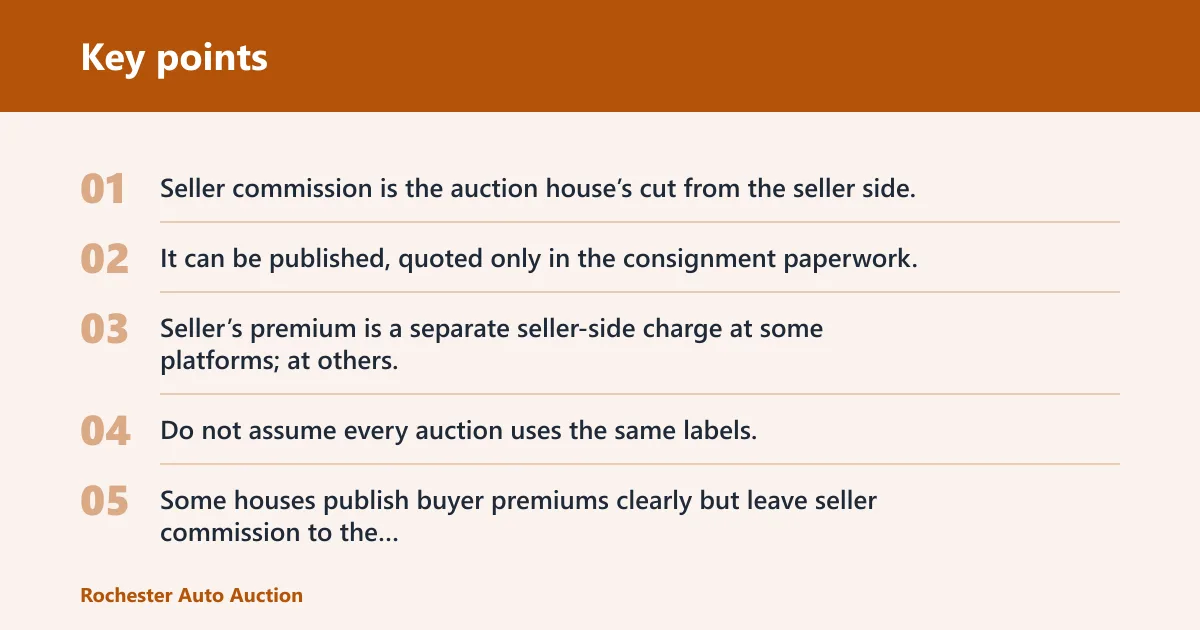
Seller commission is the auction house’s cut from the seller side. It can be published, quoted only in the consignment paperwork, reduced for a specific vehicle, or waived in some cases. Seller’s premium is a separate seller-side charge at some platforms; at others, there is no seller’s premium and the auction instead uses a listing fee or documentation fee.
Do not assume every auction uses the same labels. Some houses publish buyer premiums clearly but leave seller commission to the consignment paperwork. Others separate buyer-premium terms from seller-commission terms, which means you need the actual seller sheet before you can compare offers.
Buyer’s premium and hammer price
Buyer’s premium is added on top of the hammer price and is paid by the buyer, not the seller. Its percentage varies by auction and sale type, so do not treat a buyer-side premium as a seller-side fee. It does not reduce the seller’s net unless the higher buyer cost changes bidding behavior.
Hammer price is the base number both sides build from. If a car sells for a hammer price of $18,000, that figure is the starting point for the seller’s payout math. Commission, listing fees, title handling, and penalties are then subtracted from that amount.
Published fees and negotiated fees
Published fee schedules are not the same as final consignment terms. A house may publish a base seller charge, then alter it for a specialty car, a repeat consignor, or a high-dollar lot. Christie’s and Sotheby’s generally handle seller commission by consignment rather than in a simple public rate card, so the contract matters more than a headline promise.
That is why you need the contract, not the homepage. A published schedule gives you the starting point. The consignment agreement tells you what applies to your vehicle.
Are seller fees negotiable at auto auctions?
Yes, seller fees can be negotiable at some auto auctions, especially seller commission. The chance of a waiver rises with higher vehicle value, specialty inventory, or repeat consignments. But many charges stay fixed in the agreement, so negotiation usually targets commission rather than every line item.
When negotiation is realistic
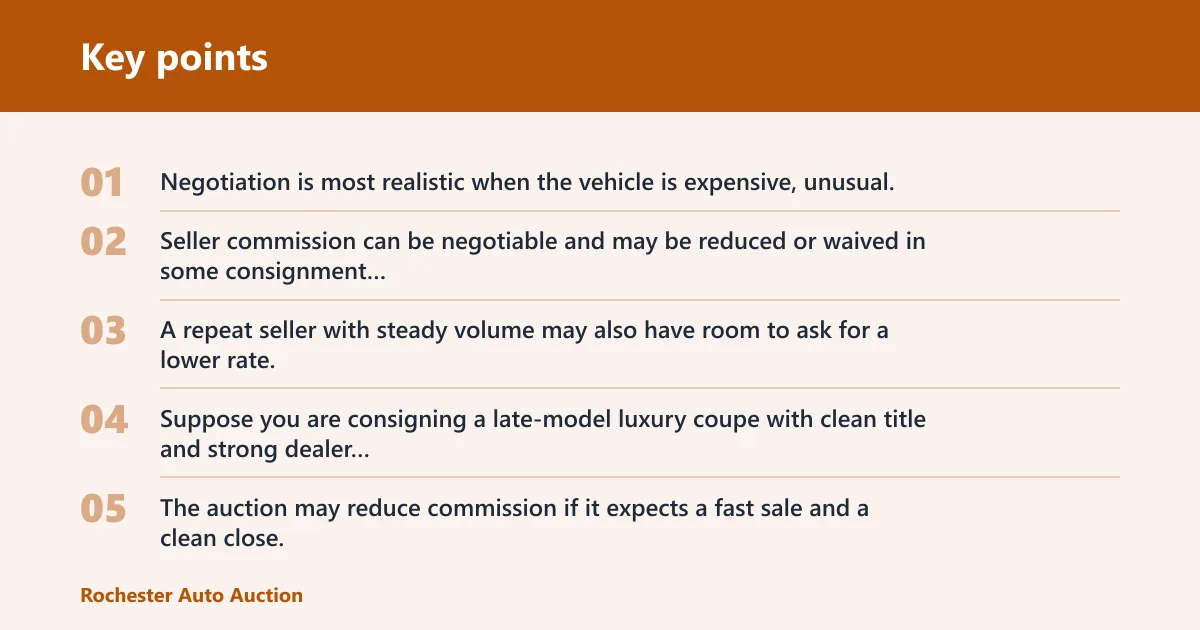
Negotiation is most realistic when the vehicle is expensive, unusual, or likely to attract strong bidding. Seller commission can be negotiable and may be reduced or waived in some consignment structures. A repeat seller with steady volume may also have room to ask for a lower rate, a capped fee, or a waiver.
Suppose you are consigning a late-model luxury coupe with clean title and strong dealer interest. The auction may reduce commission if it expects a fast sale and a clean close. That is a better moment to ask than when the car is low-value, hard to place, or likely to need extra reconditioning.
When fees are usually fixed
Documentation, listing, title handling, photography, shipping, storage, and late-payment charges are often fixed or semi-fixed. AuctionExport, according to its published fee schedule, charges a flat seller fee by price tier and adds a separate documentation fee; it also states that certain buyer/dealer fees are non-negotiable. Those are the kind of charges that usually stay in the agreement even if commission changes.
Some terms are tied to the sale outcome rather than to the hammer price. If payment is late, AuctionExport’s published terms also describe a daily late-payment charge, and the selling auction may impose its own late-payment penalty. Those charges are usually written into the agreement and are not treated like commission.
When to walk away
Walk away when the auction will not explain the fee stack before you sign, when storage and no-sale penalties are open-ended, or when the commission looks low but the contract adds several other charges. If the total leaves you below what another venue would net, the lower commission is not a deal.
A common first-timer mistake is assuming the posted administrative fee is the only charge that can be discussed. A $0 seller premium does not help much if the auction adds a listing fee, a documentation fee, and a no-sale charge when the car misses reserve.
Seller fee checklist
Use this checklist before you consign. Separate movable fees from fixed ones, then ask the exact question that forces a clear answer. Put every fee in writing before the car enters the lane.
| Negotiable item | Non-negotiable item | Exact question to ask the auction |
|---|---|---|
| Seller commission | Buyer’s premium | “What is the seller commission on this consignment, and can you reduce or waive it?” |
| Commission on high-value consignments | Documentation fee | “At what hammer price or vehicle type do you waive seller commission?” |
| Repeat-consignor rate | Listing fee, if posted as fixed | “Do repeat consignors get a lower rate or a fee cap?” |
| Photography package | Title handling fee | “Is photography optional, and what is the charge if I decline it?” |
| Shipping coordination | Storage fee | “Is shipping arranged separately, and what does the auction charge if the car stays on site?” |
| No-sale charge if reserve is missed | Late-payment penalty | “If the car does not sell, what fee applies and how is it calculated?” |
| Cancellation charge, if any | Arbitration or dispute fee | “What happens if the deal falls through after the hammer?” |
What costs can still be added after the sale?

Even if commission is reduced, the final invoice can still include documentation, listing, photography, insurance, shipping, storage, no-sale, and cancellation charges. These may be flat fees, per-vehicle charges, or percentage-based penalties. A lower commission does not remove the other line items.
Documentation and title handling
Documentation fees are common because the auction has to process title work, release paperwork, or related admin. That charge may be flat or tied to the vehicle. AuctionExport’s published fee schedule includes a separate documentation fee, which shows how a lower seller fee can still carry a separate processing charge.
Listing, photography, insurance, and shipping
Auctomobile advertises no seller’s premium for its car sales, but it also states a 99 EUR listing fee unless the auction is no-reserve. Auctomobile says no-reserve auctions can have free listing. That is a clear example of a platform where the seller-side headline fee can be zero while another posted fee still applies.
Photography, insurance, and shipping often appear in the consignment agreement rather than on a public fee chart. Those charges matter most on higher-value vehicles or long-distance moves, where the auction arranges more than just the sale itself.
Storage, no-sale, and cancellation fees
Unsold lot and cancellation fees can appear if the car does not clear reserve, payment is delayed, or the transaction fails after sale. These fees may be a minimum dollar amount or a percentage. A seller who ignores them can end up paying for a failed transaction even though no cash changed hands.
How seller fees affect net payout
Net payout is the hammer price minus seller-side charges. The biggest swing usually comes from commission, but listing and no-sale fees can matter just as much on lower-value cars. The same auction can look cheap on one vehicle and expensive on another, depending on the fee structure.
| Scenario | Hammer price | Commission | Listing/doc fees | No-sale or penalty | Estimated net payout |
|---|---|---|---|---|---|
| Low-value vehicle | $3,500 | $350 | $145 | $50 | $2,955 |
| Mid-value vehicle | $12,000 | $480 | $95 | $0 | $11,425 |
| High-value vehicle | $42,000 | $0 | $95 | $0 | $41,905 |
In the low-value example, a $350 commission and a $145 fee stack cut more than 15% from gross proceeds before any transport cost is counted. In the high-value example, a waived commission changes the result dramatically, which is why high-dollar consignments are the strongest place to ask for a reduction.
Picture a $12,000 SUV with a small listing fee and no penalty. The net is still strong because the fixed charges stay limited. Add a no-sale fee, and the same vehicle can move from acceptable to poor very quickly if the auction misses reserve.
Can you avoid seller fees by choosing a different auction?
Sometimes, yes. Some platforms are built around lower seller-side charges, while others replace commission with listing or documentation fees. SmartAuction says sellers can list used vehicles without seller-side fees in some selling models, while Auctomobile advertises no seller’s premium for its car sales. The fine print still matters.
No-reserve and zero-premium structures
No-reserve structures can reduce seller charges, especially where the platform waives listing fees for that sale type. The same source says no-reserve auctions can have free listing. That does not mean every other cost disappears, but it can change the total enough to matter on lower-value inventory.
Consignment terms vs sale type
Sale type and consignment terms are different. A no-reserve auction may waive one fee while keeping documentation or title handling in place. A reserved consignment may offer a lower commission but add a listing fee, so the real comparison is the full contract, not the marketing summary.
When another venue makes more sense
Choose another auction when the current house will not cap storage, will not state the no-sale fee, or will not give you a written seller schedule. If a different venue removes the seller commission entirely or sets a clearer fee path, that may be the better move even if the hammer price is slightly lower.
What should you ask before you consign?
Ask for the commission rate, the waiver threshold, the full fee sheet, and the timing of payment before you sign. The best answer is not “fees vary.” It is a written list that shows what happens if the car sells, misses reserve, or pays late.
- Ask for the seller commission and whether it can be reduced or waived for your vehicle.
- Ask for every additional charge: documentation, listing, photography, insurance, shipping, storage, and cancellation.
- Ask for the no-sale fee and the exact trigger that applies it.
- Ask when payment is released after the sale and whether late payment changes your payout.
- Ask for the same terms in writing before the vehicle is delivered.
If the auction will not give a complete answer, compare another venue. If you have to guess at the total, the quote is incomplete.
Frequently asked questions
What seller fees at a car auction can be negotiated?
Seller commission is the main negotiable item, especially on specialty vehicles, higher-value cars, or repeat consignments. Some auctions may also discuss a waiver threshold or a lower rate for volume. Documentation, title handling, and late-payment penalties are far less likely to move.
Do all auto auctions charge a seller commission?
No. Some platforms advertise zero seller’s premium or no seller-side fee on certain sales. Others handle commission per consignment and do not publish it in a standard chart. The right question is whether the auction charges commission, a listing fee, or both.
What fees get added after my car sells at auction?
After a sale, the invoice can still include documentation, title handling, listing, shipping, insurance, storage, and late-payment charges. Some auctions also charge cancellation or arbitration-related fees if the deal fails. Read the contract carefully, because the final total may be larger than the commission line suggests.
How do seller fees affect my net payout from an auction?
They lower the amount you keep from the hammer price. Commission is usually the biggest seller-side charge, but fixed fees can matter just as much on lower-value vehicles. A strong hammer price can still produce a weak net if no-sale or documentation charges are added.
What is the difference between seller fees and buyer fees at auto auctions?
Seller fees are paid by the consignor and come out of the seller’s proceeds. Buyer fees, most often the buyer’s premium, are added on top of the hammer price and paid by the buyer. They are separate charges, even when they are listed in the same sale terms.