
How to Sell My Car at Auction Near Me: What to Check
Check whether the auction accepts private sellers, what the fee schedule includes, whether reserves are allowed, and what similar cars net after commission and transport. If the expected payout is lower than a private sale after costs, skip the auction. Miss those checks and you can lose money on fees, rejected entry, or a reserve that puts bidders off. This guide shows how to compare local auction houses before you book in.
Private Seller Eligibility And Entry Rules
Yes, if the auction house accepts private sellers and the car meets its entry rules. Some auctions only work with trade customers who are VAT registered, so “near me” does not mean open to every owner. Ask about seller intake, inspection appointments, and whether public bidding is allowed.
What to ask before you book an inspection
Start with three checks: does the auction take private cars, is there an inspection or valuation appointment, and what buyer pool will see the car on sale day. A local auction house may be trade-only, public, or mixed, and that affects both reach and likely hammer price.
Ask whether the auction will accept your car at all before you travel. Some venues only admit dealer stock, and some accept private vehicles only through a specific intake desk or booking slot.
How trade-only and VAT rules affect access
Trade-only access can block a private seller even if the site is nearby. If the house only deals with trade customers who are VAT registered, you may need to use a different route. The key point is simple: local location is not the same as public eligibility.
📊 Sellers should bring the V5C document to the auction. Source: CO.
How to choose the right local auction house
Choose the nearest auction by checking seller access, appointment availability, fee structure, reserve policy, and collection or storage charges. A short drive is not enough on its own. You want an auction that will inspect the car, explain its non-binding valuation, and tell you the likely charges before you commit.
Search for nearby locations and seller intake rules
Use a local search for auction houses, then check each site’s seller intake page or phone line. Look for plain wording such as private sellers accepted, trade-only, or VAT-registered only. That first filter saves time and avoids arriving with a car that cannot be entered.
Compare fees, reserve terms, and collection or storage charges
Ask for the full seller schedule in writing if possible, including entry fees, commission, storage, collection, and no-sale charges. Also ask whether reserve fees apply, because a cheap-looking entry rate can hide higher charges elsewhere. For example, one house may charge a flat entry fee plus a commission, while another may ask for a lower entry fee but add storage charges later.
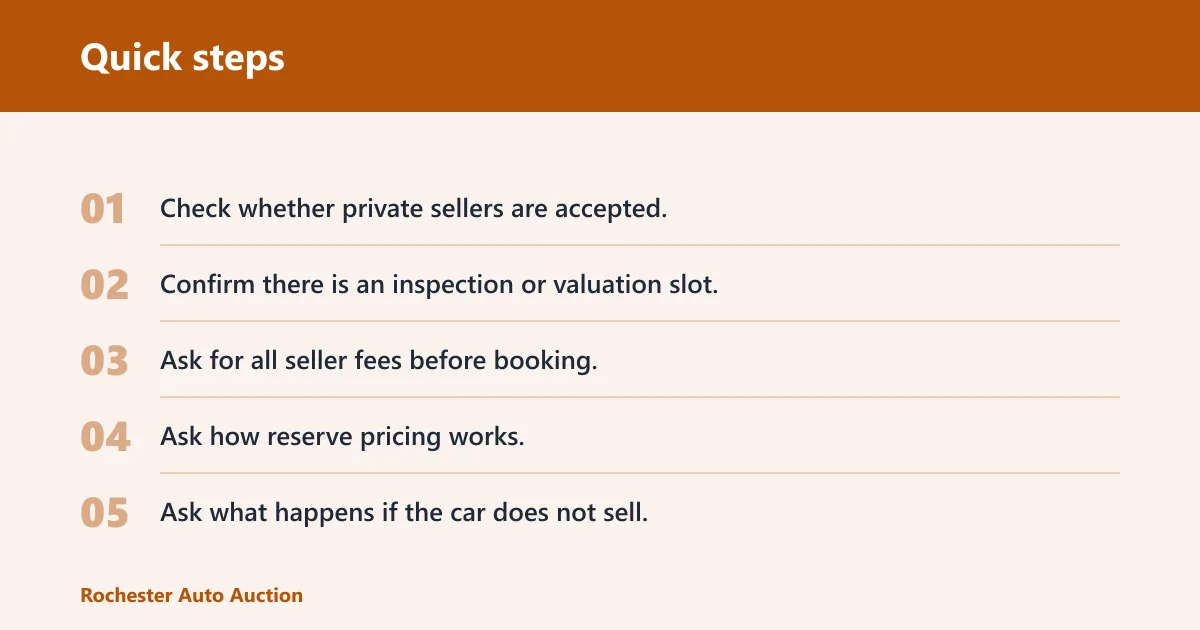
- Check whether private sellers are accepted.
- Confirm there is an inspection or valuation slot.
- Ask for all seller fees before booking.
- Ask how reserve pricing works.
- Ask what happens if the car does not sell.
- Check whether the auction is trade-only or public.
What documents and keys do you need?
Bring the V5C, service history, and all keys. The seller should usually be the registered owner, and the auction house may check ownership before entry. Missing documents do not always block a sale, but they can lower confidence, reduce bidding interest, or delay the handover.
V5C and ownership checks
The registered owner should be the person entering the car at auction. The V5C helps the auction house confirm ownership and vehicle details. If the name does not match, or if finance or another party has a claim on the car, the auction may ask for proof before accepting it.
Service history and all keys
Bring service history, receipts for major repairs, and every key or remote you have. Missing keys can reduce the car’s appeal because the buyer may need to pay for replacements. A stamped service record and invoices also help bidders judge maintenance more confidently.
How does auction valuation and reserve pricing work?

The auction house gives a non-binding estimate after inspecting the car, and that figure is based on condition, history, and likely bidder demand. You can decide whether to proceed after the valuation. If you do, set a reserve carefully, because the minimum sale figure controls whether the car can be sold in the room.
Why the valuation is non-binding
A valuation is a guide, not a contract. It reflects the auctioneer’s view of what the car may achieve on the day, given condition, demand, and the buyer pool. The final hammer price can land below or above it.
How to set a reserve price
A reserve price is the lowest amount you will accept for the car at auction. Set it with fees in mind, not in isolation. If your reserve is too high, the car may not sell. If it is too low, you may leave too little cash after commission and transport.
What happens if the bid does not reach reserve
If bidding does not reach reserve, the car will not be sold. Any bids are void. Some auctions may allow relisting, but that depends on house policy, so do not assume you can roll straight into the next sale without extra charges or a fresh agreement.
Picture a 12-year-old hatchback with cosmetic scuffs and a service book that stops two years ago. An auction may still accept it, but the reserve, buyer interest, and fees will matter more than the headline estimate. In that situation, a lower reserve can make the difference between a sale and a no-sale charge.
What fees can you expect to pay?
Seller charges can include commission, entry fees, collection or storage charges, reserve fees, and no-sale charges. Each auction house sets its own seller schedule, and some costs may still apply even if the vehicle does not sell. Always ask for the full schedule before you book the car in.
Seller commission and entry fees
Commission is the percentage or flat charge taken from the sale. Entry fees can apply when the car is catalogued for sale. Some auction houses charge both, so the headline hammer price is never the same as the amount you receive.
Collection, storage, and no-sale charges
Collection charges matter if the car cannot be driven in, while storage charges may apply if it stays on site before or after sale day. Some fees may still apply even if the car does not sell, so ask specifically about no-sale charges and storage clock rules.
How to ask for the full fee schedule before committing
Request the seller fee list before you agree to an inspection booking. Ask for the commission rate, entry charge, reserve fee, collection cost, storage tariff, and any no-sale amount. If the house will only answer verbally, note the figures before you sign anything.
Use a net-proceeds worksheet before you book
Work backward from a realistic hammer price, then subtract seller fee, collection or storage charges, and any no-sale risk. This is the clearest way to compare auction against private sale, part-exchange, or instant-buy. If the net cash looks weak, another route may suit you better.
Simple net-proceeds worksheet
| Estimated hammer price | Seller fee | Collection/storage charges | Expected cash in hand |
|---|---|---|---|
| £2,000 | £200 | £50 | £1,750 |
| £5,000 | £300 | £75 | £4,625 |
| £9,000 | £450 | £100 | £8,450 |
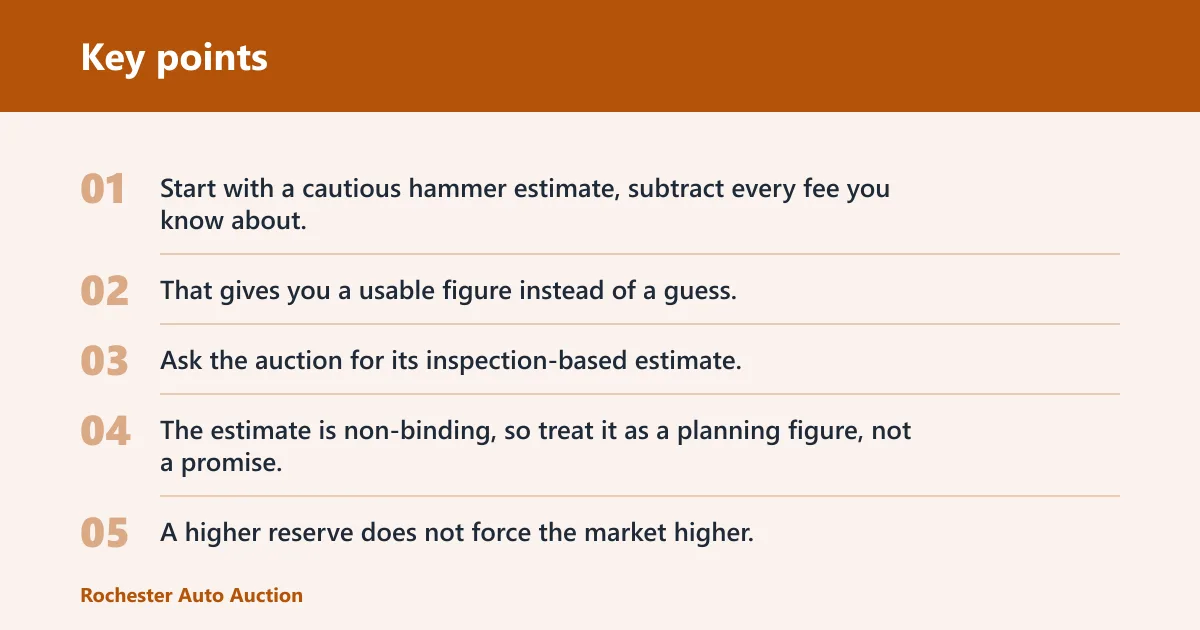
Use the same structure for your own car. Start with a cautious hammer estimate, subtract every fee you know about, and leave room for a no-sale charge if reserve is not met. That gives you a usable figure instead of a guess.
How to estimate hammer price
Ask the auction for its inspection-based estimate, then compare it with similar cars currently or recently sold at the same house. The estimate is non-binding, so treat it as a planning figure, not a promise. A higher reserve does not force the market higher.
Two quick hypothetical checks
Suppose a small city car is valued at £3,500, but fees total £375 and the reserve is set near the top of the estimate. A slightly weaker auction room can leave the car unsold, which may still trigger charges. The net result matters more than the sticker figure.
A common first-timer mistake is to compare the hammer price with a private sale listing and stop there. That misses commission, storage, and any no-sale fee, which can change the result enough to make the auction the weaker option.
Can finance, non-runners, or damaged cars go to auction?
Sometimes, yes, but each issue can change acceptance, buyer interest, and net proceeds. Finance owed, a non-running engine, or cosmetic damage does not automatically rule a car out. It can, however, affect whether the auction will take it, how it is collected, and what reserve makes sense.
Cars with money still owed
If finance is still owed, the title situation must be clear before sale. The auction house may ask for settlement steps or proof the lender will be paid. Do not assume an auction can simply handle it without checking the house policy first.
Non-runners and collection arrangements
Non-runners often need specialist collection, which can add cost. Ask whether the auction will take a vehicle that cannot be driven and what recovery charge applies. A non-runner can still sell, but the transport bill may cut the final amount sharply.
Cosmetic damage, age, and saleability
Scratches, dents, rust, worn trim, and faded paint do not always stop a sale. Older cars and cars with visible damage may still attract bidders if they are priced honestly. The reserve should reflect condition, because bidders will notice the same flaws you do.
Auction sale or instant-buy: which gives you more cash in hand?
Auction can bring a faster sale, but the buyer pool, fees, and reserve rules decide the real outcome. Instant-buy can be simpler and part-exchange can be quicker still, yet both may offer less than a strong auction day. Compare the net amount, not the headline offer.
Speed versus likely sale price
If you need to sell quickly, auction may be worth considering. The trade-off is uncertainty: reserve may not be met, fees may still apply, and the final amount can vary. Instant-buy is often easier to plan around, but the cash offer may be firmer and lower.
When part-exchange may be simpler
Part-exchange can suit a seller who wants one transaction and less paperwork. It may also reduce the effort of arranging inspection, transport, and sale day attendance. The trade-off is that the buying dealer controls the value more tightly.
When auction is the better fit
Auction tends to fit sellers who want wider dealer bidding, can meet the document rules, and are comfortable with sale-day uncertainty. It can also suit cars that are easy to explain in a short inspection. If the car is unusual or heavily damaged, ask whether the auction buyer pool is strong enough.
Frequently asked questions
can I sell my car at auction
Yes, if the auction accepts private sellers and your car meets its entry rules. The seller should usually be the registered owner, and you should bring the V5C, service history, and all keys. Also check whether the site is trade-only or open to the public.
how much does it cost to sell a car at auction
It depends on the auction house and the car. Costs can include seller commission, entry fees, collection or storage charges, reserve fees, and no-sale charges. Ask for the full schedule before booking, because some fees can apply even if the vehicle does not sell.
what documents do I need to sell my car at auction
Bring the V5C, service history, and all keys. The auction house may also want proof that you are the registered owner, plus any receipts or paperwork that support the car’s condition and history. Missing items can reduce interest or delay the sale.
what happens if my reserve price is not met
If bidding does not reach reserve, the car will not be sold and any bids are void. Some auctions may let you relist the vehicle, but that depends on house policy and may involve extra charges. Do not assume relisting is automatic.
are auction fees still charged if my car doesn’t sell
Sometimes yes. Some fees may still apply even if the car does not sell, including entry, storage, collection, or no-sale charges. That is why the fee schedule matters before you book in, especially if you are setting a reserve that might hold the car back.
do I need to be the registered owner to sell at auction
Yes, private sellers should be the registered owner before entering a car at auction. The V5C helps the auction check ownership, and the house may ask for more evidence if the name does not match. Always confirm ownership rules before delivering the car.